

An inspection from the labour inspectorate or fire safety authority doesn’t come with advance warning. They arrive, ask for your documentation, and you either produce an up‑to‑date file or start scrambling for excuses. The second option usually ends with a fine.
OHS documentation isn’t just paper to keep in a drawer. It’s written proof that the company’s management is aware of workplace risks, actively addresses them, and has made employees aware of them. Without it, you’re at an evidential disadvantage during any accident or inspection – even if you actually have the measures in place. The Labour Code and related regulations require specific documents. Their scope varies depending on the size of the company, the sector, and the risk level of the work.
What typically belongs in core OHS documentation
The minimum package that an inspection authority will ask for includes:
1. Risk identification and assessment documentation A list of identified hazards at individual workplaces, their evaluation, and the measures taken. This obligation is imposed by § 102 of the Labour Code (Act No. 262/2006 Coll.). The documentation must reflect reality, not be a generic template downloaded from the internet.
2. Work categorisation The classification of individual jobs into four categories according to the level of risk. This is based on § 37 of Act No. 258/2000 Coll. on public health protection and Decree No. 432/2003 Coll. The employer proposes categories one and two; hazardous work (risk category two, categories three and four) is determined by a decision of the regional public health authority. Without categorisation, it’s impossible to correctly set up the occupational medical examination schedule.
3. Operating rules and local workplace safety regulations Workplace operating rules, warehouse rules, site traffic regulations – depending on the nature of the operation. They must be tailored to the specific premises, not generic.
4. OHS training records Attendance sheets, training syllabi, and periodic refresher training dates. The duty to provide training stems from § 103 of the Labour Code. For initial training, it must be demonstrable that it took place before the employee started work.
5. First aid provision and trauma plan The procedure in the event of an accident: who does what, who to call, where the first aid kit is. The provision of first aid is required by § 102(6) of the Labour Code.
6. Occupational accident records An accident book and accident records. The requirements are governed by § 105 of the Labour Code and Government Regulation No. 201/2010 Coll. Even a minor accident without sick leave must be recorded in the accident book.
7. PPE provision documentation A list of assigned personal protective equipment by position, including employee signatures confirming receipt and replacement dates. The provision of PPE is addressed by § 104 of the Labour Code and Government Regulation No. 390/2021 Coll.
8. OHS organisation and management definition Determining who is responsible for OHS within the company, how risk communication takes place, and how often workplaces are inspected. This also includes proof of securing risk prevention tasks by a professionally qualified person according to § 9 of Act No. 309/2006 Coll.
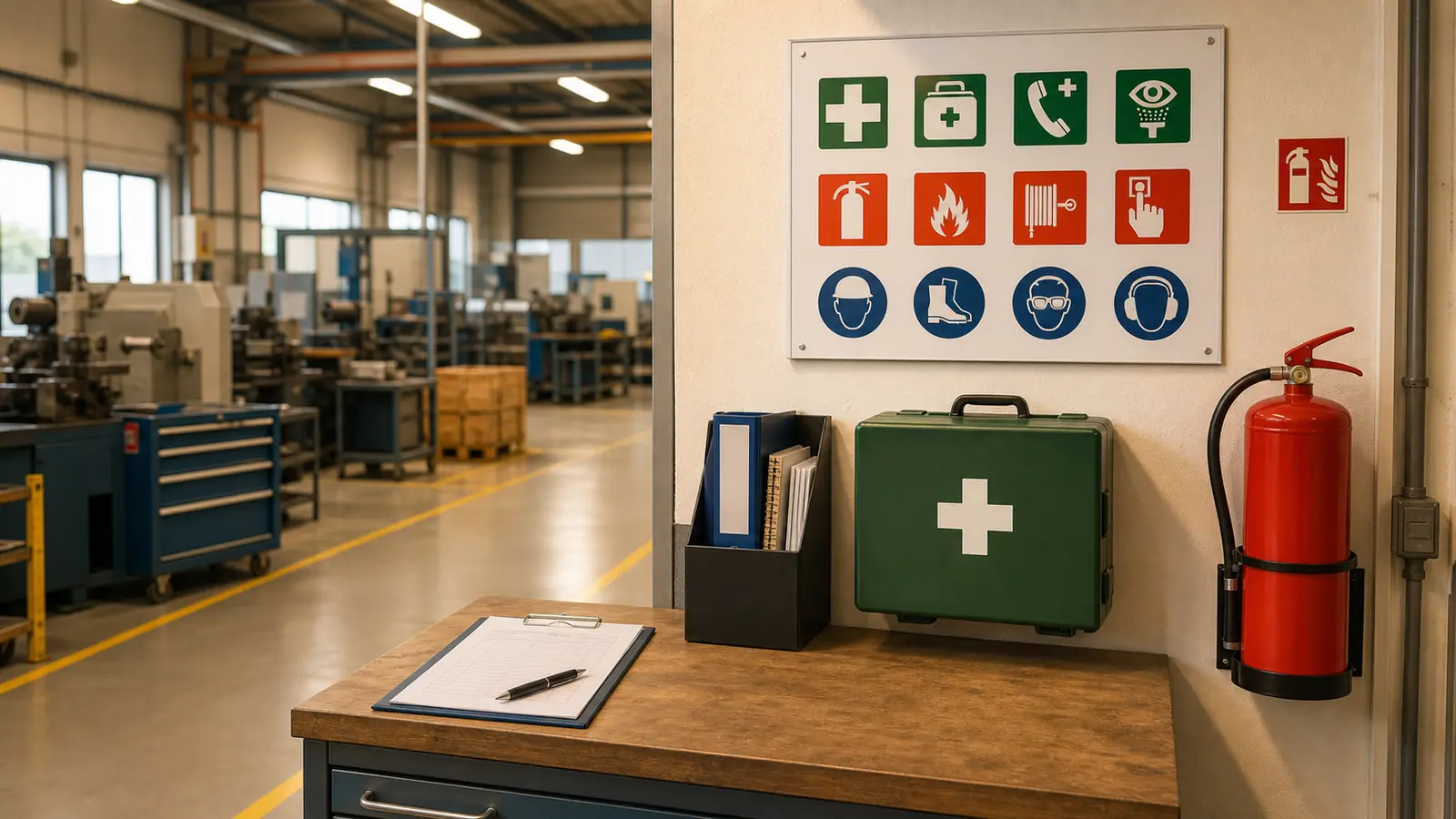
The difference between a template and tailored documentation
A downloaded template costing a few hundred crowns looks usable at first glance. The problem arises during an inspection when the inspector discovers that the document describes an operation you don’t even have, or conversely, overlooks risks that are critical in your environment.
Typical shortcomings of templates:
- The risk assessment doesn’t match the actual operation.
- Specific risks of your industry are missing.
- Specific machines, substances, or work procedures aren’t considered.
- The documentation is outdated and doesn’t account for legislative changes.
Tailored documentation is based on a physical inspection of the workplace. A professionally qualified person walks through the operation, identifies real risks, and prepares documents that correspond to reality. Then, you won’t be caught off guard during an inspection. The documentation matches what the inspector sees around them.
How much OHS documentation costs and what influences the price
The indicative price of basic OHS documentation for a small company usually ranges in the thousands of crowns. For larger operations, manufacturing, warehouses, multiple branches, or hazardous work, an individual calculation is necessary.
The biggest influence on the price is:
- the number of employees and job positions,
- the number of workplaces and operations,
- the risk level of the work and the need for risk factor measurements,
- the state of existing documentation,
- the link to fire safety, training, and technical equipment inspections.
A cheap universal template can be tempting, but it usually doesn’t cover the actual operation. In practice, it’s worth addressing the price based on what the documentation is meant to protect: people, company management, and the ability to withstand an inspection or a workplace accident.
When to update documentation
OHS documentation isn’t a one‑off matter. The law requires its continuous updating. Specific triggers:
Change in working conditions. A new machine, a change in technology, relocation of operations, a new job position. All of this requires a reassessment of risks and an update of the documentation.
Legislative changes. If a regulation that affects you changes, you must bring the documentation into compliance without undue delay. There is no fixed universal deadline in the law; the effective date of the specific regulation is decisive.
After a workplace accident. Every recorded accident should lead to a review of whether the risk assessment anticipated that situation and whether the measures are sufficient.
Periodic review. Even without obvious changes, it is advisable to review the documentation at least once a year, more frequently for higher‑risk operations. For hazardous work, the public health authority orders risk factor measurements at intervals according to the specific factor and conditions. There is no single universal interval.
After a labour inspectorate inspection. If the inspector identifies deficiencies, the documentation must be adjusted according to their findings and the measures adopted.

Links to training, categorisation, fire safety, and inspections
OHS documentation doesn’t stand alone. It’s interconnected with other obligations:
Employee training. The risk assessment is the basis for the training content. An employee must be demonstrably made aware of the risks of their position, which is impossible without an up‑to‑date risk assessment.
Work categorisation. This determines how often an employee must undergo an occupational medical examination and whether measurements of noise, dust, vibration, or chemical substances are needed.
Fire safety. Fire safety documentation (fire safety rules, fire alarm directives, evacuation plan) is a separate agenda, but it is closely linked to OHS, especially in the areas of escape routes, fire extinguishers, and training.
Construction and refurbishments. If your operation is preparing building works, a tenant fit-out, or a larger refurbishment, ordinary company documentation is not always enough. For the specific site, you may also need to address OHS on the construction site, the OHS plan, and contractor coordination.
Technical equipment inspections. Electrical installations, gas equipment, pressure vessels, lifting equipment. Inspection reports are part of the OHS documentation; you use them to prove that the equipment is in a safe condition. Without valid inspections, the documentation is incomplete.
What you risk with missing documentation
For offences in the area of occupational safety, the regional labour inspectorate can impose a fine under Act No. 251/2005 Coll. on labour inspection. The upper limit for the most serious offences by legal entities and self‑employed individuals reaches up to CZK 2,000,000. In practice, for smaller companies, it is significantly lower, depending on the extent of the deficiencies and the consequences. In addition to the fine, there is a risk of evidential disadvantage in the event of an accident and complications with insurance claims.
How SOHE proceeds
When preparing OHS documentation, we base it on the actual state of your operation:
- Initial workplace inspection. We personally walk through the operation, identifying risks, machines, work procedures, and specifics.
- Tailored documentation preparation. We prepare a complete package corresponding to your operation and current legislation.
- Handover and explanation. We go through the documentation with you and explain what each document means and how to work with it.
- Ongoing support. Legislation changes. We keep the documentation up to date and are available for consultations.
For a quick quote, just send us your industry sector, number of employees, number of workplaces, information on shift work, and whether you already have any documentation prepared. If you’re facing an inspection or dealing with a change in operations, mention it directly in your enquiry – we’ll propose the scope and priority of steps accordingly.
Frequently asked questions about OHS documentation
Do I need documentation even for an administrative operation? Yes. Even an office has its risks: ergonomics, eyesight, electrical equipment, escape routes. The scope of documentation is smaller than for manufacturing, but the obligation applies to all employers.
Is electronic documentation sufficient? Yes, the law permits electronic form. However, you must be able to present it on request, ideally printed out or on a device that allows the inspector to view the documents.
How often must the risk assessment be updated? The law does not set a fixed deadline. Risk identification must be ongoing: whenever conditions change, after an accident, or based on inspection findings. In practice, we recommend a review at least once a year.
Who can prepare OHS documentation? Risk prevention tasks are secured by a professionally qualified person according to § 9 of Act No. 309/2006 Coll. A smaller employer can, under certain conditions, handle these tasks themselves, but they bear full responsibility for their correctness and completeness.
What the article is based on
- Risk identification and assessment, employer obligations: § 102 of the Labour Code (262/2006 Coll.)
- Training (§ 103), accident records (§ 105), PPE (§ 104): ibid.
- Work categorisation: § 37 of Act No. 258/2000 Coll. and Decree No. 432/2003 Coll.
- Accident record: Government Regulation No. 201/2010 Coll.
- Professionally qualified person in risk prevention: § 9 of Act No. 309/2006 Coll.
- Penalties for OHS offences: Act No. 251/2005 Coll. on labour inspection
Need documentation that will stand up to an inspection? We prepare OHS documentation tailored to your operation, from administration to manufacturing. We’ll go through every document with you and take care of ongoing updates.
- OHS for companies – complete service including documentation
- Fire safety – fire safety documentation and related obligations
- Employee training – initial and periodic training
Write to info@sohe.cz or send a non‑binding enquiry.