
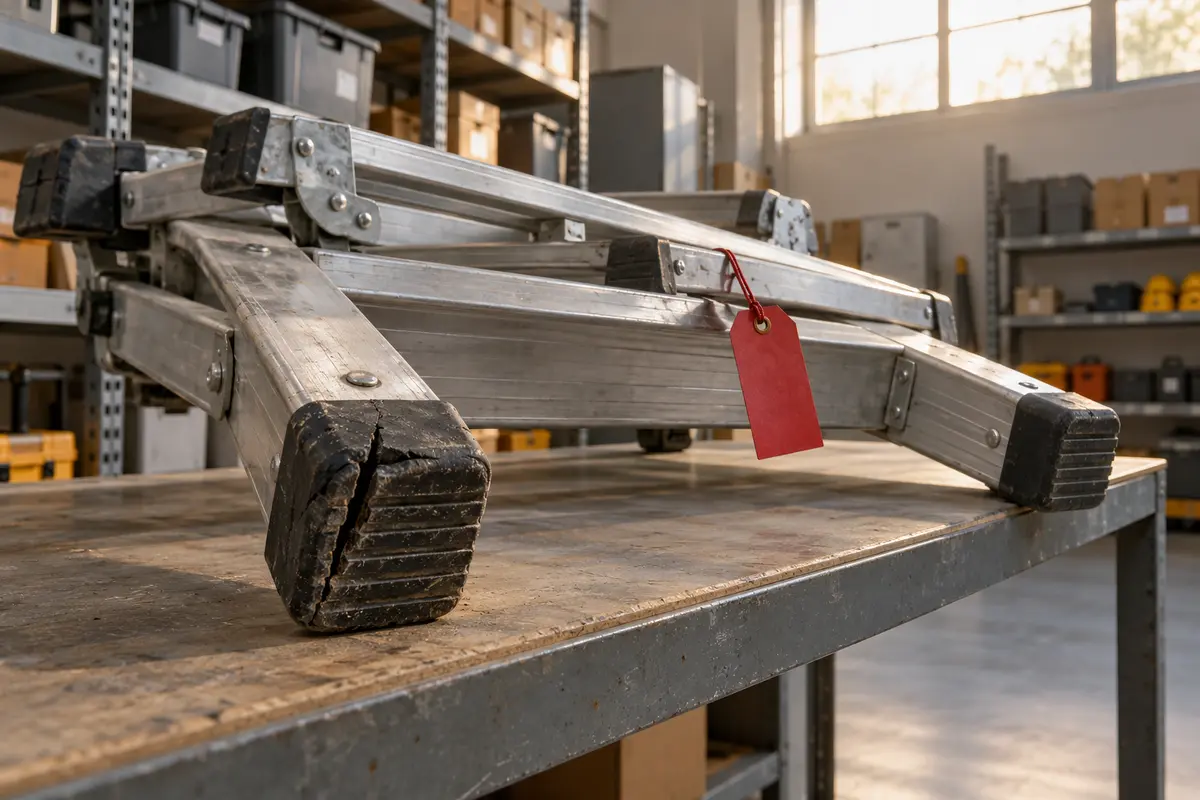
A pre-use ladder check has two parts: first, deciding whether a ladder is suitable for the job at all and how it should be positioned, and only then physically inspecting the particular ladder in accordance with the manufacturer’s instructions. Use the same process—only more thoroughly and with a written record—when accepting delivery of a new ladder. A defective component means taking the ladder out of service until an approved replacement part or a new ladder has been supplied. DIY repairs, makeshift welding or random replacement bolts are not an acceptable solution. Below you will find a specific acceptance procedure, a table of inspection points and a model case, including a dead end that is easy to stumble into.
Step 0: should this job be done from a ladder at all?
Before you start checking bolts and hinges, answer a question that often goes unasked. Under Part III of the Annex to nařízení vlády č. 362/2005 Sb., o bližších požadavcích na bezpečnost a ochranu zdraví při práci na pracovištích s nebezpečím pádu z výšky nebo do hloubky, you may use a ladder for work at height only if using other, safer equipment—typically an access platform or scaffolding—is not justified and practical in view of the risk assessment, or if local conditions make such equipment impossible to use. Only short-duration, physically undemanding work involving hand tools may be carried out from a ladder. Dangerous tools such as portable chainsaws or handheld pneumatic tools must not be used from a ladder.
In practical terms, first establish the working height, the tools required, the duration of the task, the supporting surface and whether another means of access is available. We recommend briefly recording why a ladder was chosen so that the decision can be communicated within the company. The cited provision does not itself require a special written form before every use. A ladder in sound technical condition, however, does not make it suitable for a job for which this means of access is inappropriate.
Fixed rules for positioning and working
Part III of the Annex to NV č. 362/2005 Sb. contains several specific measurements and rules that can be checked visually before anyone climbs the ladder:
| Point in Part III | Rule |
|---|---|
| 2 | Face the ladder when climbing, descending and working, with a secure handhold and reliable support available at all times |
| 3 | Carry loads of no more than 15 kg up or down unless another regulation provides otherwise |
| 4 | No more than one person may be on the ladder at a time |
| 5 | Do not use the ladder as a bridge unless the manufacturer designed it for that purpose |
| 6 | For access to a platform, the ladder must extend by at least 1.1 m above it, unless fixed handholds are provided; the angle must be at least 2.5 : 1, with at least 0.18 m of clear space behind the rungs and at least 0.6 m at the foot of the ladder on the access side |
| 7 | A portable ladder must stand on a stable, firm, sufficiently large and immovable surface, with its rungs horizontal |
| 8 | Prevent slipping by using anti-slip devices or another measure, and secure the sections of folding and extension ladders against movement relative to one another; portable wooden ladders longer than 12 m must not be used |
| 9 | Work only at a safe distance from the top: the user’s feet must be at least 0.8 m from the top of a leaning ladder and at least 0.5 m from the top of a stepladder |
| 10 | If the worker’s feet are more than 5 m above the ground, the worker must be protected against falling by personal protective equipment |
A typical real-world failure is therefore not limited to a cracked rung. It may also be a worker standing on the second-highest rung of a stepladder, or a leaning ladder positioned so steeply or shallowly that it fails to meet the 2.5 : 1 ratio.
Step 1: check the documents and markings
When accepting a new ladder from a supplier, obtain:
- instructions for use in Czech, or in another language understood by the workers concerned,
- the documentation supplied by the manufacturer for that particular model, including assembly and inspection instructions,
- the type, serial number and load rating, both in the documentation and on the ladder’s own label.
The decision is binary: if the instructions for use are missing, do not put the ladder into service. Under point 11 of Part III of the Annex, the instructions determine how inspections must be carried out—and without them, you have nothing on which to base the inspection. Ask the supplier to provide them. A practical lesson: documentation packed in cardboard near the ladder’s feet can easily be discarded with the packaging. Remove it immediately during acceptance, file it and link it to the particular ladder in your records.
Step 2: physically inspect the particular ladder
Inspect the ladder while it is unfolded, in daylight, in a safe place and in the configuration specified by the manufacturer. Work through it component by component instead of jumping randomly from one area to another.
Fittings and securing the sections
Points 7 and 8 of Part III of the Annex require the ladder to stand on a stable and sufficiently firm surface, to be prevented from slipping and to have its individual sections secured against movement relative to one another. Assess the ladder being accepted according to how well it meets these three requirements:
| Inspection area | What specifically to look for | Pass / fail |
|---|---|---|
| Steps and rungs | cracks, bending, integrity of joints with the stiles | Pass only if the component is intact and not bent |
| Stiles | dents, cracks, deformation caused during transport | Any deformation = fail |
| Metal joints and rivets | loose, corroded or missing components | Missing component = fail |
| Hinge locks (on a combination ladder) | locking function in both positions | Hinge not fully locked = fail |
| Feet and anti-slip components | presence, wear and security of attachment | Missing or dislodged component = fail |
| Markings on the ladder | identification and safety markings required for the model | Illegible or missing label = fail |
| Documentation | instructions for use and documents supplied by the vendor | Missing = fail |
Adapt the table into your own inspection record and have it signed by both the person accepting and the person handing over the ladder. Using your own checklist is our recommendation for evidentiary purposes, not a legal obligation in itself. The duty to ensure that equipment is in a safe condition may nevertheless arise from the law in a particular work context.
Physical test
Perform functional checks of safety catches and locks only as specified in the instructions. This article does not prescribe a separate load test and is not an instruction to climb a ladder that may be defective. Refer an uncertain lock, unusual joint movement or damage to the supplier or a designated competent person. Audible cracking or visible looseness is a reason to stop using the ladder, not to repeat the test at a greater height.
Defective component: replace it, do not repair it
If the acceptance inspection reveals a defective component, follow this procedure:
- Tag the ladder. Attach a clearly visible “do not use” label and place the ladder somewhere it cannot be picked up and used.
- Photograph and record the defect. Note the date, ladder, component and a description of the defect.
- Contact the supplier. A defect found during acceptance is a warranty claim—request a replacement part from the manufacturer or replacement of the entire ladder. An unauthorised alteration to the load-bearing structure leaves you unable to demonstrate that the ladder still conforms to its original design. Check the instructions and consult the manufacturer to determine whether the particular component may be replaced and who is authorised to replace it.
- Keep the ladder out of service until delivery and a new acceptance inspection. Inspect the new component using the same procedure as for the complete ladder, including functional checks of the hinges and locks.
Do not weld cracks yourself, cut new slots for rungs or replace rivets with bolts from a DIY store. You do not have the equipment or qualifications needed to verify that a repaired load-bearing component retains the parameters of the original design.
Model case: a combination ladder with a defective lock
A small installation company was accepting delivery of a combination ladder for use as a stepladder or leaning ladder when working in bathrooms in newly built homes. This is a typical case of short-duration work with hand tools in which using a ladder in a confined space can be justified by the local conditions referred to in Part III of the Annex.
Unsuccessful approach: The plumber accepting the ladder visually inspected its stiles, steps and feet. Everything looked fine, so he considered the ladder accepted. He did not test the locking spring in the hinge. With the ladder unfolded on the ground, the hinge remained in place under its own weight, and nothing suggested a defect. A subsequent inspection carried out in accordance with the instructions revealed that the safety catch failed to lock the hinge in one of the prescribed positions. Fortunately, nobody had yet climbed the ladder.
What failed in the process: The acceptance inspection was purely visual and covered only one position. With a combination ladder, checking one position and making assumptions about the others is not enough. Only configurations permitted by the manufacturer and the prescribed functions of the safety catches should be tested, not improvised load conditions.
Successful approach in the same case—the version to adopt: A supervisor accepted the second ladder in the same order and paid particular attention to its hinges. The visual inspection revealed nothing, but the functional test—checking that the locks engaged in the prescribed positions in accordance with the instructions—showed that the spring in one hinge did not fully engage the stop. He tagged the ladder as non-compliant, photographed the hinge in detail, filed a claim with the supplier and did not put the ladder into service.
Verification of the outcome: The supplier replaced the entire ladder. During the repeat acceptance inspection, the supervisor went through the full table again, including checking both locks in accordance with the instructions, and recorded the result in an inspection record with the date and signature. Only this signed record completed the acceptance process. Verification therefore did not mean “the ladder arrived”, but “every item in the table passed and the result was recorded”.
This explicitly modelled case says nothing about other types of ladders or about which components are always defective. It illustrates a properly managed acceptance process and the cost of omitting a single check.
Inspections and training during operation
Point 11 of Part III of the Annex to NV 362/2005 Sb. requires the employer to arrange ladder inspections in accordance with the instructions for use. The manufacturer’s instructions are therefore decisive: if they specify inspection intervals and scope, follow them. The regulation itself does not prescribe a uniform annual interval for every ladder. If the interval is unclear, ask the manufacturer for clarification and agree the inspection regime with the person responsible for occupational safety. A single point of NV 362/2005 cannot establish every requirement that may apply to work equipment under other regulations.
Staff competence is a separate issue. Zákoník práce, § 103, requires employers to inform workers about the risks associated with their work and provide training and instructions on how to perform it safely. The exact way in which you organise the training and verify that workers have understood the procedure depends on the particular work involved. A one-off briefing for occasional use and systematic preparation for daily work at height are very different things. In practical terms, include defect recognition and reporting procedures in the training: a worker who does not know how to recognise a defective lock will not recognise one during operation either.
If your company needs to incorporate the entire ladder acceptance and periodic inspection process into its occupational health and safety documentation, including training and record-keeping, specialist occupational health and safety support is available from SOHE on the bozp-pro-firmy page.
Frequently asked questions
Does ladder acceptance have to be documented in writing?
Part III of the Annex to NV 362/2005 Sb. does not itself prescribe a special written form for every acceptance inspection. We nevertheless recommend making a record containing the date, identification of the ladder and the findings. It helps demonstrate what was inspected and why the ladder was removed from service, although it cannot be described as the only possible form of evidence.
What should I do if the instructions for use are missing?
Do not put the ladder into service. Under point 11 of Part III of the Annex to NV 362/2005 Sb., inspections must be carried out in accordance with the instructions. Request them from the supplier and permanently retain the documentation with the records for the particular ladder.
May I repair a defective ladder myself?
No. Replacing components with original parts supplied by the manufacturer or supplier, ideally following their instructions, is an acceptable approach. Any DIY structural repair—such as welding, replacing rivets or modifying components—casts doubt on the safety of the entire ladder, and you have no means of verifying it.
How often should a ladder be inspected?
Follow the manufacturer’s instructions, as required by point 11 of Part III of the Annex to NV 362/2005 Sb. If the interval or scope is unclear, ask the manufacturer for clarification and determine the work equipment inspection regime with the responsible person. Your own estimate is not a substitute for all applicable requirements.
Is a visual inspection enough, or is a functional test also required?
Both are required. A visual inspection can reveal cracks and deformation, but defective locks, loose locking mechanisms and movement in joints may become apparent only during the functional check prescribed by the manufacturer. The model case involving a defective lock shows that a visual inspection alone is not sufficient.
Sources and scope
This article is based on the following primary legislation:
- Nařízení vlády č. 362/2005 Sb., o bližších požadavcích na bezpečnost a ochranu zdraví při práci na pracovištích s nebezpečím pádu z výšky nebo do hloubky — Annex, Part III, available from e-Sbírka
- Zákon č. 262/2006 Sb., zákoník práce, § 103 — available from e-Sbírka
Sources verified on 7 October 2026. The legal position is current as of the verification date, and this text does not guarantee that the legislation will remain unchanged. The article is a working aid for the specific acceptance inspection of a portable ladder, not a universal regulation or instructions for a particular product. The manufacturer’s instructions and the conditions of the work always apply to the particular ladder. The procedures described in the sections on inspection records and record-keeping are our own practical recommendations where legal obligations arise from the cited provisions. The frequently asked questions section is intended as general guidance and is not advertising.