
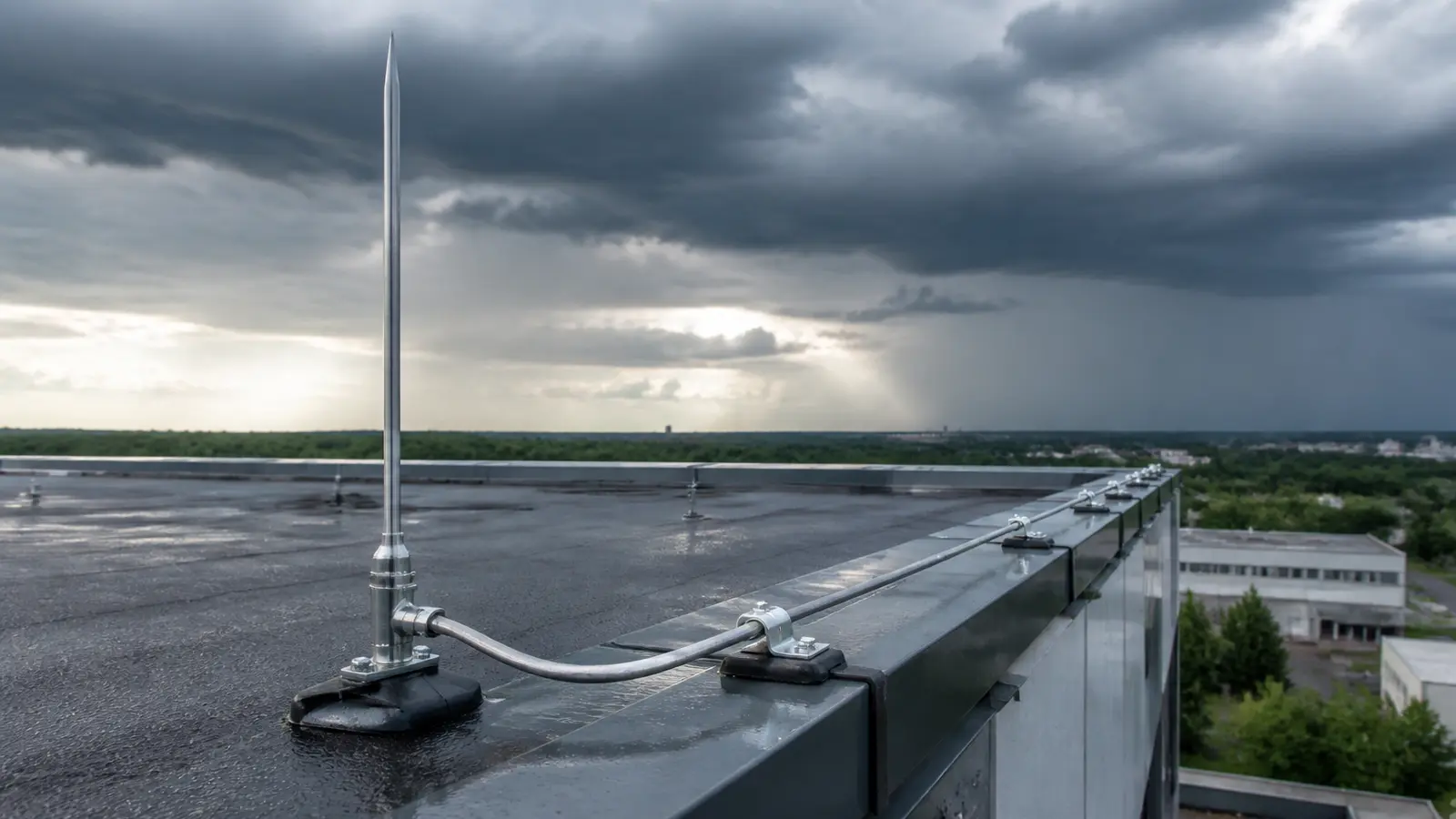
People often search for the “new lightning rod standard” and encounter conflicting answers. Some sources say every building needs a lightning rod, while others claim only the building’s height matters. The current approach is more precise: lightning protection is assessed according to the ČSN EN 62305 series and its risk analysis.
This article explains what the standard covers, when you need a lightning rod, what a lightning protection system consists of, and what the LPL classes mean. If you are mainly looking for inspection intervals, we cover that in detail in the article Lightning rod inspection – how often according to ČSN EN 62305.
Quick answer
The current standard basis for lightning protection is the ČSN EN 62305 series. The need for a lightning rod is not determined solely by the building’s height. It is decided by a risk analysis according to ČSN EN 62305-2, fire safety requirements, the purpose of the structure, the number of people, its location in the landscape, construction, internal technology, and the possible consequences of a strike.
The lightning protection system is referred to as LPS (Lightning Protection System). In common speech, we call it a lightning rod, but the standard works with a whole system: an air-termination system, down conductors, earthing, bonding, and surge protection devices. The level of protection is expressed by classes LPL I to IV; LPL I is the most stringent.
What is ČSN EN 62305 and what did it change
Previously, the old ČSN 34 1390 was used in the Czech Republic. It worked with a simpler approach: building type, height, number of thunderstorm days, and the derived need for a lightning rod from that. It was clear, but often too rough.
The ČSN EN 62305 series consists of four parts:
- Part 1 – general principles of lightning protection.
- Part 2 – risk management, i.e., a calculation of whether and at what level you need protection.
- Part 3 – physical damage to structures and life hazard, i.e., the design of external protection.
- Part 4 – electrical and electronic systems within structures, i.e., internal protection and surges.
The key change is the risk-based approach. For a new building or a major renovation, the risk analysis is addressed in the project documentation. For an existing building, the inspection technician relies on the available documentation, the LPS design, and its actual condition; if the calculation is missing or the building has undergone changes, it may need to be supplemented.
New 3rd edition of ČSN EN IEC 62305: what exactly is being issued
The ČSN EN 62305 series has been established here for a long time and represents the valid technical basis for lightning protection. From October 2025, its new 3rd edition — ČSN EN IEC 62305 ed. 3 — is being issued. “IEC” has been newly added to the designation, so the document previously listed as ČSN EN 62305 can now be found under ČSN EN IEC 62305. The new edition is valid concurrently with the existing 2nd edition until 31 October 2027; from 1 November 2027, only the 3rd edition remains valid. Both editions thus exist side by side during the transitional period.
Alongside the publication of the new edition, the rigor with which the fulfillment of the series’ requirements is enforced is also shifting. Whereas previously a lightning rod on an older building was not a concern as long as it “somehow” worked, today, designers, inspection technicians, and building authorities increasingly refer to the current version — typically during building permits, final inspections, or periodic inspections. What was previously “recommended” has become a commonly required standard for many structures — most notably for the combination of a lightning rod with photovoltaics and for buildings undergoing renovation.
When do you need a lightning rod
A lightning rod is not automatically mandatory for every building. At the same time, you cannot safely say you don’t need one just because a house isn’t tall. A specific assessment according to ČSN EN 62305-2 and other documents is the deciding factor.
The risk analysis mainly considers:
- Location of the structure – a detached building on a hill has a different risk profile than a house in a dense urban area.
- Dimensions and shape of the structure – height, roof area, metallic superstructures, and technology.
- Construction and materials – combustible construction increases the consequences of a strike.
- Purpose and occupancy – schools, hospitals, accommodation, gathering places, or operations with people inside have higher requirements.
- Risk of fire or explosion – for some operations, the fire safety solution plays a significant role.
- Technology on the roof – PV system, HVAC, antennas, or cooling change the protection conditions.
- Sensitive electronics inside – server rooms, manufacturing control systems, security systems, or PV inverters require consistent internal surge protection.
In practice, for a terraced house, the calculation may show that an LPS is not necessary. Conversely, a detached wooden building, an industrial hall, an administrative building with a larger number of people, or a building with a PV system on the roof can turn out completely differently. The answer is given by a specific calculation, not a general table.
When renovation re-opens the lightning rod question
This is where most companies get caught. You are repairing a roof, changing the covering, adding photovoltaics, or insulating the façade — and suddenly the building authority or inspection technician requires you to document the lightning rod’s condition according to the current standard.
A simple guideline applies: if the intervention in the building changes the parameters on which the original risk analysis was based, it is appropriate to redo it. This mainly concerns the following cases:
- Replacement of the roof covering. If the original corrugated metal roof covering served as a natural air-termination and is replaced by a clay tile without conductive connection, the entire logic of the protection changes.
- Façade insulation. This fundamentally affects the route of the down conductors. Original down conductors routed on the façade need to be brought above the insulation or routed otherwise — a down conductor hidden under polystyrene without a solution is a classic error.
- Extensions and attic conversions. The height and ground plan of the building change, and thus the area where lightning can strike.
- Photovoltaic installation. Panels change the geometry of the roof and bring new conductive paths and new risks — this is covered in a separate section below.
Conversely, if the renovation does not change the roof layout, the building’s height, or the façade solution — for example, you only replace windows in existing openings — the risk analysis usually does not need to be repeated. Even here, however, consider seemingly unrelated changes: new technology on the roof, an extension of a shelter, or a change in the building’s use can shift the input parameters of the analysis more than it might seem at first glance.
New building: what to resolve right from the start
For a new building, the situation is clearer — the standard is applied from the initial design. The completion and handover of the building typically include:
- Risk analysis according to ČSN EN 62305-2. This is prepared by the designer and is part of the project documentation; its outcome determines whether and how the building should be protected.
- Lightning rod project according to ČSN EN 62305-3. If the analysis recommends protection, the air-termination system, down conductors, and earthing are designed in the corresponding lightning protection level (I–IV).
- Initial lightning rod inspection. Carried out by an inspection technician after the installation is completed, confirming that the execution corresponds to the project and the standard. This is described in more detail in the article Initial electrical inspection.
- As-built documentation. Where the down conductors run, where the earth electrode is, and what materials are used — without this, later inspections are very difficult to perform.
For buildings subject to final inspection (kolaudace), the initial inspection is often one of the documents required by the building authority under the Building Act. The attitude of “it’s just a sheet metal hall, it’ll hold up” doesn’t stand here: without a documented initial inspection, the handover and use of the building become unnecessarily complicated.
What a lightning rod consists of
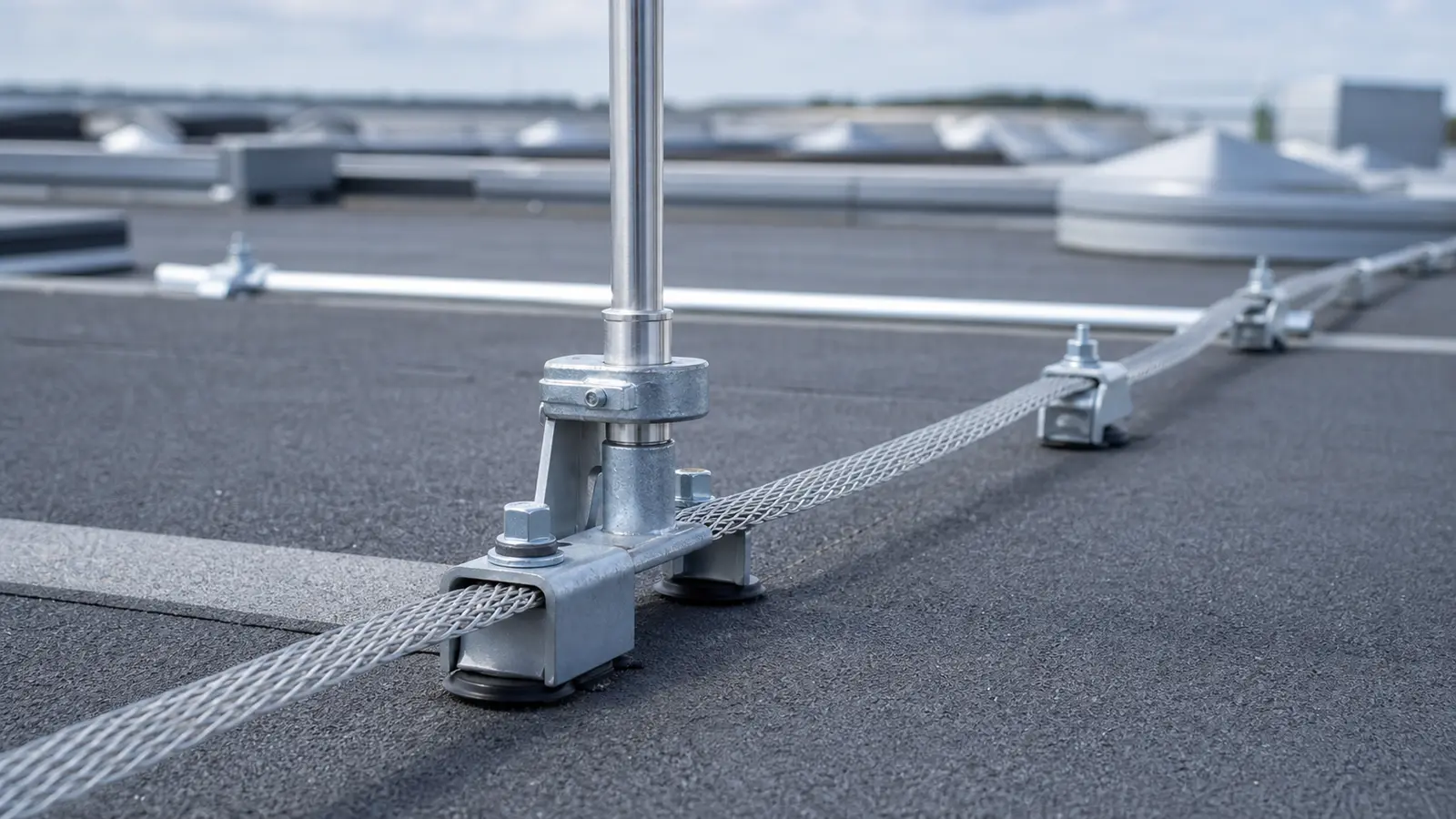
According to ČSN EN 62305, lightning protection is divided into external and internal protection. They must work together. An air-termination rod on the roof alone will not protect the electronics in the distribution board; surge protection alone will not stop a direct strike on the roof.
External protection (what is visible):
- Air-termination system – captures a direct lightning strike. This can be a mesh network, air-termination rods, ridge conductors, or a combination thereof. It must also protect superstructures on the roof: HVAC units, antennas, PV panels, or access hatches.
- Down conductors – conduct the lightning current from the air-termination system to the earth. They must be mechanically protected, continuous, and routed along the most suitable path according to the system class.
- Earth-termination system – dissipates the lightning current into the ground. It’s not just about one universal earth resistance value; the design, interconnection, measurement, and compliance with the project are important.
Internal protection (what protects the installation and technology):
- Main bonding and equipotential bonding – limits dangerous voltage differences inside the building.
- Sufficient distances – prevents the lightning current from flashing over to metal structures or cables.
- Surge protective devices (SPD) – protect the electrical installation, electronics, PV inverters, control systems, and appliances against surge voltage from a direct or nearby strike.
Simply put: external protection addresses a direct strike to the structure, internal protection addresses the consequences of the lightning current and surge inside the building.
LPL protection classes I–IV
The standard introduces four lightning protection levels – LPL I to IV (Lightning Protection Level). LPL I is the most stringent, LPL IV is the least stringent. In documentation, you will also encounter the LPS class, i.e., the design of the lightning protection system. LPL and LPS class are related, but it is not good to interchange them without reading the project.
What the classes mean in practice:
- LPL I – the highest protection. Typically for structures where a strike could have exceptionally serious consequences: explosion hazard, critical infrastructure, selected healthcare or technological operations.
- LPL II – a higher level of protection for industrial, commercial, or public buildings with a more significant risk.
- LPL III and IV – more common levels of protection for less exposed structures, if the risk analysis shows they need an LPS.
The class affects the specific technical design: spacing of down conductors, mesh size of the network system, rolling sphere radius, separation distances, conductor dimensions, and maintenance requirements. Therefore, it’s not enough to say “there’s some kind of lightning rod there”. It must correspond to the design and the protection class.
Lightning rod and photovoltaics
A PV system on the roof is a frequent reason why an old lightning rod must be reassessed. Panels themselves are not lightning magnets, but they change the roof’s built environment, add conductive structures, cable routes, and technology that may be sensitive to surges.
For PV systems, the main issues addressed are:
- Protection zone of the air-termination system – panels and their support structures should not protrude outside the protected area without further assessment.
- Separation distance – to prevent lightning current from flashing over from the LPS to the panel structure or cables.
- Bonding and earthing – according to the system design and the panel mounting method.
- SPDs on both the DC and AC side – surge protection devices must protect both the DC wiring from the panels and the AC part after the inverter.
If you are interested in PV systems comprehensively, also see the articles Photovoltaics on a company roof: everything you need to address and Fire safety of roof-mounted PV systems.
Inspections and intervals (briefly)
A lightning rod is not a “mount and forget” device. It must be checked regularly because it can be damaged by corrosion, building work, façade repairs, PV installation, roof replacement, or normal mechanical stress.
In practice, you will most often encounter these intervals for LPS:
- standard structures – complete inspection typically once every 4 years,
- critical structures or higher protection classes – complete inspection typically once every 2 years,
- visual inspection – once a year.
The exact interval is taken from the documentation, the LPS class, standard requirements, and operating conditions. A complete inspection may only be performed by an inspection technician with a valid certificate for the relevant scope, typically E3A for lightning rods. The inspector’s certificate is valid for 5 years.
Details about the intervals and the inspection process can be found in the separate article: Lightning rod inspection – how often according to ČSN EN 62305.
What to request in lightning rod documentation
When dealing with a new lightning rod, a renovation, or an inspection of an older building, ask for:
- risk analysis according to ČSN EN 62305-2,
- LPS project including the protection class and technical report,
- drawing of the air-termination system, down conductors, and earthing,
- documentation on the components used and their suitability for the given class,
- earthing measurement and connection to the main bonding,
- SPD design and their location in distribution boards,
- initial or last periodic inspection report,
- records of changes on the roof: PV, HVAC, antennas, access hatches, roof covering repairs.
Without documentation, the condition can only be checked to a limited extent. Often, the inspection technician will then recommend supplementing the risk calculation or the project part so that it is clear against what the system is actually being assessed.
What to watch out for in practice
For an owner who doesn’t want to study four parts of a standard, it can be summarized in a few points:
- Don’t let the risk analysis be done “by eye”. It is calculated using software with the real parameters of the building and its surroundings; a documented calculation holds up better than one person’s estimate.
- Insist on measurable inspection outputs — specific values, the date of the next inspection, and clearly described defects.
- Document every intervention on the roof or façade. When a technician arrives in a few years and sees new photovoltaics, they will want to know who reconciled it with the lightning rod and how. Without documentation, a new risk analysis awaits you.
- For older buildings, expect that the original lightning rod may not comply. The interpretation is becoming stricter, and what passed twenty years ago may not be sufficient today — this is not an error by the technician, but a development in lightning protection.
And one final thing: for workplaces and equipment for which it follows from legal regulations, project documentation, or risk assessment, the employer must ensure their regular maintenance, checks, and inspections in the relevant scope — this stems, among other things, from Section 4 of Act No. 309/2006 Coll., as amended. Oversight of the fulfillment of obligations in the field of OSH is carried out by the Regional Labour Inspectorate according to Act No. 251/2005 Coll., as amended, and it can impose a fine for identified deficiencies. Whether and how a potentially missing or invalid inspection affects insurance claims after damage occurs is assessed by the insurance company according to the specific insurance conditions and the causal link between the identified defect and the damage incurred — an automatic reduction or denial of the claim does not follow from this alone.
How SOHE can help
At SOHE s.r.o., we specialize in lightning rod inspections in Brno and throughout the Czech Republic. For older buildings, we check the condition of the air-termination system, down conductors, earthing, and surge protection devices. For buildings with PV systems or new technology on the roof, we check whether the changes have compromised the protection zone and the connection to the LPS.
The output is a comprehensible inspection report that you can use for building management, insurance purposes, final inspection (kolaudace), or further project adjustments.
Frequently asked questions
Is a lightning rod mandatory for every building? No. The need for a lightning rod is determined by a risk analysis according to ČSN EN 62305-2 and related project or fire safety requirements. For some buildings, it turns out to be necessary; for others, it does not.
What is an LPL class? LPL stands for Lightning Protection Level. There are four classes, I to IV, with I being the most stringent. The technical design of the LPS is derived from the LPL.
Did ČSN EN 62305 replace the old standard? Yes. The old ČSN 34 1390 is no longer the current basis for new designs. The ČSN EN 62305 series introduced a risk-based approach and the assessment of a specific structure.
Do I need a lightning rod if I have photovoltaics on the roof? A PV system is a significant factor for assessing lightning and surge protection but does not itself replace a risk analysis. It is necessary to verify the protection zone, separation distances, bonding, and SPDs on both the DC and AC side.
Who can perform a lightning rod inspection? A complete inspection may only be performed by an inspection technician with a valid certificate for the relevant scope, typically E3A for lightning protection. The certificate’s validity is 5 years.
What the article is based on
Text status as of: 6 July 2026, according to currently valid standards and regulations.
- Lightning protection, risk management, LPS design, and LPL protection classes: the ČSN EN 62305 series (parts 1–4). The old ČSN 34 1390 has been replaced.
- Requirements for documents for LPS inspection and lightning protection components within designated electrical installations: NV No. 190/2022 Coll..
- Professional competence and certification of an inspection technician: Act No. 250/2021 Coll., NV No. 194/2022 Coll..
- Requirements for lightning protection of buildings from the perspective of fire safety: ČSN 73 0810.
Are you wondering whether you need a lightning rod, or do you want to verify compliance with ČSN EN 62305? We provide lightning rod inspection, earthing measurement, and a comprehensible report for building management, insurance purposes, and final building inspection (kolaudace). We are based in Brno and operate throughout the Czech Republic.
- Lightning rod inspections – inspection and measurement according to ČSN EN 62305
- Non-binding inquiry
Write to info@sohe.cz or call +420 724 689 762.