
The question “how much does a lightning protection inspection cost” usually gets one of two answers on the market. Either a flat rate quoted from a desk, which stops applying the moment the technician arrives, or a vague “it depends on the building” with no explanation of what it actually depends on. The truth sits in between: the price of a lightning protection inspection can be estimated fairly accurately — just not from the building’s floor area. What matters is the number of down-conductors and test joints, the height and accessibility of the roof, and the scope of earth resistance measurement.
This article is purely about money: what makes up a quote, which ranges make sense, what unexpectedly pushes the price up, and what to send a supplier so you get a quote quickly and without a “just in case” margin. We won’t cover intervals here — how often a full inspection and a visual check need to be repeated according to the lightning protection level is covered in a separate article, Lightning protection inspections: how often under ČSN EN 62305.
Full inspection or visual check? Two jobs, two prices
The first thing to watch for in a quote: “lightning protection inspection” covers two different jobs with very different price tags.
- A full inspection is the work of a qualified inspection technician who meets the requirements of Section 8 of Government Regulation No. 194/2022 Coll. and holds a valid certificate for carrying out inspections of electrical installations under Act No. 250/2021 Coll. Alongside examining the air-termination system and the down-conductors, it primarily involves measurement — earth resistance, contact resistance of joints — and the issuing of an inspection report. That is the job you pay for, and the one this article is about.
- A visual check is an inspection without measurement: whether the down-conductors are secure, the joints are not corroded, and nothing has appeared on the roof that does not belong in the protected volume of the air-termination system. A trained member of your own maintenance staff can handle it, so for a business it means an hour of an employee’s time rather than a line on an invoice.
When a suspiciously low quote lands, check which of the two jobs it actually covers. A visual check sold at the price of a full inspection is a bad deal — and an “inspection report” without measured earth resistance values is just a piece of paper that will not hold up when a claim is made.
Lightning protection is not an optional roof ornament. Equipment intended to protect against the effects of atmospheric electricity is classed as designated electrical equipment under Act No. 250/2021 Coll. and Government Regulation No. 190/2022 Coll. — which is why inspectors, insurers and building managers all ask to see proof of inspection.
What makes up the price of a full inspection
An inspection technician does not calculate square metres, but their time on the roof, at the down-conductors and on the measurements — plus writing up the report. A quote is therefore built from several variables, most of which you can work out yourself before you even ask for a price.
Number of down-conductors and test joints
The strongest variable. Every down-conductor means checking the route from the air-termination system down, examining the joints and, above all, taking a measurement at the test joint. A building with four down-conductors and a building with twelve represent three times the work, even with identical footprints. That is why the number of down-conductors is the first thing a serious supplier will ask about — and the first thing you should send. You can count them by walking around the building: the down-conductors are the conductors running down the facade to the ground, and the test joint is usually within reach from ground level.
Roof height and accessibility
A single-storey hall with a roof hatch and a walkable flat roof is the fastest scenario. The price goes up with a pitched roof without anchor points, complex multi-storey buildings, and the need for rope access equipment or a mobile platform. Platform hire appears in a quote as a separate item — and on taller buildings it can cost more than the inspection itself. If the technician cannot safely get onto the roof, part of the examination has to be handled differently and more slowly, which also feeds into the price.
Scope of earth resistance measurement
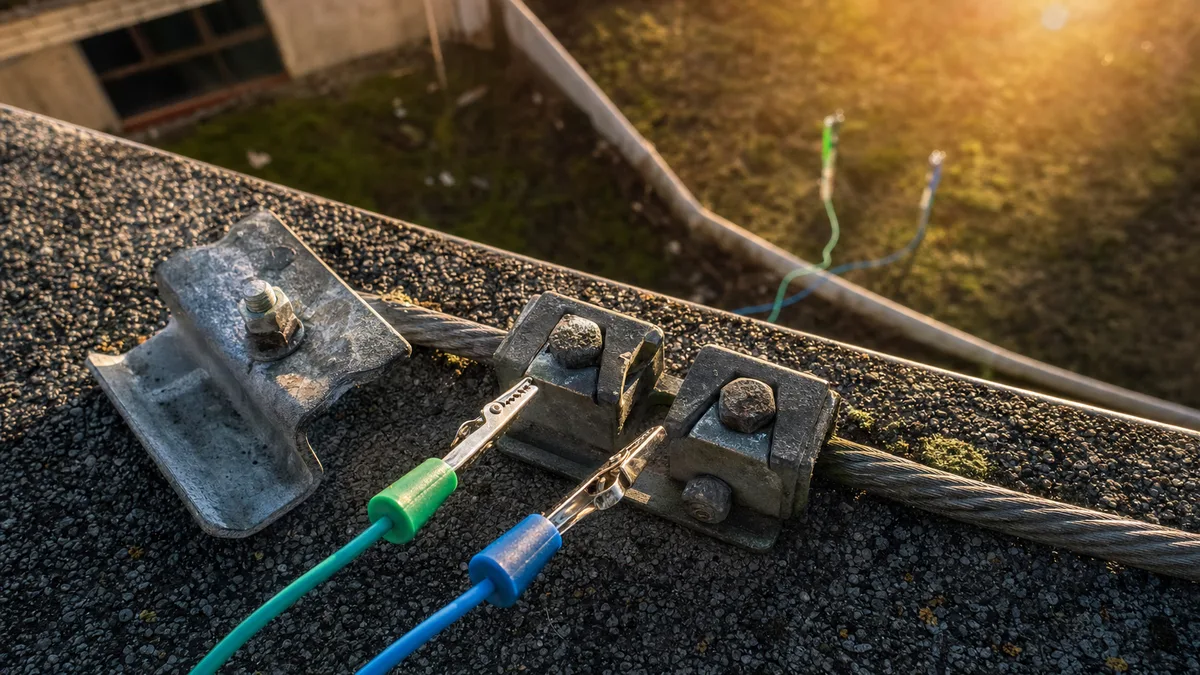
Measuring the earthing system is the reason no amount of looking through binoculars can replace a full inspection. The time required depends on the number of measurement points and the state they are found in: a test joint that is overgrown, buried, painted over or set in concrete means extra work before the technician can even start measuring. If you want a cheaper inspection, keep the joints accessible.
Documentation and the last inspection report
The previous report tells the technician the number of down-conductors, past measured values and any recorded defects — and it brings the quote down, because the supplier does not have to price in a margin for the unknown. Without documentation, the building has to be mapped on site and the price rises. It is the same dynamic we describe for the cost of an electrical inspection in a business: you pay most for what the supplier does not know in advance.
Travel and combining jobs
A call-out charge appears in practically every quote — the question is how many jobs fit into it. A lightning protection inspection combined with an inspection of the electrical installation or of appliances on the same date spreads travel and overheads across several items and works out better than three separate visits from three suppliers.
Indicative price ranges
The ranges below are an indicative summary of common market practice — not a SOHE price list and not a binding quote. The actual price is set according to the real scope, ideally from the documentation described below.
| Type of building | Indicative range | What decides it |
|---|---|---|
| Smaller office building or shop | roughly CZK 1,000 to 3,000 | number of down-conductors, roof access |
| Production or warehouse hall | several thousand CZK | number of down-conductors and test joints, height, scope of measurement |
| Multi-building site, high-rise properties | depends on scope, usually tens of thousands | number of buildings, need for a platform, travel |
On small buildings, travel and the minimum job charge often affect the final figure more than the inspection itself. On large sites, what matters is whether all the buildings can be inspected in a single scheduled visit or require repeated trips.
What unexpectedly pushes the price up
A few items tend to appear in quotes only after the fact — and they are behind most of the disappointment over a final invoice:
- A mobile platform or rope access work. On buildings without safe roof access, this is a separate and far from trivial item.
- Inaccessible test joints. Buried, concreted-in or painted-over joints make measurement take longer.
- Defects found. A broken down-conductor, corroded joints or high earth resistance mean a repair followed by a verification check. This is usually not a rebuild of the whole lightning protection system but a partial fix — ask for it to be priced in advance, not on the invoice.
- Changes on the roof. New solar panels, air conditioning or a replaced roof covering can reopen the risk assessment and the design of the air-termination system under the ČSN EN 62305 series — and the new ČSN EN IEC 62305 ed. 3 edition has been complete since March 2026 and will apply exclusively from 1 November 2027; until then it runs in parallel with edition 2. What that means in practice is covered in the article The new lightning protection standard.
- A rush date. An inspection “within a week” after a storm or ahead of building approval tends to cost more than a scheduled date — some suppliers charge extra for express call-outs.
Where you can genuinely save
Cutting back on the scope of measurement does not pay off — a report without values protects nobody. There are other places to save:
- Do the annual visual check in-house. A damaged down-conductor or a loose joint caught in time is a minor repair, not a defect in an inspection report.
- Combine lightning protection with the electrical inspection. One supplier, one call-out, one set of documents — the electrical inspection service can be scheduled for the same date.
- Keep access clear. Unobstructed test joints, clear space around the down-conductors, a working roof hatch — all of it shortens the time on site.
- Plan outside peak season. The end of the year, when everyone orders inspections for their insurance policies, means worse dates; an inspection planned for a quieter period works out better.
- Don’t let the deadline lapse. An expired inspection turns into an argument for the insurer when a claim is made — the article A missing inspection and your insurer explains the connections. The most expensive inspection is the one you never had.
What to send for a fast quote
For a desk quote — without a site visit and without an “unknowns” margin — all a supplier needs is:
- the last inspection report (a scan is fine; it contains the number of down-conductors and past values),
- the number of down-conductors, if you don’t have the report — count them by walking around the building,
- the number of storeys or the approximate height of the building,
- the type and pitch of the roof and how to get onto it (hatch, ladder, anchor points),
- the address of the building, for travel,
- what has changed on the roof since the last inspection (solar panels, air conditioning, new roof covering),
- your preferred date — and whether you want to combine it with an inspection of the electrical installation or appliances.
And who will take care of it? Send this information through our no-obligation enquiry form — we will come back with an itemised price that shows what the inspection costs, what the travel costs and what any repairs would cost. Indicative rates for our other inspections are in the price list.
FAQ: the cost of a lightning protection inspection
Is a lightning protection inspection charged “per down-conductor”? Many suppliers do build the price on the number of down-conductors and test joints, because it corresponds best to the amount of work involved. It is not the only logic, though — the height of the building and roof access can change the calculation more than one extra down-conductor.
Is a visual check free? Done in-house, yes — it costs a trained employee’s time. Ordered from a supplier, it is typically charged as a smaller item, or combined with another call-out.
Why do quotes from different suppliers vary so much? Most often because each assumes a different scope: one includes measurement of every down-conductor, travel and the report, another only an examination. Ask for the scope broken down item by item — only then can prices be compared.
Sources
- Electrical inspections – a SOHE service, including lightning protection inspections.
- Lightning protection inspections: how often under ČSN EN 62305 – intervals for full inspections and visual checks by lightning protection level.
- The new lightning protection standard – the transition to ČSN EN IEC 62305 ed. 3 and when work on the roof reopens the risk assessment.
- The cost of an electrical inspection in a business – the same pricing logic applied to electrical installations.
- A missing inspection and your insurer – why a valid inspection report matters when a claim is settled.
- Act No. 250/2021 Coll. – the act on occupational safety in relation to the operation of designated technical equipment.
- Government Regulation No. 190/2022 Coll. – designated technical electrical equipment; this includes equipment intended to protect against the effects of atmospheric electricity.
- Government Regulation No. 194/2022 Coll. – professional competence in electrical engineering; Section 8 sets out who may act as an inspection technician. The certificate for carrying out inspections itself is issued by TIČR under Act No. 250/2021 Coll.
- The ČSN EN 62305 series (lightning protection) – the technical basis for LPS inspections. The new ČSN EN IEC 62305 ed. 3 edition was published in parts: parts 1 and 2 in October 2025, part 3 in December 2025 and part 4 in March 2026. Edition 2 applies in parallel until 31 October 2027; from 1 November 2027 only edition 3 applies. Czech technical standards are not freely available.
The legal position was verified on 2 August 2026 against the e-Sbírka: Act No. 250/2021 Coll. as amended by Act No. 318/2025 Coll., and Government Regulations No. 190/2022 Coll. and No. 194/2022 Coll. as amended by Government Regulation No. 175/2024 Coll. Details of the ČSN EN 62305 series are verified in the ČSN online catalogue of the ČAS agency and in ÚNMZ Bulletins 10/2025, 12/2025 and 3/2026.
The price ranges in this text are an indicative summary of common market practice as at the date of publication, not a SOHE price list and not a binding quote; the actual price is set according to the real scope of the job.
This text is informational and does not replace legal advice. The specific inspection regime needs to be set according to the actual design of the lightning protection system, the project documentation, the lightning protection level and the condition of the building.
Is your lightning protection inspection coming up, or do you just want to know where you stand? Send us the number of down-conductors and your last report through our no-obligation enquiry form or to info@sohe.cz — we will come back with an itemised price and no hidden extras, and we can combine the inspection with an electrical inspection on the same date.