
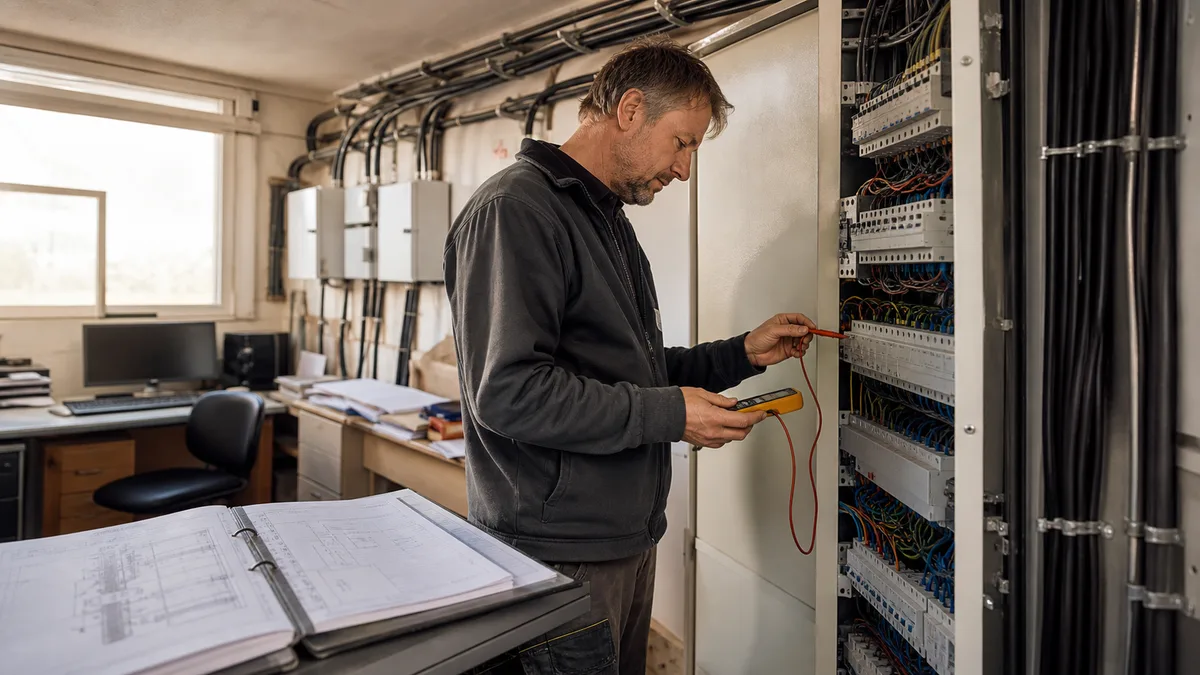
When a company requests an “electrical inspection,” the first price offered via email often differs from the final invoice. Not because the supplier is deceptive—the term actually covers several different tasks, and the price is determined by things you can’t see from the street or a floor plan: the number and size of distribution boards, access to individual circuits, and whether documentation exists for the building.
This article doesn’t promise a single figure for every situation—such a figure doesn’t exist for electrical inspections. However, it shows what drives a quote up and what drives it down, what indicative price ranges make sense for an office, premises, and hall, and how to write a request so you receive quotes that target the same scope and can be compared.
What “Electrical Inspection” Actually Covers
When a company says “electrical inspection,” they usually mean an inspection of the electrical installation according to ČSN 33 1500—i.e., distribution boards, wiring, socket and lighting circuits, circuit protection, and surge protection. However, a supplier sees other tasks within the same term, which will be reflected in the quote:
- Electrical installation inspection — the fixed part: distribution boards, wiring, socket and lighting circuits, circuit protection, surge protection.
- Appliance testing — everything that plugs into a socket: computers, kettles, chargers, extension cords.
- Lightning conductor inspection — if the building has a lightning protection system, this is a separate check and measurement.
- Photovoltaic system inspection — panels on the roof have their own inspection intervals and checks for inverters, DC cabling, and safety features.
- Emergency (escape) lighting check — falls under both electrical and fire safety regulations.
For condominiums and commercial premises, the core of the request is often the inspection of common areas, garages, boiler rooms, or elevators. In offices, it’s primarily open spaces and meeting rooms with a large number of socket circuits and data networks. Before you start comparing prices, clarify which of these tasks you actually want from one technician in one visit—otherwise, you’re comparing quotes that each assume a different scope.
What a Supplier Factors into the Price
The price isn’t determined by square meters, but by the technician’s time on site and the complexity of the measurements. A technician reads an order through several variables.
Scope and Layout of the Building
- Number of distribution boards. Main, sub-distribution, machinery. One large distribution board takes more time than you’d expect, and five small ones scattered throughout a building mean five relocations and five sets of measurements. The article Distribution Board Inspections details what a technician looks for in a distribution board.
- Number of circuits. You can estimate this from the circuit breakers in the board. The scope and number of required measurements usually increase with the number of circuits and installation components.
- Access to measurement points. Suspended ceilings, cable shafts, cramped machine rooms. Climbing ladders and dismantling covers all count towards the time.
- Number of floors and rooms. Offices on three floors will take longer than one open-plan hall with the same area.
Environment According to ČSN 33 2000-5-51
Both the scope of checks and their intervals are influenced by the environment defined by external factors. For the price, the following are crucial:
- Normal environment (offices, shops) — faster procedure, fewer measurements.
- Wet, hot, or dusty operations (bakeries, laundries, woodworking) — slower work, plus checks of IP ratings, seals, and corrosion.
- Outdoor installations (car parks, facade lights, terraces) — measurements under variable conditions, weather influence.
Availability of Documentation
This is where the price is most significantly affected. Complete as-built documentation noticeably speeds up the work—the technician measures according to schematics and doesn’t spend time tracing routes and connections. Partial documentation means investigation and a contingency allowance in the quote. Without any documentation, the technician maps the connections themselves, which can easily add hours in more complex operations; some suppliers will even decline such a job without documentation, as they cannot guarantee the completeness of the inspection.
As-built documentation is part of the standard records kept for buildings; however, for older properties, it’s often not readily available.
Indicative Price by Type of Building
The following ranges are indicative—they are based on common market practice and scope, not a fixed price list. Each job is priced individually after an inspection or at least based on documentation. Consider these figures as rough estimates, not as a formal offer.
Office and Administration
A small office up to 100 m² with one distribution board and a few circuits can usually fit within the lower thousands of Czech crowns. For a larger open space with multiple distribution boards and dozens of socket circuits, the price rises to the lower tens of thousands. This typically includes an inspection of the fixed installation; appliances are charged separately.
Premises, Shop, Warehouse
Here, the price is determined by the environment and the number of permanently connected machines. For a smaller shop with standard equipment, the cost is in the thousands to lower tens of thousands of Czech crowns; the scope usually includes checking the supply to permanently connected equipment, such as air conditioning or window display lighting.
Production and Storage Hall
The widest price range applies here. A hall with one main distribution board, standard lighting, and several socket outlets will cost in the lower to mid tens of thousands. As soon as machinery distribution boards, crane runways, extraction systems, pumps, or specific environments (wood dust, areas with an explosion hazard) are added, the job is priced exclusively on an individual basis, and the amount can be significantly higher. The article Electrical Inspection in an Industrial Hall analyzes hall inspections in detail.
Condominiums — Common Areas
Inspections of common areas in a residential building (hallways, cellars, stroller rooms, elevator shafts, entrance lighting) usually remain in the thousands to lower tens of thousands of Czech crowns, depending on the number of distribution boards and floors. The price is significantly increased by checking the elevator machine room, including the cabin’s emergency lighting.
Appliance Testing as a Separate Item
Some suppliers include appliance testing within the electrical inspection, while others charge for it separately—this is a significant difference for the total price. The price for a standard, easily accessible appliance is roughly in the tens of Czech crowns per item; for more complex equipment (industrial vacuums, workshop machines, welding equipment), it’s determined individually.
What to watch out for:
- The operator is responsible for maintaining an appliance register. Without it, the technician will check the equipment but has nowhere to record the next inspection date.
- Extension cords and splitters are counted separately—one cord equals one item. An office with twenty workstations and thirty extension cords will therefore add thirty items to the price, not twenty.
- For new appliances, a check upon receipt is generally sufficient until the first periodic inspection—it’s advisable to ask the supplier about this interval in advance.
When There’s a Photovoltaic System on the Roof
A company PV system adds a separate inspection chapter. The building’s electrical installation inspection and the PV system inspection are two distinct tasks with their own intervals. If you have panels on the roof, ask the supplier three things:
- Does the quote include the inspection of DC cabling, inverters, and the PV distribution board?
- Does the price cover insulation resistance measurements for the PV strings?
- Does the inspection also address fire safety (DC side disconnection, labeling)?
A separate inspection for a smaller commercial PV system is in the thousands of Czech crowns; for larger systems with several strings and external inverters, the price rises. Obligations, intervals, and risks for commercial PV systems are discussed in the article PV System Inspections: Obligation, Intervals, and Risks.
Why a “Ballpark” Quote Might Not Be Accurate
Some suppliers will send a price via email without any details. For a simple office, this can work. For a more complex operation, however, watch for three signals:
- A quote without a specification of scope. Ask directly: Does the price include checking all socket and lighting circuits, issuing the inspection report, and labeling the distribution board?
- A price significantly below the standard range. For a much lower quote, ask for a breakdown by scope and verify that it includes all required circuits, measurements, and the inspection report.
- A quote that ignores the environment. Did you describe an operation with moisture and dust, and the supplier doesn’t mention IP ratings or insulation resistance at all? They are making a compromise somewhere.
A good supplier will themselves ask for at least three things: the number and type of distribution boards, the existence of documentation, and the nature of the environment. If they don’t ask anything, they don’t know the scope—and without the scope, they can’t set an honest price.
For an express timeframe (an inspection within a week, priority visit), some suppliers charge a surcharge. Conversely, a planned inspection outside of peak season—i.e., not at year-end, when many companies request one simultaneously due to insurance policies—tends to be cheaper and has better technician availability.
What a Quality Inspection Report Should Contain
A company pays for an inspection primarily for the documentation—for an authority, the insurance company, and their own peace of mind. But it only protects them if it corresponds to the actual condition. A thorough electrical inspection is based on several steps:
- Visual check — terminal tightness, condition of insulation, conductor labeling, completeness of the distribution board, corrosion, and mechanical damage.
- Measurements — earth fault loop impedance, continuity of protective bonding, insulation resistance.
- Measurement protocol — specific measured values, not just a verbal “pass.”
- List of defects with removal deadlines — even minor issues should be included; an empty defects list is more suspicious than reassuring.
- Labeling the distribution board with a sticker showing the inspection date and the technician’s name.
A legally valid inspection report can only be issued by a technician with a valid professional competence certificate according to Government Regulation No. 194/2022 Coll. Anyone looking only for the cheapest “paper” risks the report not reflecting reality—and that can be a problem during an insurance claim; the article Missing Inspections and Insurance explores these connections.
How to Request Comparable Quotes
A short email brief is all it takes. If it includes the following, you’ll eliminate half of the follow-up questions and receive quotes that target the same scope:
- Building type and size — e.g., “Production hall 600 m² with an 80 m² built-in office.”
- Number of distribution boards — “One main and four sub-distribution boards.”
- Environment — “Dry metalworking, normal environment, no explosion hazard.”
- Documentation — “As-built documentation from 2019 available.”
- What you want included — “Inspection of the fixed installation, including a measurement protocol and labeling of distribution boards, excluding appliance testing.”
- Timeframe — “February–March 2027, planned shutdown on the first weekend of March.”
A brief like this takes three minutes to write and turns a vague “how much will it cost” into price quotes that can actually be compared.
Sources for This Article
- Electrical Installation Inspection – SOHE service.
- Electrical Inspection in a Company: Obligations and Intervals – when you need an inspection and how often it repeats.
- Electrical Installation Inspection Intervals According to ČSN 33 1500 – how intervals and scope are determined by the environment and type of operation.
- Requirements for an Inspection Report – what to look for in a protocol and what to avoid.
- The ČSN 33 1500 (inspection of electrical installations) and ČSN 33 2000-5-51 (environments according to external influences) series form the technical basis for the scope of inspection; Czech technical standards are not freely available.
- Government Regulation No. 194/2022 Coll. – requirements for professional competence in electrical engineering, on the basis of which a technician issues an inspection report.
This text is for informational purposes and does not replace legal advice. The specific scope of the inspection and its price must be set according to the actual operation, manufacturer’s documentation, usage environment, and risk assessment.
Do you need an electrical installation, appliance, or photovoltaic inspection for an office, premises, or hall? Electrical Inspection by SOHE prices the job based on the actual scope, not just a ballpark estimate. Send us a no-obligation inquiry or write to info@sohe.cz—we’ll return a price that can be realistically compared.