
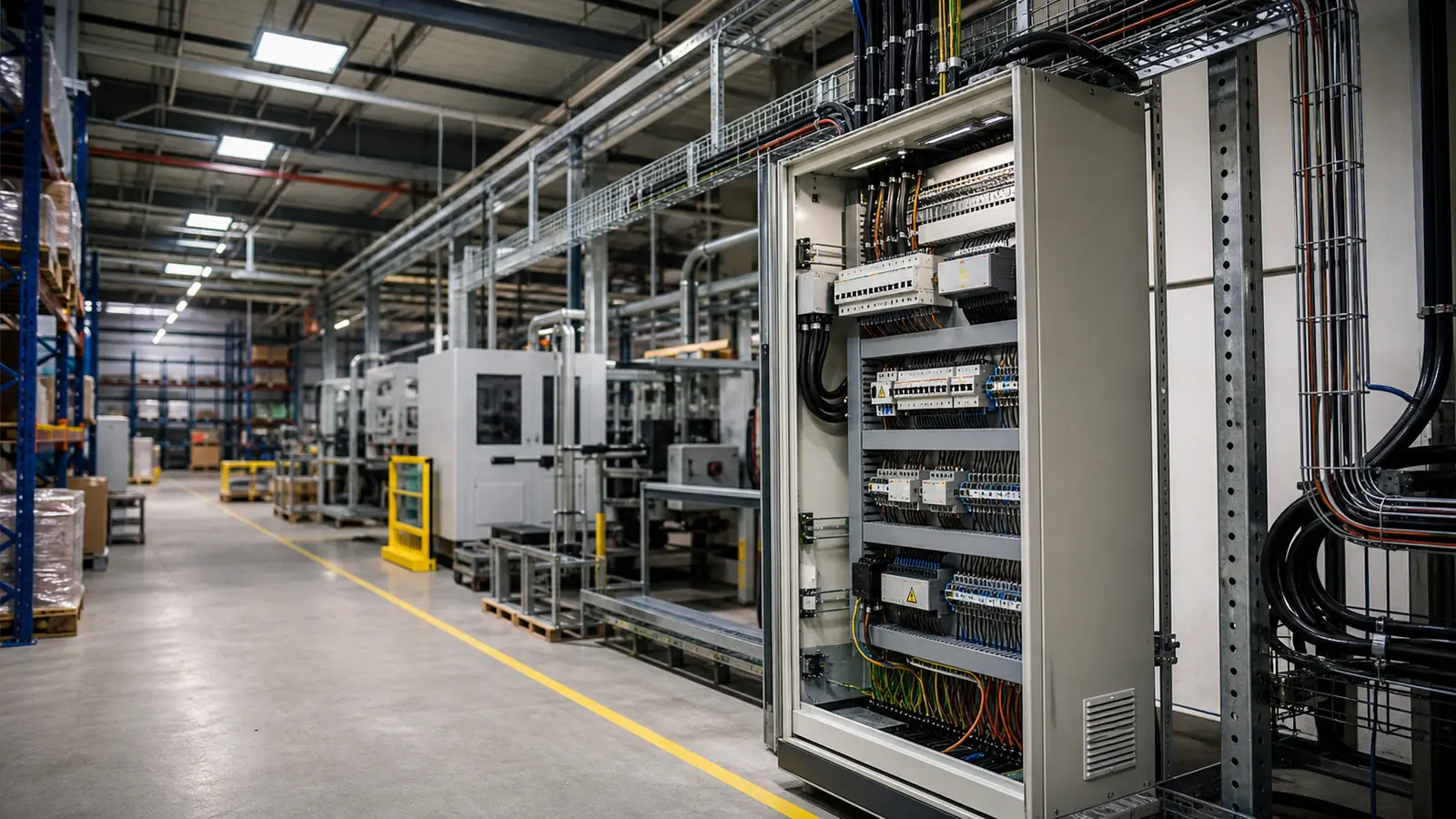
Why an Industrial Hall Is Different from an Office
In an office building, the electrical installation is relatively stable. A few sockets, lighting, maybe a server room. An industrial hall is a different world. You’re working with heavy machinery, cranes, switchboards handling hundreds of amps, often in damp, dusty, or extreme temperature conditions. An inspection here is not a formality. It’s a tool that reveals whether your operation could kill someone or shut down half your production.
A certified electrical inspector in a hall doesn’t just check switchboards. They need to understand the operation, know where the power circuits run, how the machines are protected, and what’s happening in places people don’t usually go – near the ceiling, in cable trays, behind equipment.
Fixed electrical installations and distribution systems in an industrial hall are classified as designated technical electrical equipment. Operating such equipment without a documented inspection within the specified interval is explicitly considered by law as a condition endangering occupational health & safety and operation. It’s not just an administrative oversight – it’s a conscious risk.
Specifics of Manufacturing and Warehouse Operations
Production halls and warehouses have specific characteristics that complicate inspections.
Environments with External Influences Dust, moisture, chemical vapors, vibration. All of these degrade insulation, connections, and protection devices. An inspection in such an environment must account for the fact that what was fine a year ago might be borderline today. This is especially true for operations with flammable materials – where any spark equals a disaster.
High Power Consumption and Surge Loads The start-up of large motors, welding units, cooling compressors. This isn’t the stable load you find in an office. The certified electrical inspector must verify whether the cable sizing and protection correspond to the actual operation, not just the project documentation from a decade ago.
Retrofits and DIY Modifications Every hall accumulates new wiring over time. A new machine here, an extension cord there, a splitter for the lights. Hardly anyone documents these changes. An inspection often reveals that the actual state has little in common with the documentation.
Outdoor and Semi-Outdoor Areas Warehouses with ramps, shelters, outdoor lighting. Everything is exposed to the weather. Here, the ingress protection (IP) rating, switchboard corrosion, and the state of the grounding are checked – a lightning strike on a hall is not unusual.
Different Inspection Intervals in One Hall A fundamental difference from an office: different inspection intervals often apply to different parts of the operation within a single hall. The reason is the classification of spaces according to external influences – moisture, dust, corrosion, mechanical stress. This is not determined by law, but by a protocol for determining external influences, prepared according to ČSN 33 2000-5-51. The same hall might have a 3-year interval in a dry warehouse, while a wet operation area requires just 1 year.
Inspection Intervals: What Actually Applies
The maximum permissible intervals for periodic inspections are set out in Annex No. 4 of Government Regulation No. 190/2022 Coll.:
- Office buildings: 5 years
- Buildings for manufacturing, education, accommodation, and medical purposes: 3 years
- Buildings for more than 200 people: 2 years
- Wet spaces and areas with a permanent presence of corrosive or polluting substances: 1 year
- Areas with fire and explosion hazards: 3 years
- Temporary construction site installations: 0.5 years
A simple rule applies here: if multiple intervals apply to a piece of equipment simultaneously, the shortest one is used. A production hall that is also a wet operation thus realistically falls to a 1-year interval – not because an explosion or fire hazard itself dictates the shortest interval, but due to the combination of influences triggering the shortest-interval rule.
The listed intervals are maximums. Shorter ones can always be set. An operator with a preventive maintenance schedule may double them. We’ve discussed intervals in more detail in a separate article on electrical installation inspection intervals.
Preparing Documentation, Access, and Shutdowns
Without preparation, an inspection won’t happen, or it will happen poorly. What to prepare before the technician arrives:
Documentation Gather everything you have – project documentation, previous inspection reports, records of repairs and modifications. If you have an inspection log, pull it out. The technician needs to see the history, not just the current state. Without documentation, the inspection becomes more expensive and takes longer – the technician will have to map the circuits from scratch.
Access Ensure the technician can reach all switchboards, cable routes, and machines. This means clearing away pallets, removing covers, unlocking rooms. If a switchboard is blocked by a rack, the inspection cannot be performed there. And the excuse “no one’s been there for two years” won’t hold up during an insurance claim.
Shutdown Expect that part of the inspection requires de-energizing circuits. Measuring insulation resistance, contact resistance on joints, checking protection devices – this cannot be done live. Schedule the shutdown for a time that hurts production the least. Ideally off-peak, on a weekend, or during planned maintenance. The technician should know in advance what can be shut down and what must run continuously – the schedule will be adapted accordingly.
What Gets Measured and Checked
An industrial hall inspection is not a visual check. It’s a set of measurements and tests:
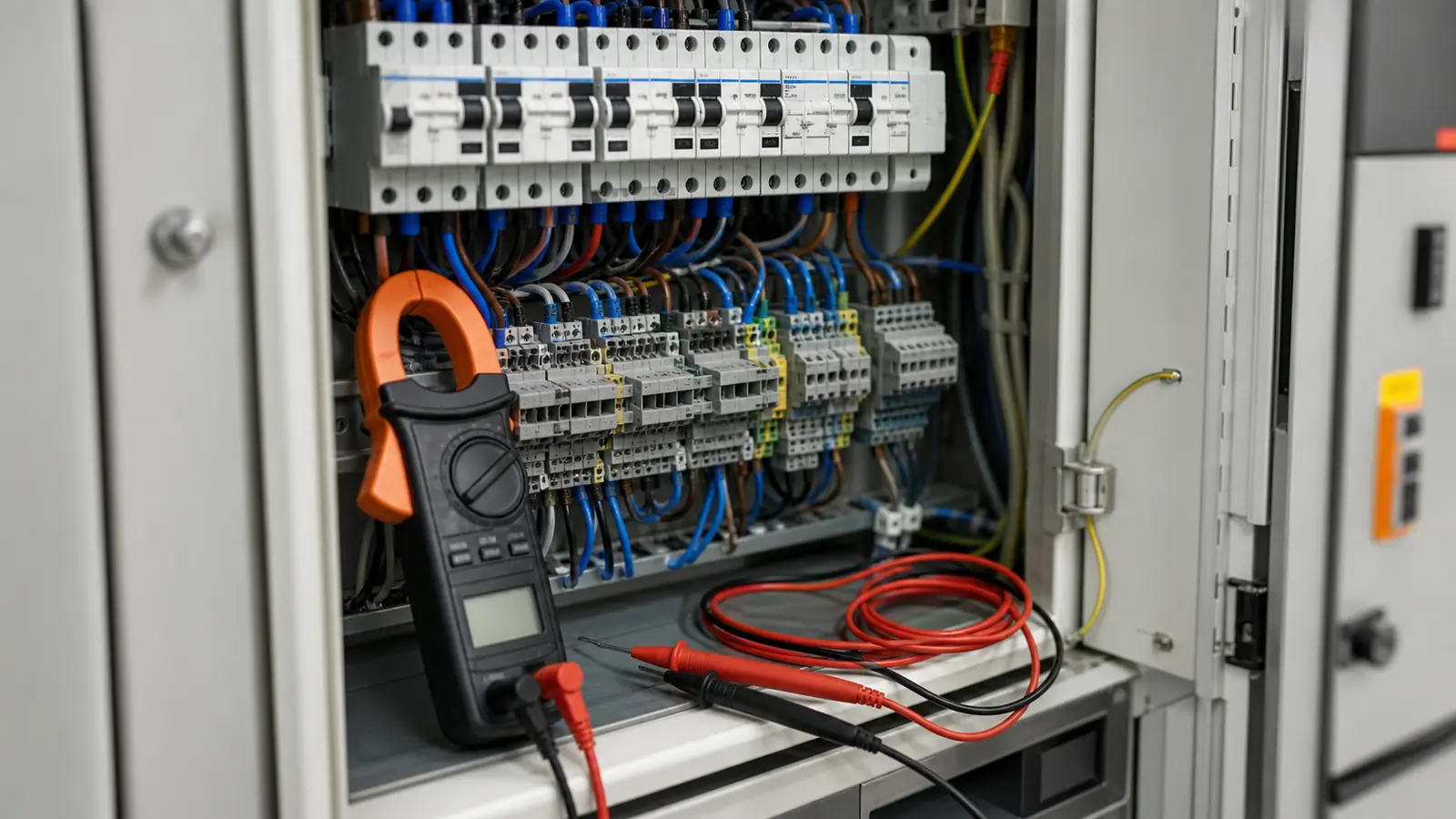
Insulation Resistance Measurement The foundation of everything. Measured between conductors and against ground. Low values indicate degraded insulation – a risk of short circuit or fire. In dusty and humid environments, insulation ages faster.
Fault Loop Impedance Verifies whether the protection device will trip fast enough during a short circuit. If the impedance is high, the short-circuit current is low, and the circuit breaker may not react in time. This is a common problem with long cable runs in large halls.
Contact Resistance Checking connections, terminals, busbars. A loose or oxidized connection heats up, burns insulation, and can cause a fire. A thermal camera reveals problems here that a multimeter won’t show – and without needing a shutdown, directly during operation on loaded connections.
Lightning Protection System (LPS) and Overvoltage Inspection Lightning rods, surge protective devices, grounding. This is critical for halls with sheet metal roofs or large steel structures. Lightning will find a path – the question is whether it has a controlled one, or whether it will punch through your switchboard.
Ingress Protection (IP) and Mechanical Resistance Check Switchboards in dusty operations must have the appropriate IP rating. Damaged seals, missing covers, pierced cable glands – all of these let contaminants inside.
Inspection of Machinery and Equipment Every machine with its own power supply should have a valid inspection. Shorter intervals apply to portable equipment, extension cords, and hand tools – this is often forgotten.
Typical Defects and How to Handle Them
What inspections most commonly reveal in halls:
Loose Connections in Switchboards Vibration from operation loosens screws on terminals over time. The result: contact resistance, heating, insulation degradation. The fix is simple – tightening. If not done, the damage grows.
Missing or Damaged Covers Missing blanking plugs, missing switchboard doors, cracked junction boxes. Risk of contact with live parts. This must be addressed immediately.
Incorrect Protection Someone replaced a circuit breaker with a stronger one because it “kept tripping.” But the cable isn’t rated for that current. This is a direct path to a fire.
Outdated or Missing Documentation Not a technical defect, but a problem during an audit. If the certified electrical inspector doesn’t know what is where and how it’s connected, they can’t check it properly.
How Defects Are Classified The law mandates the removal of defects endangering safe and reliable operation without undue delay; others are addressed according to their severity. In practice, defects are classified into three levels of severity (according to ČSN and standard practice): critical – risk of injury or fire, addressed immediately even at the cost of shutting down the operation; major – danger arises under a combination of circumstances, repair within days to weeks; recommended – does not meet the standard but poses no immediate safety threat, planned repair during the next shutdown.
Who Is Authorized to Perform the Inspection
An inspection may only be performed by a certified electrical inspector with a valid certificate in the scope corresponding to the given equipment. Professional competence is governed by Act No. 250/2021 Coll. and Government Regulation No. 194/2022 Coll. Do not be misled by references to the old Decree No. 50/1978 Coll. – it was repealed on 1 July 2022 and is no longer valid.
Output for the Insurer and Audit
The inspection report is a document proving you have done your utmost for operational safety. The Labor Inspectorate will want to see it during an audit. And the insurer will want it during a claim.
What the report should contain:
- Identification of the premises and the equipment inspected
- A list of measurements performed with the measured values
- A list of defects with a severity classification
- Deadlines for rectifying defects
- The date of the next inspection
File the report and, most importantly – address the defects listed in it. An inspection report with a list of unresolved defects is more of an aggravating circumstance during an insurance claim. A missing or expired inspection can complicate the settlement of an insurance claim, especially if there is a link between the equipment’s condition and the occurrence or extent of the damage.
For failing to perform an inspection of designated technical equipment, the labor inspectorate can impose a fine on the company of up to CZK 2,000,000, according to §33 of Act No. 251/2005 Coll. It’s not a certainty – it’s a possibility. But it’s a possibility worth paying attention to.
Frequently Asked Questions
How often do we need to inspect the hall?
It depends on the environment and type of operation. Manufacturing buildings have a basic interval of 3 years. If the hall is wet or corrosive substances are permanently present, it shortens to 1 year. Areas with fire and explosion hazards have a 3-year interval. The shortest-interval rule applies – if multiple intervals apply to the equipment, the shortest one is used. The exact classification is determined by the certified electrical inspector based on the external influences protocol.
Do we have to shut down the entire production for the inspection?
Not necessarily all of it. Some measurements require de-energizing, while others can be done during operation – for example, thermal imaging checks of loaded connections. You plan a schedule with the technician so the shutdown only affects essential circuits, ideally outside peak production times.
What if we have no documentation?
An inspection can be done without it, but it will take longer and be more expensive. The technician must map the circuits. We recommend having documentation of the actual state prepared during the inspection – you’ll save yourself problems in the future.
Who can perform the inspection?
Only a certified electrical inspector with a valid certificate according to Act No. 250/2021 Coll. and Government Regulation No. 194/2022 Coll. The old Decree 50/1978 Coll. is no longer valid – don’t be misled by it when verifying qualifications.
What happens if we don’t have an inspection?
You are operating equipment in violation of regulations. The law considers this a condition endangering occupational health & safety and operation. During an audit, a fine of up to CZK 2,000,000 is possible; during a claim, a missing inspection can complicate the insurance settlement. And most importantly – you bear responsibility for the safety of people in the operation.
Need an Inspection for Your Hall or Production Facility?
We’ll take care of the complete inspection of your electrical installation, machinery, and appliances. We’ll come, measure, identify defects, and advise on what and how to fix. We track your inspection deadlines for you.
We’ll specify the scope and price after a site survey. Get in touch – let’s discuss your operation with no obligation.
Sources for This Article
The information in this article is based on the current wording of the following regulations (verified against the official e-Sbírka):
- Government Regulation No. 190/2022 Coll. – §3 (designated electrical equipment) and §7 with Annex No. 4 (periodic inspection intervals according to environment).
- Act No. 250/2021 Coll. – §17 (inspections may only be performed by a certified electrical inspector) and §20 (safe condition; operation without an inspection = condition endangering safety; rectification of defects).
- Government Regulation No. 194/2022 Coll. – §8 (professional competence of a certified electrical inspector).
- Act No. 251/2005 Coll., on Labor Inspection – §33 (sanctions for failing to inspect designated equipment).
The classification of spaces according to external influences and the inspection procedure are governed by ČSN technical standards (ČSN 33 2000-5-51, ČSN 33 1500, ČSN 33 2000-6), which are not part of the Collection of Laws. The former Decree No. 50/1978 Coll. was repealed on 1 July 2022. This text is for informational purposes only, does not replace individual assessment, and regulations may be amended.