
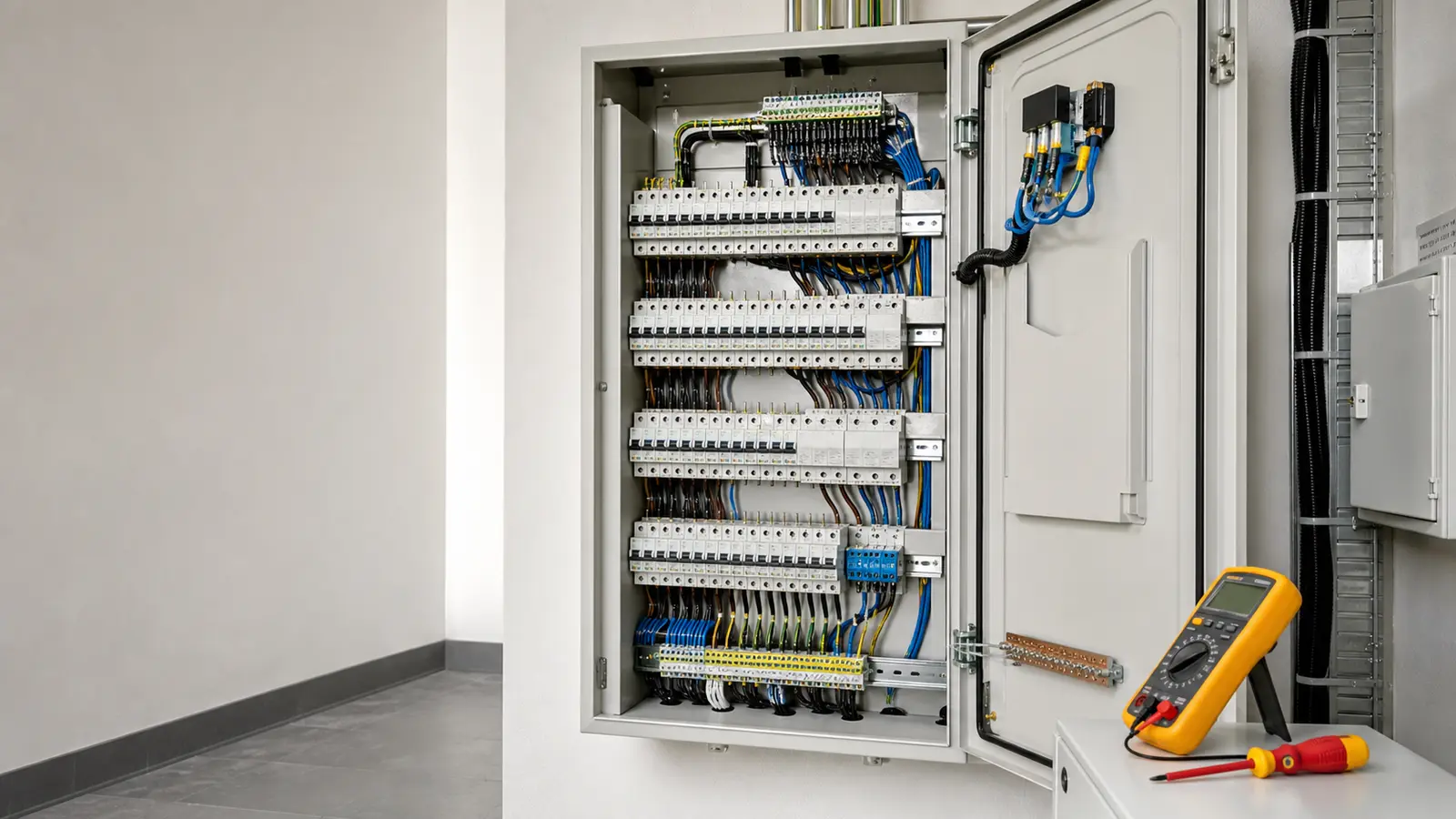
A switchboard is not just a box with circuit breakers. It is the central point where electricity is distributed, protected, and measured. When something fails inside it, the consequences are not limited to a single circuit. It can lead to a fire, electric shock, or a complete building shutdown. A switchboard inspection is therefore not a formality. It is a technical check that identifies problems before they have a chance to manifest.
What is checked during a switchboard inspection
During an inspection, the technician goes through several areas. The check begins with a thorough visual examination. They look at the integrity of covers and doors, the condition of seals, and the legibility of circuit breaker and circuit labels. Inside the switchboard, they search for signs of corrosion, dust, or moisture. Attention is also paid to unprofessional modifications—typically, extra wires added outside the terminal blocks.
This is followed by checking the tightness of screw connections on both incoming and outgoing terminals. A loose connection means higher contact resistance. This leads to heating, which can end in charred insulation and a fire. The thermal expansion of materials also causes connections to loosen over time on their own—this is one of the most common defects of all.
Several parameters are measured. The continuity of the protective bonding, the insulation resistance between conductors and to earth, and the earth fault loop impedance. This verifies whether the circuit breaker will trip within the prescribed time. For residual current devices (RCDs), the tripping time and current are measured. If the inspection includes a thermographic survey, it will reveal overheating connections or overloaded circuits without the need for a shutdown.
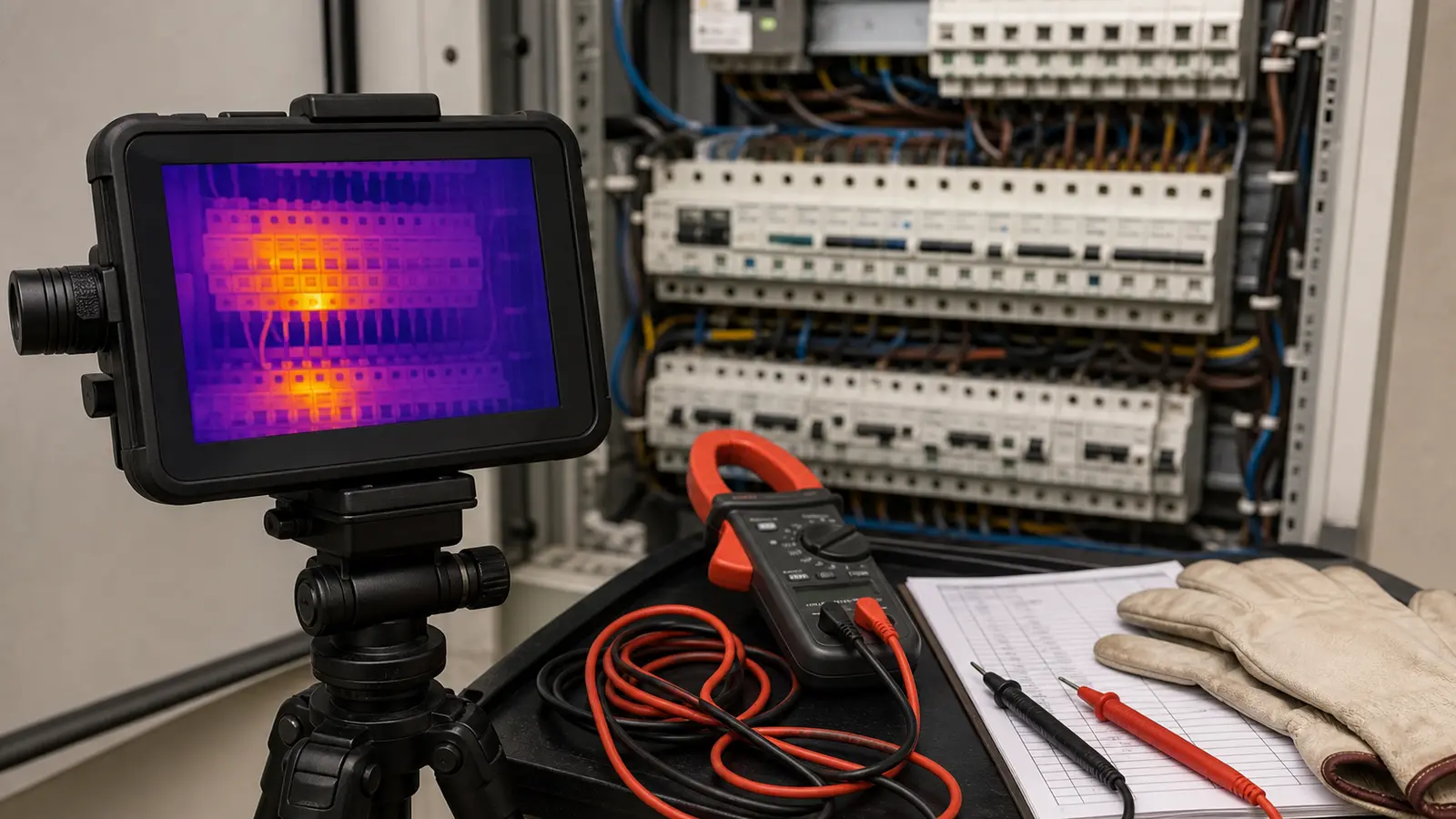
The technician also checks the correct installation of protective devices according to the project documentation. They verify the ratings and types of circuit breakers, including selectivity—ensuring that a short circuit in an apartment does not trip the main breaker for the entire building. Replacing a circuit breaker with a higher-rated type without a calculation is a common bad practice. Instead of solving the cause of the overload, someone over-dimensions the circuit and risks damaging the wiring.
When is the inspection standalone and when is it part of a complete electrical installation inspection
This is a frequent question from facility managers. The answer depends on the situation.
A standalone switchboard inspection is typically performed after a switchboard replacement or expansion, after an intervention in the main protection or metering, or when a fault is suspected. This could be a burning smell or repeated circuit breaker tripping without an obvious cause. Another reason is a request from an insurance company after a loss event or the final approval of a partial renovation where only the switchboard was changed.
A switchboard check is always part of a complete electrical installation inspection whenever a periodic inspection of the entire building is carried out. In such a case, the switchboard is checked as one of the points—along with wiring, sockets, lighting circuits, and other equipment.
If you have a valid overall electrical inspection and only need to check the switchboard after a partial modification, you do not need to inspect the entire building again. A standalone switchboard inspection with the issuance of a partial report is sufficient.
What to prepare before the technician arrives
The better you prepare the documentation and access, the faster the inspection will proceed. Prepare the original switchboard project documentation, the wiring diagram, and previous inspection reports. If you have nothing, the technician will document it on site, but it will take more time.
Ensure access—keys to the switchboard, unlocked doors, and a clear service space in front of the switchboard (dimensions according to ČSN). Inform the technician in advance if anything has changed in the switchboard since the last inspection. Write down operational defects—what is bothering you, what is tripping, where there is suspicion. For main switchboards, a short-term power outage is often necessary. Arrange the appointment to minimize operational disruption.
Legal framework: why not to postpone the inspection
A switchboard is part of a building’s electrical installation and electricity distribution. It thus falls under designated technical electrical equipment according to § 3, paragraph 1, letter a of Government Regulation No. 190/2022 Coll. Unlike portable appliances up to 400 V, which are not designated.
The operator is responsible for its safe condition. And here comes a strong argument: the operation of designated equipment for which an inspection performed within the set interval cannot be proven is explicitly considered by law as a “condition endangering safety” (§ 20 of Act No. 250/2021 Coll.). This is not a minor formal deficiency. It is a condition with direct legal consequences.
The inspection may only be carried out by a certified electrical inspector with a valid certificate. This follows from § 17 of Act No. 250/2021 Coll. and the requirements for professional competence according to § 8 of Government Regulation No. 194/2022 Coll. It cannot be done DIY.
The intervals for periodic inspections are set directly by Annex No. 4 of Government Regulation No. 190/2022 Coll. The basic maximum intervals differ according to the environment and purpose: for administrative activities, 5 years; for manufacturing, education, accommodation, and medical purposes, 3 years; for a building with more than 200 people, 2 years; for temporary construction site facilities, 0.5 years; for wet areas and areas with a permanent presence of corrosive substances, 1 year. For lightning protection systems (LPS), the interval is 2 years for critical structures and 4 years for others. A more detailed breakdown by environment is further specified by ČSN 33 1500. Annex No. 4 also contains other rules: the shortest of multiple influences acting on the equipment always decides; with an established preventive maintenance system, the interval can be up to doubled; and LPS is subject to an annual visual inspection. We have detailed the intervals in a separate article on electrical installation inspection intervals.
And sanctions? For failing to carry out a proper inspection of designated equipment, the labor inspectorate can impose a fine on a company of up to CZK 2,000,000 according to § 33 of Act No. 251/2005 Coll., on labor inspection. For failing to rectify identified defects, up to CZK 1,000,000. It is not an automatic certainty, but a risk that exists. And an insurance company may investigate the connection during a loss event—a missing inspection can complicate the settlement of an insurance claim.
Metering switchboard: specifics
A metering switchboard is part of the installation and is subject to inspections. Its design is also governed by the Distribution System Connection Conditions (PPDS) issued by the relevant distributor. These conditions may stipulate additional requirements beyond general standards.
Updates in standards from 2025
From January 1, 2025, ČSN 33 2130 ed. 4 is effective, expanding the requirements for internal electrical wiring. The new wording responds to the growing number of photovoltaic (PV) systems and charging stations for electric vehicles. When inspecting a switchboard in a building with these technologies, it is therefore advisable to expect that the standard places broader demands on the installation.
Typical defects and risks
In addition to the already mentioned loose connections and incorrectly rated circuit breakers, other problems recur. A missing or bridged residual current device (RCD)—in older installations, it is often missing entirely, or it is faulty and someone has bridged it so it “wouldn’t cause trouble.” Mess in the switchboard in the form of dust, cobwebs, or mouse droppings. Moisture causes contact corrosion and reduces insulation resistance. And last but not least, illegible labeling—in a fault situation, no one then knows which circuit breaker controls what. In an apartment building, this means half a floor is shut down because of one circuit.
Defects are classified in the inspection report by severity (according to ČSN 33 1500). Those with immediate danger must be rectified immediately. For less serious ones, a deadline for correction is set, and a follow-up measurement is performed after rectification.
Cost factors
Indicative prices are always conditional on the scope. What influences the final amount:
- Size and complexity of the switchboard – a residential switchboard with ten circuits is priced differently than a main industrial LV switchboard with hundreds of circuits.
- Number of measured elements – each residual current device (RCD), each circuit breaker means a separate measurement.
- Accessibility – a switchboard in a basement without an elevator versus one in a technical room with direct access.
- Need for shutdown – if it is necessary to turn off the power and coordinate this with operations, the work can be more time-consuming.
- Initial state of documentation – missing diagrams and descriptions mean more work on site.
- Thermographic survey – if required, it is a separate item.
For a smaller residential or metering switchboard, the price of a standalone inspection is indicatively from CZK 1,000 excluding VAT per piece, depending on the size and number of outgoing circuits. For larger LV switchboards in industry, the price depends on the scope and the number of hours on site. An electrical installation inspection for a smaller business premises starts indicatively at CZK 2,500 excluding VAT. Specific pricing is always after specifying the scope—we will discuss it without obligation over the phone and clarify the scope.
Frequently Asked Questions
How often must a switchboard inspection be carried out?
The periodicity is based on the overall electrical installation inspection of the building. The basic intervals are set by Annex No. 4 of Government Regulation No. 190/2022 Coll. and range from 0.5 to 5 years depending on the type of environment and the purpose of the building. The switchboard is inspected separately after changes or when a fault is suspected.
Is an inspection of a metering switchboard mandatory?
A metering switchboard is part of the electrical installation and is subject to the same inspection regime. Its design is also governed by the distributor’s connection conditions (PPDS), which may require the fulfillment of additional requirements.
Can I perform a switchboard inspection myself?
No. The inspection may only be carried out by a certified electrical inspector with a valid certificate. A layperson does not have the necessary measuring instruments or knowledge to evaluate the results.
What if the inspection reveals defects?
The technician will list the defects in the inspection report, classified by severity (according to ČSN 33 1500). Defects with immediate danger must be rectified immediately. For less serious ones, a deadline for correction is set. After the defects are rectified, a follow-up measurement is performed.
How long does a switchboard inspection take?
For a smaller residential switchboard, allow one to two hours. For large LV switchboards, it can take a whole day or more. The time is also affected by the need for a shutdown and the state of the documentation.
Do you need a switchboard inspection or are you dealing with a complete electrical installation inspection? Get in touch—we will discuss the situation, clarify the scope, and arrange the next steps. We keep track of inspection deadlines for you.
Electrical Inspections – more information
Indicative Price List
Non-binding Inquiry
Sources for this article
The information in the article is based on the current wording of these regulations (verified against the official e-Sbírka):
- Government Regulation No. 190/2022 Coll. — § 3 (designated electrical equipment) and § 7 with Annex No. 4 (periodic inspection intervals).
- Act No. 250/2021 Coll. — § 17 (inspection may only be performed by a certified electrical inspector) and § 20 (safe condition; operation without a documented inspection = condition endangering safety).
- Government Regulation No. 194/2022 Coll. — § 8 (professional competence of a certified electrical inspector).
- Act No. 251/2005 Coll., on labor inspection — § 33 (sanctions for failing to inspect designated equipment).
The technical design and inspection procedure are further governed by ČSN standards (ČSN 33 1500, ČSN 33 2000-6, ČSN EN 61439, from 1. 1. 2025 ČSN 33 2130 ed. 4), which are not part of the Collection of Laws. The text is for informational purposes, does not replace individual assessment, and regulations may be amended.