
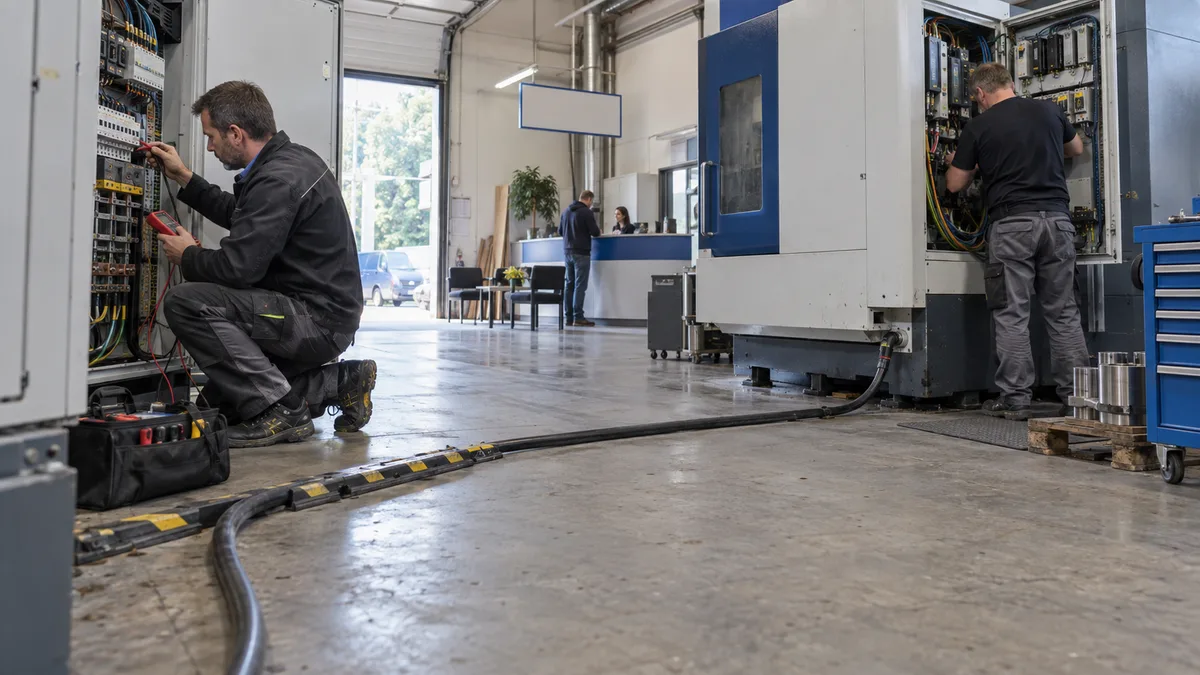
A machining centre stands in a production hall. An inspection technician arrives to carry out a periodic inspection, checks the switchboards, wiring and socket circuits, and issues a report—but stops at the machine itself. One contractor says the machine is not covered by the electrical inspection. Another includes it in the quotation as a separate item labelled “electrical inspections of machinery”. Yet both are talking about the same piece of equipment.
The difference is not a matter of opinion. It lies in a single sentence that few people read to the end in practice: § 3 odst. 2 písm. d) nařízení vlády č. 190/2022 Sb. The electrical equipment of machinery that is considered a product under the law on technical requirements for products is not designated electrical equipment. The power supply, switchboard and socket circuit from which the machine operates, however, remain designated electrical equipment.
A single machine is therefore subject to two different regimes, each producing a different document. We will explain where the regulation draws the boundary, what it means for each part of the machine, which documents should result from both processes, and where things most often go wrong in practice.
Two sentences that define the entire boundary
The list of designated electrical equipment begins in § 3 odst. 1 písm. a) nařízení vlády č. 190/2022 Sb. According to this provision, designated electrical equipment includes equipment for the generation, conversion, transmission, distribution and consumption of electrical energy, as well as electrical installations in buildings and technologies. This covers the equipment a company has in its production hall: transformation and distribution systems, cable routes, switchboards, outlets and socket circuits.
The second paragraph of the same section then expressly excludes certain items from the category of designated equipment. Under písm. d), designated electrical equipment does not include electrical equipment of machinery that is considered a product under another legal regulation. The footnote to this provision refers to zákon č. 22/1997 Sb., o technických požadavcích na výrobky.
In other words, if a machine has been placed on the market as a product, its electrical equipment forms part of that product. It is not assessed again as the operator’s designated electrical equipment. This does not mean that it escapes oversight—it is simply governed by a different regulation, different documentation and a different type of record.
The same paragraph contains two further exemptions that are commonly confused in relation to machinery. Under písm. a), hand-held electromechanical tools, electronic devices and electrical appliances with voltages up to and including 400 V are not designated equipment unless they are intended for permanent connection to the mains. Under písm. b), neither are extension leads and detachable power cords.
What this means for each part of a machine
| Part of the operation | Designated electrical equipment? | Legal basis | Applicable regime and resulting documentation |
|---|---|---|---|
| The switchboard, cable route, disconnecting device and socket circuit from which the machine operates | Yes | § 3 odst. 1 písm. a) NV č. 190/2022 Sb. | Inspection of designated electrical equipment, with intervals under příloha č. 4 k NV č. 190/2022 Sb.; the output is an inspection report |
| Electrical equipment of machinery that is a product under zák. č. 22/1997 Sb. | No | § 3 odst. 2 písm. d) NV č. 190/2022 Sb. | Regime under NV č. 378/2001 Sb.: a pre-commissioning check in accordance with the manufacturer’s accompanying documentation (§ 4 odst. 1), followed by subsequent checks (§ 4 odst. 2); the output is a record in the operating documentation |
| Hand-held electromechanical tools, electronic devices and electrical appliances with voltages up to and including 400 V, unless intended for permanent connection to the mains | No | § 3 odst. 2 písm. a) NV č. 190/2022 Sb. | Outside the designated-equipment regime; as devices and tools, they remain within the scope of NV č. 378/2001 Sb. |
| Extension leads and detachable power cords | No | § 3 odst. 2 písm. b) NV č. 190/2022 Sb. | The same applies—they are excluded from the list of designated equipment, but not from operational care |
The physical boundary between the first and second rows is determined by the design and documentation of the specific installation, not by a universal rule. It is important to define this boundary before the technician arrives; otherwise, something may either be measured twice or, worse, not measured at all. We discuss the specifics of inspections on the production-hall side in our article on electrical inspections in industrial buildings.
What a machine needs instead of a designated-equipment inspection
This is where the second misconception, mirroring the first, tends to arise: “The machine is a product, so we do not need to deal with its electrical equipment.” NV č. 378/2001 Sb. says otherwise.
Under § 4 odst. 1, an equipment safety check must be carried out before commissioning in accordance with the manufacturer’s accompanying documentation. If the manufacturer is unknown or the accompanying documentation is unavailable, the employer must define the scope of the check in a local operational safety regulation. The order is therefore clear: consult the manual first and only use the company’s own regulation if the manual is unavailable.
Under § 4 odst. 2, the equipment must have operating documentation and a subsequent check must be carried out at least once every 12 months, to the extent specified in the local operational safety regulation—unless a special legal regulation, the accompanying documentation or standardised values specify a different scope or frequency. Under § 4 odst. 3, the operating documentation must be retained throughout the equipment’s operating life.
The most important sentence concerning the electrical side of the machine, however, appears in the definitions. Under § 2 písm. e), the accompanying documentation includes the manufacturer’s instructions for assembly, handling, repairs, maintenance, initial and subsequent periodic checks and inspections of the equipment. The term “inspection” may therefore appear in relation to a machine—but its basis is not the regulation governing designated electrical equipment. It is the manual issued by the machine’s manufacturer. If the manufacturer specifies the scope and frequency of checks on the electrical equipment, that is the applicable requirement: § 4 odst. 2 expressly gives precedence to it.
The practical procedure is unexciting, but it works: find the manual, identify what the manufacturer requires for the electrical equipment and how often, and address anything else in a local regulation.
We have covered the entire regime of subsequent checks under NV č. 378/2001 Sb.—the interval, scope, local operational safety regulation and what the labour inspectorate examines in relation to machinery—in a separate article: NV 378/2001 Sb.: machinery checks at least once every 12 months. This article focuses on the electrical side and the boundary between a product and designated equipment.
Why the exemption is not a way out of both regimes
Under § 1, NV č. 378/2001 Sb. applies unless the requirements for the safe operation and use of equipment are provided for differently by a special legal regulation. Companies sometimes interpret this reservation as a way to avoid the twelve-month check: after all, a machine contains electrical equipment, which is covered by an inspection.
That reasoning does not work for the electrical equipment of machinery covered by the exemption in § 3 odst. 2 písm. d). The designated-electrical-equipment regime does not apply to it, so there is nothing that would replace the requirements of NV č. 378/2001 Sb. An exemption from one regulation is not an exemption from all regulations.
The reverse is equally important: an inspection of the power supply and switchboard does not replace a check of the machine, and a check of the machine does not replace an inspection of its power supply. These are two documents covering two different things.
One more sentence is worth remembering when drafting your own regulation. Under § 2 písm. a) NV č. 378/2001 Sb., the use of equipment also includes repairs, adjustments, handling, modifications, maintenance and cleaning throughout its operating life. The safety regime therefore does not end with the production shift: machine setters, maintenance technicians and anyone cleaning the machine are equally covered.
Which documents should result from both processes
An inspection report is produced after the designated part has been inspected. We explain what it should contain and how it is subsequently used during checks and insurance claims in Electrical inspections in companies: when they are mandatory, how often they are required and what an inspection report contains.
On the machine side, there must be operating documentation under § 4 odst. 2, supplemented by a record of the pre-commissioning check under § 4 odst. 1 and records of subsequent checks. It must be retained throughout the equipment’s operating life (§ 4 odst. 3). We describe the broader context of electrical-equipment documentation and what an inspection technician expects to see in our article on operating documentation for electrical equipment.
The three documents or definitions most commonly missing for machinery in practice are:
- The manufacturer’s instructions for the electrical equipment. Without them, § 4 odst. 1 transfers responsibility for defining the scope of the check to the employer. For a machine that has passed through three owners, this is common rather than exceptional.
- A record of the pre-commissioning check. This is the hardest document to reconstruct retrospectively because no one asked for it when the machine was installed.
- A definition of where the installation inspection ends and the machine begins. There is no prescribed form for this definition, but without it there is no way to tell whether everything is covered.
Common mistakes that cause problems
- The production hall’s inspection report is treated as documentation for the machines as well. Under § 3 odst. 2 písm. d) NV č. 190/2022 Sb., the machine’s electrical equipment is not—and need not be—included in that report. This does not exempt it from checks under NV č. 378/2001 Sb.
- The opposite assumption: the machine is a product, so nothing needs to be done. § 4 NV č. 378/2001 Sb. still applies, while § 2 písm. e) refers to the checks and inspections prescribed by the manufacturer.
- The power supply is overlooked. The company has the machine checked, but the cable route, disconnecting device and socket from which it operates are not included in any inspection report. Yet these are designated equipment under § 3 odst. 1 písm. a).
- Hand tools and extension leads are grouped under “machinery inspections”. § 3 odst. 2 písm. a) and b) excludes them from the list of designated equipment, but as devices and tools they remain subject to care under NV č. 378/2001 Sb. Our article on inspections of appliances, equipment and tools explains how companies should approach them.
- Checks are designed only around production operations. Under § 2 písm. a), use also includes adjustment, maintenance and cleaning. If the local regulation fails to address these activities, it omits precisely the situations in which people most often reach behind a machine guard.
- The quotation does not identify the applicable regulation. An item labelled “machinery inspection” without the number of the regulation and the relevant section does not explain what is being purchased. Two contractors will often understand it to mean two different types of work.
How to commission the work without overlaps or gaps
Before sending out an enquiry, you only need to answer four questions for each machine:
- Is the machine a product under zákon č. 22/1997 Sb.—in other words, do we have documents showing that it was placed on the market as a product, and do we have its manual?
- What does the manual prescribe for the electrical equipment (§ 2 písm. e) and § 4 odst. 1 NV č. 378/2001 Sb.)?
- Where is the boundary with the building installation, and is there anything at that boundary that falls under § 3 odst. 1 písm. a) NV č. 190/2022 Sb.?
- Who will record the check, and where, so that the operating documentation required under § 4 odst. 2 and 3 actually exists and can be found?
Each item in the quotation should then state the regulation under which the work will be performed. An inspection of designated electrical equipment under NV č. 190/2022 Sb. is one service; a check under § 4 NV č. 378/2001 Sb. is another.
Frequently asked questions
Does a production machine require an electrical inspection?
The electrical equipment of machinery considered a product under zákon č. 22/1997 Sb. is not designated electrical equipment, as follows from § 3 odst. 2 písm. d) NV č. 190/2022 Sb. The inspection regime for designated electrical equipment therefore does not apply to it. Checks under § 4 NV č. 378/2001 Sb. and the requirements prescribed by the manufacturer in the accompanying documentation still apply.
Does that mean no one checks the machine’s electrical equipment?
No. Under § 4 odst. 1 NV č. 378/2001 Sb., a pre-commissioning check must be carried out in accordance with the manufacturer’s accompanying documentation. Under § 4 odst. 2, a subsequent check must be carried out at least once every 12 months unless a special regulation, the accompanying documentation or standardised values specify otherwise.
Are the socket and switchboard supplying the machine included in the inspection?
Yes. The exemption for machinery does not apply to them. Equipment for the distribution and consumption of electrical energy, as well as electrical installations in buildings and technologies, is designated electrical equipment under § 3 odst. 1 písm. a) NV č. 190/2022 Sb.
What about hand tools and extension leads?
Hand-held electromechanical tools, electronic devices and electrical appliances with voltages up to and including 400 V are not designated electrical equipment unless intended for permanent connection to the mains. The same applies to extension leads and detachable power cords—§ 3 odst. 2 písm. a) and b) NV č. 190/2022 Sb. As devices and tools, however, they remain within the scope of NV č. 378/2001 Sb.
What if we do not have the machine’s manual?
§ 4 odst. 1 NV č. 378/2001 Sb. expressly addresses this situation: if the manufacturer is unknown or the accompanying documentation is unavailable, the employer must define the scope of the check in a local operational safety regulation. A missing manual therefore does not remove the obligation; it merely transfers responsibility for defining the scope to the company.
How long must the machine documentation be retained?
Under § 4 odst. 3 NV č. 378/2001 Sb., the operating documentation must be retained throughout the equipment’s operating life.
Sources for this article
- Electrical inspections – a SOHE service.
- NV 378/2001 Sb.: machinery checks at least once every 12 months – the full regime governing subsequent machinery checks, their scope, the local operational safety regulation and the labour inspectorate’s perspective.
- Electrical inspections in industrial buildings – what is measured on the installation side in a production hall and how to prepare for a shutdown.
- Electrical inspections in companies: when they are mandatory, how often they are required and what an inspection report contains – the contents of an inspection report for the designated part.
- Operating documentation for electrical equipment – which electrical-equipment documents a company must keep and what an inspection technician expects to see.
- Inspections of electrical appliances: how often to check equipment, tools and extension leads – the regime governing hand tools and detachable power cords.
- Nařízení vlády č. 190/2022 Sb. – on designated electrical equipment and requirements for ensuring its safety; § 3 odst. 1 písm. a) lists designated equipment, § 3 odst. 2 písm. a), b) and d) sets out exemptions, and příloha č. 4 specifies periodic inspection intervals. Wording effective from 1 July 2024.
- Nařízení vlády č. 378/2001 Sb. – detailed requirements for the safe operation and use of machinery, technical equipment, devices and tools; § 1 defines its scope, § 2 písm. a) and e) define use and accompanying documentation, and § 4 odst. 1 až 3 covers pre-commissioning checks, subsequent checks and the retention of operating documentation.
- Zákon č. 22/1997 Sb. – on technical requirements for products; the regulation referenced in the footnote to the exemption in § 3 odst. 2 písm. d) NV č. 190/2022 Sb.
- Zákon č. 250/2021 Sb. – on occupational safety in connection with the operation of designated technical equipment; the law implemented by NV č. 190/2022 Sb. Wording effective from 1 November 2025.
- Nařízení vlády č. 194/2022 Sb. – on professional competence to perform work on electrical equipment and professional competence in electrical engineering. Wording effective from 1 July 2024.
This article is for information only and does not constitute legal advice. The specific inspection and checking regime for individual machines must be determined according to the actual operation, the manufacturer’s documentation, the operating environment and the risk assessment.
Not sure where the electrical-installation inspection ends and the regime under NV č. 378/2001 Sb. begins for your machinery? We will review your machinery, define the boundary with the building installation and set up records so that the operating documentation is generated as part of the process. Contact us at info@sohe.cz or send a non-binding enquiry—an approximate list of machines and information about which manuals you have will be enough. Alongside electrical inspections, the same review can also address occupational health and safety for companies.