
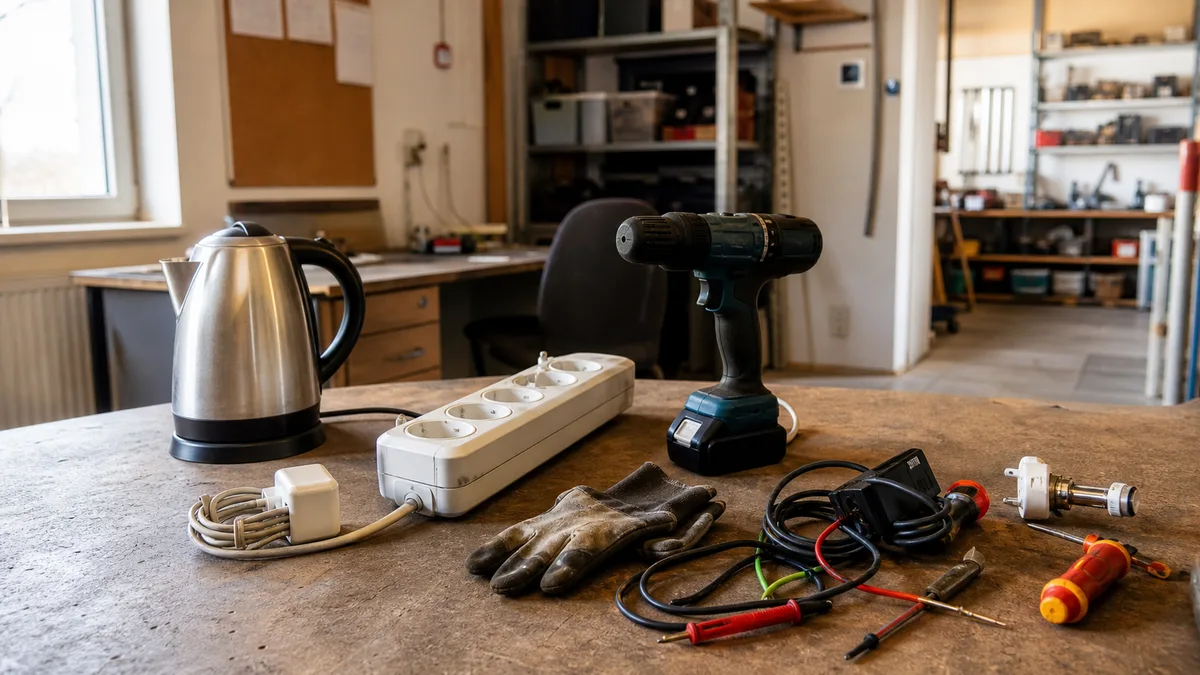
The moment you plug a kettle, a laptop charger, or an extension cord into a company socket, an ordinary item becomes an electrical appliance with all that entails. The question is no longer whether it works, but whether it is in a condition that poses no risk—and how often this needs to be verified.
The answer to “how often” is not determined by the purchase date or a single figure from the manufacturer. The interval is based on the environment in which the appliance is used and on the type of equipment. A laptop in a clean office is assessed differently than a drill on a construction site or an extension cord moving between various operations.
When an Ordinary Item Becomes an Electrical Appliance
The determining factor is the method of use, not the price tag. As soon as a device is connected to a socket via a flexible cord, can be carried, disconnected, and reconnected, and is used in a company’s operation, it falls under the category of electrical appliances that must be maintained, checked, and tested—regardless of ownership.
The legal framework is general, and you will not find a specific interval for a kettle in it. According to Sections 101 and 102 of the Labour Code, employers are obliged to ensure occupational safety and health protection and to prevent risks. More specifically, Section 4 of Act No. 309/2006 Coll., as amended, mandates that machinery, technical equipment, and tools are regularly maintained, checked, and tested. How to do this for appliances is described in the technical standard ČSN 33 1600 ed. 2 (as amended by Z2). The standards themselves are not generally binding, but they represent a recognized procedure by which the fulfillment of legal obligations is assessed.
Oversight of compliance is carried out by the regional labour inspectorate according to Act No. 251/2005 Coll., which can impose a fine for identified deficiencies. A specific overview of intervals and possible sanctions is detailed in the article Inspection and Testing of Electrical Appliances and Tools in a Company: Intervals and Fines; the connection between missing tests and a potential reduction in insurance payouts is covered in the article Missing Inspections and Your Insurance Company.
Appliance or Not? The Method of Use is Decisive
The most common reason why testing is missing somewhere is incorrect classification. People focus on the type of device, whereas the method and location of its use are what matter. A few typical disputed cases can help.
| Item | Is it a testable appliance? |
|---|---|
| Kettle in a kitchenette | Yes, it is part of the company’s operation. |
| Company monitor with an external adapter | Yes, including the power adapter. |
| Angle grinder in a workshop | Yes, the high-risk environment only underscores this. |
| Extension cord on a construction site | Yes, and shorter intervals apply. |
| Employee’s own laptop from home office | Not in their home; a different situation arises if it is regularly brought and plugged in at the workplace. |
| Coffee machine hardwired via a terminal block | Falls under electrical installation testing rather than appliance testing. |
The common denominator is simple: an appliance has a flexible cord and is intended for repeated use. As soon as it can be carried and reconnected, it makes sense to log and check it.
How Often: Indicative Intervals by Environment
The frequency is not determined by the manufacturer, but by classification according to the ČSN 33 1600 ed. 2 standard, in conjunction with a risk assessment at the specific workplace. The standard divides appliances into groups based on environment—from administrative and public spaces, through internal workshops and production, to outdoor construction sites—and within each group, it distinguishes between hand-held, portable, and fixed appliances, along with their protection class. Hand-held tools and portable leads have shorter intervals than equipment sitting on a desk; however, the specific interval stems from this classification, not from the type of appliance itself.
It is crucial not to confuse two activities with different scopes and frequencies:
- Inspection (visual check and functional test) is the more frequent one. It is usually carried out by the instructed user before using the appliance, and for high-risk tools, even before each shift. It does not run on a fixed, long interval—it is repeated the more often, the more demanding the operation.
- Testing (visual check, measurement, and functional test with documented results) is the less frequent one. It is carried out by a specialist at regular intervals defined by the appliance’s classification under the standard; for equipment in a dry office, they are the longest, while for tools and leads on a construction site, they are the shortest.
The following overview therefore does not provide a single universal number but shows how both activities change according to the environment and type of equipment—from the mildest to the strictest regime:
| Environment and Type of Equipment | Inspection (Instructed User) | Periodic Testing (Technician with Measurement) |
|---|---|---|
| IT and office equipment (PCs, monitors, printers) in a dry office | Ongoing, visually | Longest intervals |
| Shared kitchen appliances (kettle, coffee machine) | Ongoing, visually | Longer intervals |
| Extension cords, socket strips, and reels in an office | Before use | Shorter than for desk equipment |
| Hand-held power tools and extension cords in a workshop and production | Before each use | Significantly shorter intervals |
| Hand-held tools and portable supply units on a construction site | Before each use and shift | Shortest intervals in the entire standard |
Take this overview as indicative—it shows the order, not exact numbers. The specific interval is determined by the standard’s classification (environment group × appliance type × protection class) and a documented risk assessment, which can shorten or reasonably lengthen it; the numerical intervals for individual groups are detailed in the article Inspection and Testing of Electrical Appliances and Tools in a Company: Intervals and Fines. Furthermore, the interval is counted from the last testing or inspection, not from the purchase date. For newly acquired equipment, it is therefore sufficient to set the first date immediately upon putting it into service and to record it in the registry—this topic is explored further in the article Testing New Computers and Office Equipment.
A shorter interval is mainly required by:
- dusty, humid, or chemically aggressive environments,
- frequent mechanical stress, carrying, and coiling of cables,
- high frequency of use and operation in one or more shifts,
- poor results from previous tests.
Conversely, a lower frequency of use does not, on its own, extend the interval—a longer interval is only appropriate based on the aforementioned written risk assessment.
What a Technician Checks During Testing
“Testing” sounds complex, but for appliances, the procedure is standardized and consists of three steps.
Visual inspection. The integrity of the casing, the condition of the plug and the supply cord, securing and strain relief, legibility of labels, and the absence of burn marks or unprofessional interventions are checked. For extension cords, the entire cable length, the condition of sockets, and the reel are examined.
Measurement. The instrumental part includes, depending on the protection class, mainly the protective conductor resistance, insulation resistance, and leakage (touch) current. For extension cords, the continuity of all conductors and the integrity of the insulation are verified.
Functional test. It is verified that the appliance operates without unusual noises, smells, or sparking.
The result is a record with a verdict of “pass” or “fail.” For a failing item, the technician states the reason, labels the device, and recommends repair or disposal.
Three Groups That Cause the Most Chaos
Extension Cords and Socket Strips
Small companies have dozens of them, and they often go unchecked entirely—no one realizes it is a separate appliance with its own identification number and deadline. Typical defects: cut insulation near the plug, a loose or broken pin, an overheated reel operated while coiled under full load, and daisy-chaining multiple strips together.
Office Equipment
Computers, laptops, monitors, and printers are usually the largest group volume-wise, and a longer interval generally suffices for them in a dry office. Be careful with devices using an external adapter—they are tested with it. A special chapter involves employees’ private devices: if the company allows or requires their use in the workplace, it is advisable to handle them for safety purposes similarly to company equipment and to enshrine the rules in an internal regulation.
Hand-held Tools in Workshops and on Construction Sites
Shorter intervals for hand-held tools stem from the increased risk—the tools are mechanically stressed, exposed to dust and moisture, and handled in confined conditions. The standard also expects that the user will perform a visual inspection before use; this does not replace periodic testing. On construction sites, checking by the H&S coordinator or the client is common, and missing documentation on tool and extension cord tests can, in practice, lead to a ban on their use on site.
Records That Stand Up to an Inspection
A completed test is only half the job. The other half is keeping auditable records from which deadline compliance can be managed. A useful record usually contains:
- an identification number matching the label on the appliance,
- the name and type, possibly the serial number,
- the date of the last test or inspection and the scheduled next date,
- the result (pass / fail),
- who created the record.
The format is not prescribed—a spreadsheet, database, or specialized software suffices; accessibility during an inspection is what matters. In practice, it is advisable to physically go through the appliances once a year and compare the list with reality: add new items and remove discarded ones. The topic of record-keeping and its setup is discussed in detail in the article Managing Records of Inspections and Appliances in a Company.
What to Do with an Appliance That Fails
An appliance with a “fail” result must be taken out of service—not stored in a cupboard “for later” or used “carefully.” It is worth physically separating it from functional devices and clearly marking it so no one accidentally plugs it in again.
From there, there are essentially two paths. If repair is technically and economically reasonable, the appliance is repaired and retested. If not, it should be disposed of in an environmentally sound manner; passing on a failing item, i.e., donating or selling it without repair and a new test, is not appropriate. For extension cords, repair is often not cost-effective, and a new piece costs less than a technician’s time. Any intervention in the electrical part, such as replacing a plug, should be left to a person with the appropriate electrical qualification.
Who Performs the Testing and How It Relates to Installation Inspections
Testing and inspections of electrical appliances are performed by a person with professional competence in electrical engineering, as defined by Government Regulation No. 194/2022 Coll.; the required level follows from the standard and the nature of the activity. In practice, this is handled by a test technician or an external specialist company, or by a trained person for simpler inspections.
It is important to distinguish appliance testing from the inspection of the electrical installation. Appliance testing concerns equipment connected via a flexible cord, while an electrical installation inspection concerns fixed wiring, sockets, distribution boards, and lighting circuits. These are two separate obligations with different intervals—a coffee machine plugged into a socket is covered by appliance testing, while the same coffee machine hardwired via a terminal block falls under installation inspection.
In summary: office equipment in a dry environment generally requires a longer interval; hand-held tools and extension cords in a workshop and on a construction site need checking significantly more often. However, precise intervals do not rely on a single number found online—they are based on classification according to ČSN 33 1600 ed. 2 and a risk assessment at the specific workplace.
What the Article Is Based On
- Appliance and Tool Testing – SOHE service.
- Inspection and Testing of Electrical Appliances and Tools in a Company: Intervals and Fines – related overview of intervals and operational groups.
- Managing Records of Inspections and Appliances in a Company – how to maintain a list, labels, and deadlines.
- Act No. 251/2005 Coll. on labour inspection.
- Act No. 309/2006 Coll. on ensuring further OSH conditions, as amended (most recently by amendment No. 318/2025 Coll.).
- Government Regulation No. 194/2022 Coll. on professional competence in electrical engineering.
- ČSN 33 1600 ed. 2, as amended by Z2 (2021) – inspection and testing of electrical appliances during use (without link, standard not freely available).
The text is for informational purposes and does not replace legal advice. The specific regime for records, inspections, and tests must be set up according to the actual operation, manufacturer’s documentation, usage environment, and risk assessment.
Do you want to have your testing intervals, labels, and appliance records in order without managing it yourself? We provide appliance and tool testing, including deadline settings. Send us a no-obligation inquiry or write to info@sohe.cz.