
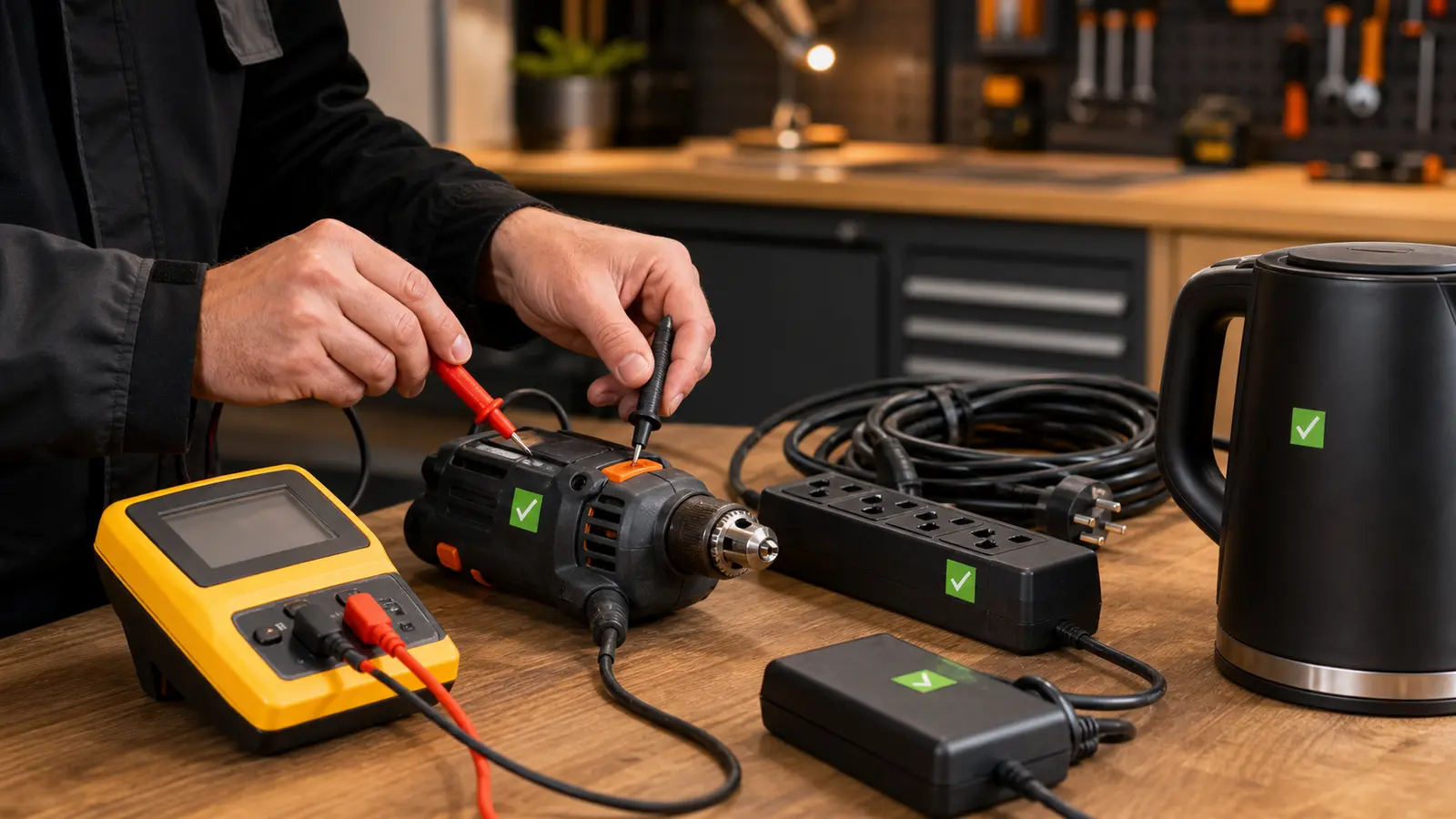
The obligation to ensure the safe condition of electrical appliances and tools doesn’t just apply to production halls full of machinery. It applies to every employer, including you, if you run a purely office-based company, a warehouse, a school, or a restaurant. The Labour Code is clear: the employer must ensure occupational health & safety (OHS). And that includes periodic inspections of everything that plugs into a socket. Let’s break it down without unnecessary theory, in a practical way, with the terms and numbers you need to know.
Who the Obligation Applies To
Every employer who provides electrical equipment to their people or allows them to use their own is legally responsible for its safe condition. There’s no escape. Even if you only have a few laptops, a printer, a kettle, and an extension cord in the meeting room, it’s your turn. The general obligation to ensure occupational health & safety (OHS) is imposed by the Labour Code (§ 101 of Act No. 262/2006 Coll.). For machinery and equipment, Act No. 309/2006 Coll., § 4, explicitly requires them to be “regularly and properly maintained, checked, and inspected.”
Government Regulation No. 378/2001 Coll., § 4, then requires a follow-up check of operated equipment at least once every 12 months, unless a special regulation, manufacturer’s documentation, or technical standard specifies otherwise. And for electrical appliances, the intervals from the standard ČSN 33 1600 ed. 2 apply. These are sometimes longer, and other times significantly shorter than those 12 months. On a construction site, you can expect an inspection as often as every three months.
What is an Appliance vs. a Tool and Usage Groups
The standard divides appliances according to the environment in which they operate. It’s not complicated. Groups A to E describe the risk level of operation, from the most demanding conditions on a construction site to a quiet office.
Group A concerns appliances provided through rental to another operator or user. Typically tool rental companies, leased machines. They are tested before each release to the customer and then according to the environment where the lessee uses the equipment.
Group B includes appliances in outdoor spaces. Construction sites, demolitions, agriculture. The most demanding category with the shortest inspection intervals. A concrete mixer, angle grinder on a construction site, or a cut-off saw in the yard – everything that works outdoors belongs here.
Group C covers appliances used in industrial and craft activities in indoor spaces. Workshops, production, warehouses. A drill, table saw, compressor. The environment is covered, but the work is often demanding.
Group D covers publicly accessible spaces. Schools, hotels, restaurants, internet cafés. The public moves around here, so the risk is higher than in a standard office.
Group E is administration. Offices, the least risky environment and the longest inspection intervals. A laptop, monitor, charger, kettle in the kitchenette.
One important change in terminology: Edition 2 of the standard abolished the old 18 kg limit, so it no longer matters whether an appliance is portable or non-portable. Instead, the standard divides non-fixed appliances into two categories. “Hand-held” (this includes hand-held power tools and also all extension and detachable leads) and “other non-fixed, i.e., portable appliances.” The standard does not address anything permanently connected to the installation at all. That’s where the electrical installation inspection according to ČSN 33 2000-6 comes in, which is a separate service.
Inspection Interval Table
Since the Z2 amendment of 2021, an important adjustment applies. The original inspection intervals from Edition 2 are now used as intervals for repeat tests. A repeat inspection takes place at a fourfold interval, meaning after three repeat tests within a given interval, one repeat inspection follows. An inspection can replace a test, and many companies do this in practice: they maintain a shorter cadence and directly order inspections. One thing follows from this for you. Every appliance must undergo a control measurement within the interval from the table, whether in the form of a test or an inspection.
The values are repeat test intervals in months. A repeat inspection equals four times this value.
| Group (where used) | Protection Class | Hand-held, hand-held tool, extension cord | Other (portable) appliance |
|---|---|---|---|
| A – rental | — | Before release to user, then according to the group where used | According to group |
| B – outdoors, construction sites | I | 3 months | 6 months |
| B – outdoors, construction sites | II and III | 6 months | 6 months |
| C – workshops, production, warehouses | I | 6 months | 24 months |
| C – workshops, production, warehouses | II and III | 12 months | 24 months |
| D – schools, hotels, public spaces | I, II, III | 12 months | 24 months |
| E – offices, administration | I, II, III | 12 months | 24 months |
Protection Class I means an appliance with a protective earth pin, i.e., with grounding. Class II has double insulation and is recognizable by the symbol of two squares inside each other; the earth pin is missing. Class III operates with safe extra-low voltage.
A few examples for practical application. A laptop, charger, or kettle in an office falls into Group E and is mostly Class II, so a test is sufficient once every 24 months. A drill in a workshop is Group C, hand-held, and depending on the protection class, it requires a test every 6 to 12 months. A concrete mixer or angle grinder on a construction site belongs to Group B with an interval of 3 to 6 months. For extension and detachable leads, the same intervals apply as for hand-held appliances. Therefore, you inspect an extension cord on a construction site as often as a drill.
How an Inspection is Conducted
An inspection may be performed by a qualified person according to Government Regulation No. 194/2022 Coll., i.e., an electrician (§ 6), a lead electrician (§ 7), or a certified electrical inspector (§ 8). For appliances, a certified electrical inspector is not a requirement. Since July 2022, portable appliances, hand-held tools, and extension leads up to 400 V inclusive, if not intended for fixed connection to the network, are not classified as designated technical equipment (GR No. 190/2022 Coll., § 3, para. 2). The fixed electrical installation remains designated technical equipment, and its regime is stricter.
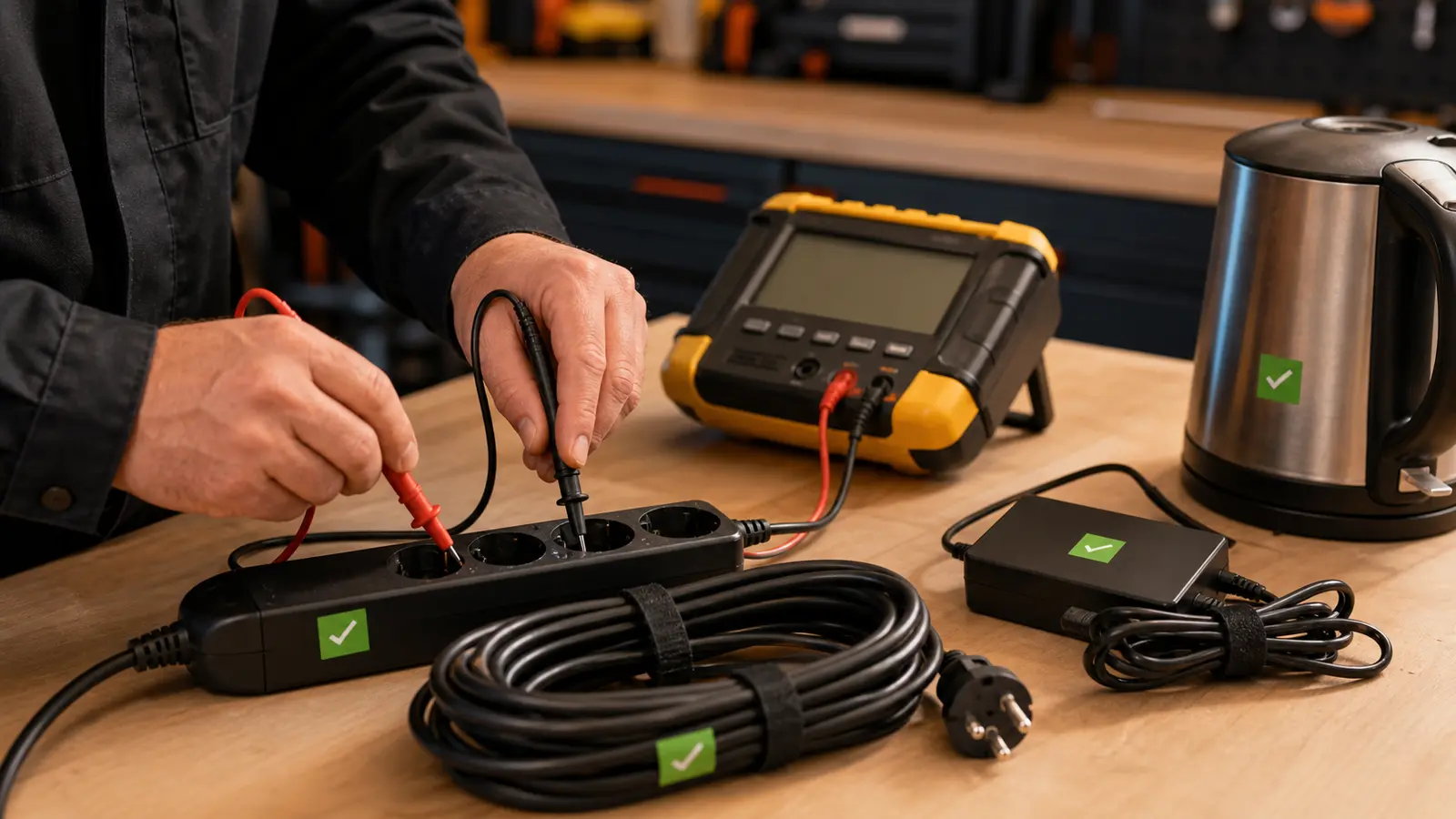
The inspection itself has five steps. It begins with a thorough visual check: checking for damage to covers, plugs, supply cables, insulation, ventilation openings, and the legibility of markings. This is followed by measurement, specifically protective conductor resistance for Class I, insulation resistance, and leakage or touch current. Then comes a functional test. The certified electrical inspector checks or supplements the identification label with the date of the next inspection and finally issues a report.
The inspection report contains the appliance identification (serial or inventory number), date, results of the visual check and measurements, instruments used, evaluation, proposed interval for the next inspection, and the name and signature of the inspector. You can also keep it electronically. A non-compliant appliance is immediately taken out of service, visibly marked, and returned to operation only after a repair substantiated by an inspection.
Don’t confuse an inspection with a check. A check is just a visual examination and functional test performed by an instructed user before use, without measurement. An inspection is a professional act with measuring instruments and a report.
5 Most Common Company Mistakes
1. “New = not needed.” For a new appliance, an inspection before first use is indeed not necessary. But the interval for the first periodic test or inspection starts from the date of commissioning. Even a brand new drill needs an inspection after a few months. The time is counted from the day you first plug it in.
2. Forgotten extension cords, splitters, and chargers. The company has machines inspected exemplarily, but extension cables, splitters, and chargers lie in a drawer without records. Yet it is precisely these small items that often cause an injury or fire. They belong in the inspection regime just like large machines.
3. Employees’ private appliances in the workplace. A personal kettle, fan, mobile phone charger, under-desk heater. If an employee uses them at work, you bear the responsibility for their safe condition. The argument that “it’s his” will not stand up during an audit. Either ban private appliances in the workplace or include them in the inspections.
4. Confusing intervals. The “once every 5 years” interval applies to the electrical installation according to ČSN 33 1500, not to appliances. For appliances, intervals are counted in months, i.e., 3, 6, 12, 24. A five-year interval for appliances will not pass an audit. More about installation intervals can be found in the article on electrical installation inspection intervals according to ČSN 33 1500.
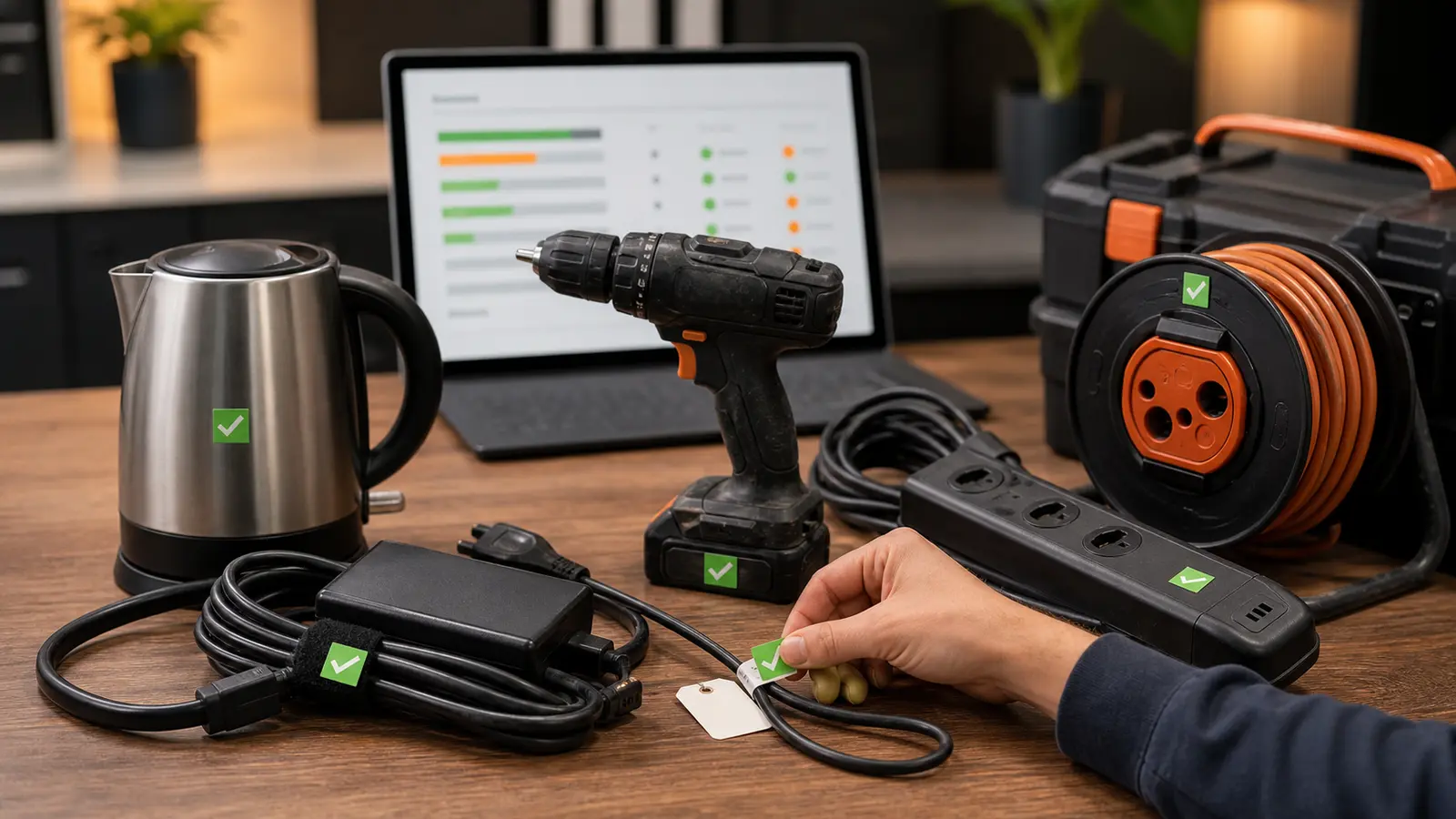
5. Missing records and labels. Without a list of appliances and without labels showing the next inspection date, you cannot prove during an audit that you are monitoring the intervals. Records are just as important as the measurement itself.
What’s at Risk: Audit, Fines, Insurance
Compliance with intervals is checked by the State Labour Inspection Office. An inspector arrives, looks at the records, checks the labels on the appliances. If documentation is missing, they issue fines. For failing to ensure occupational health & safety (OHS), a company faces a fine of up to CZK 2,000,000 according to Act No. 251/2005 Coll., on Labour Inspection.
The second blow is less visible but often worse. If a fire or injury occurs and you do not have inspection reports, the insurance company may reduce the insurance payout or outright refuse it. In the case of a workplace injury, there is a risk of it being classified as gross negligence by the employer, and part of the damages then falls on you personally. That is no longer a fine from the inspectorate, but an amount that can bring a company down.
Frequently Asked Questions
How often should extension cables be inspected?
For extension and detachable leads, the same intervals apply as for hand-held appliances. In an office, once every 12 months; in a workshop, depending on the protection class, 6 to 12 months; on a construction site, 3 to 6 months.
Do I have to inspect laptops and chargers in the office?
Yes. They fall into Group E and mostly into Protection Class II, so a test is sufficient once every 24 months. The obligation applies even if it’s just a single laptop.
Who can perform appliance (PAT) testing?
An electrician (§ 6 GR No. 194/2022 Coll.), a lead electrician (§ 7), or a certified electrical inspector (§ 8). For appliances, a certified electrical inspector is not a requirement. Since July 2022, portable appliances are not designated technical equipment, so an electrician is sufficient.
What if I have appliances on rent or lease?
If you provide them to other users, you are in Group A and they are tested before each release. If, on the contrary, you use them as a lessee for your own operation, you are responsible for their safe condition as the employer. The contract with the lessor alone does not solve this for you.
What is the difference between an inspection and a check?
A check is a quick visual examination and functional test performed by an instructed user before use, without measurement. An inspection includes a visual check, measurement with instruments, a functional test, labelling, and issuing a report. It is performed by a professional.
Leave Interval Monitoring and Records to Us
Appliance (PAT) testing is not a one-off event but a regular process. Intervals vary according to the environment, protection class, and type of appliance. Records must be maintained, labels checked, and deadlines monitored. If you don’t want to handle this yourself, get in touch with us.
We will arrange complete appliance and tool testing, from visual checks through measurement to records. The price ranges from CZK 80 to 140 per item, and we offer a volume discount for larger quantities. We maintain records and monitor deadlines for you. As a single supplier, we ensure inspections for electrical systems, lightning protection systems (LPS), appliances, and photovoltaic (PV) systems, plus fire safety and employee training. We operate nationwide (whole Czech Republic) and will give you a written price quote in advance.
Request a non-binding quote or email us directly at info@sohe.cz, or call +420 724 689 762.