
Appliance testing alone is not enough if the company lacks a usable record system. You need to know which appliances and extension leads are in operation, where they are used, when the last check or inspection took place, what the outcome was, and when the next one is due. Without this, an inspection becomes a one-off document that, within a few months, no one can link to the actual state of the workplace.
Good record-keeping is not complicated. It should be clear enough for an operations manager, facility manager, OHS technician, or external inspection provider to quickly find a specific item, determine its status, and decide what needs to happen next. This is important not only for inspections but primarily for day-to-day operations: new laptops, chargers, extension leads, hand tools, moves between workplaces, and repairs should be continuously reflected in the records.
What records should show at a minimum
Appliance inspection records should answer four questions at a glance:
- what exactly the company uses,
- where the specific item is used,
- when the last check, test, or inspection took place and with what result,
- when the next one is due.
If the list only contains an asset name and purchase date, it is an inventory, not an inspection record. For appliances and tools, the environment in which they are used is also essential. A monitor in an office, an extension lead in a warehouse, and an angle grinder taken to a construction site will each have a different regime. Inspection intervals vary according to the type of use, environment, protection class, and other conditions, so the records should be able to capture these differences.
A detailed overview of intervals and usage groups can be found in the article Appliance and tool inspection in a company: intervals and fines. This text focuses mainly on the practical side: how to get things in order.
What to include in the list of appliances and tools
The list should be maintained so that a specific appliance can be physically located. A line saying “laptops” or “extension leads” is not enough. Each significant item should have its own entry, especially if it moves between workplaces or has its own next inspection date.
In practice, the following items have proven useful:
| Record item | Why include it |
|---|---|
| Identification or inventory number | Uniquely links the list, label, and specific item. |
| Name, type, manufacturer, serial number | Helps with locating documentation, repair, or disposal. |
| Location or operation | Without this, the appliance is hard to find at the next inspection. |
| Usage environment | Office, workshop, warehouse, construction site, or public space can mean a different regime. |
| Protection class | If known, it influences assessment and intervals for some appliances. |
| Date added to records | Important for new purchases and inherited equipment. |
| Last check, test, or inspection | Shows history and document validity. |
| Result | Pass, fail, repaired, discarded. |
| Next due date | A specific date, not just a note saying “in a year”. |
| Person or provider | Who performed the task and where to find the document. |
| Note | Repair, relocation, lost label, disposal, change of operation. |
For a small office, such a list can start as a simple spreadsheet. For a company with multiple sites, a warehouse, a workshop, or construction sites, it becomes important for the records to be filterable by operation and due dates. Otherwise, an appliance can easily be moved but remain documented in its original environment.
Labels on appliances: useful, but not sufficient on their own
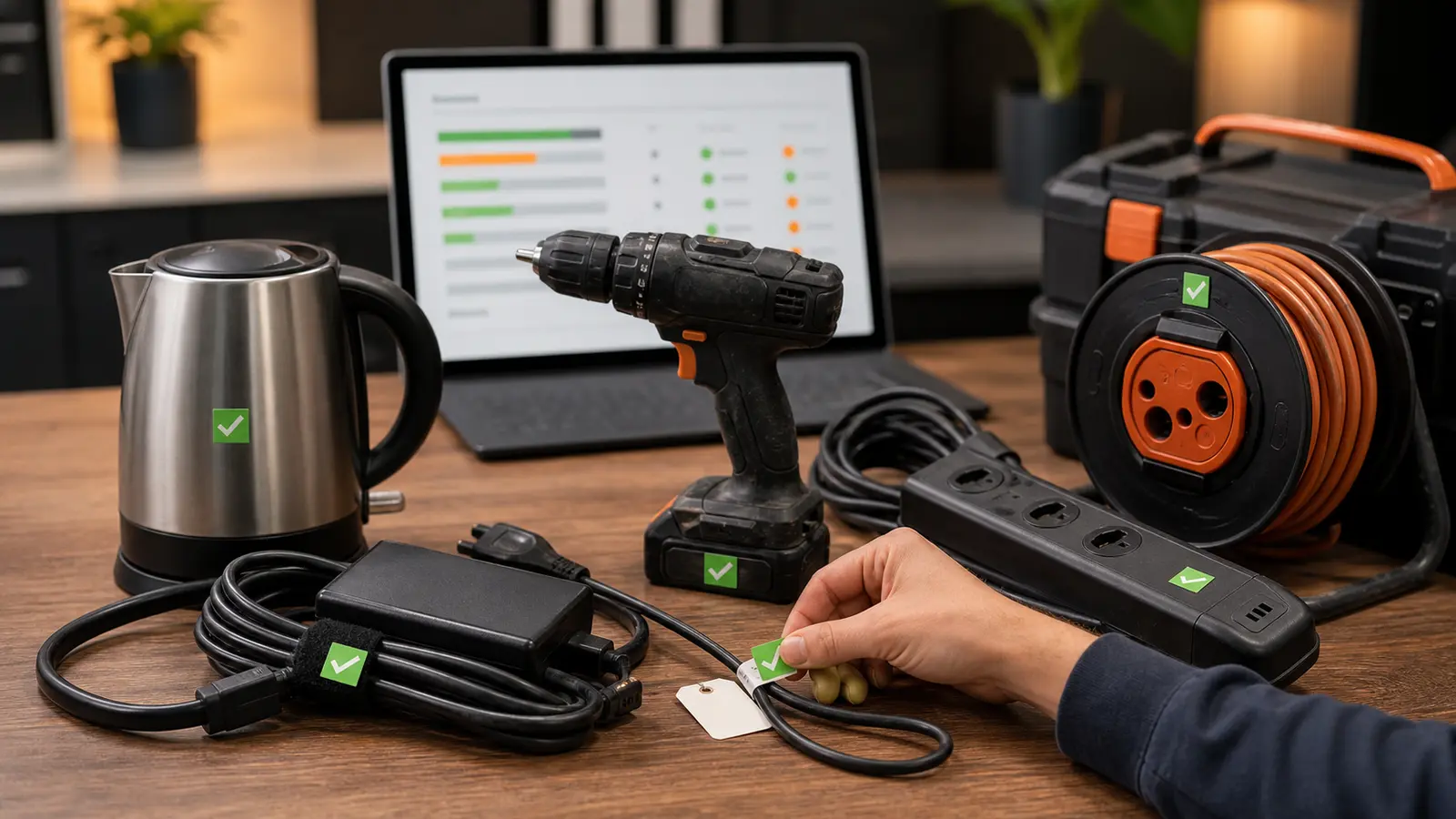
An inspection or check label is a practical tag directly on the appliance. It usually contains the identification number, date of check or inspection, next due date, and the designation of the person or company that performed the task. This allows an employee or site supervisor to quickly see that the item has been checked and whether its due date has passed.
However, a label does not replace the records. It can peel off, get damaged, covered, dirty, or remain on the appliance even after it is moved to a different environment. The primary record should be the entry in the list and the associated document. The label serves as a quick operational reference.
For small devices, marking needs to be handled practically. Chargers, adapters, extension leads, or small hand tools do not always have a suitable spot for a standard label. Smaller tags, labels near the plug, sleeves, labels on the lead, or an identification number linked to the description in the list are used. The important thing is that it is clear which record belongs to which item.
Who is responsible for tracking due dates
The employer is responsible for safe working conditions. However, the practical maintenance of records should be assigned to a specific role within the company. This is often the operations manager, facility manager, building manager, warehouse supervisor, OHS technician, or an external inspection provider.
It is important that the responsible person is aware of operational changes. Records should not be updated only once a year before an inspection. They should be updated whenever a change occurs:
- a new appliance or tool is purchased,
- an appliance is moved to another workplace,
- equipment is loaned to a construction site,
- an item returns from repair,
- equipment failed and should be removed from normal use,
- the method of use or risk level of the environment changes.
A new appliance does not mean “permanently resolved.” Even a new laptop, charger, extension lead, or drill should be entered into the records so it is clear when its operational history begins and when the next check should be scheduled based on the conditions of use.
Paper, Excel, or software
The format of the records depends on the size of the company. A paper list might suffice for a small establishment with a few pieces of equipment, but it quickly runs into problems with updating and history. Excel is usable for small and medium-sized companies if it has a clear owner and someone monitors backups, versions, and due dates.
For a larger company, it is worth considering a specialized system or external records management. The reason is not trendy software but operational reality: hundreds of items, multiple sites, moves between workplaces, repeated repairs, different intervals, and the need to quickly provide history.
Typical mistakes of manual record-keeping:
- a new item is purchased, but no one adds it to the list,
- when moved, neither the workplace nor the usage environment is updated,
- the spreadsheet only contains the last inspection date, but the next due date is missing,
- a failed appliance is in the list, but physically remains in operation,
- old versions of spreadsheets circulate among people, and it is unclear which one is valid,
- the label on the appliance does not match the record in the system.
Records should be a working tool, not an archive for an inspection. If no one uses them regularly, they quickly become outdated.
What to do with a failed appliance
A failed item should not remain in normal use. In practice, it should be visibly marked, taken out of service, and physically stored so that an employee cannot accidentally use it again. The records should clearly state when and why it failed and what happened next: repair, re-test, or disposal.
This is where records often fail. The certified electrical inspector states a fail result in the document, but the company does not complete the operational step. The appliance stays plugged in, the label is overlooked, and a few weeks later, no one knows if it was repaired. Therefore, a “fail” result should be linked to a specific action and a responsible person.
How SOHE approaches it
When we handle appliance and tool testing for a company, record-keeping is not an afterthought. It is part of the work from the beginning.
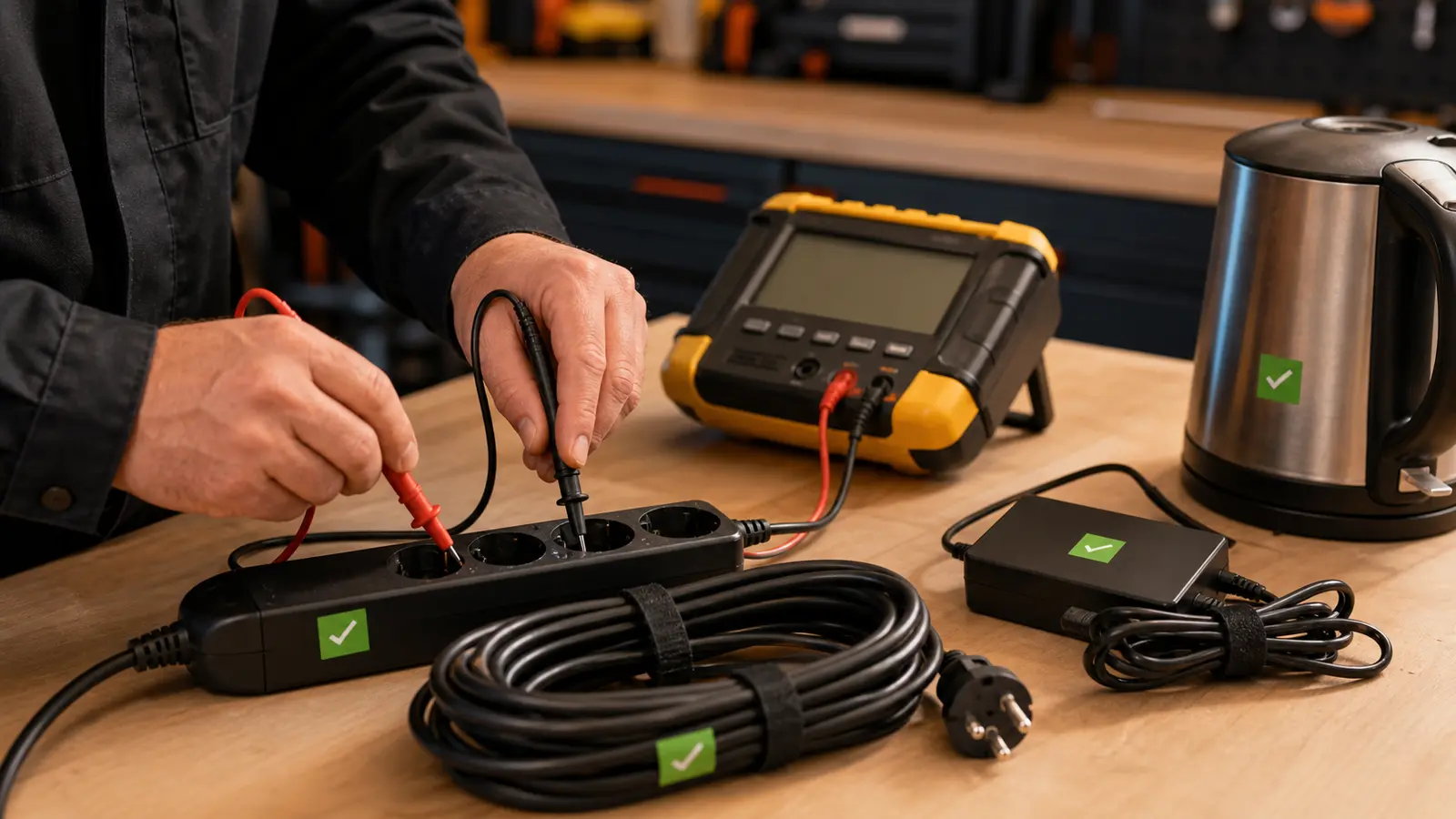
First, we walk through the operation and locate the appliances, extension leads, and tools that need to be under a check regime. We mark each item so it can be found in the list. Then we perform measurements and checks according to the type of appliance and environment, issue documents, and set the next due dates.
The output is not just a set of labels. The company receives a clear list showing the status of individual items, the check result, the next due date, and notes on repairs or disposal. If you already have records, we can review, supplement, and align them with the current operational state.
Appliance records also link to other areas. For companies that work with us on OHS for companies, it makes sense to connect appliance testing, electrical installation inspections, and documentation so that due dates are not tracked in several separate folders.
Frequently asked questions
Does every appliance need its own identification number?
For appliances that are regularly checked or inspected, having its own identification number is very practical. It allows you to uniquely link the physical item, label, spreadsheet entry, and document. Without it, you quickly lose track of similar laptops, chargers, or extension leads.
Are labels without a spreadsheet enough?
This is not sufficient as a good system. A label is a quick operational aid but can get damaged or lost. Records should be stored separately and should contain the history, result, next due date, and link to the document.
How often should records be updated?
Every time something changes: purchase, relocation, repair, disposal, a new inspection, or a change in the usage environment. If records are only opened once a year, they will become outdated between checks.
What about employees’ personal appliances?
If the employer allows the use of personal appliances in the workplace, they should have clear rules. In practice, this is handled either by banning private appliances or by including them in the check and record-keeping regime. Without rules, typical problems arise with kettles, chargers, fans, or portable heaters.
Who can maintain the records?
An authorized person within the company can maintain the administrative list. Professional checks, tests, and inspections belong to a person with the appropriate electrical qualification according to the scope of work. In practice, it is simplest when the inspection provider also delivers usable records directly.
Do records have to be on paper?
Not necessarily. The important thing is that they are conclusive, up-to-date, and available when needed. They can be in electronic form, as long as you can trace individual items, results, due dates, and associated documents.
Sources for this article
- Appliance and tool testing – SOHE service.
- Appliance and tool inspection in a company: intervals and fines – related overview of intervals and operational groups.
- Inspection report requirements – what should be in inspection documents.
- Act No. 262/2006 Coll., Labour Code.
- Act No. 309/2006 Coll. on ensuring further OHS conditions.
- Government Regulation No. 378/2001 Coll. on detailed requirements for the safe operation and use of machinery, technical equipment, devices, and tools.
- Government Regulation No. 194/2022 Coll. on professional competence in electrical engineering.
- Government Regulation No. 190/2022 Coll. on designated technical electrical equipment.
This text is for informational purposes and does not replace legal advice. The specific regime for records, intervals, and responsibilities should be set according to actual operations, manufacturer documentation, usage environment, and risk assessment.
Want to get your appliances, labels, and due dates in order? We provide appliance and tool testing, prepare records, and set next due dates so they are not forgotten. Send us a no-obligation inquiry or write to info@sohe.cz.