
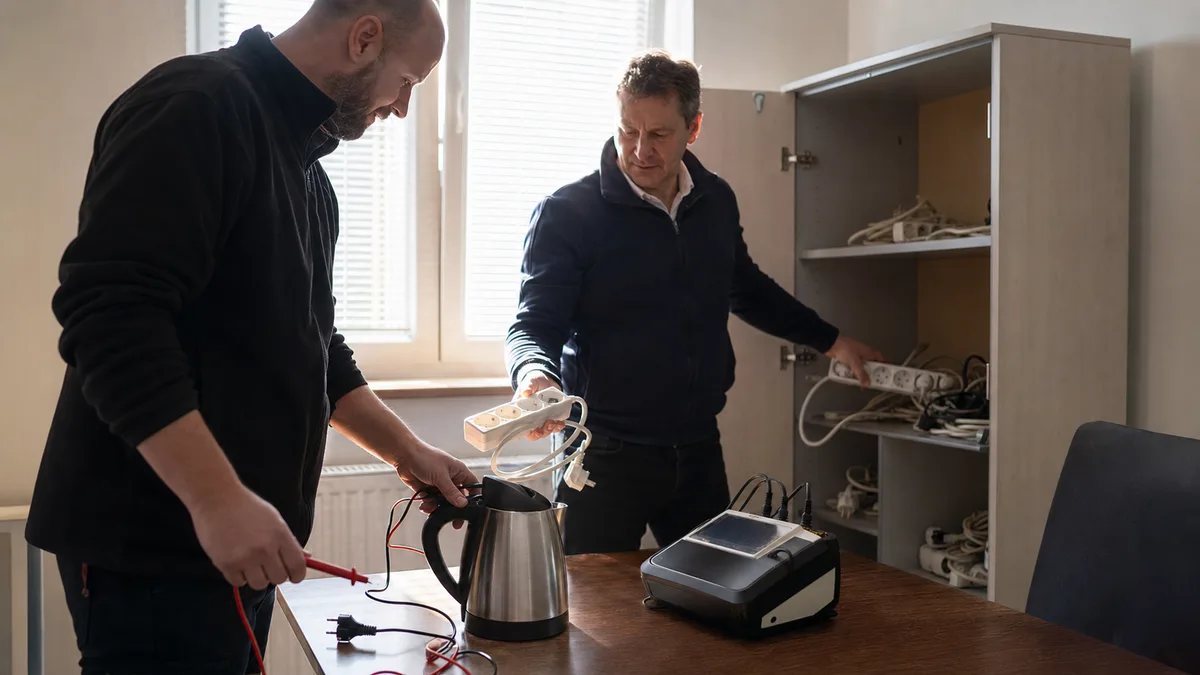
Enquiries about appliance testing almost always come down to a single number: “What do you charge per item?” But the price per item is only half the answer. What really decides the final invoice is how many items the technician can get through at one site during a single visit — and how much time goes into something other than measuring: hunting down appliances around the building, waiting for the keys to the meeting room, or copying serial numbers into records that did not exist until then.
This article is purely about money. We will break down what makes up the price, what range per item is typical, how the model calculation works out for 20, 100 and 500 appliances, and what will noticeably cut the final figure without reducing the scope of the inspection. You will not find intervals, usage groups or penalties here — those are covered in detail in the article on appliance testing in the workplace.
What you are actually paying for: the job, not the sticker
The price per item covers the whole job under ČSN 33 1600 ed. 2 as amended by Z1 and Z2 and ČSN EN 50699 (Czech technical standards for in-service testing of electrical appliances): visual inspection of the appliance, measurement according to its protection class (typically protective conductor resistance, insulation resistance, leakage current), a functional test, labelling and an entry in the report. When a quote promises a strikingly low price, ask how much of that is actually included. “Sticker only” with no measurement and no report is not an inspection — and it will not help you during an inspection by the authorities or in an insurance claim.
Added to the price per item are then items that have nothing, or only loosely, to do with the number of appliances:
- travel and the technician’s call-out,
- time spent on preparation, taking over and handing back the records,
- a minimum order charge where the number of items is small,
- tracking down and initially tagging appliances that appear on no list.
It is precisely this fixed portion that makes appliance testing a typically “volume-driven” service: it gets spread across the number of items. For three extension leads in a single office, the call-out can cost more than the measurement itself. For five hundred appliances in one complex, it is all but invisible per item.
One factor that keeps prices down: portable appliances and hand-held tools up to and including 400 V, unless they are intended for permanent connection to the mains, do not count as reserved electrical equipment under government regulation No. 190/2022 Sb. — the implementing regulation to Act No. 250/2021 Sb. on reserved technical equipment. Appliance testing therefore does not have to be carried out by an inspection technician certified for reserved equipment; a person with the appropriate professional competence in electrical engineering under government regulation No. 194/2022 Sb. is sufficient. As a result, the pool of providers is wider than for electrical installation inspections, and competition pushes the price per item down.
The usual price per item
The SOHE price list gives testing of electrical appliances and tools in a range of CZK 80 to 140 per item, with a volume discount for bulk testing at a company. Where a specific job lands within that range is driven mainly by:
- the type of appliance — office equipment with double insulation is measured faster than hand-held tools with a protective conductor, which require additional measurements and tend to be more worn from use,
- the number of items at one site — the more measurements per visit, the lower the price per item,
- the state of the records — whether the technician measures from a prepared list or is doing a stocktake at the same time,
- accessibility — appliances along a single corridor versus scattered across three floors, storerooms and fitters’ vans.
Things outside the job itself are usually charged separately: travel, building the records from scratch, repairs to items that fail, and any repeat call-out for appliances that were not available on the first visit. A serious quote itemises these separately — otherwise you are comparing apples with oranges. We describe the same principle in the article on the cost of electrical installation testing: the lowest number in an email does not necessarily mean the lowest final invoice.
Other providers’ prices naturally vary by region and by the scope of the job; treat the SOHE price list range as one concrete anchor, not as a description of the whole market.
Model calculation: 20, 100 and 500 appliances
The figures below are a model illustration of the logic, not a quotation. We work with a price per item from the price list range (with a volume discount at larger volumes) and a model call-out charge of CZK 800 per site. An actual quote is always built around the specific list of appliances.
| Model situation | Measurement (model) | Call-out (model) | Total | Per item |
|---|---|---|---|---|
| 20 appliances — small office | 20 × CZK 100 = CZK 2,000 | CZK 800 | CZK 2,800 | CZK 140 |
| 100 appliances — company with a workshop | 100 × CZK 90 = CZK 9,000 | CZK 800 | CZK 9,800 | CZK 98 |
| 500 appliances — production site | 500 × CZK 80 = CZK 40,000 | CZK 800 | CZK 40,800 | CZK 82 |
Three things worth remembering from the table:
- Small jobs are made expensive by the fixed portion. With 20 items, the call-out makes up almost a third of the invoice. That is why small companies do well to combine appliance testing with another job on the same date — an electrical installation inspection, for instance.
- The volume discount is not marketing, it is saved working time. A technician measuring a hundred items along one corridor from a prepared list gets through an entirely different amount of work than one hunting for twenty chargers across three floors.
- The same number of items ≠ the same price. A hundred appliances at one address is one job. A hundred appliances across four branches means four call-outs, four preparations and four handovers — and the model shifts noticeably higher.
What drives the price up
Scattered workplaces. Every address means its own call-out and its own overheads. Sixty appliances across three branches at twenty apiece works out more expensive per item than sixty items in one building — and if the branches are in different towns, the gap grows further.
Missing records. Where no list exists, the technician starts with a stocktake instead of measurement: tracking down items, reading rating plates, noting serial numbers, setting up asset tagging. That is extra work, and it shows up in the quote — either as a separate line or as a higher price per item. What a usable list should look like is covered in the article on appliance testing records in the workplace.
An unprepared site. A locked meeting room, laptops with people working from home, tools driven around in fitters’ vans. The technician either waits or comes back — and a repeat call-out for ten forgotten items can wipe out the entire volume discount.
Fragmented dates. Testing “department by department” across five dates instead of one means five lots of overheads. Sometimes it cannot be avoided (shift operations), but often it is just a matter of convenient scheduling.
Surprises in the count. Fifty items in the enquiry, a hundred and twenty on site. The quote has to be recalculated, the time slot is not enough and some of the appliances get finished on a second visit. Better to genuinely count the items before you send the enquiry — including the extension leads, chargers and adapter plugs that are the most commonly forgotten.
How to cut the price
- Prepare the list in advance. Even a simple table with locations and item counts by room turns a stocktake into measurement. If records exist from the last inspection, send them with your enquiry.
- One date, everything on site. Call in laptops from home office, pull tools out of the vans, and gather the portable bits and pieces (chargers, extension leads, adapter plugs) in one place. An hour of preparation by your facilities person saves hours of the technician’s time.
- Combine jobs into a single call-out. Appliance testing together with electrical installation testing, and lightning protection if relevant, means one journey and one lot of coordination instead of three. For small sites, this is the most effective lever on price.
- Keep a regular cycle with one provider. A provider who knows your site and maintains your records offers the next round more cheaply — there is no tracking down and tagging from scratch. And keeping an eye on the due dates stops being your problem.
- Send your enquiry with the background information. A quote drawn up without background information carries a margin for the unknown. The more precise the input, the less “just in case” there is in the price.
And who will handle all of this for you? Our appliance and tool testing service is built for exactly this scenario: we walk your site, measure, label, hand over the records with due dates, and keep an eye on the next round for you. Just send us the number of items and the addresses of your premises via a no-obligation enquiry — you will get the price in writing up front, with travel itemised separately and no hidden extras.
How to write an enquiry that makes quotes comparable
Include in your enquiry:
- the number of appliances — at least an informed estimate, extension leads included,
- the mix — how much is office equipment, how many tools, how many kitchen and other appliances,
- the number of sites and their addresses,
- the environment — office, workshop, warehouse, outdoor work (this affects both scope and intervals),
- whether records exist from the last inspection or new ones are being created,
- your preferred date and any operational constraints (shifts, seasonality).
Then ask the provider for a quote that separates the price per item (ideally by appliance type), travel, work on the records, and the terms for any second visit. Only then will you find out who is genuinely cheaper — rather than just who put a smaller number in the email subject line.
Frequently asked questions
Why did one firm quote me CZK 60 per item and another CZK 150?
They are almost certainly not offering the same thing. Ask whether the price includes measurement under ČSN 33 1600 ed. 2 as amended by Z1 and Z2 and ČSN EN 50699, the label, the report and work on the records, how travel is calculated, and whether it applies to your actual number of items. The difference is usually in the scope of the job and in the fixed items, not in the margin.
Is it worth combining appliance testing with electrical installation testing?
For smaller sites, generally yes — the fixed costs of the call-out and coordination are spread across two jobs, and you get the whole building sorted on one date with one provider. What makes up the price of the second part is described in the article on the cost of electrical testing in the workplace.
How often will I be paying for testing?
Intervals vary by environment, appliance type and protection class — they are longer in an office and considerably shorter on a construction site. The table of intervals is in ČSN 33 1600 ed. 2 as amended by Z2; the concurrently valid ČSN EN 50699 additionally distinguishes between a repeat test and an inspection. Specific intervals, including a clear table, can be found in the article on appliance testing in the workplace; for budgeting purposes, count on this being a recurring cost, not a one-off.
Sources for this article
- Appliance and tool testing – the SOHE service.
- SOHE price list – the source of the CZK 80–140 per item range with volume discount; the model calculations in this article are based on it, but are not a binding quotation.
- Testing of electrical appliances and tools in the workplace: intervals and penalties – intervals, usage groups and the scope of the job.
- Records of inspections and appliances in the workplace – how to keep a list that makes your next inspection cheaper.
- ČSN 33 1600 ed. 2 – inspection and checking of electrical appliances during use.
- ČSN EN 50699 (33 1600) – In-service repeat testing of electrical equipment.
- Act No. 250/2021 Sb. – the Act on occupational safety in connection with the operation of reserved technical equipment; its implementing government regulation No. 190/2022 Sb. establishes that portable appliances up to 400 V are not reserved electrical equipment, and government regulation No. 194/2022 Sb. governs professional competence in electrical engineering.
The legal position was verified as of 12 August 2026. Prices other than those in the SOHE price list are model illustrations; a specific quote always depends on the number of items, the mix of appliances, the number of sites and the state of the records.
This text is informational and does not replace legal advice. The specific regime for inspections and checks needs to be set according to actual operations, the manufacturer’s documentation, the environment of use and a risk assessment.
Want to know what appliance testing will cost at your site? Count up the items (don’t forget the extension leads and chargers), add the addresses of your premises and send us a no-obligation enquiry or an email to info@sohe.cz. You will get the price in writing up front — per item, with travel itemised separately and a volume discount based on the actual count.