
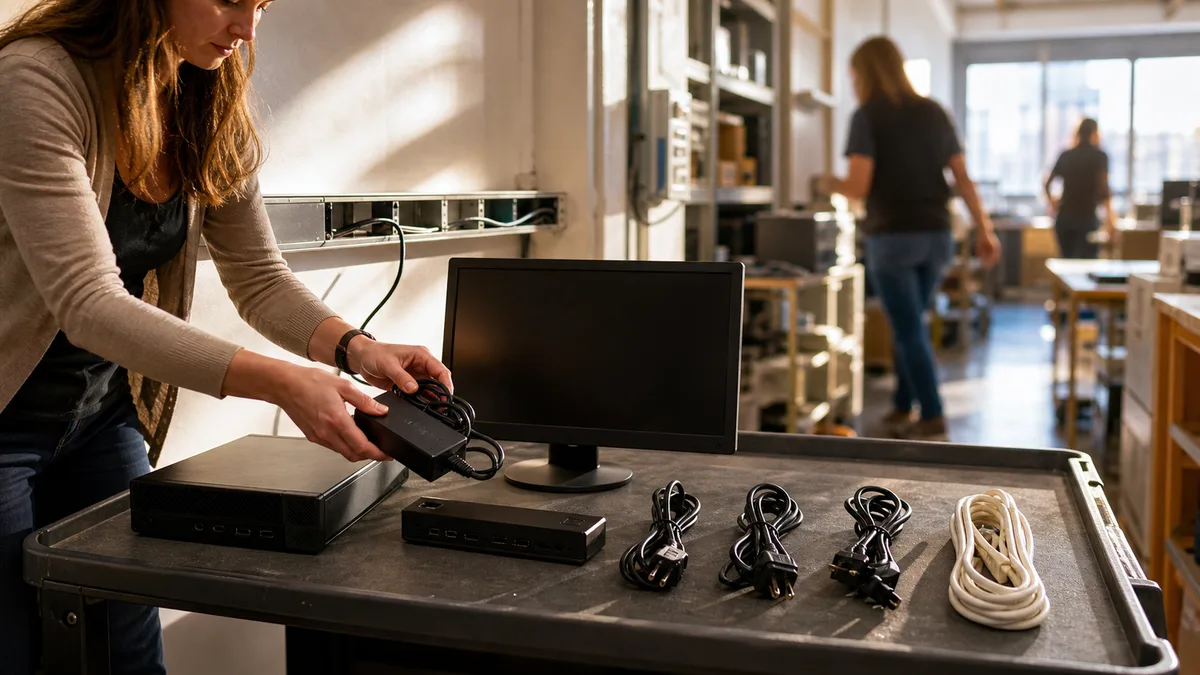
The enquiry arrives in a single sentence: “We have about 120 appliances here. How much will it cost, and when can you come?” The question the facility manager does not expect is: where did that figure come from? If it was calculated by adding up rows in the asset register, there will be considerably more individual items on site—and some of them will not be found that day.
Testing itself is rarely what causes delays during a bulk inspection. Delays arise when nobody knows who owns the laptop under the desk, its user has taken the adapter to a meeting, an extension lead is behind a locked cabinet, and the docking station beneath the desktop is not recorded anywhere. Instead of testing, the technician waits and searches—and that takes up the working day just as much as the inspection itself.
Preparation therefore does not simply mean “making a list of appliances.” It means answering four questions: what is included in the job, where the items are physically located, when they will be available, and who will decide what to do if an item is missing or fails the inspection. We will look at what such a list should contain, how to divide operations into waves, what to address in shift-based workplaces and home offices, and what to agree on regarding the deliverables so that the result is not an unusable spreadsheet.
One workstation is not one item
An asset register records a complete setup. An inspection deals with individual items. A row labelled “PC setup” commonly includes:
- a laptop or desktop computer;
- its power supply;
- the detachable lead for that power supply;
- a docking station;
- the docking station’s power supply and lead;
- a monitor and its lead;
- an extension lead under the desk.
That is nine items where the inventory records only one. Docking stations are the most common blind spot in this list: the Dell WD19 and WD22 families, HP USB-C and Thunderbolt Docks, and Lenovo ThinkPad USB-C Docks all have their own external power supplies with separate leads. These disappear behind monitors or into cable trays and may never appear in the records at all.
Items also differ in what can actually be tested on them. A power supply with a three-pin plug and a C5/C6 connector has a protective conductor; a flat two-pin Class II power supply does not have one by design, so a different testing procedure applies. The technician decides which procedure is appropriate for each item. For the purposes of the list, the conclusion is simple: an adapter is a separate item, not merely an accessory.
It is equally worthwhile to check items under desks and in kitchenettes that may never have been recorded: height-adjustable desks with control units screwed underneath the desktop, uninterruptible power supplies, fans, and portable heaters that appear in November and disappear into cupboards in March.
For two groups in particular, it makes sense to anticipate defects. The most common fault in extension leads is invisible: the protective conductor breaks where the cable enters the plug because repeated bending and pulling on the cord eventually damages it. The lead looks fine from the outside and the appliance still works—but the protection does not. In kettles and coffee machines, moisture and deposits accumulate around the heating element and affect insulation performance before any visible problem appears. In workshops, remember that cordless tools and their chargers are two different things; the charger and its lead are included in the inspection.
We discuss how often each type of equipment should be inspected in a separate article about inspection intervals for office equipment and tools. Here, we are concerned with organising a single visit.
Where the obligation comes from and what it means for planning
It is worth stating the legal basis up front, as it also determines the scope of the job. Under § 4 odst. 1 písm. c) zákona č. 309/2006 Sb., ve znění pozdějších předpisů, employers must ensure that machinery, technical equipment, means of transport, and tools are regularly and properly maintained, checked, and inspected. Nařízení vlády č. 378/2001 Sb. further stipulates in § 4 odst. 2 that subsequent inspections must be carried out at least once every 12 months, to the extent specified by local operational safety regulations—unless special legislation, the manufacturer’s accompanying documentation, or applicable standards specify a different scope or frequency.
That final sentence is more important than it may appear. For electrical appliances, the scope and intervals are commonly supported by technical standards: ČSN 33 1600 ed. 2 ve znění změn Z1 a Z2 covers inspections and checks of electrical appliances during use and is applied in practice alongside ČSN EN 50699 (recurrent tests of electrical equipment) and ČSN EN 50678 (verification of safety after repair). The standard itself is not legally binding—under § 4 odst. 1 zákona č. 22/1997 Sb., ve znění pozdějších předpisů, Czech technical standards are not generally binding. They are a recognised way of demonstrating compliance, not the source of the obligation.
This has two practical implications for preparation. Both the quotation and the deliverables should clearly state which regulation and which edition of the standard the supplier follows; otherwise, the results are being judged against an unclear benchmark. The scope of the job can also be defined by subject matter: electrical installations, switchboards, and production machinery are governed by different requirements and are not automatically included in an appliance inspection. The technician should confirm how borderline items are classified.
Define the scope before setting the date
Two quotations with the same price per item may not include the same work. One may assume a completed list and a single workplace, while the other includes labelling, movement between floors, and an electronic export. Before setting a date, review and confirm the following in writing:
| What to clarify | Why it affects both price and time |
|---|---|
| Which equipment groups are included | Office equipment, power supplies, detachable and extension leads, kitchen appliances, hand tools, chargers, and uninterruptible power supplies. |
| What is not included | Electrical installations, switchboards, machinery, and production units requiring a different scope of inspection. The technician should confirm how borderline items are classified. |
| Whether detachable leads are counted separately | This determines the final number of items and therefore the price. Across 100 workplaces, the difference between a “setup” and an “item” amounts to hundreds of rows. |
| How employees’ privately owned equipment will be handled | Agree on one company-wide rule in advance instead of deciding separately at each desk on the day of the visit. |
| What is currently off-site | Laptops, power supplies, and chargers used for home working, taken on business trips, or sent for servicing. |
| How new equipment will be handled | Whether it will be included in this visit or added during the next regular inspection. |
| Who will disconnect and reconnect equipment | A designated person for standard workplaces; IT or the operations manager for servers, network components, and production equipment. |
| What the deliverables will include | Type of report, itemised records, file format, labelling system, and a separate list of exceptions. |
Ask for an anonymised sample of the deliverables. Within a minute, it will show whether the results can be linked to your asset list and whether the records will make it clear what still needs to be resolved.
This is not unnecessary administration; it is the core of the job. Without an agreed scope, the day of the visit becomes a series of decisions made in the corridor. If you do not want to put everything together yourself, our appliance and tool inspection service begins with precisely this discussion: we review equipment groups, workplaces, shifts, and the record format before agreeing on a date.
A working list, not a second accounting register
A fixed-asset register is a good starting point, but it is not enough for organising the work. It does not tell you that a monitor has been in a different office since spring, a user has taken their laptop home, or a docking station left under a desk was never entered in the inventory. Build the working list so that every row can be matched to a specific physical item.
| Field | Purpose |
|---|---|
| Internal ID or existing label number | Links the physical item, inspection result, and asset register. Without it, the results cannot be matched. |
| Equipment type | Makes it possible to divide the job into working groups and estimate the time required for each wave. |
| Manufacturer, model, and serial number where applicable | Distinguishes similar items when no internal ID is available. |
| Building, floor, room, and location | Prevents the technician from having to search for equipment. |
| User or responsible person | Makes it clear who will provide access to the item. |
| Availability | Shift, time window, home office, servicing, or business trip. |
| Operational priority | Standard, critical, or disconnect only by prior agreement. |
| Processing status | Ready, completed, not presented, or pending decision. |
Keep the list in a shared spreadsheet, not in a file distributed by email. Two versions of the same list will cause you to lose track of precisely the items the list was intended to manage.
Divide operations into waves, not “the whole day”
Booking a technician for the whole day is not an organisational plan. Divide the workplace by building, floor, department, or shift, give each section a time window, and assign one contact person. The technician can then move through prepared workplaces instead of waiting for people to return from meetings.
For shift-based operations, schedule handovers during shift overlaps or establish a collection point for portable equipment. Items brought there should be labelled; otherwise, a laptop, adapter, and docking station may be returned to different users, breaking the link between the equipment and its results.
Record critical items separately. These include point-of-sale systems, computers controlling operations, network components, server UPS units, and reception equipment that cannot be disconnected without an alternative arrangement. A UPS cannot simply be dealt with by unplugging it: once disconnected from the mains, it continues supplying power to connected equipment. For every such item, determine:
- who will approve its disconnection;
- who will save work in progress or ensure that a backup is available;
- who will shut the equipment down safely and put it back into operation;
- during which operational window work may be carried out;
- what will happen if it cannot be presented during that window.
For equipment that is off-site, set a specific return date instead of issuing a general request by email. An item that the technician has not seen belongs in the records as not presented—not as completed.
There is no single answer to the question, “Does every computer have to be shut down?” that applies to all setups and procedures. Employees should save their work; agree on the specific disconnection requirements and sequence of operations with the technician in advance and, for critical systems, together with IT. A universal time per item or zero downtime cannot be promised without knowing the equipment and the workplace. Any quotation that makes such a promise before the scope has been established needs further clarification.
What to prepare the day before
Review the list with shift managers and responsible staff so employees are given a specific time, rather than merely being told that “an inspection will take place at some point tomorrow.” Make cables, plugs, adapters, and labels accessible at each workplace. This does not mean dismantling equipment or asking unqualified employees to disconnect components they do not understand; simply remove boxes from under desks and unlock cabinets.
Also prepare:
- the current working list in a shared spreadsheet;
- a room plan and the sequence of work waves;
- a description of the existing labelling system and previous records;
- a clear surface for portable equipment;
- contact details for the coordinator, IT, and shift manager;
- a designated area for items that must not be returned to service.
Do not produce new labels in advance until you know which labelling system the supplier uses. Two parallel numbering systems without a conversion table will reliably separate physical items from their results.
Four statuses and one identifier make the difference on site
One person representing the company should manage availability, not the technician’s professional work. The coordinator opens rooms, brings in the next wave, resolves unclear ownership, and records exceptions. Four separate statuses should be maintained throughout the process:
- Ready — the item is on site and can be presented.
- Completed — the result has been assigned to the correct ID.
- Not presented — the item is missing, locked away, in use, or off-site.
- Pending decision — the technician has identified a condition requiring repair, replacement, or another measure.
The “not presented” status must not be merged with completed items, nor should an item inherit last year’s result simply because it appears on an older list. An item identified by the technician as unsafe must remain out of service until the defect has been rectified and its safe condition verified by a professionally qualified person—or until a safety measure specified by the technician has been implemented. A responsible person cannot return it to service merely by deciding to do so. In this case, “pending decision” refers to choosing between repair, replacement, and disposal, not deciding whether the item may continue to be used. Record repairs, replacements, and disposals under the same internal ID to preserve a traceable history.
Handover of records is part of the job
At handover, it must be possible to compare the agreed scope, the items actually presented, the results, and any unresolved exceptions. In addition to the relevant report, agree in advance on an itemised export in a format supported by your system—XLSX or CSV with an unambiguous matching key based on the internal ID or label number. The inspection technician will confirm the exact form of the deliverables and the required contents of the report according to the agreed scope.
During acceptance, check in particular:
- whether the records use the same identifiers as the physical labels;
- whether completed, not presented, and failed items can be separated;
- whether the location and date of the inspection are traceable;
- whether each defect clearly identifies what it concerns;
- whether the total number of items matches the submitted list and recorded exceptions;
- who will resolve repairs, replacements, and subsequently presented items, and by when.
The long-term management of deadlines and labels between visits is covered in a separate article about appliance inspection records. For a single job, one point is essential: without a shared identifier, the result becomes a list that cannot be used during the next inspection.
How to compare quotations and recognise a well-prepared supplier
Do not assess the price merely as a cost per item. Give every prospective supplier the same information: an estimated number of items by group, the number of workplaces, shift arrangements, required labelling, off-site equipment, and the desired record format. A qualified estimate is usually enough for an initial quotation, but ask the supplier to explain immediately how the price will be adjusted according to the number of items actually presented and what an additional visit for missing items would cost. The article on the cost of electrical appliance inspections explains what may be included in the price per item.
Ask whether the quotation includes movement between workplaces and floors, work outside normal operating hours, labels, an electronic export, and an additional visit. Only then can the prices be compared properly.
Ask the supplier to provide current documentation relevant to the work being ordered—and distinguish between two different regulatory regimes.
Routine checks and inspections of portable appliances constitute work on electrical equipment for which professional competence is governed by nařízením vlády č. 194/2022 Sb. Nařízení vlády č. 190/2022 Sb. explicitly states in § 3 odst. 2 písm. a) a b) what does not constitute vyhrazené elektrické zařízení: this includes hand-held electromechanical tools, electronic devices, and electrical appliances rated up to and including 400 V, unless designed for permanent connection to the mains, as well as extension leads and detachable leads. This is precisely what a standard appliance inspection job covers.
Osvědčení and oprávnění under zákona č. 250/2021 Sb., by contrast, apply to work involving vyhrazená technická zařízení. Require them when the commissioned work actually falls under this regime—typically when an electrical installation, switchboard, or other vyhrazené elektrické zařízení becomes part of the job. A blanket request for “oprávnění podle 250/2021” for an office-equipment inspection does not verify anything useful; it should be included in the enquiry only together with a definition of the work to which it applies. Designations under earlier regulations kept in a file from previous years do not, by themselves, establish the current scope of competence.
For employees’ privately owned equipment, agree on a company-wide rule in advance. The article on employees’ private appliances in the workplace explains who owns each item and who is responsible for it.
A well-prepared supplier will ask about operations, critical equipment, records, and the responsible contact person. Warning signs include an unclear scope, a promise of zero operational disruption without knowing the workplaces, and deliverables described merely as “a stamp.”
Indicative preparation timeline
The following schedule is not an estimate of how long the inspection itself will take. It is a preparation timeline that should be adapted to the size of your operation and its shifts.
- 7 to 14 days in advance: confirm the scope, responsibilities, record format, and the rule for missing items.
- 2 to 5 days in advance: complete the working list, divide workplaces into waves, and give employees a specific time.
- The day before: verify equipment availability, access to rooms, and contact details for the coordinator, IT, and shift managers.
- On the day of the visit: continuously match results to IDs and keep exceptions separate from completed items.
- After handover: compare totals, accept the agreed files, and assign an owner to every outstanding item.
Good preparation does not make the testing itself faster. It eliminates waiting, searching, and decision-making in the corridor—the parts of the day that have nothing to do with the specialist work but reliably make it take longer.
Sources used for this article
- Appliance and tool inspections – a service provided by SOHE.
- Electrical appliance inspections: how often to inspect office equipment and tools – intervals by appliance type and method of use.
- Appliance inspection records in companies – how to manage deadlines, labels, and continuity between inspection results.
- Employees’ private appliances in the workplace – who is responsible for equipment that an employee brings from home.
- Zákon č. 309/2006 Sb., ve znění pozdějších předpisů (naposledy zákona č. 318/2025 Sb., účinnost od 1. 11. 2025) – additional occupational health and safety requirements; § 4 odst. 1 písm. c) covers the maintenance, checking, and inspection of machinery, technical equipment, and tools.
- Nařízení vlády č. 378/2001 Sb. – detailed requirements for the safe operation and use of machinery, technical equipment, devices, and tools; § 4 odst. 2 covers subsequent inspections at least once every 12 months.
- Zákon č. 22/1997 Sb., ve znění pozdějších předpisů – technical requirements for products; § 4 odst. 1 states that Czech technical standards are not generally binding.
- Nařízení vlády č. 194/2022 Sb., ve znění nařízení vlády č. 175/2024 Sb. – requirements for professional competence to perform work on electrical equipment and professional competence in electrical engineering.
- Nařízení vlády č. 190/2022 Sb., ve znění nařízení vlády č. 175/2024 Sb. – vyhrazená elektrická zařízení and requirements for their safety; § 3 odst. 2 písm. a) a b) states that hand-held electromechanical tools, electronic devices, and electrical appliances rated up to and including 400 V (unless designed for permanent connection to the mains), as well as extension leads and detachable leads, do not constitute vyhrazená elektrická zařízení.
- Zákon č. 250/2021 Sb., ve znění zákona č. 318/2025 Sb. – occupational safety in connection with the operation of vyhrazená technická zařízení; the system of osvědčení and oprávnění applies to work involving vyhrazená technická zařízení.
- ČSN 33 1600 ed. 2 ve znění změn Z1 a Z2 – inspections and checks of electrical appliances during use; applied in conjunction with ČSN EN 50699 (recurrent tests of electrical appliances) and ČSN EN 50678 (verification after repair). The standards are not freely available.
This article is for informational purposes and does not constitute legal advice. The specific inspection and testing regime for appliances must be established according to actual operations, the manufacturer’s documentation, the environment in which the equipment is used, and the risk assessment.
Are you preparing a bulk inspection and want to avoid shutting down operations? We will review the scope with you, divide workplaces into waves, and agree on a record format that remains useful afterward. We provide appliance and tool inspections for shift-based operations and multi-building sites as well. Email info@sohe.cz or send a non-binding enquiry with an estimate of the number of items and workplaces; we will get back to you with a proposed date and scope.