
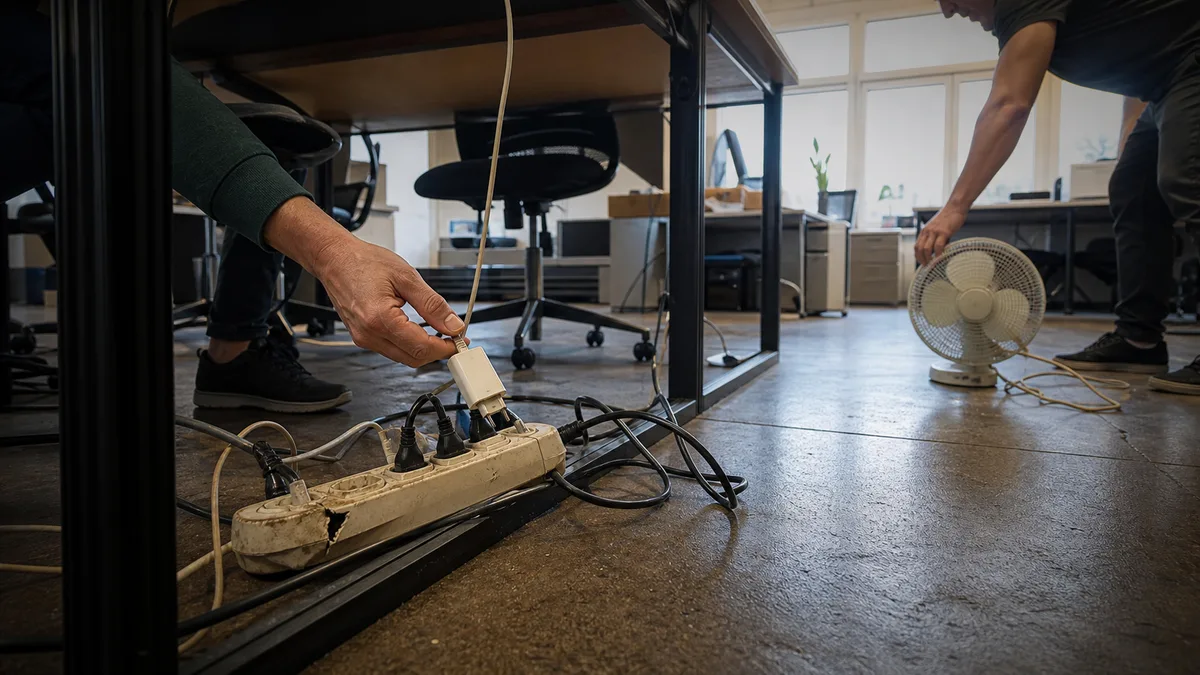
An electric kettle someone brought from home years ago, a fan that remembers the previous decade, and a phone charger bought for pocket change at a market stall. There are thousands of them in the kitchenettes and under the desks of Czech companies — and almost none of them in any appliance register. As long as they work, nobody gives them a second thought. The question of “whose is this, actually” only becomes interesting when an inspection arrives, or when the carpet under a desk starts to smoulder next to a heater.
The answer will not please most business owners: the fact that an appliance belongs to an employee does not relieve the employer of liability. Let’s look at why that is, what two clean options a company has — a ban, or inclusion in the inspection regime — and how to set the rules so they work in everyday operation, not just on paper.
Why a personal kettle is the employer’s problem
The Labour Code (Section 101 of Act No. 262/2006 Sb.) requires employers to ensure the safety and health of employees at work with regard to the risks of possible harm. This duty attaches to the workplace and to what actually happens there — not to who owns individual items. As soon as a personal kettle is plugged into a socket in the kitchenette and employees use it, it becomes part of the working environment, whose risks the employer is required to assess and manage.
The same logic runs through ČSN 33 1600 ed. 2, the standard governing inspections and checks of electrical appliances during use. From its perspective, what matters is that the appliance is used at the workplace — not who paid for it. In practice, the argument “it’s his, we have nothing to do with it” therefore does not hold up during an inspection. The inspector sees an appliance plugged in at the workplace and asks what condition it is in, who last checked it, and how the company has dealt with its use.
Yet the most common situation is neither a ban nor a register, but quiet tolerance: nobody has explicitly permitted personal appliances, nobody has banned them, nobody keeps a record of them and nobody has ever tested them. So the company has its own equipment impeccably inspected — and right next to it a grey zone the documentation says nothing about.
What the Labour Code says to employees
The other half of the equation is Section 106 of the Labour Code, which sets out employees’ rights and duties in occupational safety and health. Among other things, an employee is required to follow legal and other regulations and the employer’s instructions on ensuring OSH, provided they have been properly informed of them, and to use the prescribed work equipment.
For personal appliances this has an important consequence: if the employer sets rules — whether a ban or conditions of use — it has grounds to enforce them. The reverse holds too. If the company issues no rule, there is nothing for the employee to breach, and the unmanaged risk stays entirely with the employer.
Option one: a ban by internal policy
The simplest option on paper. The internal policy states that only appliances provided by the employer may be used at the workplace and that personal electrical appliances must not be plugged in. For the ban to hold up in practice, it needs three things:
- A clear scope. Exactly what is banned — typically heating appliances (kettles, direct heaters, hot plates), personal extension leads and older equipment brought from home. And what is tolerated, if anything, such as ordinary phone chargers. It is better to write the line down than to leave it to individual managers’ interpretation.
- Informing employees. An instruction nobody knows about is hard to enforce. A change to the internal policy should be worked into OSH training, with a written record confirming employees were informed.
- A replacement. A blanket ban with nothing offered instead ends predictably: the kettles move into desk drawers. A combination works better — a company kettle and microwave in the kitchenette, included in the normal inspection cycle, plus a ban on personal heating appliances at workstations. When there is a heater under a desk, the real problem is usually the heating, not the employee.
Option two: allow them and include them in inspections
The second clean option accepts that personal appliances are simply part of company life. But then they have to go through the same regime as company equipment:
- An inventory. At the next opportunity, walk the premises and write down what is plugged in where and who owns it.
- Labelling and registration. Approved items get an inventory number and an entry in the same list as company appliances — how to build such a list is described in our article on keeping an appliance inspection register.
- Checks and inspections on the same cycle. Intervals depend on the environment, the type of appliance and its protection class; a detailed overview of the groups and intervals is in our article on appliance inspection intervals in a company, so we will not repeat them here. The key point is that a personal kettle in the kitchenette is assessed by the same rules as the company one on the shelf beside it.
- Consequences for items that fail. An appliance that fails a check is removed from the workplace — even if it is personal property. The owner can take it home, but it should not go back into a company socket.
Portable appliances typically do not fall among reserved electrical equipment within the meaning of Act No. 250/2021 Sb. and the related government regulations, so their regular checks and inspections are not as demanding organisationally as fixed wiring. A few extra personal items in a bulk inspection appointment usually do not amount to a significant cost.
Which appliances come up most often in practice
| Appliance | Typical risk | What to do about it in practice |
|---|---|---|
| Electric kettle, coffee machine | heating appliance, worn cord, limescale | a company unit in the kitchenette included in inspections, personal ones only with a register entry |
| Direct heater, under-desk heater | high power draw, plugged into an extension lead, flammable surroundings | the riskiest category; consider a ban and fix the cause — the heating |
| Fan | old units from home, damaged insulation, dust in the motor | allow only checked units, inspect them at the start of the season |
| Chargers and adapters | cheap non-original units with no markings | set a clear line in the internal policy, remove suspect items |
| Fridge, microwave “from home” | age, condition of the cord, unsuitable placement | take it into the register as workplace equipment, or refuse it |
| Personal extension leads and adapters | daisy-chaining, overloading socket circuits | handle together with company leads, remove unregistered ones |
Certain combinations that keep recurring on site deserve attention: a heating appliance plugged into an adapter on an extension lead, a heater right next to cardboard boxes under a desk, a kettle on top of a cabinet full of documents. The appliance itself may be perfectly fine — and yet its placement and connection are a risk that should not go unnoticed during a workplace walk-through.
When something happens: fire, injury and the insurer
Here is the scenario that makes this topic worth addressing before the event rather than after: at night, a fire starts from an appliance that was in no register at all. Neither the fire service nor the fire cause investigators care who owned the item — they care what was plugged in at the workplace. The insurer will then typically ask for documentation of checks and inspections; what its absence can do to a claim payout is covered in our article on missing inspections and the insurer.
An equally unpleasant situation is an electric shock injury from a tool brought from home or a damaged charger. The investigation looks at how the employer assessed the risks and what rules it set for the use of appliances. “We didn’t know he had it there” is not a defence at that point but a description of the problem — knowing your own workplace is exactly what is expected of an employer.
How to set it up in a week
The whole agenda can be handled quickly if the company approaches it systematically:
- Walk the workplace. Write down what is actually plugged in — including kitchenettes, changing rooms, the reception desk and workshop corners — and note what is company property and what is personal.
- Make a decision. A ban with a replacement, or permission with conditions. Both options are legitimate; put the decision in writing in the internal policy.
- Register the approved items. An inventory number, an entry in the list, inclusion in the next round of checks.
- Inform employees. Briefly, specifically, with a record of the briefing — ideally as part of regular employee training.
- Include personal items in the next inspection and take those that fail out of service.
And who will handle it for you? The simplest approach is to fold personal appliances into your regular appliance and tool inspection: in a single visit, the technician goes through both company and approved personal items, updates the register and sets the next dates. Just send us a no-obligation enquiry, stating the approximate number of appliances and that you want to include equipment brought in by employees — indicative per-item prices are in our price list.
Frequently asked questions
Can a company ban personal appliances entirely?
Yes. A ban is a legitimate risk management measure, and under Section 106 of the Labour Code employees are required to follow the employer’s OSH instructions they have been informed about. In practice, though, a ban only works with a replacement — a company kettle in the kitchenette — and with occasional checks that it is being observed.
Who pays for inspecting a personal appliance — the company or the employee?
The regulations do not address this explicitly. In practice, the simplest approach is for the company to include approved personal items in the bulk inspection appointment; a few extra items usually do not raise the final price significantly. The alternative — making use conditional on the employee providing proof of a check themselves — is considerably harder to keep track of.
Does a phone charger need an inspection too?
Strictly speaking, it is an electrical appliance used at the workplace. In practice, companies draw a sensible line in their internal policy: ordinary phone chargers are tolerated, possibly with a visual condition check, while heating appliances and personal extension leads are conditional on being registered and inspected. The important thing is to write the line down explicitly rather than leave it to chance.
What if an employee breaks the ban?
OSH instructions an employee has been properly informed about are binding on them. A breach is dealt with by standard employment law tools, from a verbal warning to a written one. For repeated breaches, we recommend consulting a lawyer on how to proceed — this article is not a substitute for legal advice.
How does this work for home office?
A home workplace is a separate topic with its own rules. In practice, the recommendation is to focus above all on equipment the employer provided for work — laptop, charger, monitor. These belong in the register and the check cycle regardless of where they are used. The regime for an employee’s own household equipment is outside the scope of this article.
Sources
- Appliance and tool inspections – a SOHE service.
- Inspections of electrical appliances and tools in a company: intervals and fines – usage groups, intervals and how an inspection works.
- Appliance and inspection registers in a company – how to keep the list, labels and dates.
- Missing inspections and the insurer – what an insurer examines when inspection records are missing.
- Act No. 262/2006 Sb. – the Labour Code; Section 101 the employer’s duty to ensure OSH, Section 106 employees’ duties.
- Act No. 250/2021 Sb. – the act on occupational safety in connection with the operation of reserved technical equipment.
- ČSN 33 1600 ed. 2 – inspections and checks of electrical appliances during use.
The legal position was verified as at 24 July 2026; the Labour Code is used as amended.
This text is for information purposes and does not replace legal advice. The specific regime for personal appliances needs to be set according to your actual operations, the environment of use and a risk assessment.
Not sure what is plugged in at your premises and who it belongs to? During an appliance and tool inspection we go through both company items and those brought from home, update your register and set dates that do not get forgotten. Send us a no-obligation enquiry or write to info@sohe.cz and we will agree the scope based on how you operate.