
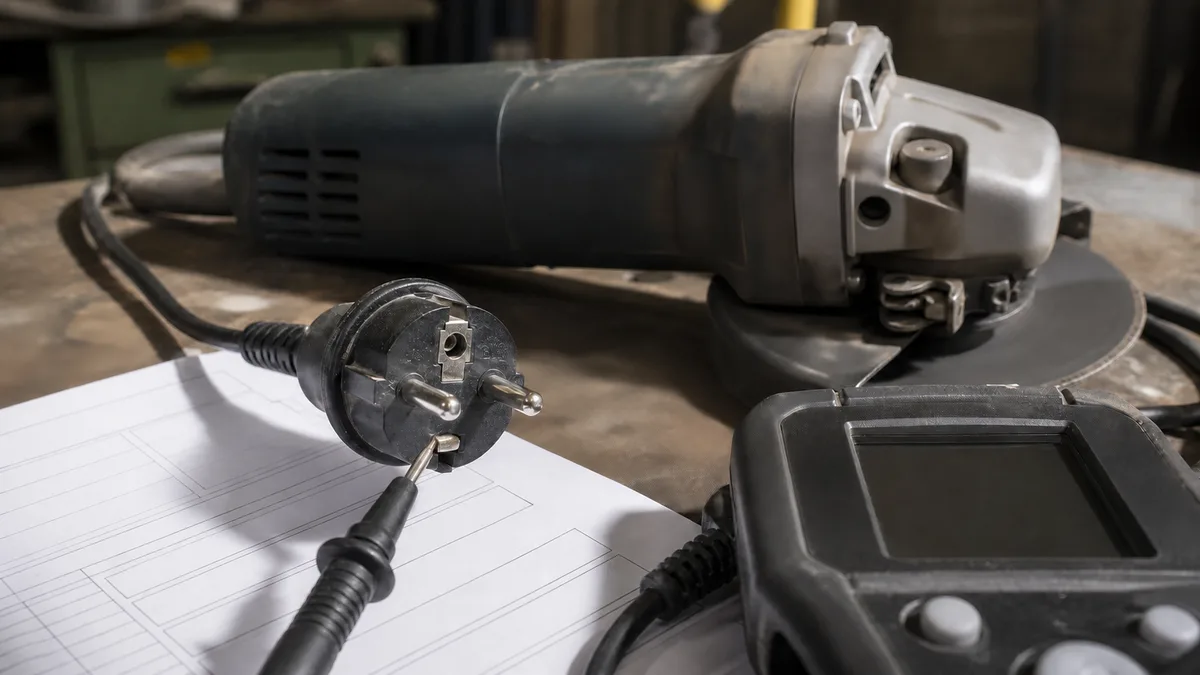
The question usually comes up over the first quote for appliance testing: why pay someone to walk around the office with a meter when you can buy the instrument yourself and the maintenance guy has time on his hands? The answer is “yes, you can” — it just isn’t the purchase of a tester that settles it. What settles it is the qualification of the person taking the measurements, the procedure chosen according to the type of equipment, and the record that remains once the test is done.
Intervals are not the subject here; we covered those in Appliance testing in the workplace: intervals and fines. This text is about competence: how a pre-use check differs from a repeat test, what an instructed employee can handle, where the employer has to be able to demonstrate competence, and when in-house testing pays off more than an external technician.
An appliance in a socket is not designated equipment — and still gets checked
Government Regulation No. 190/2022 Sb., as amended, does not treat hand-held electromechanical tools, electronic devices and electrical appliances up to and including 400 V as designated electrical equipment, provided they are not intended for permanent connection. Extension cords and detachable supply cords are likewise excluded from the designated-equipment regime.
The practical consequence is fundamental: for a drill, a laptop or an extension strip, this is not an inspection of designated equipment under Act No. 250/2021 Sb., as amended. A revision technician’s certificate from TIČR (the Czech technical inspection authority) is therefore not the document that determines competence for this group — and a company that asks its supplier only about that is asking the wrong question.
The obligation does not disappear, though; it simply rests on a different basis. Act No. 309/2006 Sb., as amended, requires the employer under Section 4 to ensure that machinery, technical equipment, means of transport and tools are regularly and properly maintained, checked and inspected. Government Regulation No. 378/2001 Sb. adds, in Section 4(2), a follow-up check at least once every 12 months to the extent set by the local operational safety regulation — unless a special legal regulation, the accompanying documentation or standard values set a different scope and frequency. It follows that an angle grinder on a building site and a monitor in an office should not be under the same regime, even though they hang on the same label.
Check, repeat test, inspection: four different tasks
In everyday speech everything gets called “an inspection”. But when deciding whom to assign, it helps to distinguish four tasks that differ in scope and in the qualification they require.
| Task | What actually happens | Who may carry it out |
|---|---|---|
| Pre-use check | A look at the plug, cord, casing, loose parts, signs of overheating or mechanical damage | The user, if they know the procedure and know when to take the device out of service |
| Follow-up check under Gov. Reg. No. 378/2001 Sb. | Scope set by the manufacturer’s instructions, the local operational safety regulation and the risk assessment | A person designated by the employer whose competence matches the scope of the check |
| Repeat test of an appliance | Inspection, measurement according to the type of device, functional test, evaluation and record | A person designated by the employer, for whom the employer demonstrably ensures competence for the given procedure, measurement, evaluation and scope of work |
| Inspection of designated electrical equipment | Assessment of a fixed installation or of equipment that genuinely falls under the designated-equipment regime | A revision technician holding a valid certificate of the relevant scope |
For non-designated appliances, the last column is not a quotation from the law, and it is worth knowing that before someone starts demanding a document that does not exist. Government Regulation No. 378/2001 Sb. does not specify the qualification of the person performing the check, and Government Regulation No. 194/2022 Sb., as amended, reserves revision technicians in Section 5(3) for inspections of designated electrical equipment — that is, for the last row of the table, not for the kettle in the kitchenette. Responsibility for deciding whom to assign the task to and how to document their competence lies with the employer; the supporting basis can be the scope of activities in the local operational safety regulation, the procedure under the standard applied, and evidence that the person has been practically trained in that procedure.
The terminology follows the standards: ČSN EN 50699 uses the term repeat test, while ČSN EN 50678 covers verification of an appliance after repair. In documentation and supplier quotes you will also come across appliance inspections under ČSN 33 1600 ed. 2, as amended by Z1 and Z2 — that standard is still in force. This is not hair-splitting: a test after repair, a periodic appliance test and an inspection of a fixed installation describe three different situations with different outputs.
What is actually measured on an appliance
This is where the idea that you just walk through the office sticking on labels falls apart. The method is chosen by the person according to the specific device and its protection class.
- Class I versus Class II. On a metal kettle, a microwave oven or a desktop computer, you verify the continuity and resistance of the protective conductor from the plug pin to accessible conductive parts, plus the state of the insulation. A laptop power supply and most double-insulated hand tools have no protective conductor at all — with Class II, insulation condition is assessed a different way.
- Insulation resistance is not a universal quantity. In equipment with an interference-suppression filter, where capacitors sit between the conductors and the chassis, a non-zero leakage current is a feature of the design, not a fault. In an extension strip with surge protection, the varistor can “pull down” the DC test voltage and turn a healthy unit into a failed one. That is why, depending on the type of device, you choose between measuring insulation resistance, substitute leakage current and touch current — and anyone who cannot justify that choice is producing numbers with no informative value.
- Extension cords. Besides insulation, you verify correct wiring and the continuity of each conductor separately. A broken protective conductor inside a cable reel or swapped conductors in a socket cannot be spotted by eye, yet that is precisely the state in which the chassis of the connected tool is left unprotected.
- A laptop is two items, not one. The power supply and the detachable mains cord are tested and recorded separately. Companies that record only “laptop” have half the assembly outside their records.
- Hand tools age in specific places. The supply cord cracks at the gland into the handle, where it is repeatedly flexed. In angle grinders and cutters, conductive dust gets inside and degrades the insulation condition before anything is visible from the outside.
- Three-phase equipment. A mixer, a construction saw or an industrial dishwasher with a five-pin plug can only be measured with a standard tester using an adapter for three-phase appliances. Without one, this group usually gets waved through by eye — and it tends to be the riskier half of the assets.
Each unit also calls for a visual inspection and a functional test. Without them, an appliance can pass even though it meets the measurement limits but has a cracked casing or a faulty switch.
What an instructed employee can handle
A person instructed under Section 4 of Government Regulation No. 194/2022 Sb., as amended, is trained for specific activities, specific risks and a specific workplace; under paragraph 4 of the same section, the scope of their activities is set by occupational health and safety regulations, including the local operational safety regulation. The regulation itself says nothing about appliance testing — so who may carry it out at your company, and to what extent, follows from your own regulation, from the procedure under the standard applied, and from how the employer documents the competence of the specific person. The scope belongs in the record of instruction — a general certificate with no description of activities is weak evidence, during an inspection, that the employee knows how to test appliances.
An instructed employee can handle, for example:
- a visual check of the cord, plug and casing before use,
- taking out of service a kettle with a cracked cord or an extension lead with a wobbly socket,
- record-keeping, tracking due dates and preparing appliances for testing,
- those parts of the repeat test that the local operational safety regulation or the procedure under the standard applied expressly entrusts to them — within the scope for which they have been demonstrably trained, and under the conditions that regulation lays down.
Outside that framework remain the independent choice of measurement method, the assessment of an atypical result, and the issuing of a document covering the whole process. Here the employer must be able to justify why their person is competent: practical training in the given procedure, the measurement and the evaluation, documented in a record. And as soon as electrical work on electrical equipment is involved — opening up a device, working on live parts — professional competence under Government Regulation No. 194/2022 Sb., as amended, to the extent matching that activity, is part of the package. What exactly the record of instruction should contain and how to document it is covered in Electrical safety training in the workplace: who is an instructed person.
When you want to test in-house
In-house testing is a process, not a purchase. Before you buy the instrument, designate the person responsible for electrical equipment, describe the procedure in the local operational safety regulation, and verify the actual scope of your person’s professional competence. A one-day course will not turn a worker without electrical qualifications into an independent test technician.
To run it, you need at a minimum:
- a list of equipment groups and their risks — office technology, kitchen appliances, hand tools, extension cords, three-phase equipment,
- procedures based on manufacturers’ instructions and the applicable standards, including the post-repair regime under ČSN EN 50678,
- roles defined in writing: who performs which task, to what extent, and how their competence is documented,
- practical training in measurement and in evaluating results, documented in a record,
- a measuring instrument capable of every method your set of appliances requires — testers such as the ILLKO Revex plus USB or the Metrel MI 3309 BT DeltaGT differ in the range of methods, memory, barcode handling and adapter availability,
- a system for checking and calibrating the instrument in line with the manufacturer’s requirements and your metrological procedure,
- records of results, faults, repairs, write-offs and next due dates,
- a rule on who may return equipment to service after a failed result.
Owning a tester is no substitute for qualification — the instrument will produce a reading for someone who has no idea whether it was the right thing to measure. If you would rather not build this process yourself, we will set it up with you, or carry out the testing ourselves as part of our Appliance and tool testing service — and the two options can be combined.
Your own person, or an external technician
External testing is usually charged per unit, with call-out, travel and work on hard-to-reach equipment on top; what goes into the price is covered in How much appliance testing costs: the price per unit. With the in-house option, budget not only for the employee’s time but also for adapters, software, training, instrument calibration and administration. Calculate the payback from the real number of tests per year, not from the number of items in your asset register.
In-house testing makes operational sense where the set of equipment keeps changing: a construction company, a tool hire business, a repair shop where devices come back from repairs and would otherwise have to wait for a call-out before their post-repair test. An external service tends to be more practical for an office or a smaller site with a predictable set of equipment. The most common arrangement is a combination — employees do the pre-use checks and keep the records, while a specialist carries out the repeat tests.
How to tell whether a supplier is selling more than labels
Six questions for your enquiry that separate a service from stickers:
- Who will actually carry out the tests, and what professional competence do they hold?
- What procedure will they follow for each group of appliances?
- What measurements can their instrument perform, and how is its calibration documented?
- What do we get besides a label — a list of equipment, measured values, faults, due dates?
- How will they mark a failed unit, and to whom do they report the fault?
- How will they handle a laptop with a detachable cord, an extension strip with surge protection, and three-phase tools?
A usable output lets you trace a specific unit by its inventory or serial number, plus the date, the procedure used, the result, the instrument, the person and the next step in case of a fault. A sticker with no traceable record is weak ground for risk management — how to link the list, the labels and the due dates is shown in Keeping records of inspections and appliances in the workplace.
What a repeat test will not solve
Testing a charger tells you nothing about the state of the cells in a cordless tool, an e-bike or a power bank. A swollen casing, damage after a fall, unusual heating during charging or charging in an escape route are matters for risk assessment and operating rules, not for a measuring instrument.
Nor does a label stuck on an employee’s private kettle shift responsibility away from the employer. Private appliances can either be excluded from the workplace or brought under rules for approval and checking.
And with a permanently connected appliance, the first step is to determine whether it is part of a designated electrical installation. If it is, the inspection is carried out by a revision technician certified for the relevant scope, and the regime for a plug-connected appliance cannot be transferred to it.
What to prepare before ordering or training
Write down the approximate number of units by group, the sites, accessibility and any operating constraints. Mark extension cords, hand tools, equipment returning from repair, three-phase appliances and permanently connected equipment separately. Add your existing records and the manuals for less common devices — that is enough to build two comparable options: having the tests carried out externally, records included, or setting up the process and training your own worker.
Sources for this article
- Appliance and tool testing – a SOHE service.
- Employees’ private appliances in the workplace – who is responsible for a kettle or charger brought from home, and how to set the rules.
- Electrical appliance testing: how often to check office technology and tools – splitting the set into groups and deriving the frequency from the environment and the way equipment is used.
- Professional competence in electrical engineering – the levels of competence under Government Regulation No. 194/2022 Sb., as amended, and what each of them entitles you to do.
- Act No. 250/2021 Sb. – occupational safety in connection with the operation of designated technical equipment; defines what counts as designated equipment and who may inspect it.
- Act No. 309/2006 Sb. – Section 4 requires the employer to ensure that machinery, technical equipment, means of transport and tools are regularly and properly maintained, checked and inspected.
- Government Regulation No. 190/2022 Sb. – defines designated electrical equipment; non-fixed appliances and tools up to 400 V, extension cords and detachable supply cords are not among them.
- Government Regulation No. 194/2022 Sb. – professional competence for work on electrical equipment; Section 4 describes the instructed person and in paragraph 4 refers the scope of their activities to occupational health and safety regulations including the local operational safety regulation, Section 5(3) reserves inspections of designated electrical equipment for revision technicians.
- Government Regulation No. 378/2001 Sb. – detailed requirements for the safe operation and use of machinery and tools; Section 4(2) sets a follow-up check at least once every 12 months unless a special regulation, the accompanying documentation or standard values provide otherwise; it does not specify the qualification of the person performing the check.
- ČSN EN 50699 – repeat testing of electrical appliances; the standard is not freely available, and the specific requirements on the person carrying out the test have to be read from its current version.
- ČSN EN 50678 – verification of electrical appliances after repair; the standard is not freely available.
- ČSN 33 1600 ed. 2, as amended by Z1 and Z2 – the applicable Czech standard for inspections and checks of appliances, which you will commonly encounter in documentation and quotes.
This text is informative in nature and does not replace legal advice. The specific regime of checks and tests of appliances needs to be set according to actual operations, the manufacturer’s documentation, the environment of use and the risk assessment.
Do you need the appliances and tools in your company tested, or would you rather build your own regime and train your own person? Tell us how many units and which groups you are dealing with at info@sohe.cz or through our no-obligation enquiry form. We will get back to you with a comparison of both options and a proposal for setting up appliance and tool testing at your premises, record-keeping included.