
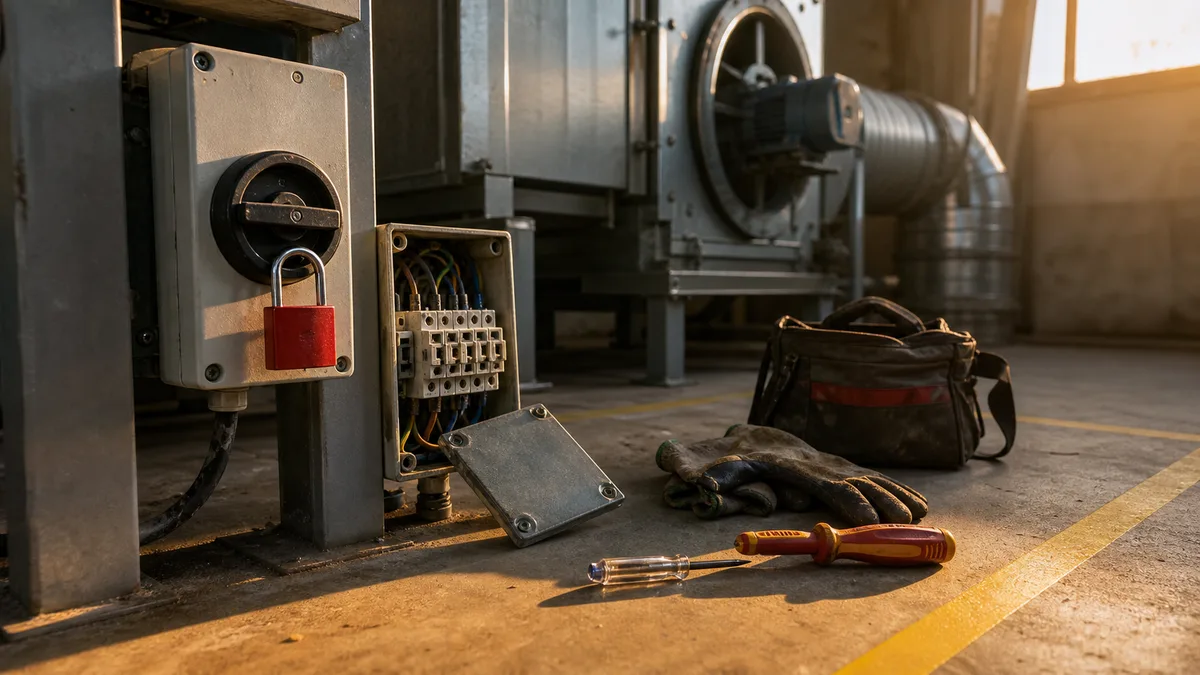
The enquiry is usually brief: “We need to train twenty people for the electrical qualification.” What lies behind it only becomes clear on site. Among the twenty names are three maintenance technicians who shut down a line before cleaning, a facility manager who opens a switchboard, fifteen people at computers and the cleaning lady. The first four need instruction tied to specific equipment, the rest are covered by ordinary occupational health and safety training. And a record that says nothing more than “electrical training” proves neither.
Let’s go through who instruction under § 4 of Government Decree No. 194/2022 Sb. really applies to, what the training must cover, who may deliver it and what a record looks like when it still proves something years later.
Who instruction under § 4 applies to
What matters is not the job title or the number of people on the payroll, but the actual activity, the specific equipment and the risks at the workplace.
Ordinary operation of extra-low and low-voltage equipment — switching a machine on using a control element intended for that purpose, working with a computer, a printer or a kettle — does not in itself require professional competence under the Government Decree. Instruction under § 4 starts to make sense where an employee works on electrical equipment, moves in its vicinity or carries out precisely defined tasks that could result in electric shock. Typically this means maintenance staff, production technicians, facility managers and people entering electrical operating areas.
| Situation at the company | What usually needs addressing |
|---|---|
| Employee uses a computer, printer or ordinary appliance | Ordinary OHS training and familiarisation with the manuals |
| Warehouse worker operates a machine using designated buttons, connects a forklift charger | Usually ordinary operation; assess according to the equipment and the manual |
| Cleaning staff work next to a closed switchboard | Set out the ban on opening it and the procedure in case of a fault; § 4 may not be needed |
| Maintenance technician works to instructions on de-energised equipment or in its vicinity | Instruction under § 4 is generally appropriate |
| Employee enters an electrical operating area or moves near uncovered live parts | Expert assessment, definition of safe distances and supervision or continuous supervision |
| Employee repairs wiring, takes measurements on live parts, connects fixed equipment | § 4 is not enough; this is work for a skilled person of the relevant scope |
The classification should follow from the risk assessment, the manufacturer’s manuals and local operational safety rules — not from how many places were left on the training date. We covered how to build a risk assessment around actual activities in our article on OHS risk assessment at your company.
Who an instructed person is and what they may do
An instructed person is someone who meets the conditions of § 19(3) of Act No. 250/2021 Sb. — full legal capacity, medical fitness for the activities performed, and instruction including verification of knowledge carried out by an authorised skilled person — and who has been instructed to the extent of the activity under § 4 of Government Decree No. 194/2022 Sb. The instruction covers the rules for ensuring occupational health and safety when working on and near electrical equipment, the possible sources and causes of risks, warnings about possible hazards, and first-aid procedures in the event of electric shock.
This need not be an employee, nor someone without an electrical education. In § 4(1) the Government Decree explicitly states that a skilled person whose examination has expired is also considered an instructed person — such a person can regain the qualification level of a skilled person only by passing the examination again.
Instruction is not a shortened electrician’s course. The scope of activities is defined by the legal and other rules for ensuring OHS, including local operational safety rules; under § 4(4) of Government Decree No. 194/2022 Sb., an instructed person may in particular:
- operate electrical equipment independently, with no voltage limit, subject to the restriction that they may only touch parts intended for operation,
- work to instructions on de-energised extra-low and low-voltage equipment and in its vicinity,
- work under supervision on de-energised high-voltage equipment and in its vicinity,
- work under the supervision of a skilled person near uncovered live low-voltage parts, at a safe distance from them or, at most, touching the insulating cover that protects against accidental contact with a live part,
- work under the continuous supervision of a skilled person near uncovered live high-voltage parts,
- work on electrical equipment in special cases — only where the operator has drawn up and issued a special working procedure, with which the instructed person was familiarised in advance and repeatedly at set intervals and for which they received practical training; a record of the familiarisation is drawn up and signed by the instructed person together with the person who carried it out.
Two things tend to get oversimplified in practice. First, the difference between supervision (dohled) and continuous supervision (dozor): the Government Decree does not define them, drawing instead on established terminology for the operation of and work on electrical equipment — under supervision, the skilled person checks the workplace before work begins and occasionally checks compliance with the rules while it is under way; under continuous supervision, they are permanently present at the workplace throughout the work. The Decree ties the stricter continuous supervision precisely to proximity to uncovered live high-voltage parts. Second, special cases: practical training, or the mere existence of a procedure, is not enough. There has to be an issued special working procedure, the familiarisation is repeated at set intervals, and there is a separate record of it signed by both parties — not just a line in the ordinary record of instruction.
An instructed employee does not extend their own scope by having once watched a similar intervention. Opening a different switchboard, a new production line or moving into an explosive atmosphere are all reasons for a fresh assessment and additional instruction. And an employee who has merely signed a general attendance sheet cannot be presented as an instructed person.
Where the instructed person ends and an electrician, a senior electrician or an inspection technician begins is described in our overview of professional competence in electrical engineering.
What electrical safety training must cover
The content and scope of the instruction are determined by the company according to its activities, equipment and risks. One presentation used identically for the office, the warehouse and the production hall is therefore typically not enough — and you can tell because the record does not name a single piece of equipment.
The instruction should reasonably cover:
- the equipment and workplaces it applies to,
- the permitted tasks and their exact limits,
- the purpose of covers, interlocks, safety signs and protective zones,
- what to do about a damaged supply cable, a missing cover, a smell of burning or a circuit breaker or residual-current device that keeps tripping,
- the ban on bypassing safety switches and interlocks,
- safe shutdown of equipment and calling in a skilled person,
- first aid in the event of electric shock,
- manufacturers’ manuals, working procedures and local operational safety rules.
Only specific examples turn training into something usable. With rooftop photovoltaics, the basics include explaining that switching off the AC side of the inverter does not remove voltage from the DC wiring — the panels generate voltage as long as the sun is on them, and strings run to hundreds of volts. On a production line, there is a difference between an emergency stop, which halts dangerous movement, and disconnecting and securing the equipment from its power supply before cleaning or maintenance; the emergency stop mushroom button does not handle that on its own. With a switchboard, it is worth mentioning that after the main switch is turned off, the incoming terminals upstream of it may remain live — it depends on the particular wiring and on whether the equipment was also disconnected on the supply side. That is why the de-energised state is not determined by the position of a lever but by verifying it and by the working procedure for that specific switchboard. Someone who hears this standing in front of their own switchboard with its doors open remembers it differently than from a picture in a presentation.
Verification of knowledge is part of the instruction. Under § 19(3) of Act No. 250/2021 Sb., it is graded as pass or fail, with 80 % correct answers required for a pass; the skilled person who carried out the verification is responsible for it and for the accuracy of the record issued. An oral test or a practical demonstration at the equipment itself is a useful addition matching the scope of activities, but the outcome must be demonstrably evaluated according to this statutory rule and documented for individual workers. The framework for the operation of and work on electrical equipment is set by standard ČSN EN 50110-1 ed. 4 (Operation of electrical installations — Part 1: General requirements), which fully superseded the earlier ed. 3 on 29 May 2026; the breakdown of activities in the Government Decree also draws on the terminology of this series of standards.
Instruction is no substitute for the technical condition of the equipment. An employee who knows what they must not do still works with whatever the company gives them — which is why training goes hand in hand with inspections of appliances and tools and with inspections of the electrical installation.
Who may deliver the instruction
The instruction and the verification of knowledge are carried out by an authorised skilled person — under the Government Decree, an electrician, a senior electrician or an inspection technician. Experience with general OHS training is not enough on its own if the trainer is not a skilled person of the corresponding scope.
So when choosing a supplier, don’t just ask for the company name. Find out:
- who will actually deliver the instruction,
- what professional competence that person holds and to what scope,
- whether they know the equipment and the environment they will be training for,
- whether they will go through the job descriptions, manuals and local rules beforehand,
- how the record will define the workplace and the permitted activities.
If you have no skilled person at your company, we will handle the instruction, the verification of knowledge and the record for you, right at your premises.
How to document the instruction
The skilled person draws up a record of the instruction. A signature on an attendance sheet headed “electrical training” does not prove which work and which equipment the employee was prepared for — and that is exactly what the first question asks, both during an inspection and after an accident.
The record should contain:
- identification of the company and the instructed person,
- the date and place of the instruction,
- the exact scope of the instruction,
- specification of the workplace,
- the designated equipment and permitted activities,
- a list of the rules, manuals and working procedures used,
- the method and result of the verification of knowledge (pass or fail),
- the interval for repeating the instruction and verification of knowledge, no longer than 3 years,
- identification of the skilled person and their professional competence,
- the signature of both the instructed person and the skilled person.
The signatures of both parties are not a formality — they are precisely what ties a particular person to a particular scope. Storing the document electronically is possible, but a plain export from an e-learning system or a ticked box may not in itself meet the requirement for a signature and demonstrable identification of the participant. Without a reliable electronic signing system it tends to be more practical to sign the record on paper and digitise it securely.
Store the documents so they can be traced by employee and by workplace, and keep them together with the rest of your operational documentation for electrical equipment. During an inspection it is not enough to know that “training happened somewhere”.
How often the instruction is repeated
For instructed persons, § 3(4) of Government Decree No. 194/2022 Sb. additionally requires regular training on the rules for ensuring occupational health and safety in line with the operator’s internal rules. If the company has no such internal rules, the training must take place at least once a year.
Two separate intervals apply to instructed persons, and they are regularly confused.
The first is the date for repeating the instruction stated in the record. The obligation follows from § 19(3) of Act No. 250/2021 Sb.: the record must set an interval no longer than 3 years within which the instruction and verification of knowledge must be repeated. The interval is set by the skilled person who carried out the instruction and verification — depending on the risk, the scope of activities and internal rules it may well be shorter. So the rule is “no later than the interval set in the record, and at most 3 years”, not an automatic three years for everyone.
The second is ordinary training on the legal and other rules for ensuring OHS. Under § 103 of the Labour Code, the employer determines its content, frequency and the method of verifying knowledge, and keeps documentation of it. So the three-year ceiling on instruction does not mean you can go three years without touching on electrical safety with an employee; we go into this in more detail in our article on when to repeat OHS training for employees.
There is, however, no point waiting for the due date when a job position, technology, equipment, workplace or working procedure changes. Fresh instruction is also appropriate after an accident, after a dangerous incident, or after finding that the prescribed procedure is not being followed in practice.
In person or online
The online format serves well for revisiting legal principles and general risks. For a first instruction under § 4, however, a generic course with no link to the workplace is usually not enough — it lacks exactly what makes a record convincing: specific equipment, specific limits.
For a small company, this combination works well:
- the theory,
- a walk-through of the actual workplace,
- a demonstration of permitted and prohibited interventions,
- verification of knowledge,
- signing the record with its exact scope.
With foreign workers, the training should be delivered in a way they genuinely understand. A Czech test signed by someone who understands neither the questions nor the work instructions is weak evidence and even weaker protection.
What affects the price and what to check in a quote
The price of company instruction is made up of two different things: preparation and the training itself. It is influenced by the number of workers, travel, the number of workplaces, the complexity of the technology and the volume of documentation the trainer goes through in advance. For visits to the premises, a fixed price for preparation and travel is therefore often combined with a per-participant price. We describe how training prices are put together in general in our article on how much OHS and fire safety training costs a company.
When comparing quotes, check whether the price includes:
- assessment of the employees’ actual activities,
- adapting the syllabus to your operation,
- the practical part at the workplace,
- verification of knowledge,
- drawing up records with a defined scope,
- keeping track of the next due dates.
The lowest price is no saving if the result is a generic certificate with no workplace, no scope of activities and no signature from a skilled person. Such a piece of paper is issued twice as fast and defended once, expensively.
What to prepare before ordering the training
Send the supplier the number of employees, their job positions, a list of workplaces and a brief description of their activities. Attach any available manuals, risk assessments, local operational safety rules and older records of instruction.
State specifically whether people enter switchrooms, open covers, secure equipment before cleaning, operate photovoltaics or intervene in the event of a fault. It is precisely these sentences that show who can be covered by ordinary OHS familiarisation and who needs instruction under § 4 — and it saves money and time on both sides.
Frequently asked questions
Does every employee who uses an electrical appliance need § 4?
No. Ordinary operation of extra-low and low-voltage equipment does not in itself require professional competence under the Government Decree. What matters is the actual activity and the risks at the workplace.
Can an employee of our company deliver the instruction?
Yes, provided they are an authorised skilled person with the corresponding scope of professional competence and they properly document both the instruction and the verification of knowledge.
How long is an instructed person’s documentation valid?
The instruction and verification of knowledge must be repeated no later than the interval stated in the record. Under § 19(3) of Act No. 250/2021 Sb., it is set by the skilled person who carried out the instruction and verification, and it may not exceed 3 years. Alongside this runs regular training on the OHS rules under the employer’s internal rules.
Is an online course with an automatically issued certificate enough?
A generic course usually does not cover the specific workplace, equipment and permitted activities. What is more, the record is signed by both the instructed person and the skilled person who carried out the instruction and verification.
Does § 4 entitle an employee to repair the electrical installation?
No. The instruction applies to the activities defined in the record and in local rules. Independent repairs to wiring, measurements on live parts or connecting fixed equipment are for a skilled person of the corresponding scope.
Sources for this article
- Electrical safety training and instructed persons – a SOHE service.
- Professional competence in electrical engineering – who is a skilled person, an electrician, a senior electrician and an inspection technician, and what each of them may do.
- Operational documentation for electrical equipment – local operational safety rules, manuals and records that the instruction builds on.
- OHS training for employees – how to set the content and frequency of the ordinary training that runs alongside instruction under § 4.
- Government Decree No. 194/2022 Sb. – requirements for professional competence to carry out activities on electrical equipment and for professional competence in electrical engineering; § 4 defines the instructed person, the content of the record and the scope of their activities, including the difference between work under supervision and work under continuous supervision and the conditions for special cases.
- Act No. 250/2021 Sb. – on occupational safety in connection with the operation of reserved technical equipment; § 19(3) sets out the prerequisites for an instructed person, the pass/fail grading of knowledge verification with a threshold of 80 % correct answers, and the repeat interval of no more than 3 years.
- Act No. 262/2006 Sb. – the Labour Code; § 103 requires the employer to determine the content and frequency of training on the OHS rules, the method of verifying knowledge and the keeping of documentation.
- ČSN EN 50110-1 ed. 4 – operation of and work on electrical installations; fully supersedes ed. 3 as of 29 May 2026. The standard is not freely available.
This text is for information purposes and does not replace legal advice. The specific training regime and the classification of individual employees need to be set according to the actual operation, the manufacturer’s documentation, the environment of use and the risk assessment.
We provide company electrical safety training, including instruction of persons under § 4 — with a workplace walk-through, verification of knowledge and a record naming the specific equipment and the scope of permitted activities. For a quote, just tell us the number of people, the training location and what your people actually do with the equipment. Write to us via our no-obligation enquiry form or at info@sohe.cz.
Exam dates for § 6 and § 7: open sessions in Brno are scheduled regularly, repeat examination online for CZK 1,400 per person — details on Electrical training and examinations.