
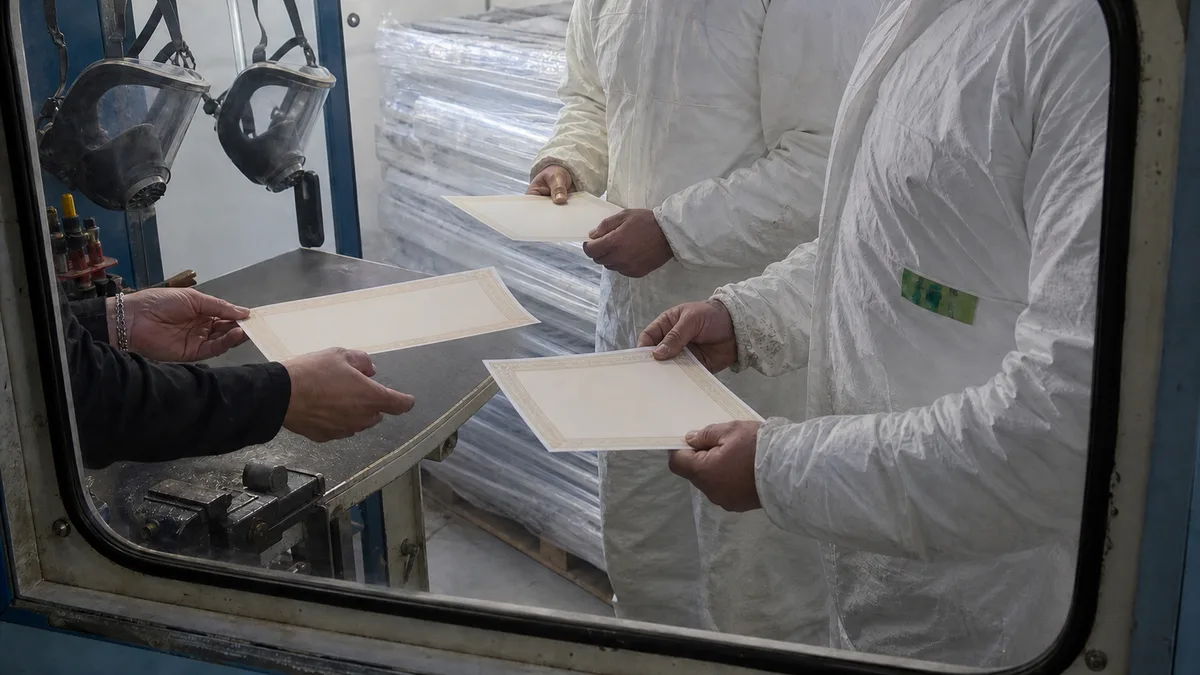
The short answer: Under Section 21(6) of nařízení vlády č. 361/2007 Sb., in the version effective from 1 January 2026, training for an employee who is or may be exposed to asbestos must be provided “at regular intervals, at least once every two years”; the previous wording did not specify any frequency. The new Section 21(7) also requires that every trainee “must be issued a certificate of completion of this training” containing seven specific items, while point (g) stipulates that the trainer must be a professionally qualified person responsible for performing risk-prevention duties. The certificate is not merely paperwork to be filed away: from the same date, Section 5(1)(b) of vyhláška č. 432/2003 Sb. requires it to accompany the asbestos work notification submitted to the public health authority.
A construction company takes on the renovation of a hall built in the 1980s. Its roof contains corrugated sheeting known to contain asbestos. A notification is prepared for the regional public health authority—but the authority asks for a list of workers by name and their training certificates. The certificates are not in the file because, until the end of 2025, they did not have to be submitted anywhere. The job comes to a standstill.
This scenario has been a new reality since January 2026. The changes were introduced by nařízení vlády č. 473/2025 Sb., promulgated on 19 November 2025, together with the regulation governing the required contents of asbestos work notifications and Section 41 of zákon o ochraně veřejného zdraví. Together, they change the documents a company must have in hand before anyone even sets foot on the roof.
What changed on 1 January 2026
| Requirement | Until 31 December 2025 | From 1 January 2026 |
|---|---|---|
| Training frequency (Section 21(6)) | “at regular intervals” with no specified frequency | “at regular intervals, at least once every two years” |
| Proof of training (Section 21(7)) | the regulation did not provide for certificates | “every employee who has completed the training must be issued a certificate” containing seven items |
| Who may provide training (Section 21(7)(g)) | the regulation did not specify the trainer | a professionally qualified natural person responsible for performing risk-prevention duties |
| Training content (Section 21(6)(e)) | safe procedures and protective measures | the same, plus “the use of technological equipment and machinery to limit the release and spread of asbestos fibres” |
| Permissible exposure limit | 0.1 respirable fibre/cm³ for fibres of all types of asbestos | 0.01 fibre/cm³ for work under Section 8(2) of zákon č. 309/2006 Sb.; 0.001 fibre/cm³ for other workplaces |
| Measurement frequency (Section 21(1)) | at least every three months or, if the conditions were met, once a year | “regularly and whenever a technical or technological change is made to the work performed” |
| Notification to the public health authority (Section 5 of vyhláška č. 432/2003 Sb.) | “number of exposed persons” | a list of names, evidence of training certificates and the date of the latest medical assessment |
| Consultation with the public health authority (Section 41(3) of zákon č. 258/2000 Sb.) | measures were discussed in advance | following the consultation, “the competent public health protection authority shall issue a decision authorising the asbestos work” |
The certificate: seven required items
The new Section 21(7) of nařízení vlády č. 361/2007 Sb. lists what the certificate must contain: the employee’s first and last name, the date of the training, its duration, the training content, the language of instruction, the certificate’s date of issue, and the name, qualifications and contact details of the trainer or institution—or both, where applicable.
The final item continues with a sentence that is more important when selecting a provider than the rest of the list combined: “for the purposes of this regulation, the trainer is a professionally qualified natural person responsible for performing risk-prevention duties under zákon o zajištění dalších podmínek bezpečnosti a ochrany zdraví při práci.” The regulation therefore newly links asbestos training to professional qualifications under zákon č. 309/2006 Sb..
A company can therefore carry out three checks itself: does it have a certificate for every exposed person, does each certificate state the language and duration of the training—which are the items most often missing, particularly for agency and foreign workers—and was the training completed less than two years ago?
Why this is not paperwork to be filed away
Until the end of 2025, an asbestos work notification under Section 5 of vyhláška č. 432/2003 Sb. included only the “number of exposed persons.” In the version effective from 1 January 2026, introduced by vyhláška č. 402/2025 Sb., the same point additionally requires a list of names, “evidence of certificates of completion of training … for all exposed persons,” and, for each employee, the date on which the latest medical assessment of fitness for work was issued.
Under Section 41(1) of zákon č. 258/2000 Sb., the notification must be submitted at least 30 days before work begins and again whenever the notified information or conditions change in a way that is likely to increase exposure. Clients and contractors carrying out construction work, as well as persons participating in it, have a shorter deadline under subsection 7—at least three days—and the obligation does not apply to work involving sporadic and low-intensity exposure.
A second change in the same section alters the nature of the procedure: whereas the previous wording referred to prior consultation on the measures, Section 41(3), in the version effective from 1 January 2026, adds that the public health protection authority will issue a decision authorising the asbestos work on the basis of the consultation’s outcome. Under subsection 6, public health protection authorities must also publish, in a remotely accessible format, a list of employers and persons who have obtained such authorisation within the previous three years. Anyone hiring an asbestos-removal company now has a public source for verifying it.
A 30-day deadline, complete certificates and valid medical assessments mean that preparation for an asbestos job begins roughly a month before the first site visit—much like the process for work categorisation.
Limits have fallen and been divided into two categories
The most significant numerical change appears in Annex 3, Part A. Until the end of 2025, the permissible exposure limit for fibres of all types of asbestos was a single value of 0.1 fibre/cm³. From 1 January 2026, there are two values:
- 0.01 fibre/cm³ for work listed in Section 8(2) of zákon č. 309/2006 Sb.—laboratory research, analytical work, disposal of stocks, waste and equipment containing asbestos, removal of buildings and building components containing asbestos, repairs and maintenance work on buildings, and work involving sporadic and low-intensity exposure;
- 0.001 fibre/cm³ for working environments and work not listed in that subsection.
This list is no coincidence: Section 8(2) of zákon č. 309/2006 Sb. begins with the sentence “Work with asbestos is prohibited” and then sets out the exemptions. The stricter value of 0.001 therefore applies to ordinary workplaces where asbestos work should not take place and where asbestos is encountered as a remnant of an old structure—the typical situation faced by a facility manager. Section 21(4) refers to the same value: after asbestos removal, verification measurements must be taken, and further activities may continue if the measured value is lower. The threshold above which a work process is considered to present a chemical carcinogenicity risk under Annex 2, Part C has also fallen tenfold, from 0.1 to 0.01 fibre/cm³.
The method has changed as well: Annex 3, Part B, point 6 now requires fibres to be counted using electron microscopy or another equivalent method producing at least equivalent results, whereas a phase-contrast binocular microscope was previously sufficient. For measurements within workplace areas, point 5 refers to ČSN EN ISO 16000-7 and sets a minimum sample volume of 2 m³ at a standard flow rate of 8 dm³/min. Anyone commissioning measurements from a laboratory now has clear criteria against which to check the report.
What the deferred effective date of 1 September 2026 does not affect
Nařízení vlády č. 473/2025 Sb. has a two-stage effective date, which has led to a misconception that further asbestos-related changes take effect on 1 September 2026. They do not. A comparison of the consolidated versions of nařízení vlády č. 361/2007 Sb. effective on 1 January 2026 and 1 September 2026 reveals only one substantive difference: Section 12a, concerning the handling of hazardous chemical substances by underage students during vocational training, is repealed on 1 September 2026. The asbestos provisions are identical in both versions. The relevant date is therefore 1 January 2026, and the two-year period is calculated from the training date stated on the certificate.
When this also applies to you, even if you “do not work with asbestos”
The obligations under Section 21 apply to an employee who is or may be exposed to asbestos or dust from asbestos-containing material. The determining factor is therefore the health risk assessment under Section 20. Under subsection 2, information from the building owner or other verifiable sources may be used to establish whether asbestos is present; if such information is unavailable, the materials must be analysed.
This includes occupations that are not generally considered “asbestos-related”: maintenance workers on older roofs, ventilation installers working above suspended ceilings, and electricians cutting channels into old building cores. Whether you need training and certificates depends not on the job title but on the risk assessment.
Frequently asked questions
Does an asbestos certificate replace standard occupational safety training?
No. It is separate training focused on a specific risk factor, with its own content under Section 21(6)(a) to (j) of nařízení vlády č. 361/2007 Sb. and its own interval. General employee training is discussed in our article on occupational safety training.
Are certificates issued in 2025 still valid?
Nařízení vlády č. 473/2025 Sb. contains no transitional provision concerning certificates. The wording of Section 21(7) and Section 5(1)(b) of vyhláška č. 432/2003 Sb. therefore provides the relevant guidance: a certificate must be submitted with the notification, and the regulation specifies seven items that it must contain. An older document missing any of these items should be replaced before the notification is submitted.
Sources used for this article
- Employee training – a service provided by SOHE.
- Occupational safety training for employees: when it should be repeated – intervals, content and documentation of general training.
- Work categorisation: what a company reports to the public health authority – classification of work into categories and exposure records.
- Occupational safety risk assessment in a company – the basis for deciding which workplace risks must be addressed.
- Nařízení vlády č. 361/2007 Sb. – podmínky ochrany zdraví při práci, version effective from 1 January 2026; Section 19(2), Section 20, Section 21(1), (4), (6) and (7), Annex 2, Part C, and Annex 3, Parts A and B.
- Nařízení vlády č. 473/2025 Sb. – amendment to the preceding regulation, promulgated on 19 November 2025 and effective from 1 January 2026, with one provision deferred until 1 September 2026.
- Zákon č. 258/2000 Sb. – o ochraně veřejného zdraví, version effective from 12 June 2026; Section 41(1), (3), (6) and (7) on notification and authorisation of asbestos work.
- Zákon č. 309/2006 Sb. – o zajištění dalších podmínek BOZP; Section 8(2) on the prohibition of asbestos work and exemptions, and Section 12 on persons outside employment relationships.
- Vyhláška č. 432/2003 Sb. – kategorizace prací a náležitosti hlášení prací s azbestem, version effective from 1 January 2026; Section 5(1) and (2).
- Vyhláška č. 402/2025 Sb. – amendment to vyhláška č. 432/2003 Sb., effective from 1 January 2026.
- ČSN EN ISO 16000-7 – Vnitřní ovzduší – Část 7: Postup odběru vzorku při stanovení koncentrace azbestových vláken v ovzduší.
The legal position was verified against e-Sbírka as of 29 August 2026, including a comparison of the consolidated versions of nařízení vlády č. 361/2007 Sb. effective on 1 January 2026 and 1 September 2026, as well as the wording of vyhláška č. 432/2003 Sb. before and after the amendment.
This text is for informational purposes and does not constitute legal advice. The specific arrangements for your building or operations—whether the activity constitutes asbestos work, who is exposed, and what measurements and documentation are required—must be determined according to the actual operations, the manufacturer’s documentation, the environment in which the materials are used and the risk assessment.
Are you planning renovation, demolition or maintenance work on an older building and unsure whether the asbestos rules apply to you? We will review the risk assessment with you, identify who qualifies as exposed and prepare employee training, including certificates under Section 21(7) of nařízení vlády. We can also handle all related occupational safety requirements—see occupational safety services for businesses. Send us a no-obligation enquiry or email info@sohe.cz.