
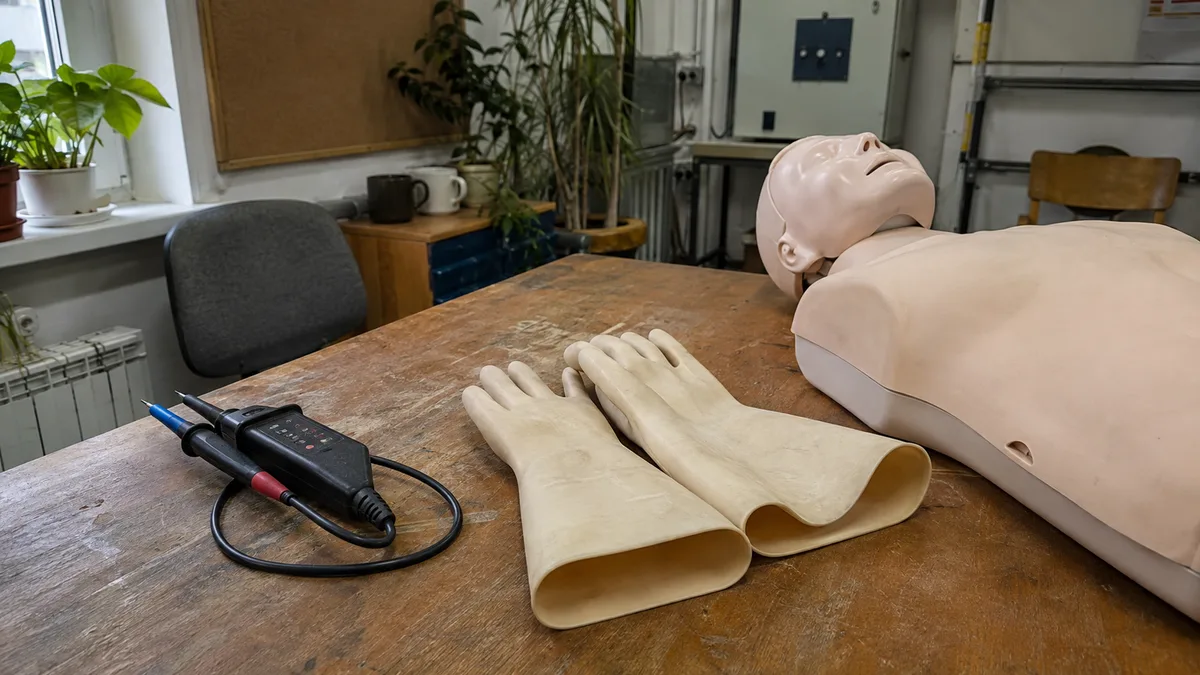
Anyone preparing for a professional competence exam in electrical engineering will usually look for a mock test. However, there is no single national question bank for § 6 and § 7—each examination board prepares its own set within the limits of the applicable regulations.
Those limits are defined quite precisely. The following twenty questions are for practice: they are not questions used by the SOHE examination board or anyone else. They cover the four areas specified for examination boards by NV 194/2022 Sb., and each answer identifies the provision on which it is based. The article How to Obtain Electrical Qualifications explains the entire qualification process from the beginning; this article focuses on the exam content.
Quick answer
Practice questions are not a shortcut to passing the exam, but a tool for identifying gaps in your knowledge. Under § 9 odst. 2 NV 194/2022 Sb., the actual exam has two parts: a written test with at least 10 questions and an oral interview covering the test result, any mistakes made, and technical topics relevant to the examinee’s intended work.
Each part is graded pass or fail. Under § 19 odst. 2 písm. c) zákona č. 250/2021 Sb., at least 80% of the answers must be correct in each part, and the examinee may proceed to the oral part only after passing the written part. Under § 19 odst. 2 písm. b) of the same law, the certificate is valid for three years from its date of issue. Anyone who fails may take the exam again, but no sooner than 15 days after the unsuccessful attempt; the law does not limit the number of retakes.
What the examination board may test
Section 9 odst. 1 NV 194/2022 Sb. defines four areas covered by both the training and the exam:
- a) obligations arising from legal and other occupational health and safety regulations applicable to the work the examinee will perform or manage;
- b) theoretical and practical knowledge of first aid, particularly in cases of electric shock;
- c) work and technological procedures, operating and safety instructions, and the sources and causes of risks associated with the same work;
- d) other essential facts and information affecting occupational and operational safety.
One detail is particularly easy to overlook during preparation. Under § 9 odst. 2 písm. a), the written test covers only areas a) and b)—regulations and first aid. Under písm. b) of the same paragraph, areas c) and d) belong in the oral interview. Anyone who studies only for the test is preparing for just half of the exam.
For companies with their own training system, § 9 odst. 6 also allows training and examination in area c) to be replaced by confirmation from the responsible person that the individual regularly undergoes such training. The template is provided in příloha č. 4.
20 practice questions
There is one correct answer to each question. Answer without looking at the solution, and whenever you make a mistake, look up the cited provision.
A) Regulations and obligations (questions 1–7)
1. Which qualification level may manage work on and design vyhrazená elektrická zařízení (designated electrical equipment)?
a) osoba poučená under § 4 b) elektrotechnik under § 6 c) vedoucí elektrotechnik under § 7
Correct answer: c) — § 7 odst. 1 NV 194/2022 Sb.; an elektrotechnik under § 6 odst. 1 works independently but may not manage or design such work.
2. Who determines the minimum professional experience required for an elektrotechnik under § 6?
a) the examination board b) the responsible person, through the local operating safety regulations c) the regulation specifies the same number of years for everyone
Correct answer: b) — § 6 odst. 2 NV 194/2022 Sb., in accordance with the risk assessment. Section 6 does not specify a fixed number of years—unlike § 7 odst. 2, which lists the required periods of experience for scopes E1A to E3B.
3. An elektrotechnik starts work with the appropriate education but no experience. What must the local operating safety regulations require?
a) nothing additional; the exam certificate is sufficient b) supervision by an osoba znalá with at least two years of experience for a minimum of one year c) supervision by a revizní technik for five years
Correct answer: b) — The second sentence of § 6 odst. 2 NV 194/2022 Sb.; this is the only fixed period relating to experience specified by the regulation.
4. Who must chair the three-member examination board for an exam under § 6 or § 7?
a) a representative of Technická inspekce ČR b) an osoba odborně způsobilá k provádění revizí under § 11 zákona č. 250/2021 Sb. c) any vedoucí elektrotechnik
Correct answer: b) — § 6 odst. 3 and § 7 odst. 4 NV 194/2022 Sb. An exception applies only to operators of electricity transmission and distribution systems.
5. How long is the exam certificate valid, and within what period must the instruction of an osoba poučená be repeated?
a) the certificate is valid for five years; instruction is repeated annually b) the certificate is valid for three years; instruction must be repeated within three years at the latest c) the certificate is valid indefinitely; instruction is not repeated
Correct answer: b) — The certificate’s validity follows from § 19 odst. 2 písm. b) zákona č. 250/2021 Sb.; under § 19 odst. 3 písm. b), the deadline for repeating the instruction is recorded by an osoba znalá and may not exceed three years.
6. What determines the scope of professional competence stated on the certificate?
a) the voltage range and the environment, meaning premises without or with an explosion hazard b) the number of years of experience c) the employer’s size
Correct answer: a) — § 6 odst. 5 NV 194/2022 Sb.: up to 1 kV AC (1.5 kV DC), or without limitation. Under § 6 odst. 6, the examination board may limit the certificate to the activities actually performed.
7. An electrician is self-employed and has no employer. Who must arrange the exam?
a) Technická inspekce ČR b) the electrician does not need one because they have no employees c) the electrician is required to arrange it for themselves
Correct answer: c) — § 19 odst. 4 zákona č. 250/2021 Sb. An external provider must include the provision of training and examinations within its registered business activities.
B) First aid for electric shock (questions 8–12)
8. A colleague is still in contact with a live part. What should you do first?
a) grab them and pull them away b) protect yourself and interrupt the current—switch off the equipment or move the injured person away using a non-conductive object c) begin CPR before disconnecting the power
Correct answer: b) — A rescuer who touches someone still in contact with live voltage becomes a second casualty. First aid is an exam topic under § 9 odst. 1 písm. b) NV 194/2022 Sb.
9. Which number should you call for emergency medical services?
a) 155, or the single European emergency number 112 b) 150 c) 158
Correct answer: a) — 150 is for the fire service, while 158 is for Policie ČR.
10. The injured person has been disconnected from the source. What should you check next?
a) whether they are carrying identification b) whether they respond and are breathing normally c) the extent of their burns
Correct answer: b) — A person who responds and breathes needs rest, monitoring, and professional help; a person who is unresponsive and not breathing normally needs CPR.
11. What is the ratio of chest compressions to rescue breaths during adult CPR?
a) 15 : 2 b) 5 : 1 c) 30 : 2
Correct answer: c) — This is the generally accepted procedure for adults; anyone unable or unwilling to give rescue breaths should at least provide uninterrupted chest compressions.
12. The affected colleague is conscious and insists that they feel fine. What should happen next?
a) they may continue working b) recording the incident in the accident log is sufficient c) they should undergo a medical examination even if they feel well
Correct answer: c) — Electric current passing through the body can cause an abnormal heart rhythm that only becomes apparent later. Anyone who has suffered an electric shock should therefore be medically examined.
C) Work procedures (questions 13–16)
13. How many safety rules must be followed before working on de-energised equipment, and what is the first step?
a) three; begin by verifying the absence of voltage b) five; begin by disconnecting the equipment from all power sources c) two; begin by earthing the equipment
Correct answer: b) — Disconnect completely, secure against reconnection, verify the absence of voltage, earth and short-circuit, and protect against adjacent live parts. These principles are set out in ČSN EN 50110-1 ed. 4, and their order is not arbitrary.
14. At what point should the absence of voltage be verified?
a) after disconnection and securing against reconnection, at the worksite and on all poles b) only before leaving the worksite c) it does not need to be verified if the main circuit breaker is switched off
Correct answer: a) — Verification is the third rule in the sequence. A switched-off circuit breaker does not itself prove that the equipment is de-energised—it may be supplied from the other side or by a backup source.
15. Why is equipment earthed and short-circuited for certain types of work?
a) to measure insulation condition b) to reduce power consumption c) to protect the worksite if voltage unexpectedly appears
Correct answer: c) — This is the fourth of the five rules; the extent to which it applies to a particular task depends on the work procedure and risk assessment.
16. What does the fifth rule—protection against adjacent live parts—mean?
a) unplugging appliances throughout the building b) covering or enclosing nearby live parts that a worker could approach c) dividing the work crew into two groups
Correct answer: b) — Work is often carried out on a de-energised section while an adjacent section remains live; the fifth step establishes a protective boundary between them.
D) Risks and personal protective equipment (questions 17–20)
17. What are the two main hazards when working on electrical equipment?
a) noise and vibration b) electric current passing through the body after contact with a live part, and the effects of an electric arc c) dust and chemicals
Correct answer: b) — In addition to burns, an arc can cause temporary blindness and a pressure wave. Sources and causes of risks are an exam topic under § 9 odst. 1 písm. c) NV 194/2022 Sb.
18. What is step voltage?
a) voltage between two electrical sockets b) voltage measured while walking up or down stairs c) the potential difference between two points on the ground around a location where current enters the earth
Correct answer: c) — This hazard may arise around a fallen conductor and increases with the distance between the feet; move away from such a location using small shuffling steps or with both feet together.
19. What is meant by working in the vicinity of live equipment?
a) work during which a worker or their tools may approach exposed live parts b) any work in a building with electrical wiring c) work inside a substation
Correct answer: a) — The equipment has not been switched off; it is simply not the object of the work. Under § 4 odst. 4 písm. d) NV 194/2022 Sb., an osoba poučená may perform such work near low-voltage equipment only under the supervision of an osoba znalá.
20. What applies to a voltage detector and insulating gloves?
a) they may be used as long as they appear visually undamaged b) they must be checked before use and used only within their rated scope; the voltage detector’s operation must be verified both before and after testing c) an inspection once every five years is sufficient
Correct answer: b) — A voltage detector that fails between disconnection and verification may indicate “no voltage” even when the equipment is live. Inspection intervals are based on the manufacturer’s instructions and internal regulations.
How to use these questions before the exam
- For every mistake, open the cited provision, not your training notes. The wording of the regulation often differs from the explanation given during training, and the examination board tests the former.
- Prepare separately for the oral part. It covers work procedures, operating instructions, and risks under § 9 odst. 1 písm. c) and d) NV 194/2022 Sb.—topics that were not included in the written test. Review your local operating safety regulations.
- Clarify the scope in which you are taking the exam—the voltage and environment under § 6 odst. 5. The questions will then reflect the work you will actually perform.
Under § 9 odst. 5 NV 194/2022 Sb., evidence of qualifications and experience must be presented to the chair of the examination board before the exam begins. The article on the exam procedure and composition of the examination board explains what to bring and what happens on the day.
The SOHE exam: dates and prices
Our exam is conducted by a three-member board chaired by a revizní technik, as required by § 6 odst. 3 NV 194/2022 Sb.
- New elektrotechnik § 6 or vedoucí elektrotechnik § 7—training, examination before the board, and certificate, approximately CZK 2,500 per person excluding VAT.
- Online re-examination after three years—a test and oral interview with the board by video call, approximately CZK 1,400 per person excluding VAT.
- Open sessions in Brno: scheduled regularly — current dates are on the Electrical training and examinations page.
- An individual online date can be arranged for urgent requirements from two people, or at your company’s premises by agreement.
The exact price depends on the scope of the training and the number of participants; current figures are available in the price list, which is our single source of truth. No one can guarantee that you will pass the exam—we can provide preparation, but the outcome depends on the examination board and the examinee.
Sources for this article
- Electrical training and exams – a SOHE service.
- How to Obtain Electrical Qualifications in 2026 – the process from education and experience to certification; this article follows on by covering the exam content.
- Professional Competence Exam in Electrical Engineering: Procedure and Examination Board – what happens on the day of the exam and how to recognise a correctly issued certificate.
- Renewal and Re-examination of Electrical Competence – what to do when the end of the certificate’s three-year validity period approaches.
- Nařízení vlády č. 194/2022 Sb., as amended (most recently by NV č. 175/2024 Sb.) – governing professional competence for work on electrical equipment; § 4 covers osoba poučená, § 6 covers elektrotechnik (experience, examination board, and certificate scope), § 7 covers vedoucí elektrotechnik, and § 9 covers training and examinations.
- Zákon č. 250/2021 Sb., as amended (most recently by zákon č. 318/2025 Sb.) – governing occupational safety in the operation of vyhrazená technická zařízení; § 19 odst. 2 covers certificate validity, the 80% threshold, the order of the two exam parts, and the waiting period before a retake, § 19 odst. 3 covers instruction, and § 19 odst. 4 specifies who arranges the exam.
- ČSN EN 50110-1 ed. 4 is mentioned by name only as the source of the principles for working on de-energised equipment; standards are not freely available.
This article is provided for informational purposes and does not constitute legal advice. The specific training arrangements, exam scope, and required experience must be determined according to the actual operation, the manufacturer’s documentation, the environment in which the equipment is used, and the risk assessment.
Do you need an exam for a new elektrotechnik, or are your entire team’s certificates approaching their expiry date? See our electrical training and exams and contact us at info@sohe.cz or through the non-binding enquiry form with the number of people requiring re-examination and the required scope. We will get back to you with a suitable date—an open session in Brno, an individual online session, or an exam at your company’s premises.