
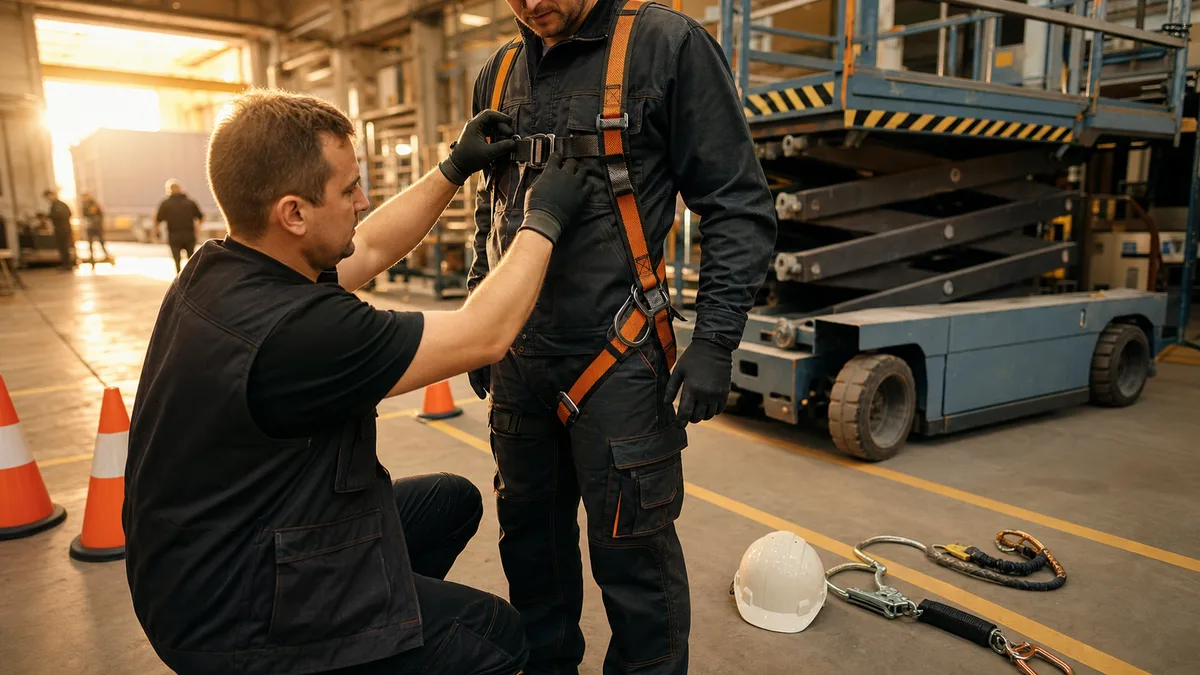
Request quotes for occupational health and safety (OHS) and fire protection training from three providers, and you’ll get back three offers that differ by an order of magnitude — yet all promise the same thing: trained employees and a certificate for the file. One price is per person, another covers a trainer’s site visit, a third is an annual app subscription. Without asking further questions, you can’t compare them, because each one assumes a different scope.
This article won’t promise you a single universal number. We’ll go through the training formats, including the limits of e-learning, the components that make up the price, red flags for suspiciously cheap courses, and what an order should look like so the offers you get back actually target the same thing.
What You’re Actually Ordering: “Training” Is Several Different Items
Behind the single sentence “train our people” hide several separate tasks, each with its own rules and price:
- OHS training for employees. Under Section 103 of the Labour Code (Act No. 262/2006 Coll.), employers must provide training on the legal and other regulations governing workplace safety — on hiring, when an employee’s job role or type of work changes, when new technology is introduced, and in other situations that affect workplace safety. The law sets no fixed interval for repeating standard training; under Section 103(3), the employer determines the content and frequency based on risk. Common practice: roughly once a year for higher-risk operations, every two to three years for office work — covered in detail in our article on OHS training for employees.
- Training for managers and supervisors. In terms of content, this goes beyond routine operations — inspection duties, procedures for workplace accidents, responsibility for the area under their supervision. In quotes, it’s usually a separate block and a separate line item.
- Fire protection training. This follows its own rules under fire protection regulations, and its scope depends on how the operation is classified by fire hazard category — more in our article on fire protection in the workplace. Small companies commonly combine it with OHS training in a single session; in the documentation, however, the two areas should still be kept separate, at least as distinct blocks.
- Specialized and professional training. Work at heights, riggers, operation of material-handling equipment, electrical qualifications — these are separate items with their own rules under special regulations, usually with their own trainers as well. They don’t fit into the “bundled” price of standard OHS training.
Before you start comparing prices, be clear about which of these items you’re actually requesting — otherwise each offer will be based on something different.
Three Training Formats and What to Expect From Each
On-site at your workplace. A trainer comes to your facility. The biggest advantage is that the training can be built around the specific risks of your workplace — walking through the operation, pointing out assigned PPE, evacuation routes and fire extinguishers, discussing real incidents from your company. Shifts can be trained in blocks, and the practical part happens right there in the operation. The price depends mainly on the trainer’s time and travel, not on headcount — so for a larger group, the per-person cost works out most favorably. The trade-off is organizational: you’ll need to pause part of the operation for a few hours.
In person at the provider’s premises. An open classroom course makes sense for individuals — a new manager, or an employee who started outside the scheduled group training date. You pay per person, and per person this is usually the most expensive format. The limit: the trainer doesn’t know your workplace — a generic course needs to be supplemented with a briefing on the specific risks at your site.
E-learning. The cheapest per person, and it scales well: a new employee gets access on their first day, and the system automatically records who completed the module, when, and with what result. It works well for office staff and for periodic refreshers where nothing significant has changed since the last time.
In practice, formats get combined: e-learning for the office, an in-person block with a practical component for production, the warehouse, and managers.
Where E-Learning Has Its Limits
Regulations don’t prescribe a specific training format — the Labour Code requires the employer to provide the training and determine its content, frequency, and method of verifying knowledge. So e-learning isn’t inherently “less valid.” The limits are practical:
- Content has to relate to the actual job. The Labour Code ties training to the risks an employee actually encounters at their workplace. A generic course about office risks won’t cover a warehouse with material-handling equipment, or a workshop — and during an inspection or after an accident, what the person was actually briefed on is exactly what gets examined.
- A screen can’t replace the practical part. Trying on PPE, a demonstration of a fire extinguisher, walking the evacuation route, correct manual handling of loads — for higher-risk roles, these things are the core of the training, not a bonus.
- Specialized training has its own regime. For work at heights, riggers, or machine operation, practical training under special rules is generally required; pure e-learning won’t cover the required scope there.
- The record has to hold up under inspection. The system should show who completed the training, when, under which curriculum, and with what result; “we sent them a link” won’t hold up.
What Makes Up the Price
A serious provider reads a request through several variables — and each one moves the price:
| What affects the price | Why |
|---|---|
| Number of employees | determines the billing model: per person (e-learning, open course) vs. per session and trainer time (on-site at your location) |
| Shift operations | two or three shifts mean more sessions, potentially training at night or on weekends — more trainer time |
| Number of job roles | office staff, production, warehouse, and managers need different curricula; each curriculum means preparation work |
| Scope of documentation | curriculum with time allocation, attendance sheets, tests with evaluation, records with the date of the next training — included in the price, or billed separately? |
| Degree of customization | a ready-made template vs. training built around your risk assessment and actual incidents |
| Participants’ language | foreign-language employees mean translated versions of materials, tests, and the presentation itself |
| Travel and location | trainer’s site visit, multiple locations, makeup sessions for absentees |
Two items deserve extra emphasis. Shifts are the most commonly underestimated variable: a company requests “training for 40 people,” and only during scheduling does it become clear that this means three sessions, including one spanning into the night. And documentation included in the price is the most common source of incomparable offers — one price includes complete records, another just a “certificate” without a verifiable curriculum, and on paper both look like the same training.
So How Much Does It Actually Cost
We deliberately won’t give specific figures here. A range that covered both e-learning for five office employees and three in-person sessions for two-shift production would be so wide it wouldn’t help — and a narrower number, without knowing your operation, would just be made up. As a rough guide, only the relative order holds: e-learning is the cheapest per person, an on-site session at your location gets cheaper per head as the number of participants grows, and an open course is usually the most expensive per person. Everything depends on scope — headcount, shifts, job roles, and what exactly is included in the price.
With ongoing cooperation, training is also often folded into a monthly OHS retainer along with inspections and documentation — we cover how that model works in our article on OHS outsourcing and an external risk prevention specialist.
Want a quote for training tailored to your headcount, shifts, and job roles? Send us a no-obligation inquiry — we schedule our training sessions well in advance, so it’s worth reaching out before deadlines start closing in.
Training “for 99 CZK”: What a Cheap Offer Usually Lacks
Ultra-cheap e-learning isn’t automatically a scam — for a small office with low risks, a simple course can be a legitimate choice. The red flags lie elsewhere, not in the price itself:
- No verifiable curriculum. The provider can’t say exactly what the course covers or how much time is allocated to it. After an accident or during an inspection, you then have nothing to prove what the employee was actually briefed on — a colorful certificate with a logo won’t save you.
- No connection to your risks. The same course for an online shop, a stamping plant, and a construction company means nobody asked what your people actually do.
- Knowledge verification is missing, or impossible to fail. A test that everyone passes on the first click isn’t verification.
- Unclear who’s responsible for the content. Ask who put the curriculum together, who updates it when regulations change, and what qualifications they hold.
- “Valid forever.” An offer with no date for the next training ignores the fact that frequency is supposed to be set based on a documented risk assessment.
Who Is Allowed to Train Managers and Supervisors
The Labour Code doesn’t specify by name who is allowed to conduct the training — responsibility for arranging it and for its content rests with the employer. However, Section 9 of Act No. 309/2006 Coll. sets the framework: with up to 25 employees, the employer may handle risk prevention tasks themselves, provided they have the necessary knowledge; from 26 employees, only if they themselves are professionally qualified, otherwise they need a qualified risk prevention specialist (OZO); above 500 employees, an OZO is always mandatory.
For training aimed at managers, which also covers inspection duties and accident procedures, insist on a trainer with professional qualifications in risk prevention, and keep proof of that qualification on file with your documentation. An offer where managers just “click through” the same generic e-learning as regular employees is suspicious in itself.
What a Good Training Order Looks Like
A good order is a short brief that lets the provider price the actual scope:
- Number of employees and breakdown by job role — “12 office staff, 28 production, 5 warehouse workers operating material-handling equipment, 4 managers.”
- Shift schedule and when training can happen — “two-shift operation, training possible in two blocks at the shift changeover.”
- Participants’ language — how many people need a version other than Czech.
- What you’re requesting — OHS training, fire protection training, managers separately, and any related specialized training.
- Format — on-site at your location, e-learning, or a combination depending on job role.
- What should be included in the price — curriculum with time allocation, attendance sheets, knowledge verification with evaluation, records with the date of the next training.
- Materials you’ll provide — risk assessment, job categorization, internal directives; and conversely, what you expect the provider to propose.
- Timeline — ideally several weeks in advance, not “by Friday.”
After the training, take receipt of the complete documentation: the curriculum, signed attendance sheets, records of knowledge verification, proof of the trainer’s qualifications, and the date of the next training. This is what actually distinguishes offers more reliably than the number on the invoice.
Sources for This Article
- Employee Training – SOHE’s service: initial and periodic OHS and fire protection training tailored to your operation.
- OHS Training for Employees: When to Repeat It, What It Should Cover, and How to Document It – intervals, content, and documentation of training.
- OHS Outsourcing: When an External Risk Prevention Specialist Pays Off – thresholds under Section 9 and pricing models for ongoing cooperation.
- Fire Protection in the Workplace – fire hazard classification and fire protection obligations, including training.
- Act No. 262/2006 Coll. – the Labour Code; Section 103 governs the obligation to provide training on legal and other regulations for ensuring OHS, with the employer determining its content and frequency.
- Act No. 309/2006 Coll. – on ensuring further conditions for OHS; Section 9 sets out when an employer may handle risk prevention themselves and when a qualified risk prevention specialist is required.
The legal status was verified against SOHE’s regulatory register: the Labour Code as of July 23, 2026 (version effective from January 1, 2026), Act No. 309/2006 Coll. as of July 14, 2026 (as amended by Act No. 318/2025 Coll., effective November 1, 2025). The price relations given in this article are indicative and depend on scope; they do not constitute a SOHE price list or a binding offer.
This text is for informational purposes only and does not substitute for legal advice. The specific training regime, its content, format, and frequency need to be set according to the actual operation, job categorization, and risk assessment.
Need OHS and fire protection training that holds up during an inspection and after an accident — with a price that matches your operation, not a template? SOHE’s Employee Training is built around the risks of your specific workplace, including shifts and managers. Send us a no-obligation inquiry or write to info@sohe.cz, and we’ll work out the scope and scheduling for your company.