
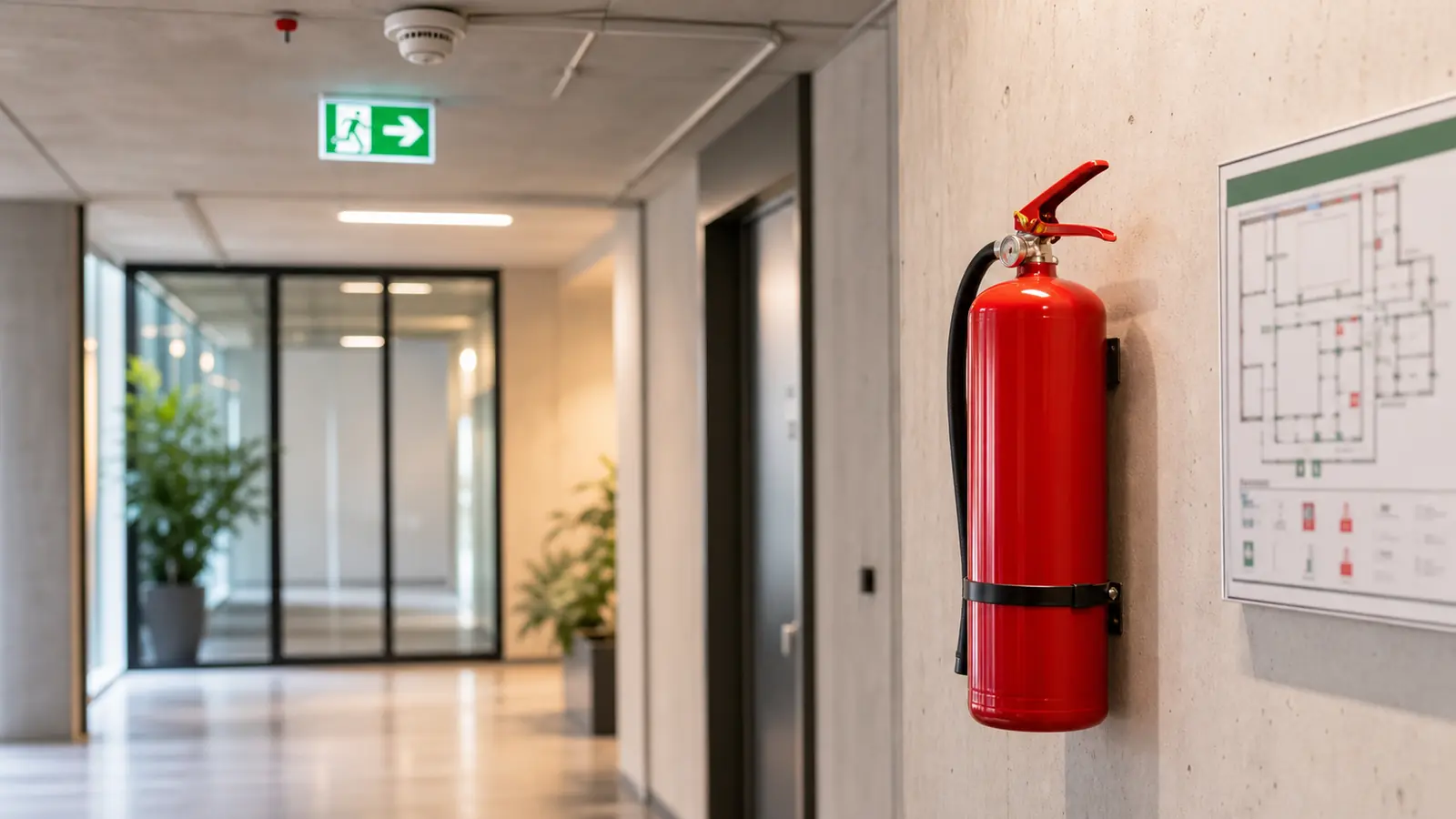
A lot of managing directors see fire safety as a necessary evil – a red canister in the corner of the hallway and a piece of paper signed by someone whose phone number is buried deep in a drawer. But the reality is different. Fire safety is a living system that must respond to what is actually happening in the company. Office relocations, a new server, a change in technology, or even just a new colleague – all of this has an impact on fire safety. And if you don’t address it, it hurts during an inspection by the Fire Rescue Service or after a loss event. It’s not just fines. It can also mean a shutdown of operations.
What category does your activity fall into
The fundamental regulation is Act No. 133/1985 Coll., on Fire Protection. Section 4 divides operated activities into three categories according to the degree of fire hazard:
- Without increased fire hazard – typically small administration, minor services. Obligations are minimal here.
- With increased fire hazard – this includes most companies with production, warehouses, and larger premises. This is where mandatory documentation, training, and preventive fire patrols begin.
- With high fire hazard – operations with large quantities of flammable substances, high-rise buildings, environments with an explosion hazard. The rules are the strictest, and you cannot manage without a professionally qualified person.
Beware of a common mistake: classification is not determined by the simple number of people in the building. The criteria for “increased hazard” are substantive (Section 4, Paragraph 2) – the quantity of flammable substances and gases, combustible dust, fire load, number of above-ground floors, or type of building (e.g., buildings for public assembly, commerce, accommodation). The classification itself is your responsibility. The obligation to prepare fire safety documentation and ensure regular training is tied precisely to the two higher categories (Section 15 and Section 16 in conjunction with Section 4, Paragraphs 2 and 3). If you are unsure about the classification, in the final instance, the correct category is decided by the state fire inspection body (Section 4, Paragraph 5).
What fire safety documentation is mandatory
What must be documented is determined by Decree No. 246/2001 Coll., on Fire Prevention. Not everyone needs a binder with a dozen directives. Generally speaking: the higher the category, the thicker the binder.
- Fire Safety Order – establishes the fire safety conditions for the operated activity. Mandatory for activities with increased and high fire hazard.
- Fire Alarm Directives – simple instructions on what to do in case of fire. Posted in visible locations.
- Fire Evacuation Plan – a graphic representation of escape routes. Mandatory for high hazard, or where stipulated by fire safety conditions.
- Fire Logbook – a record of everything that has occurred in fire safety: training, inspections, preventive checks, defects.
- Documentation of Preventive Fire Inspections – inspections are carried out by a fire prevention officer; their intervals depend on the activity category.
Fire safety documentation can also be kept electronically. For the fire logbook, it is important that it can be printed on request and signed by the persons responsible for the operation.
Inspections and checks – not just fire extinguishers
You are responsible for the operational readiness of fire safety equipment and material fire protection resources. Intervals are determined by Decree No. 246/2001 Coll. and always also by the manufacturer’s accompanying documentation – this may stipulate a shorter interval, never a longer one. A regular check is not the same as an inspection; it is a verification that the item will function when needed.
- Portable fire extinguishers – operational readiness check at least once a year (Section 9, Paragraph 2), plus after each use or if there is doubt about operability. In addition, a periodic pressure vessel test is performed: for water and foam extinguishers once every 3 years, for others (powder, CO₂) once every 5 years (Section 9, Paragraph 5). An extinguisher older than 20 years is decommissioned (for CO₂, the limit is 40 years).
- Fire safety equipment (FSE) – this includes, for example, fire detection and alarm systems or smoke and heat exhaust ventilation systems. Operational readiness check at least once a year (Section 7, Paragraph 4), unless the manufacturer or project documentation stipulates a shorter interval.
- Fire detection and alarm system (FDAS) – as designated FSE, it falls under the annual check according to Section 7. However, frequent partial tests of the control panel and detectors do not stem from the decree, but from the ČSN 34 2710 standard and the manufacturer’s documentation.
- Hydrants and hose systems – fire hoses are a material fire protection resource. The decree does not stipulate a specific interval; in practice, they are usually checked once a year according to ČSN 73 0873, or ČSN EN 671-3 (internal hose systems) and according to the manufacturer’s documentation. The pressure test of hoses is governed by the relevant standard, not a fixed legal interval.
- Emergency lighting – it is not listed as designated FSE in the decree. If installed as FSE according to project documentation, the annual check under Section 7 applies; specific functional and capacity tests of batteries are stipulated by standards (ČSN EN 50172, ČSN EN 1838) and the manufacturer.
A simple guide: the numbers “1× per year”, “3 years”, and “5 years” for fire extinguishers and the general annual check of FSE come directly from the decree. For hydrants, FDAS details, and emergency lighting, the intervals are according to standards and the manufacturer – not a fixed legal interval with a specific number.
Fire safety training and professional preparation
Employee training on fire safety takes place upon commencement and then periodically. For activities without increased hazard, basic familiarization is sufficient. The obligation for regular training arises for activities with increased and high fire hazard (Section 16 of the Act). Intervals are stipulated by Decree No. 246/2001 Coll. and are blanket, not differentiated by category:
- regular employees – training is repeated at least once every 2 years (Section 23, Paragraph 2),
- managing employees – at least once every 3 years (Section 23, Paragraph 3).
A special chapter is the professional preparation of fire prevention officers and members of preventive fire patrols. They are prepared before starting the activity, and for recurring activities, the preparation is repeated at least once a year (Section 24 and Section 25).
What you risk during an inspection
The Fire Rescue Service arrives and finds deficiencies. Sanctions are imposed according to Section 76 of Act No. 133/1985 Coll. The upper limit of the fine for legal entities and self-employed individuals depends on the category of the operated activity:
- up to CZK 250,000 for activities without increased fire hazard (Section 76, Paragraph 1),
- up to CZK 500,000 for activities with increased fire hazard,
- up to CZK 1,000,000 for activities with high fire hazard (Section 76, Paragraph 3).
The highest limit of up to CZK 10,000,000 targets the most serious cases – for example, operating an activity with high fire hazard without an approved fire hazard assessment or without fire-fighting documentation (Section 76c), or the dissolution of a fire protection unit without the consent of the Fire Rescue Service (Section 76, Paragraph 4). In the case of a repeated violation within three years, the fine can be up to double (Section 76, Paragraph 5).
And that’s not to mention a situation where an injury occurs due to a non-functional hydrant or an unmarked escape route. There, liability goes beyond the boundaries of an offense.
Link to OHS and electrical inspections
Fire safety does not exist in a vacuum. Many fires originate from electrical installations – and this is precisely where fire protection intersects with electrical inspections. Do you have an old switchboard? Rewired fuses? It’s both an occupational safety problem and a direct fire risk. When you have one supplier handling OHS, fire safety, and electrical inspections, the ping-pong between companies disappears. During an electrical check, a certified electrical inspector sees deficiencies that a fire prevention officer should immediately record in the fire logbook as a risk. It makes sense and saves time. That’s why at SOHE s.r.o., we build our services to complement each other – whether you are a company from Brno or the other end of the country.
Frequently asked questions
Do I need a fire safety order even if I only have an office? If your office falls into the category without increased fire hazard, a fire safety order is not mandatory. Even so, you must comply with the technical conditions for fire safety of buildings. In practice, even smaller companies benefit from having at least a simplified document summarizing what to do in case of fire.
How often should a fire extinguisher be checked and when should it be decommissioned? The operational readiness check is at least once a year, the periodic pressure vessel test after 3 years (water and foam), or after 5 years (others). An extinguisher is decommissioned if it is used, damaged, or older than 20 years (40 years for CO₂). An expired or damaged extinguisher must not hang on the wall as “functional”.
How do I find out if I fall into the category with increased fire hazard? It is not determined by the simple number of people. Look at the substantive criteria in Section 4, Paragraph 2 of Act No. 133/1985 Coll. – the quantity of flammable substances and gases, combustible dust, fire load, number of above-ground floors (seven or more), or type of building (public assembly, commerce, accommodation). If you are unsure, get in touch – we can help assess the classification.
Can I keep fire safety documentation only electronically? Yes, the decree does not prohibit it. The fire logbook, orders, and training records can be kept electronically. For the fire logbook, it is essential that it can be printed on request and signed by the responsible persons, and that records cannot be subsequently altered without detection.
We bought a building – is the old fire safety documentation valid? Documentation is valid for a specific operation at a specific time. If you have changed the layout, technologies, or number of people, it must be updated. After purchasing a new building, we recommend conducting a new fire safety audit.
What the article is based on
- Activity categories, obligation for documentation and training, sanctions: Act No. 133/1985 Coll., on Fire Protection (Section 4, Section 15, Section 16, Section 76, and Section 76c)
- Types of fire safety documentation, inspection intervals for fire extinguishers and FSE, training and professional preparation: Decree No. 246/2001 Coll., on Fire Prevention (Section 7, Section 9, Section 23, Section 24, Section 25)
- Specific inspection intervals for hydrants, FDAS, and emergency lighting stem from technical standards (ČSN 73 0873, ČSN EN 671-3, ČSN 34 2710, ČSN EN 50172) and manufacturer documentation, not directly from the decree.
Need to find out what category you fall into, or are you pressed by an inspection deadline? You don’t have to handle it alone.
- Fire Safety – documentation, training, and category assessment
- OHS for Companies and Electrical Inspections – interconnected under one supplier
- Non-binding Inquiry
Write to info@sohe.cz or call +420 724 689 762.