
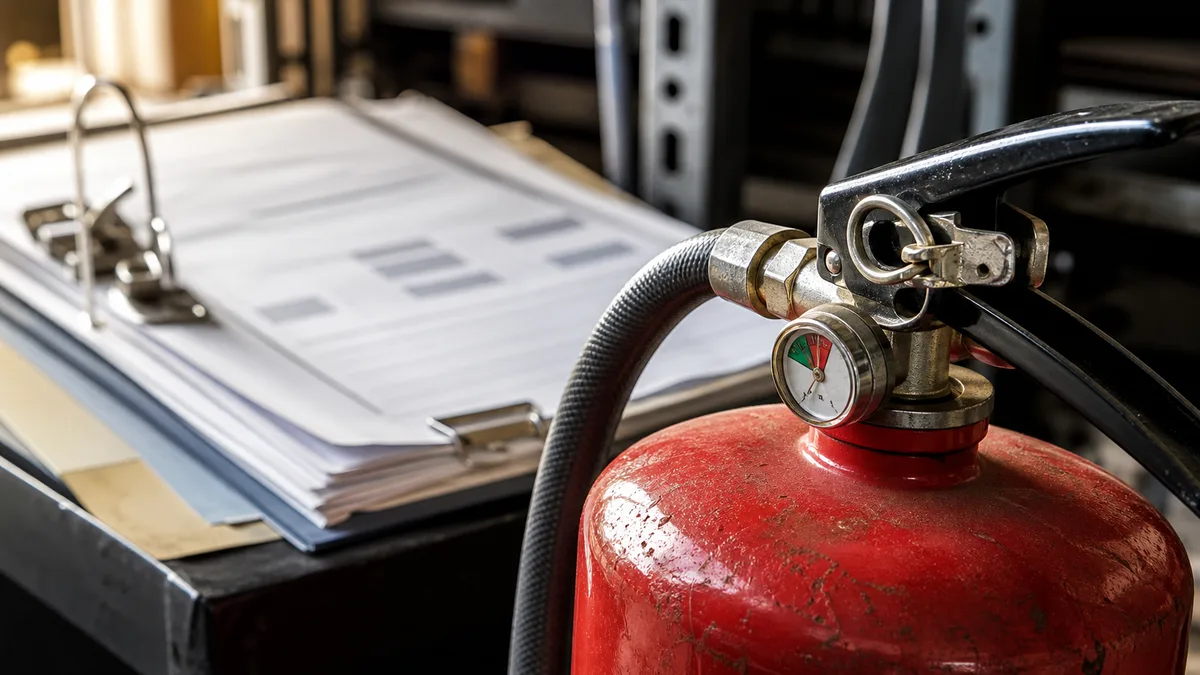
In many companies, fire safety documentation is something that simply “exists somehow.” There may be a folder inherited from a previous managing director, fire safety rules dating from when the facility was used for entirely different production, and fire alarm instructions listing the phone number of an employee who left three years ago. This works until the fire brigade arrives for an inspection, the insurer conducts an audit, or a real emergency occurs.
The basic logic is actually straightforward. Zákon č. 133/1985 Sb., o požární ochraně (the Fire Protection Act), divides business activities into three categories according to their fire hazard (§ 4). This classification determines whether the company must prepare the prescribed fire safety documentation and how extensive it must be (§ 15). The second common question—who is actually allowed to prepare it—also has a clear answer: the law assigns specialist fire safety work to appropriately qualified people, namely an odborně způsobilá osoba (fire safety professional), and for many activities also a technik požární ochrany (fire safety technician). Let us take it step by step.
In brief:
- Fire safety documentation is mandatory for companies carrying out activities with an increased or high fire hazard.
- The prescribed documentation is prepared by a fire safety professional or a fire safety technician; a fire hazard assessment for activities with a high fire hazard may only be prepared by a fire safety professional.
- The documentation must be reviewed at least once a year, as well as after every fire or any change affecting its content; it must remain consistent with actual conditions at all times.
Start with classification: which category does your activity fall into?
It is impossible to discuss documentation without first classifying the activity. Under § 4 of Zákon č. 133/1985 Sb., o požární ochraně, there are three categories:
| Category | Typical operation | Implications for documentation |
|---|---|---|
| Without an increased fire hazard | small offices, minor services | prescribed fire safety documentation is not required; general prevention duties still apply |
| With an increased fire hazard | most manufacturing facilities, warehouses and workshops, as well as buildings used for retail, accommodation or gatherings | mandatory fire safety documentation, regular training and preventive inspections |
| With a high fire hazard | large quantities of flammable substances, certain high-rise buildings and operations with an explosion hazard | the strictest regime, including a fire hazard assessment approved by the state fire supervision authority |
The classification criteria are based on the actual circumstances (§ 4(2)): the quantity and type of flammable substances and gases, combustible dust, fire load, number of above-ground floors and type of building. The number of employees or the way a company describes itself is therefore not decisive. An office-based company that adds a warehouse containing flammable liquids or a charging room full of lithium batteries may fall into a different category than it expects. The company is responsible for the classification; in cases of doubt, the state fire supervision authority decides (§ 4(5)). We discuss the broader context of categories, deadlines and inspections in our overview of fire safety in companies.
One important detail: the classification is itself the first document. The record of classification into an activity category is the opening item in the fire safety documentation, and everything else follows from it.
When does a company need fire safety documentation?
Under § 15 of Zákon č. 133/1985 Sb., o požární ochraně, companies carrying out activities with an increased or high fire hazard must prepare the prescribed fire safety documentation, comply with the conditions it sets and keep it consistent with actual conditions.
A company whose activities fall into the category without an increased fire hazard does not prepare the prescribed fire safety documentation. Even then, however, it is not advisable to have no written records at all. A written classification is the simplest way to demonstrate during an inspection why the more extensive obligations do not apply to you. General duties—including keeping fire extinguishers operational, escape routes clear and inspection records available—apply regardless of the category.
If you operate in rented premises, clarify in advance who is responsible for each part of the fire safety agenda. The law assumes that, in premises jointly used by several entities, the owner is primarily responsible for fulfilling these duties unless the contract provides otherwise. In practice, however, the division of responsibility between landlord and tenant is often precisely where the documentation ends up “belonging to nobody.”
Which documents are typically maintained?
The types of fire safety documentation are listed in Vyhláška č. 246/2001 Sb., o požární prevenci (the Fire Prevention Decree). The complete set is as follows:
| Document | Purpose |
|---|---|
| Record of classification into an activity category | documents which category the activities fall into and why |
| Fire hazard assessment | required only for a high fire hazard; approved by the state fire supervision authority |
| Definition of the fire safety organisation | specifies who is responsible for each aspect of fire safety within the company |
| Fire safety rules | set the fire safety conditions for a specific business activity |
| Fire alarm instructions | provide a concise procedure to follow in the event of a fire; displayed in clearly visible locations |
| Fire evacuation plan | specifies how evacuation is organised and graphically shows escape routes |
| Fire response documentation | provides information for fire and rescue units responding in more complex buildings |
| Fire reporting point rules | required if a fire reporting point has been established |
| Training syllabus and timetable | outline employee training and specialist instruction |
| Training and specialist instruction records | demonstrate who was trained, when and to what extent |
| Fire safety logbook | contains ongoing records of preventive inspections, defects and their correction, and incidents |
The key word is “typically”: very few companies maintain every document on the list. The required scope depends on the classification and the conditions of the particular operation. A typical company carrying out activities with an increased fire hazard usually works with a classification record, fire safety rules, fire alarm instructions, training records and a fire safety logbook. A fire hazard assessment is required only for activities with a high fire hazard, while fire response documentation applies to more complex buildings.
The documentation also includes records demonstrating that the relevant duties have been fulfilled, particularly inspection records for fire extinguishers and fire safety systems. We explain what a usable annual inspection record should contain and what to request from the service provider in our article on fire extinguisher inspections in companies. Since 1 January 2026, the decree has expressly permitted documentation to be maintained electronically: Novela č. 467/2025 Sb. added to § 36(3) that training and specialist instruction records may be kept exclusively in electronic form and do not require the signature of the trainer, the trained person or the participant in specialist instruction, provided that the records are held in a system protected against alteration. Even so, it is practical for fire safety logbook entries to be printable on request.
Who may prepare the documentation: a fire safety professional or a fire safety technician?
This is where many companies make the same mistake: they download a template from the internet, add the company name and consider the matter settled. But the law assigns specialist fire safety work to qualified people (§ 11), and a document that bears no relation to the actual operation will not stand up in practice. A discrepancy between the paperwork and actual conditions is often the first issue addressed during an inspection.
There are three roles:
- Fire safety professional (odborně způsobilá osoba v požární ochraně, OZO) — the highest qualification, demonstrated by passing a professional competency examination or by completing relevant fire safety education. This role has the broadest authority; only a fire safety professional may prepare a fire hazard assessment for activities with a high fire hazard.
- Fire safety technician (technik požární ochrany) — a qualification demonstrated by passing an examination. The technician performs specialist work primarily for activities with an increased fire hazard; Vyhláška č. 246/2001 Sb., o požární prevenci assigns the preparation and maintenance of the prescribed documentation to either a fire safety professional or a fire safety technician.
- Fire prevention officer (preventista požární ochrany) — a trained employee. This person typically carries out preventive fire inspections and enters records in the fire safety logbook but does not prepare the prescribed documentation.
The qualifications overlap downwards: a fire safety professional may also perform the work of a technician and a fire prevention officer, while a technician may also perform the work of a fire prevention officer.
Do not be lulled into a false sense of security simply because the documentation has been signed by “someone with a stamp.” Responsibility for fire safety remains with the company. Under the implementing decree, the documentation is approved by the company’s governing body or by the self-employed individual concerned, and the company is also responsible for ensuring that its content reflects the actual operation. A competent provider therefore starts by inspecting the premises and asking questions, not by sending out a template for signature.
If your company does not have anyone with the necessary professional qualifications, you do not have to employ such a person. Outsourcing is a common solution. At SOHE, we prepare fire safety documentation as part of our fire safety services for companies—from assessing the classification and preparing documents tailored to the operation to setting training and inspection intervals.
How often must the documentation be updated?
None of these documents is valid “forever.” Zákon č. 133/1985 Sb., o požární ochraně requires the documentation to be kept consistent with actual conditions (§ 15). This is an ongoing obligation, not a one-off task. Vyhláška č. 246/2001 Sb., o požární prevenci also requires the documentation to be reviewed at least once a year and after every fire or any change affecting its content.
In practice, it is more useful to monitor the events that trigger changes than to watch the calendar:
- moving to or renting new premises,
- changes in technology, product range or storage methods, such as new flammable materials, battery charging, a new paint shop or welding area,
- construction work or layout changes that alter escape routes,
- personnel changes—the departure of a fire prevention officer, changes in the members of a preventive fire patrol or new contact details in the fire alarm instructions,
- growth in operations that causes an activity to move into a higher category,
- findings from a fire brigade inspection or the company’s own inspection.
Fire safety documentation is also linked to regular training. For activities with an increased or high fire hazard, employee fire safety training must be repeated at least once every two years, while managers must be trained at least once every three years. The relevant records form part of the fire safety documentation. Occupational safety follows a similar cycle; we explain how the two sets of records relate to each other in our article on OHS documentation for companies.
Common shortcomings encountered in practice
Several recurring issues are typically addressed during inspections and audits:
- the documentation is based on a generic template—it may look formally correct but describes a different operation, address or technology,
- approvals and signatures are missing, or it is unclear which date and operation the document relates to,
- fire alarm instructions displayed on a noticeboard contain phone numbers that have been out of date for years,
- a fire safety logbook exists, but its most recent entry is two years old,
- the classification does not reflect the actual activity—the company may still be an “office business” on paper while now operating a warehouse,
- the documentation and evacuation plan were not updated after renovation or a change in the layout.
None of these issues is particularly difficult to correct, provided it is discovered during the company’s own documentation review rather than when an inspector or insurance claims adjuster asks to see the records.
SOHE prepares and updates fire safety documentation as part of its fire safety services for companies for businesses in Brno, the South Moravian Region and elsewhere in the Czech Republic. You can discuss the scope of the service through our no-obligation enquiry form.
Sources for this article
- Fire safety – SOHE services for companies: classification, fire safety documentation, training and deadlines.
- Fire safety in companies: documentation, inspections and deadlines – an overview of categories, inspection intervals and penalties under § 76 of the Act.
- Fire extinguisher inspections in companies – inspection records stored with the fire safety documentation.
- OHS documentation for companies – the related occupational safety agenda and how to maintain it alongside fire safety documentation.
- Zákon č. 133/1985 Sb. – zákon o požární ochraně; particularly § 4 (activity categories), § 15 (fire safety documentation), § 6a (fire hazard assessment) and § 11 (professional qualifications).
- Vyhláška č. 246/2001 Sb. – vyhláška o požární prevenci; types of fire safety documentation, how it must be maintained and training intervals.
The legal position is based on regulations verified in the SOHE register as of 21 July 2026; Vyhláška č. 246/2001 Sb. is applied in the version effective from 1 January 2026 following Novela č. 467/2025 Sb.
This article is for information only and does not constitute legal advice or an assessment of a specific operation. The scope of fire safety documentation must always be determined according to the actual classification of the activities, the conditions of the building and the risk assessment.
Not sure which category your activities fall into, or suspect that your fire safety documentation no longer reflects your current operation? We will review it with you—from classification to documents that will stand up to an inspection. Send us a no-obligation enquiry or email info@sohe.cz, and we will agree on the scope based on your operation.