
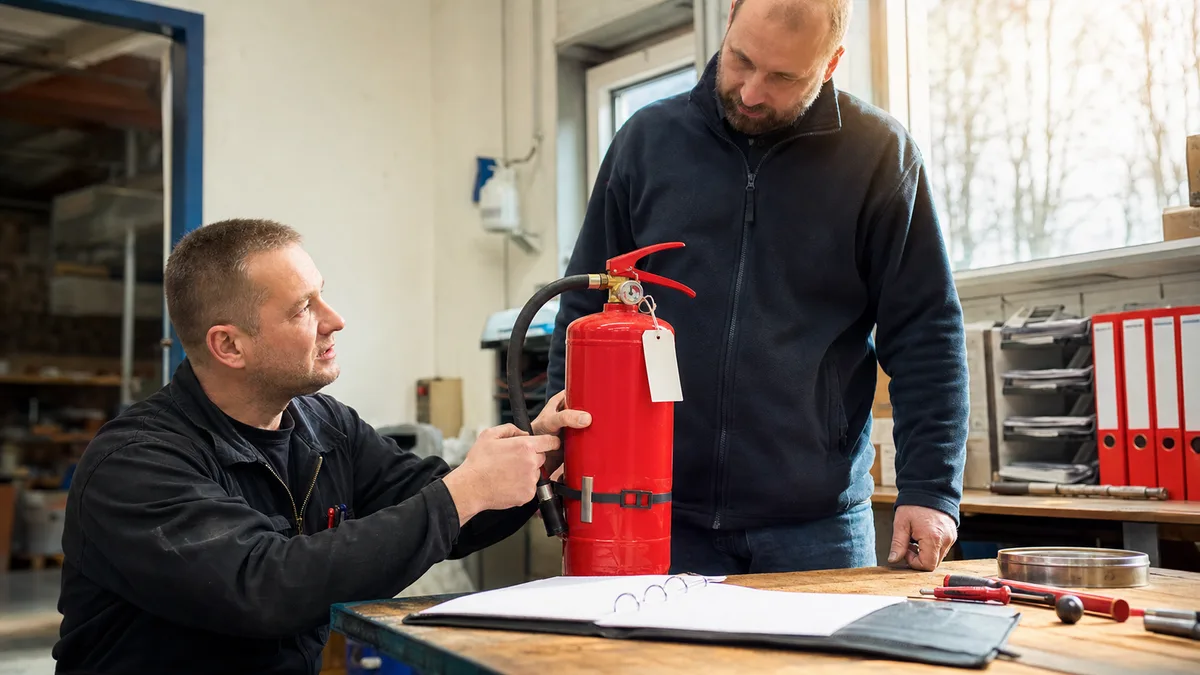
A fire extinguisher is a piece of equipment that no one in a company thinks about until an inspection comes or a fire breaks out. In the meantime it hangs on the wall, gets pushed behind a cabinet, loses its seal — and the sticker on it goes on living a life of its own. Yet it is precisely from that sticker that many owners conclude everything is “in order.”
Yet the rules are not complicated. Decree No. 246/2001 Coll., on fire prevention, works with two different tasks with different intervals: the serviceability check and the periodic test of the fire extinguisher. Anyone who confuses the two either pays unnecessarily or keeps an overdue extinguisher in operation. We will go through the intervals, the content of the check, record-keeping, the price, and what to prepare before the technician arrives.
What is the basic interval for checking fire extinguishers
Under Section 9 of Decree No. 246/2001 Coll., a serviceability check of a fire extinguisher is carried out to the extent and at the intervals set by the manufacturer’s accompanying documentation, but at least once a year. A shorter interval may be set by the manufacturer, the accompanying documentation, or a fire hazard assessment. A check is also carried out after every use of the extinguisher and whenever doubt arises about its serviceability — after a fall, damage to the valve, a broken seal, or a visible drop in pressure on the gauge.
The term the Decree uses is kontrola provozuschopnosti hasicího přístroje (a serviceability check of the fire extinguisher). “Revize hasičáku” (“extinguisher inspection”) is a common commercial label that every service company understands, but on an order it is more precise to request a check under Section 9 of Decree No. 246/2001 Coll. — you will avoid disputes over what was actually ordered.
A common mistake: the annual check is not the same as the periodic test of the fire extinguisher. The test is carried out at longer intervals, has a substantially larger scope — besides a surface inspection and a check of the labeling, it includes an inspection of the inside of the cylinder and tests of its strength and tightness, of the actuating mechanism or valve, and of the safety valve — and is billed separately.
| Task | Basic interval | When the interval changes |
|---|---|---|
| Serviceability check | at least once a year | a shorter interval may be set by the manufacturer or the relevant documentation |
| Check after use | after every use | the Decree sets no separate numerical deadline; this also applies if only part of the charge was discharged |
| Extraordinary check | whenever the condition is in doubt | e.g. after a fall, corrosion, damage, or a broken seal |
| Periodic test of water and foam extinguishers | once every 3 years | statutory interval under Section 9(5)(a) |
| Periodic test of other extinguishers | once every 5 years | statutory interval under Section 9(5)(b); this typically includes powder and CO₂ extinguishers |
One thing that surprises even experienced operators: under the Decree, the first serviceability check must be carried out no more than one year before the extinguisher is installed. So do not judge a new extinguisher by its purchase date alone. What matters is the information on the check label and the document supplied to you by the seller or service company. If, at the intended time of installation, a year has already passed since the first check, the extinguisher cannot be installed on the original document alone; it must undergo a further check before installation.
Does the annual check also apply to a small office without increased fire risk
Yes. Classifying an activity into the “no increased fire risk” category does not mean the installed fire extinguishers need not be maintained. If an extinguisher is to be part of the premises’ equipment, it must be serviceable and its condition documentable.
The number, type, and placement of extinguishers should primarily follow the building’s fire safety design, verified project documentation, or another relevant basis. Only when such a document does not determine the quantity and types, or cannot be produced, does the Decree apply fallback rules based, among other things, on the floor area and the extinguishing capacity of the extinguishers.
A practical consequence follows: a service company should not claim, without an inspection, that every premises needs the same number of six-kilogram powder extinguishers. An office with a server room, a kitchenette with a deep fryer, a workshop, a store of flammable liquids, and a room with electrical distribution boards are five different situations with five different answers.
The classification of the operation and the scope of the rest of the fire protection documentation are separate topics — more on them in the article on fire protection in a company. The annual servicing of fire extinguishers does not replace them.
What the service company should actually do during the annual check
The check should not consist of sticking on a new label and driving away. Its scope is governed by legal and normative requirements and by the manufacturer’s accompanying documentation for the specific extinguisher — a stored-pressure extinguisher with a gauge follows one procedure, an extinguisher with a gas cartridge follows another.
Depending on the extinguisher’s design, the service company checks in particular:
- the identification, type, serial number, and age of the extinguisher,
- the overall condition of the cylinder, hose, nozzle, valve, and controls,
- signs of corrosion, deformation, or mechanical damage,
- the integrity of the seal and the safety pin,
- the pressure or amount of charge in the manner prescribed by the manufacturer,
- the legibility of the instructions, the type label, and the fire-class markings,
- correct placement, accessibility, and securing against falling,
- the due date of the periodic test,
- whether the extinguisher is serviceable, needs repair, or should be withdrawn.
After the task is completed, the extinguisher should receive a legible check label and a seal on the actuating mechanism. In addition, the company needs a written record of the check. The sticker on the extinguisher alone is not a complete record — and during an inspection it is usually the first thing that shows.
When an extinguisher is withdrawn from use
The Decree anticipates cases where the person carrying out the check withdraws an extinguisher from use: an irreparable defect, the impossibility of safely determining the serial number and year of manufacture, or exceeding the specified age.
A fire extinguisher is withdrawn if it is more than 20 years old; for a CO₂ extinguisher, the threshold is more than 40 years. The owner or user should receive a document stating the reason for withdrawal — it is not enough for the technician to take the extinguisher away and say “that one was old.”
But age is not the only criterion, nor in practice the most common one. Replacement often happens sooner because of corrosion of the cylinder, a damaged valve, unavailable spare parts, or a failed periodic test. For an older, inexpensive extinguisher it therefore pays to compare the cost of the test and repair with the cost of a new unit — the service company should quote both options in advance, not only on the invoice.
Do not leave a withdrawn extinguisher in its original place as seemingly functional equipment. If one is required for the given space, a corresponding serviceable unit belongs in its place.
What you can check yourself during the year
Between service dates you do not need to dismantle the extinguisher or break the seal. But it makes sense to walk through the premises a few times a year and check what is visible without any expert intervention.
Check whether:
- the extinguisher has stayed in its designated place and is not hidden behind furniture, a pallet, or material,
- there is free access to it,
- the seal, safety pin, hose, or nozzle is not missing,
- the cylinder is not dented, heavily corroded, or otherwise damaged,
- the gauge, if the type has one, does not show an obvious deviation outside the green zone,
- the label is legible and the check due date has not passed,
- the safety sign is not obscured by a shelving unit or cabinet,
- an extinguisher standing on the floor is secured against falling over.
The handle of an extinguisher hung on a vertical building structure should be no more than 1.5 meters above the floor. The extinguisher should be easily visible and freely accessible; in a hidden or hard-to-see space, its location is marked with the appropriate fire safety sign.
If you find damage, do not wait for the regular date and order a check. For an overdue extinguisher, or one without a seal, serviceability cannot be demonstrated in the manner required by Section 9(1) of the Decree. It cannot be claimed in advance, however, that the Fire Rescue Service (HZS) will in every individual case assess it exactly the same as a missing extinguisher; the specific conclusion depends on the condition found and the context of the inspection.
What to prepare before the service technician arrives
Good preparation shortens the visit and, above all, reduces disputes over which extinguisher was actually checked.
Send or prepare the following for the service company:
- the addresses of all buildings to be checked,
- the approximate number of extinguishers in each building,
- a breakdown into powder, water, foam, and CO₂ extinguishers,
- an overview of wheeled extinguishers, if you use any,
- the latest records of checks and periodic tests,
- the available fire safety design or information on the required equipment,
- a list of used, damaged, or relocated extinguishers,
- a contact for the person who will provide access to offices, warehouses, technical rooms, and distribution boards.
Before the visit, clear access to the extinguishers. If they are spread across several buildings, prepare a simple list of rooms or a floor plan. For dozens of units, require identification by serial number, not an entry reading “25 extinguishers checked” — such a document will be of no use to you a year later when you are trying to trace a specific unit.
In leased premises, verify in advance who owns the extinguishers and who, under the lease agreement, orders the servicing. Do not automatically rely on the landlord. A similar division of responsibility tends to be disputed in electrical work too — how it is resolved is described in the article on who pays for the electrical inspection in a leased hall. A company operator should know where the valid document is stored and whether the check covered all the spaces they use.
What usable records should look like
The record of the check should make it possible to link each result to a specific extinguisher. It should include details of the owner or user, the address of the building, the location of the extinguisher, the type, the manufacturer, the type designation, the serial number of the cylinder, the date and result of the check, and the identification of the person who carried out the task.
Alongside the record from the service company, it pays to keep your own simple overview:
| Record item | Example content |
|---|---|
| Internal label | HP-01 |
| Location | ground floor, corridor by the warehouse |
| Type | powder, 6 kg |
| Manufacturer and model | per the type label |
| Serial number | cylinder number |
| Last check | month and year |
| Next check | specific date |
| Periodic test | date according to type |
| Condition | serviceable / repair / withdrawn |
| Note | relocate, add sign, clear access |
The table does not replace the prescribed document from the service company. But it helps you keep track of dates, changes of location, and the rectification of defects — and it is usable by the next person who takes over the agenda from you. The same logic works for electrical work; how to build such an overview is discussed in the article on record-keeping for appliance inspections in a company. Store the documents together with the other fire protection records so that they are available during an inspection and after the responsible employee leaves.
How much a fire extinguisher check costs
The price depends mainly on the number of units, the type of extinguishers, transport, and whether it is only an annual check or also periodic tests, refilling, and repairs.
In public price lists verified on 21 July 2026, the annual check of a portable extinguisher alone ranged roughly around 50 to 200 CZK per unit excluding VAT. For just a few extinguishers, the final price is often increased significantly by the call-out, the check label, the drafting of the report, or a minimum job charge — for three fire extinguishers in one office, transport can be more expensive than the check itself. A periodic test is roughly in the hundreds of Czech crowns per unit. Refills, valves, hoses, brackets, safety signs, and the disposal of withdrawn extinguishers may be billed separately. This is a time-limited market range, not a SOHE price list or a binding quote.
In the quote, ask to separate out:
- the annual check per unit,
- the periodic test,
- transport or the call-out,
- minor materials,
- repairs and spare parts,
- new extinguishers,
- the removal and withdrawal of old units,
- the preparation of the overview and records.
The lowest price per label does not mean the lowest final price. For a small company, the outcome is often decided by transport and the way repairs are billed — the same dynamic we describe in the cost of electrical inspection in a company.
How to recognize a quality service company
Before ordering, ask which types and manufacturers of extinguishers the supplier is able to check, maintain, and repair. The requirements for knowledge, equipment, and procedures stem, among other things, from the manufacturer’s accompanying documentation — and that differs from brand to brand.
A reliable supplier:
- finds out the number and types of extinguishers in advance,
- identifies individual units by serial number,
- points out upcoming periodic tests,
- does not carry out a paid repair without approval,
- flags defects and proposes a date for their rectification,
- issues a complete record, label, and seal,
- documents the reason for withdrawing an extinguisher,
- points out unsuitable placement or the wrong type of extinguishing agent.
A warning sign is a check without a record of serial numbers, a blanket replacement of all older units without justification, or an offer of a single universal extinguisher for every space.
The choice of extinguishing agent is a technical question, not a commercial one. A powder extinguisher covers more common risks, but powder can significantly contaminate electronics and technology — in a server room or by a production line, the damage can be comparable to the fire itself. CO₂ leaves no powder residue, but that does not automatically make it the right choice for every space. For kitchen fats and oils, Class F extinguishers are used. And spaces with lithium batteries, e-bike charging, or battery storage call for a separate risk assessment: an ordinary portable extinguisher may not stop the further development of the thermal process inside the cells, even if it extinguishes the flames on the surface.
How to easily order the annual service
In your inquiry, state the number of premises, the estimated number and type of extinguishers, the date of the last check, and whether you also need to complete the records. Request the price of the check, transport, and periodic tests separately.
After the visit, collect:
- a list of all checked extinguishers,
- the result for each unit,
- a record of the check, repair, or withdrawal,
- an overview of defects and recommended measures,
- the date of the next check.
Set the date well in advance. Ordering the service a few weeks before the validity ends is considerably more practical than catching up on expired checks at the moment when a Fire Rescue Service (HZS) inspection, an insurance loss adjuster, or the building manager is standing in the yard.
What the article is based on
- Fire protection – a SOHE service for businesses.
- Fire protection in a company: everything a small business must address – classification of the operation, fire protection documentation, and the duties that the annual servicing of fire extinguishers does not replace.
- Record-keeping for appliance inspections in a company – how to build an overview of dates and records that survives the departure of the responsible employee.
- Fire and the insurance company – what the loss adjuster addresses after a fire and what role documented records play.
- Decree No. 246/2001 Coll. – on fire prevention; Section 9 governs the serviceability check of fire extinguishers, periodic tests, withdrawal, and records of the check.
- Act No. 133/1985 Coll. – on fire protection; in particular the general duties of legal entities and self-employed persons to keep fire protection equipment in a serviceable condition.
- A public price list for checks in Brno and another public price list – an indicative check of the price range as of 21 July 2026; a specific quote varies according to the number of units, transport, records, repairs, and materials.
The legal status was verified as of 21 July 2026. Decree No. 246/2001 Coll. is used in its current wording effective from 1 January 2026 following Amendment No. 467/2025 Coll.; this amendment did not change Section 9 on fire extinguishers.
This text is for informational purposes and does not replace legal advice. The specific regime of checks and the number and type of fire extinguishers must be set according to the actual operation, the manufacturer’s documentation, the environment of use, and a risk assessment.
Not sure how many fire extinguishers you have, where they are, and when their due date is? We will help you sort out fire protection in your company — from an extinguisher inventory to documentation that will stand up to an inspection. Send us a non-binding inquiry or write to info@sohe.cz, and we will agree on the scope to match your operation.