
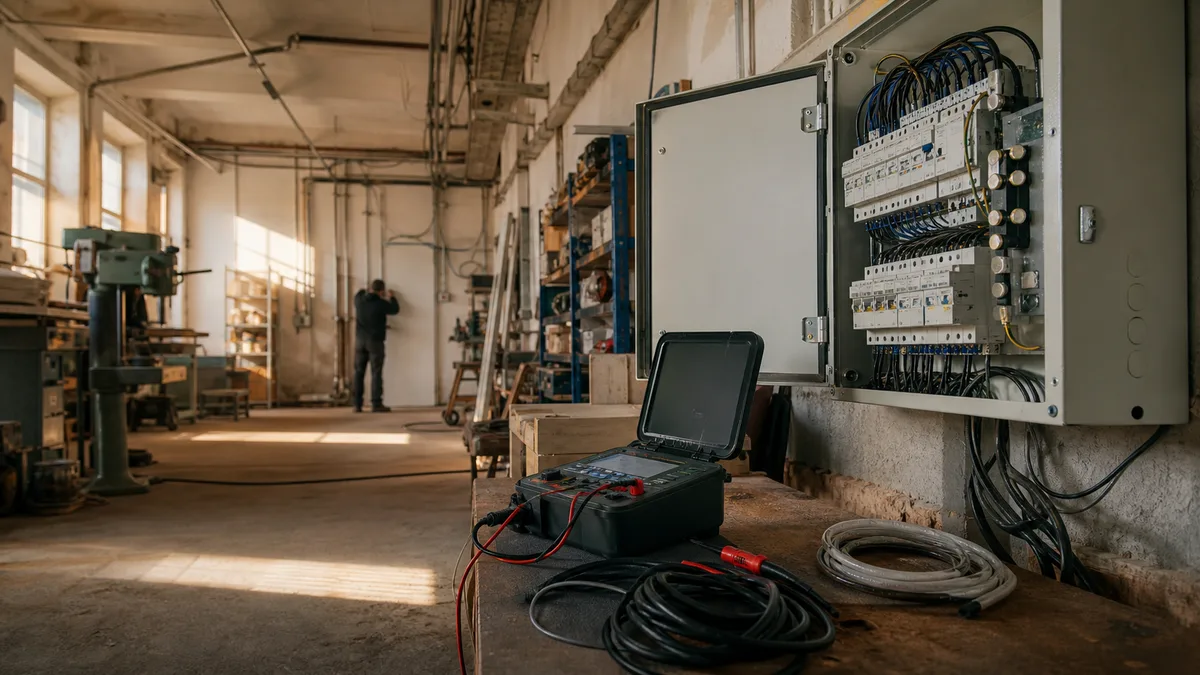
A dispute over an electrical inspection in a leased hall always looks the same. The tenant claims the electrical installation belongs to the building owner, so the owner should also take care of it. The landlord responds that the tenant uses the equipment, so the tenant should have it inspected. Both are partially right—and that’s precisely why the question can’t be answered in a single sentence.
The resolution depends on a combination of three things: what the lease agreement states, which equipment the tenant demonstrably took over, and who actually operates it. We’ll walk through how the cost is typically divided by equipment type, what to do when the contract doesn’t address inspections at all, and why it pays off to have the electrical handover boundary described before you sign.
The owner, the operator, and the payer may not be the same person
Three different questions get mixed up during these arguments:
- Who owns the electrical installation?
- Who operates it and is responsible for its safe use?
- Who must pay for the inspection and any repairs under the lease agreement?
Act No. 250/2021 Coll., on occupational safety in connection with the operation of designated technical equipment, ties obligations to the operator, not just the owner. According to § 20 (7), if a designated technical device is operated by someone other than its owner, that person is responsible for its proper use and operation from the day of demonstrable takeover. Therefore, ownership of the building alone does not determine who is obliged to operate the equipment safely and with a valid inspection. The law also does not regulate who pays for the inspection—that is a matter of contractual agreement.
This is precisely why the handover protocol is key. Handing over the keys to the hall is not enough. The documentation should make it clear whether the tenant also took over the sub-distribution board, fixed socket and lighting circuits, machine power supplies, or other parts of the electrical equipment. Where the protocol is silent, disputes arise after an accident or an inspection.
Practical breakdown by equipment type
The following overview is a guide based on common practice, not a substitute for a specific lease agreement.
| What is being inspected | Who typically arranges and pays for the inspection | What to verify |
|---|---|---|
| Main building distribution board, common distribution systems, and common areas | Landlord or building manager | Whether the cost is not apportioned among tenants as a service |
| Fixed installation inside the leased office | Depending on the contract: landlord, tenant, or manager | Who took it over for operation and who arranges periodic inspections |
| Sub-distribution board serving a single hall | Often the tenant, if they demonstrably took it over | The exact boundary between the main and sub-distribution system |
| Wiring and sockets added by the tenant | Typically the tenant | Landlord’s consent, project, initial inspection, and as-built documentation |
| Machines and permanently connected technology belonging to the tenant | Typically the tenant | Whether the machine inspection also includes the power supply and permanent connection |
| Computers, kettles, extension cords, and other portable appliances | Tenant as their user and employer | Do not confuse appliance checks with fixed installation inspections |
| Photovoltaic systems, charging stations, or technology owned by the building owner | Typically the landlord, unless the contract specifies otherwise | Who operates the equipment and whether it is included in the lease |
The most common mistake is the assumption that one inspection report covers everything. An inspection of the main site distribution board alone does not document the condition of the socket circuits in a leased workshop—and vice versa. Similarly, two different things are often confused: a periodic inspection of the fixed electrical installation and the inspection of electrical appliances, i.e., laptops, kettles, and extension cords that the tenant brought into the space. These are almost always the tenant’s responsibility because they are the user and the employer of the people who work with them.
What applies when the contract is silent on inspections
For spaces used for business, the general provisions of the Civil Code (Act No. 89/2012 Coll.) on leases apply. Under § 2205, the landlord is to maintain the leased item in a condition fit for the agreed use. Under § 2207, the tenant performs routine maintenance, while the landlord arranges other maintenance and necessary repairs—unless the parties have agreed otherwise.
The catch is that a periodic inspection is not a repair. It is a professional assessment of the equipment’s condition, not the removal of a defect. The dispute therefore cannot be closed with the sentence, “The electrical installation belongs to the owner, so the owner pays for everything.”
When the contract does not address inspections, it pays to proceed in writing:
- request the latest inspection report from the landlord,
- specify which distribution boards and circuits the inquiry concerns,
- point out an approaching or exceeded deadline,
- agree on who will order the inspection and who will pay for it,
- separately clarify the payment for defects the inspection reveals.
If you discover a defect that the landlord must remedy, notify them without undue delay; the tenant’s notification obligation is regulated by § 2214 of the Civil Code. Ordering an inspection on your own and then simply forwarding the invoice to the other party usually does not lead to reimbursement.
What to look for in the contract and the handover protocol
Don’t just search for the word “inspection.” The obligation is often hidden under phrases like technical administration, operating costs, maintenance of technical equipment, or services related to the lease.
Specifically, review:
- who arranges inspections of the fixed electrical installation;
- whether the costs are included in the rent or apportioned as a service;
- where the electrical equipment handover boundary lies;
- who is responsible for the main distribution boards and who for the sub-distribution boards;
- who is allowed to order repairs;
- how tenant interventions in the installation are approved;
- who keeps the project and inspection documentation;
- who will provide the inspection technician access to the space;
- what happens if one party fails to arrange the inspection on time.
The sentence “the tenant ensures routine maintenance” is too vague for electrical inspections—routine maintenance could encompass changing a light bulb just as easily as a periodic inspection of a distribution board. For your next contract, demand a separate paragraph dedicated to technical equipment inspections, ideally with reference to an appendix listing the specific distribution boards and circuits.
Who pays for defects found during the inspection
The cost of the inspection and the cost of removing defects are two different items, and it’s good to keep them separate from the start.
The landlord usually handles defects in the original fixed installation, worn wiring, and repairs necessary for the space to be used for the agreed purpose. The tenant typically covers defects caused by their own operation, unauthorized intervention, or equipment they installed themselves.
A typical dispute arises when the inspection technician records:
- unmarked or undocumented circuits;
- missing distribution board covers;
- inadequate protective bonding;
- a non-functional or non-compliant residual current device (RCD);
- an overloaded circuit after connecting the tenant’s technology;
- sockets and power supplies added without corresponding documentation.
For each defect, it should be clear exactly where it is, how serious it is, and who is responsible for managing that part of the equipment under the contract. Without this breakdown, the inspection often proves cheaper than the subsequent argument over who will pay for the repair.
How much an inspection costs and what should be included in the price
The price cannot be derived from floor area. For a small office, a periodic inspection of the fixed installation indicatively ranges in the lower thousands of Czech crowns; for a hall with multiple distribution boards, a large number of circuits, more complex technology, or missing documentation, it rises to higher thousands or tens of thousands. The deciding factors are the number of circuits and the condition of the documentation, not square meters.
A quotation should at least state:
- the number and type of distribution boards;
- the approximate number of circuits;
- the scope of fixed installations and technology;
- whether common areas are included;
- the cost of transport and work outside normal operating hours;
- whether the preparation of the inspection report is included in the price;
- what will be surcharged for missing documentation or circuit tracing.
A more detailed breakdown can be found in the article on the cost of an electrical inspection in a company. For a dispute between the tenant and the landlord, it is mainly important to request an itemized quotation—otherwise, the cost cannot be divided according to what was actually inspected.
How to know you’re not just paying for a piece of paper
An inspection of designated electrical equipment is carried out by an inspection technician with a certificate corresponding to the given scope; the authorization and certificate can be verified in TIČR registries.
The technician must actually inspect the equipment and perform the necessary tests and measurements. Depending on the specific installation, this includes verifying, for example, the continuity of protective conductors, insulation condition, conditions for automatic disconnection from the supply, or the function of residual current devices (RCDs).
In the report, check for:
- a precise specification of the inspected equipment;
- a list of the documentation submitted;
- the measuring instruments used;
- the results of the visual inspection, tests, and measurements;
- specific defects and their locations;
- an overall safety assessment;
- the identification and signature of the inspection technician.
We discuss what the report must contain in more detail in the article on the requirements of an inspection report. A report drafted from a desk using an old form, without an on-site inspection, will not help you during a check or after an accident—and in a dispute over costs, it is worthless for both parties.
Before signing the lease and when an inspection has lapsed
Before taking over the space, request the latest inspection report and compare it with reality. An old document may not cover a new partition, a kitchenette, air conditioning, charging for handling equipment, or production expansion—yet it is precisely these changes that usually added circuits that no one ever measured.
If an inspection is missing or past its deadline, do not accept responsibility for unclearly defined equipment without reservation. Record the condition in the handover protocol and agree on a remedy deadline. Changes to the installation after a space renovation are a separate topic—when an initial inspection after renovation is appropriate, we address separately.
If you have employees in the space, you are responsible for a safe working environment under § 101 and § 102 of the Labour Code (Act No. 262/2006 Coll.), regardless of how the billing with the landlord ultimately turns out. In the event of an immediate risk, it is appropriate to shut down the affected part of the installation, secure the space, and inform the landlord. Address the question of payment only once the danger has passed.
A missing inspection report can also complicate an insurance claim. The insurance company examines compliance with the policy conditions, the condition of the equipment, and the connection between the defect and the origin or extent of the damage; the outcome depends on the specific contract and the cause. This does not automatically mean the insurance company won’t pay without an inspection—but it also doesn’t mean no one will ask for the documentation.
Article sources
- Inspection of appliances and tools – SOHE service.
- Cost of an electrical inspection in a company – what influences the quotation and why the price is not determined per square meter.
- Requirements of an inspection report – what a report must contain to stand up to scrutiny.
- Electrical inspection after renovation – when an initial inspection is necessary after an intervention in the installation.
- Act No. 250/2021 Coll. – on occupational safety in connection with the operation of designated technical equipment; § 20 (7) addresses the responsibility of an operator who does not own the equipment.
- Act No. 89/2012 Coll. – the Civil Code; § 2205, § 2207, and § 2214 regulate maintenance, repairs, and the tenant’s notification obligation.
- Act No. 262/2006 Coll. – the Labour Code; § 101 and § 102 stipulate the employer’s responsibility for a safe working environment.
The text is for informational purposes only and does not substitute for a legal opinion. The specific inspection regime in a leased space must be set according to actual operation, manufacturer’s documentation, the environment of use, and a risk assessment.
Unsure which equipment in your leased hall or office is your responsibility and which belongs to the landlord? We’ll go through the handover protocol and contract with you and arrange inspections of appliances and tools as well as fixed installations within the scope you actually operate. Write to info@sohe.cz or send a non-binding inquiry — we’ll get back to you with an itemized quote, not a flat rate per square meter.