
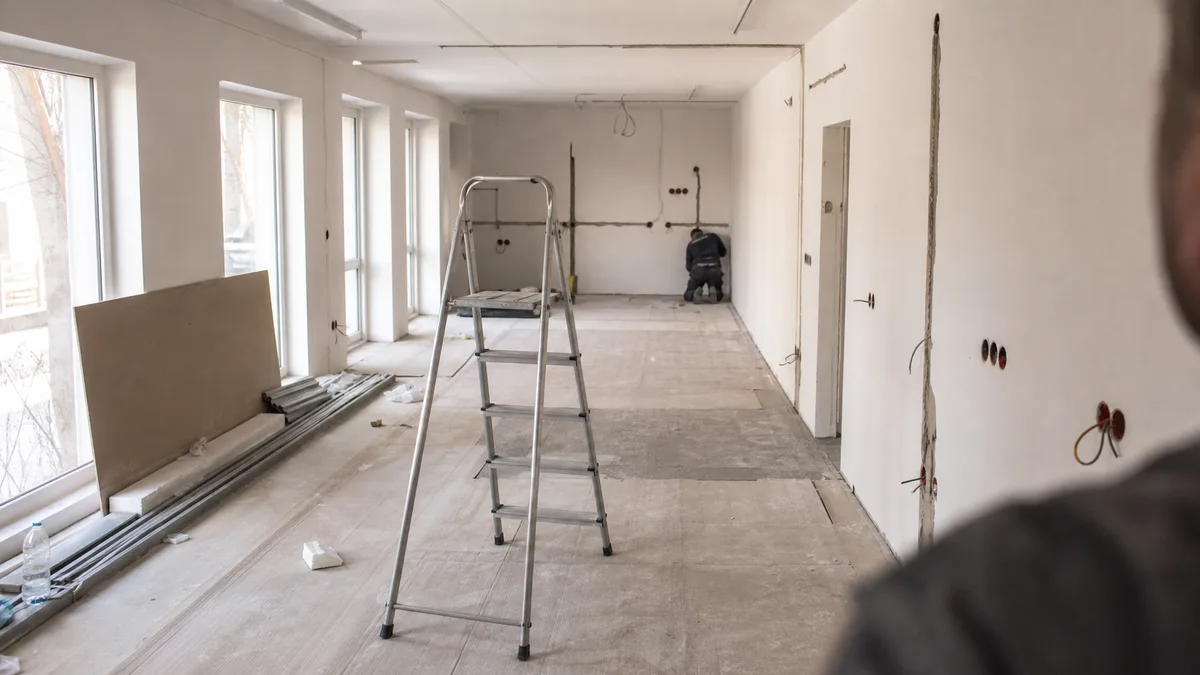
After an electrical installation renovation, a critical question arises that will determine both the documentation and the cost: is a standard periodic inspection sufficient, or is an initial inspection required? The answer depends not on how extensive the rebuild appears, but on whether the scope or parameters of the installation have changed—whether a circuit was added, the protection was altered, or the purpose of the space was modified.
The difference is not a formality. An initial inspection verifies that the new part is executed according to the design and standards and can be safely put into operation; a periodic inspection only assesses the condition of the existing installation in service. If you mistakenly order a periodic inspection where an initial one is needed, it may not cover the required scope of the new or modified part—the technician may then demand an initial inspection or supplementary documentation, and you will pay for an extra trip. The following text summarizes when each type of inspection applies after a renovation and what to prepare for the technician so it’s done right the first time.
When a renovation requires an initial inspection—and when a minor repair is enough
The decisive factors are the extent of the intervention into the installation and whether its parameters are changing. An initial inspection is appropriate especially when:
- a new part of the installation is created—a new switchboard, a new cable circuit, added circuit breakers;
- the layout or purpose of the space changes and the installation is adapted accordingly (a storage room becomes an office with IT equipment);
- you are working on the main switchboard or changing its configuration;
- the cable sizing, circuit protection, or type of residual current device (RCD) is changed;
- the renovation takes place where external influences change—from a normal environment to a humid, dusty, or potentially explosive one.
Conversely, a new inspection is usually not required for:
- replacing a damaged switch or socket with the same type, in the same location, and with the same ingress protection (IP) rating;
- replacing a light fixture with the same type without interfering with the wiring;
- repairing an existing circuit without changing parameters, such as a faulty circuit breaker replaced with an identical one.
For reserved electrical equipment, the requirement for inspections is based on Act No. 250/2021 Coll. and Government Regulation No. 190/2022 Coll.; the technical execution and scope of the inspection are described by standard ČSN 33 2000-6, and the intervals for periodic inspections by ČSN 33 1500. There is no universal rule here—it’s the nature of the intervention that matters, not the visual scale of the rebuild.
A practical field note: many companies order a routine periodic inspection after renovation, assuming it’s sufficient. However, if the installation was expanded or circuits were moved, the technician will still require an initial inspection for the new part—and you’ll just be wasting time and paying extra.
Initial and periodic inspection: why they are not the same
Initial and periodic inspections differ in both scope and purpose. The difference in measurement is fundamental: for a periodic inspection, insulation resistance is often measured collectively for the entire installation, whereas for an initial inspection, each circuit is measured separately—for a larger renovation, this means hours of additional measurement work.
| Aspect | Initial Inspection | Periodic Inspection |
|---|---|---|
| When it’s performed | Before commissioning and after a renovation that changes installation parameters | At regular intervals based on the environment and type of building |
| Scope of measurement | Each new and modified circuit separately, complete measurement | Inspection and measurement of selected parameters, insulation often tested collectively |
| Input documents | As-built documentation, material certificates | Previous inspection report, operational documentation |
| Output | Initial measured values serving as a reference baseline | Current condition and comparison with the previous inspection |
The exact intervals for periodic inspections according to environment and operation are summarized in the article how often to inspect electrical installations.
What the technician checks and measures during an initial inspection
An initial inspection is not a longer periodic one. It’s a different kind of check: while a periodic inspection evaluates the condition of the existing installation, an initial inspection verifies that the new part is executed according to the design and standards and can be safely commissioned. The initial electrical inspection article discusses it in more detail; here is what the technician actually does.
Visual inspection — a visual check of workmanship, IP ratings, conductor identification, switchboard labeling, and a rough check of sizing based on conductor cross-sections and circuit breaker types.
Measurement — for an initial inspection, this is done circuit by circuit, not just collectively:
- continuity of protective conductors and supplementary bonding;
- insulation resistance of each new and modified circuit (typically at 500 V DC, between conductors and to earth);
- earth fault loop impedance—verifies that the circuit breaker or fuse will disconnect within the prescribed time;
- function of residual current devices (RCDs)—tripping current and time using ramp and time methods, according to the RCD type (AC, A, F, B), with an installation tester (Illko, Metrel, Sonel);
- phase sequence and voltage conditions;
- condition of surge protective devices (SPDs) by visual inspection and measurement.
Functional tests — control and safety circuits, emergency stop, backup power sources (UPS), network switching.
The measured values go into the inspection report specifically—not just “pass,” but numbers for each circuit: loop impedance in ohms, insulation resistance in megaohms, RCD tripping time in milliseconds. Everything the report should contain is summarized in the article requirements for an inspection report.
What to prepare before the inspection technician arrives
This is an underestimated phase that delays and increases the cost of the inspection. The inspection technician does not finish the installation—he comes to check a completed job. Without a prepared setup, he will leave and charge for the call-out. What to have ready:
- As-built documentation — project documentation with recorded changes from the installation phase; for smaller renovations, a switchboard wiring diagram and a floor plan with cable routes and device locations will suffice. Without it, the technician doesn’t know what to check.
- Documents for the materials used — invoices or delivery notes for the electrical material. The technician uses them to verify that the components meet standards and parameters: cables with the required cross-section, circuit breakers with the correct tripping characteristic, sockets with the appropriate IP rating for the environment.
- Lightning protection inspection, if affected by the renovation — if the roof was worked on or new technology was added (HVAC, photovoltaics), it’s good to provide this as well.
- Access to all switchboards and junction boxes — a switchboard not blocked by material, junction boxes in the ceiling accessible through inspection hatches. In warehouses and halls, this is the most common cause of delays.
- Labeled circuits — each circuit breaker and RCD labeled to make it clear which circuit it controls; permanently, not with a marker on the door.
- Appliances disconnected from sockets — insulation resistance is measured at 500 V DC, and connected appliances could be damaged, so they are disconnected before measurement.
- Temporary wiring disconnected — if the construction ran on a site switchboard or temporary cables.
Practical tip: keep the electrician who performed the renovation on the phone. If the technician finds a discrepancy, it can be explained or fixed immediately.
When to order the inspection: a schedule that saves a call-out
A common mistake is calling for an inspection only after all work is finished—the building then sits idle unnecessarily. It’s better to plan the date in advance:
- Book a date ahead of time. Demand for inspection technicians is usually highest in spring and summer when the construction season peaks.
- Verify readiness a few days before. That the electrician has completed the installation, labeled the circuits, and handed over the documentation.
- Clear the operation the day before. Disconnect appliances, provide access to switchboards and boxes, ensure keys for all rooms.
If the technician finds defects during the check, he will list them in the inspection report along with whether the equipment is safe for operation. After they are rectified, the affected circuits are re-measured and a clean report is issued; this subsequent round is usually charged as a separate call-out.
What determines the price
The price is not determined by floor area, but by the scope of measurement. The main factors that drive it up are:
- the number of switchboards and circuits — each circuit means a separate measurement of impedance and insulation resistance; a switchboard with 30 breakers is a different job than one with ten;
- the number and types of RCDs — each is measured in several modes; measuring one takes a few minutes;
- accessibility — a freely accessible switchboard versus having to navigate a warehouse, boxes in inspection hatches versus having to dismantle drywall;
- availability of documentation — if the technician has to piece it together from what he sees, you’re paying for extra time;
- travel — for longer distances, travel costs are charged.
The exact amount will only come from specifying the scope of the renovation; the article what affects the price of an electrical inspection details what a quote consists of.
Faults repeatedly found during post-renovation inspections
- Missing or incorrect supplementary bonding — typically in bathrooms, kitchens, and utility rooms. After replacing metal pipes with plastic, incidental bonding disappears, and its replacement is forgotten.
- A sensitive 30 mA RCD in an old part of the installation — older wiring tends to have higher leakage currents, and the RCD then trips for no apparent reason.
- Poor selectivity of protection — a new switchboard is connected to an existing supply without verifying that the main and sub-circuit breakers coordinate.
- A new part fed from an old switchboard of unknown condition — the initial inspection will cover the new installation, but the source remains unchecked.
- Inadequate IP rating after a change of environment — after a storage room becomes a workshop or an office becomes a lab, original sockets and switches with a lower IP rating remain, which is insufficient for the new environment.
How post-renovation inspection differs by building type
Office and administrative. Fewer circuits, a normal environment, emphasis on RCDs for socket circuits. Delays often occur in open-plan spaces where finding end devices is harder.
Production hall and workshop. Determining external influences is key—a protocol according to ČSN 33 2000-5-51 should exist before the inspection. In dusty or humid operations, stricter requirements apply to IP ratings and cable routes; the inspection takes longer due to the number of switchboards and machine circuits.
HOA—common areas. After the renovation of hallways, pram rooms, or basement storage units, work involves lighting, cleaning sockets, or emergency lighting. The initial inspection only covers the renovated circuits, not the entire building.
Premises with increased fire hazard. For a flammable liquids store, paint shop, or boiler room, the inspection also considers fire safety requirements—cable type, workmanship, and sealing of penetrations.
Article sources
- Electrical installation inspections – SOHE service.
- Initial electrical inspection – what an initial inspection entails and how it differs from a periodic one.
- How often to inspect electrical installations – periodic inspection intervals by environment and operation.
- The price of an electrical inspection for a company – what a quote consists of and what raises it.
- Act No. 250/2021 Coll. – on occupational safety in connection with the operation of reserved technical equipment; framework for the operation and inspection of reserved electrical equipment.
- Government Regulation No. 190/2022 Coll. – on reserved technical electrical equipment and requirements for ensuring their safety; equipment classification and related obligations.
- ČSN 33 2000-6, ČSN 33 1500, and ČSN 33 2000-5-51 – technical standards for electrical installation inspections, intervals, and determination of external influences (not freely available).
The text is for informational purposes and does not substitute for a legal opinion. The specific inspection regime after a renovation needs to be set according to actual operation, the manufacturer’s documentation, the usage environment, and a risk assessment.
Are you preparing to start up an operation after a renovation and want to avoid paying for a second call-out due to missing documents? We perform electrical installation inspections including a readiness check and measurements circuit by circuit. Ask for a no-obligation quote or write to info@sohe.cz—we’ll get back to you with a date and scope.