
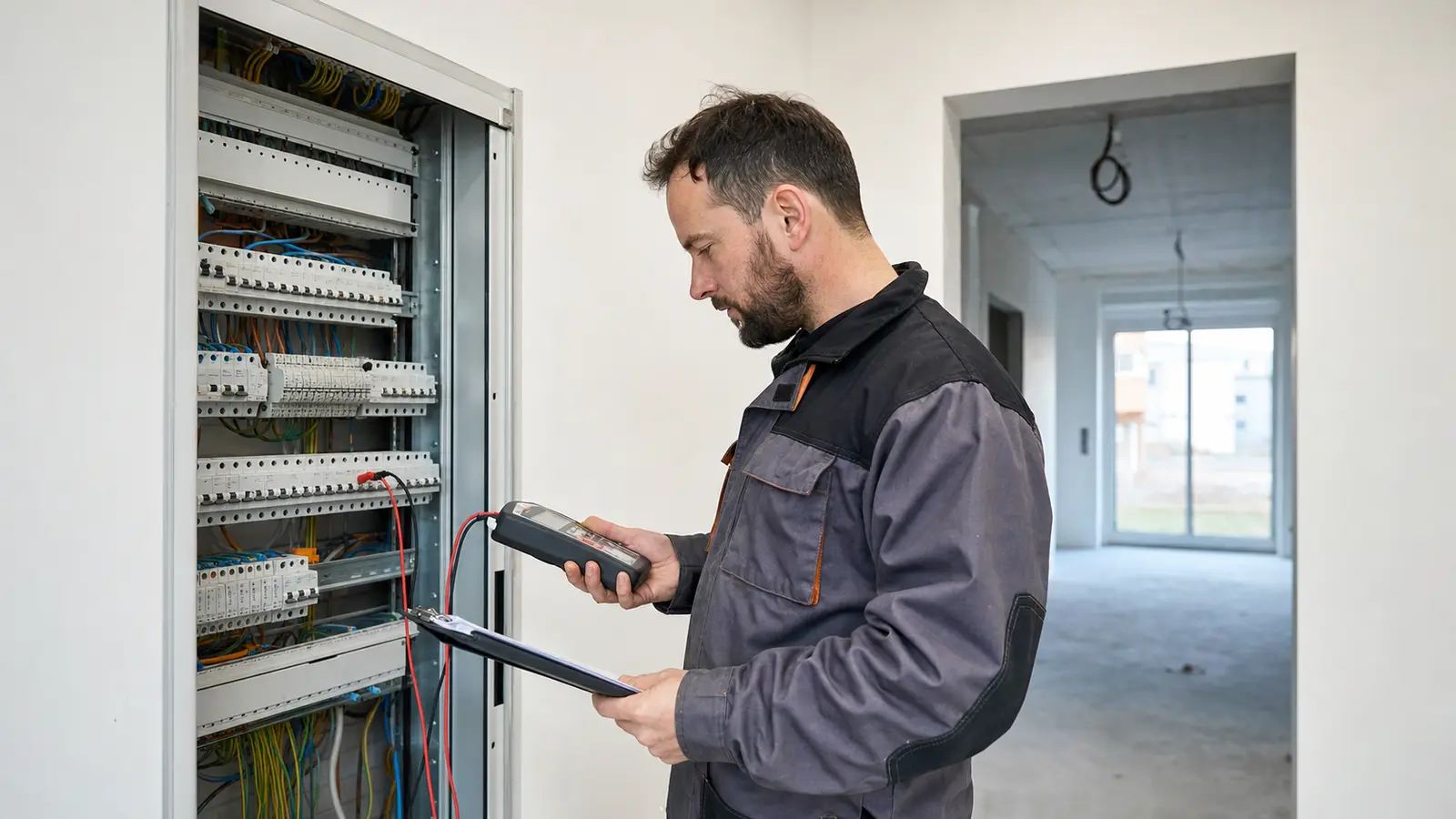
Initial Electrical Inspection
An initial electrical inspection is the first inspection of a new, reconstructed, or substantially modified electrical installation. It is carried out before the equipment is put into operation, often before final building approval, and also when the use of a space changes – for example, when an apartment is converted into an office, a medical practice, or a commercial establishment.
It differs from periodic inspections in both timing and significance. A periodic inspection monitors the installation during operation, whereas an initial inspection is an entry check, without which you have no documented proof that the equipment can safely begin service. We discuss periodic inspection intervals separately in our article on electrical installation inspection intervals and company obligations in the article electrical inspections in a company.
Quick Answer
You need an initial electrical inspection before first putting a new electrical installation into operation, after reconstruction, or after a substantial change to the installation. You will typically also need to submit it for final building approval or a change in building use. The inspection may only be performed by a certified electrical inspector with a valid certificate for the given scope. The output is an inspection report with a positive or negative conclusion; only equipment with a conclusion stating it is capable of safe operation may be put into service.
What an Initial Inspection Is and When It Is Mandatory
An initial inspection is a professional verification of the safety of an electrical installation before it is first put into operation. It is performed at the moment when the equipment is completed but has not yet been started up. Its purpose is to confirm that the installation complies with the project documentation, standards, and is safe for both people and property.
The obligation to perform an initial inspection stems directly from the standards. ČSN 33 1500 defines it as an inspection carried out before putting a new electrical installation into operation and after every reconstruction or substantial change to an existing installation. ČSN 33 2000-6 then sets out the procedures for verification – visual inspection, measurement, and testing. The legislative framework for the safety of designated electrical equipment is formed by Act No. 250/2021 Coll. and Government Regulation No. 190/2022 Coll. These state clearly: the equipment must be safe even before you start using it.
When specifically do you need an initial inspection? In these situations:
- New electrical installation – whether in a family house, apartment building, production hall, or office
- Reconstruction of an electrical installation – complete replacement of wiring, significant expansion of circuits
- Substantial change to an existing installation – an intervention that changes the parameters or scope of the installation
- Change in the purpose of use of the premises – typically converting an apartment into a business premises, shop, or office (we will cover this in more detail)
- Restoration of an installation after an accident – fire, water ingress, mechanical damage requiring extensive repairs
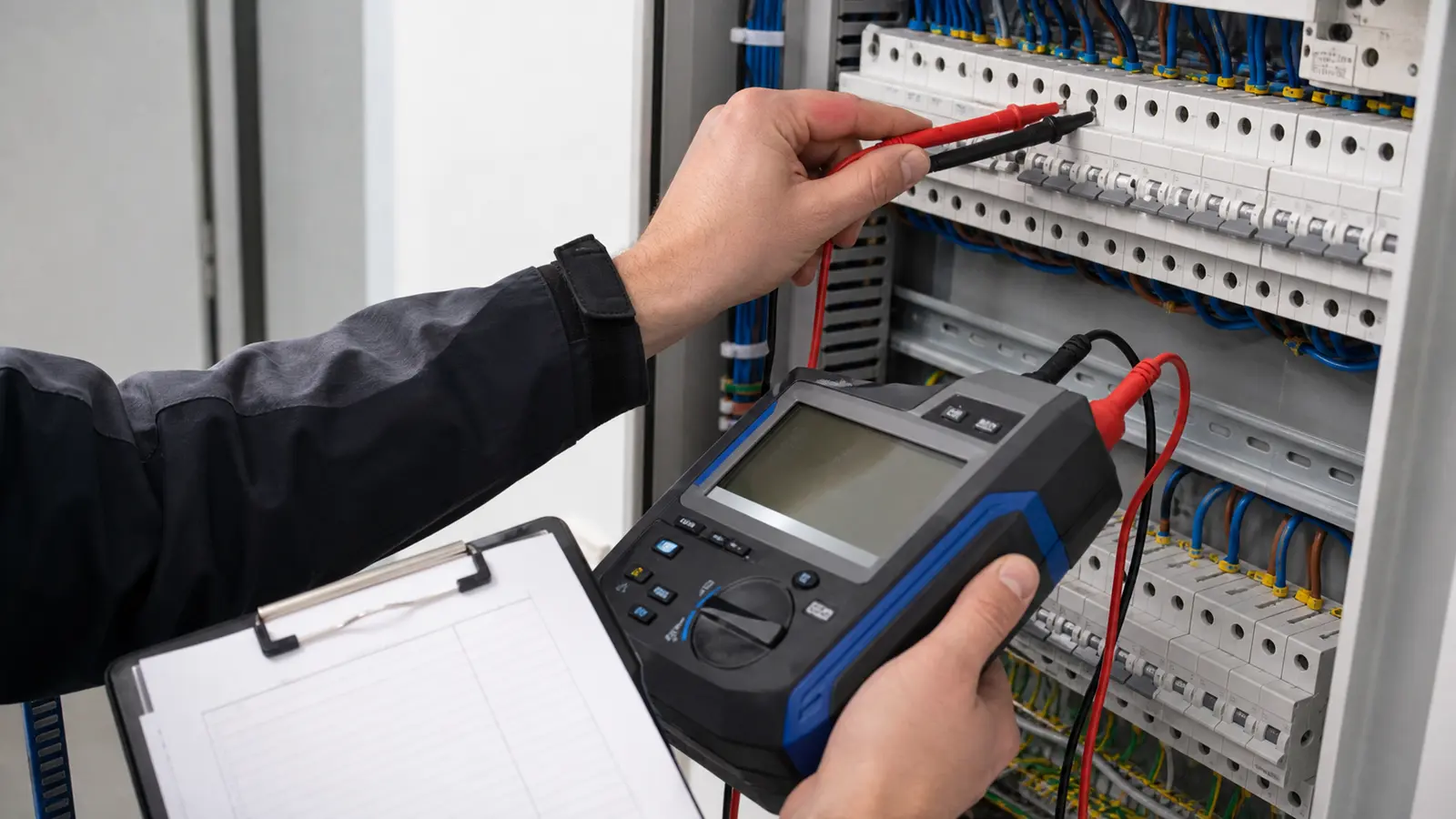
Initial vs. Periodic Inspection
These two types of inspections are often confused, even though each serves a different purpose and occurs at a different time.
An initial inspection is a one-time event. It is performed on new or reconstructed equipment, and its report is filed with the building documentation. Without it, the equipment must not be put into operation. It is the entry gate – only when it passes the initial inspection can the electrical installation begin to be used legally.
Periodic inspections (also referred to as repeated inspections) follow on from the initial one. They verify that the equipment has not lost its safety parameters over time – that insulation has not cracked, connections have not corroded, and protective elements are still functioning. Their intervals are set by Annex No. 4 of NV 190/2022 Coll. and detailed by ČSN 33 1500 according to the type of environment. For exact repetition frequencies, see our article on electrical installation inspection intervals and the text on company obligations.
In simple terms: initial inspection = the start of the installation’s life cycle. Periodic inspection = ongoing checks in cycles.
Initial Inspection, Final Building Approval, and Change of Use
Here we get to a topic that troubles most builders and property owners. An initial electrical inspection is not just a technical formality – it is one of the documents the building authority will require from you.
Final Building Approval: It Won’t Happen Without the Inspection
A completed building is governed by the Building Act – Act No. 283/2021 Coll. Specifically, § 230 addresses final building approval and putting a building into use, and § 235 deals with the final building approval decision. To issue the final building approval decision, the building authority generally requires the submission of an initial electrical installation inspection. This is logical – the authority needs confirmation that the electrical installation in the new building is safe and corresponds to the project documentation.
Without an inspection report with a positive conclusion, the final building approval process will stall. And without final building approval, you are not legally using the building.
Changing the Purpose of Use? An Inspection Is Needed Here Too
A fairly common situation: you bought an older apartment and want to turn it into a shop, office, or smaller business premises. This changes the purpose of use of the building – and this is addressed by § 239 and § 240 of the Building Act. A change in use is subject to the consent of the building authority. And the authority will want proof that the premises are technically adequate for the new purpose.
The original electrical installation in the apartment was designed for domestic appliances, not for operating commercial equipment. It is often necessary to modify, expand, or replace the installation – and thus the obligation for an initial inspection arises. Even if the installation remained untouched, the building authority may require an inspection as proof of safety for the new type of use. Furthermore, from 1 January 2025, new or modified internal installations are also assessed under ČSN 33 2130 ed. 4 – the certified electrical inspector must also take this into account.
What an Initial Inspection Includes and Who Performs It
An initial inspection is not a cursory look with a flashlight. It is a structured process governed by the standard ČSN 33 2000-6 and related regulations. It typically includes:
- Visual inspection – a visual check of the installation’s execution: correct conductor sizing, protection, enclosure ratings, labels, accessibility, compliance with project documentation
- Measurement – verification of parameters such as continuity of protective conductors, insulation resistance, fault loop impedance, tripping times of residual current devices (RCDs)
- Functional tests – verification that protective elements, disconnectors, and other devices function as intended
The output of the entire process is an initial inspection report. This contains an unambiguous conclusion: either “the equipment is capable of safe operation” or “the equipment is not capable of safe operation” with a list of identified defects. Only a report with a positive conclusion will allow you to proceed to final building approval or a change of use.
The inspection may only be performed by a certified electrical inspector with a valid certificate for the relevant scope. According to § 11, paragraph 3 of Act No. 250/2021 Coll. in conjunction with Government Regulation No. 194/2022 Coll., a certified electrical inspector’s certificate is valid for 5 years. Before ordering an inspection, it is worth verifying that the inspector’s certificate is current – and that their scope matches your type of equipment.
What Risks You Face Without an Initial Inspection
No initial inspection, or an inspection with a negative conclusion? The consequences affect several areas:
Final building approval and change of use – the building authority generally requires an initial inspection as a supporting document; without a positive report, the approval process will not proceed. You then cannot legally use the property.
Insurance – be cautious here. In the event of damage caused by the electrical installation, the insurance company may reduce the payout if it finds that the operation commenced without a valid initial inspection. We are not saying this always happens, but practice shows that the absence of inspection documentation is a signal for insurers to investigate more thoroughly.
Subsidies – many subsidy programs (e.g., for renovations, energy savings, business support) condition the payment of support on the submission of an initial inspection. Without it, you could lose the subsidy or have to return it.
Sanctions – the labour inspectorate can impose a fine of up to CZK 2,000,000 for breaching obligations in the area of designated technical equipment safety (Act No. 250/2021 Coll., or Act No. 251/2005 Coll. on labour inspection). This is an extreme, but possible, scenario.
Liability for damage – if harm to health or property occurs as a result of an unapproved installation, the liability falls directly on you.
What to Prepare Before Ordering the Inspection
The better prepared the building or reconstruction is, the lower the risk of delays. Before ordering an initial inspection, mainly prepare:
- project documentation of the actual execution, switchboard schematics, and a description of the protection system,
- declarations and technical sheets for the switchboards, RCDs, surge protective devices, and other components used,
- access to all switchboards, sockets, lights, and technical rooms,
- information on the purpose of the space – residential, office, commercial premises, production, warehouse,
- links to other equipment – photovoltaic (PV) system, lightning protection system (LPS), technology, charging stations, or machinery.
If something is missing, it may not stop the inspection, but it can prolong the search for documents or lead to defects in the report. For final building approval, it is therefore sensible to arrange the inspection earlier rather than on the last day.
How SOHE Can Help
At SOHE s.r.o., we have been dedicated to electrical inspections long-term – from Brno nationwide (whole Czech Republic). We consider initial inspections a natural part of our services, and thanks to the interconnection of inspection activities with occupational health & safety (OHS) and fire safety, we can also capture related requirements. If you are currently moving to new premises or taking over a business from another owner, also check out our article on inspections when relocating a company.
Frequently Asked Questions
When exactly do I need an initial inspection? Whenever you are completing a new electrical installation, reconstructing an existing one, or making a substantial change to it. And also when you are changing the purpose of use of a building. According to standards, an initial inspection is a condition for putting the equipment into operation.
Is an initial inspection enough, or does it need to be repeated? An initial inspection is a one-time event – it is done at the beginning. It is then followed by periodic inspections at intervals set by ČSN 33 1500 according to the environment and type of equipment. We elaborate more in the article on inspection intervals.
Do I need an initial inspection for final building approval? Yes. The building authority generally requires it as part of the documentation for the final building approval procedure according to § 230 and § 235 of the Building Act. Final building approval will not proceed without a positive inspection report.
I am converting an apartment into a business premises – do I need an inspection? Yes. This is a change in the use of the building according to § 239–240 of the Building Act. Even if the installation remains unchanged, the authority will want proof that it is safe for the new purpose. In practice, at least some modifications almost always occur – and these already require an initial inspection.
How long is the initial inspection report valid for? The initial inspection report itself does not “expire” – it is a permanent record of the installation’s condition at the time of its completion. Periodic inspections at set intervals then follow on from it. If the installation does not change in any way, the initial report remains valid as a reference document.
Article Sources
Text status: 3. 7. 2026, according to the current wording of regulations.
- Initial inspection before commissioning and after reconstruction, verification procedures (visual inspection, measurement, tests): ČSN 33 1500 and ČSN 33 2000-6; internal wiring ČSN 33 2130 ed. 4.
- Framework for designated electrical equipment, periodic inspection intervals (Annex No. 4), and certified electrical inspector certificate (5 years, § 11, paragraph 3): Act No. 250/2021 Coll. and Government Regulation No. 190/2022 Coll.
- Final building approval (§ 230), final building approval decision (§ 235), and change in building use (§ 239–240): Act No. 283/2021 Coll., Building Act
Are you dealing with a new building, reconstruction, or change of use and need an initial electrical inspection? We will go through exactly what your situation requires and ensure the inspection is carried out within the timeframe you need. We are based in Brno and operate nationwide (whole Czech Republic).
- Electrical Inspections – initial and periodic inspections
- Non-binding Inquiry
Write to info@sohe.cz or call +420 724 689 762.