
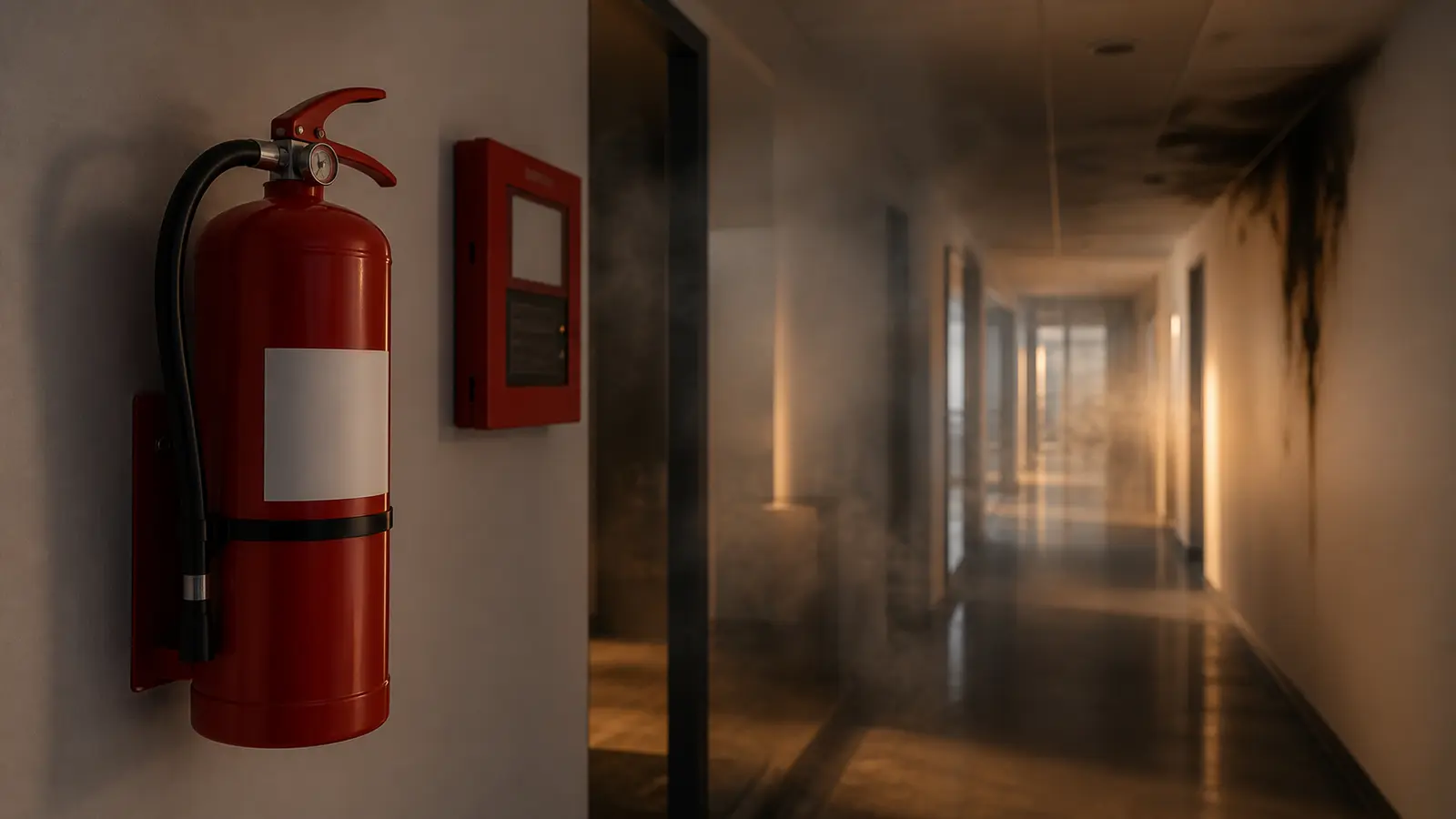
It caught fire. Whether it was a spark from the electrical installation, a cigarette butt in the bin, or a technical fault on a machine – now you’re standing in the yard, looking at the burnt-out hall or office, and only one thing is running through your head: what happens next.
The first person to appear after the Fire Rescue Service investigators is usually the insurance loss adjuster. And their first questions aren’t just about where it started. They’re also interested in what you did beforehand. Fire safety documentation, fire extinguisher inspections, employee training. It sounds like an administrative triviality until something goes wrong. Then it becomes one of the main documents for smooth claims handling and a defence against payout reductions.
This isn’t about scaremongering. It’s about common sense and a basic overview.
Short version: the insurer does not reduce the payout automatically for every missing piece of paperwork. What matters is whether the breached duty had a substantial influence on the start of the fire, its course, or the extent of the damage. That is exactly why it helps to be able to quickly prove that checks, documentation, and training were in order.
What the Insurance Company Investigates After a Fire
The loss adjuster receives a report from the Fire Rescue Service – this determines the cause of the fire. That’s the first layer. But they’re also interested in a second thing: the state of fire safety at the time the damage occurred. And here, an electrical inspection report alone isn’t enough – while it’s important (and we’ve dedicated a separate article to missing inspections and the insurance company), a fire is more complex.
The insurance company looks at the whole picture:
- Was the company correctly classified into a category according to the level of fire risk?
- Are the inspections of fire extinguishers and fire safety equipment valid?
- Is there a fire safety procedure, fire logbook, evacuation plan – if you are required to have them?
- Were employees trained and would they know how to react correctly?
Why are they more interested in this than “just” the electrics? Because a fire arises from many causes, and its consequences are often magnified by failures in fire safety. When a fire spreads due to a non-functional smoke extraction system or because employees didn’t know where the fire extinguisher was, that’s significant information for the scope of the insurance payout. And the loss adjuster will find it.
When the Insurance Company Can Reduce the Payout
It pays to read slowly here. Section 2800, paragraph 2 of the Civil Code stipulates an important point: a breach of duty does not mean automatic refusal of the payout. It’s not black and white.
It’s about a causal link. The insurance company may reduce the payout only if your failure had a substantial influence on the start of the fire, its course, or on the increase in the extent of its consequences. And even in such a case, it has the right to a proportionate reduction – not a reduction of the entire amount.
Example: a fire extinguisher inspection expired by a few weeks, yet the extinguisher was fully functional and the fire started in a laboratory where no one could get to it anyway. A substantial influence on the extent of the damage? Hard to prove.
But a different picture: a fire engulfs a warehouse, and the fire safety equipment – such as smoke extraction – fails because no one has performed a periodic inspection on it for three years. Smoke spreads throughout the entire hall, and the damage is several times higher than if the equipment had worked. Here, the causal link may be much easier to prove, and the loss adjuster will take it into account.
What is essential: the insurance company always proceeds according to the specific insurance contract, its terms and conditions, and exclusions. Each contract may have different requirements. Likewise, it depends on whether the contract is agreed on a “new value” or “actual cash value” basis – this will affect the payout amount regardless of fire safety. But that’s more of a topic for a meeting with your insurance advisor.
What Specifically the Loss Adjuster Wants to See
When they arrive on site, they have a checklist in hand. Practically speaking, they will be mainly interested in this:
- Records of fire extinguisher inspections – operational check once a year, periodic pressure vessel test every 3 years (water, foam) or every 5 years (powder, CO₂). Without paperwork, it’s as if it didn’t happen.
- Inspection reports for fire safety equipment – fire alarm systems, smoke and heat extraction – at least once a year, unless the manufacturer specifies a shorter interval. For fire alarm systems, emergency lighting, or hydrants, the intervals are governed by standards and manufacturer documentation; they aren’t fixed in law – but the absence of documentation hurts just the same.
- Fire safety procedure, alarm directives, evacuation plan, fire logbook – if you fall into the two higher categories of fire risk. And do you? That’s determined by factual criteria under the Fire Protection Act – not the number of people, not what you think. This catches even experienced operators off guard.
- Fire safety training records – employees once every 2 years, managers once every 3 years. Again, this applies to the two higher categories. A missing attendance sheet is an unnecessary complication.
- Classification into activity category – do you have it documented? Can you prove that you are in a category without increased risk and that mandatory fire safety documentation doesn’t apply to you? This also needs to be evidenced, not just claimed.
Good advice: keep all these documents in one place, ideally in a binder or digital storage that you can access even on a Saturday evening. After a fire, there’s chaos – and you don’t want to be hunting for papers.
What to Do Immediately After a Fire
Once the site is safe and the Fire Rescue Service intervention has ended, the second part of the work begins: preserving evidence and gathering documents for the insurer. In practice:
- Do not clean up the damaged site more than necessary for safety – follow the instructions of the Fire Rescue Service, police, and insurer. Premature clean-up can complicate proving the cause and the extent of the damage.
- Report the event to the insurer according to the contract – save the claim number and the name of the loss adjuster. Some contracts set specific deadlines and cooperation requirements.
- Take your own photo documentation – overviews, details, damaged property, equipment labels, fire extinguishers, and places where documents were stored. Not as a substitute for the official investigation, but as your own working record.
- Prepare technical and fire safety documents – inspection reports, fire extinguisher and fire safety equipment checks, training records, fire logbook, evacuation plan, and activity category classification.
- Write down a simple timeline – who discovered the fire, when the Fire Rescue Service was called, who intervened, which equipment was used, and when you contacted the insurer.
Three Typical Scenarios After a Fire
In practice, we mainly encounter these scenarios:
- Fire extinguisher inspection expired by a few weeks, but the extinguisher is fully functional and the fire started elsewhere – typically damage caused by a technical fault, not a fire safety failure. The insurance company checks the documentation, but if the delay had no substantial influence on the extent of the damage, the payout is usually not reduced. Still, it will be noted in the report and can lead to uncomfortable questions.
- Fire extinguisher or fire safety equipment demonstrably non-functional, which contributed to the extent of the damage – here, the risk of a payout reduction increases. If the documents show that the non-functional equipment caused a greater extent of consequences, the insurance company has room for a proportionate reduction. It’s not an automatic refusal, but the numbers change.
- Everything in order – inspections, documentation, training – a random event covered by the insurance contract. The loss adjuster checks the documents, states that due care was taken, and standard claims settlement proceeds. No disputes about fire safety.
The point is simple: the better you can document due care, the less room for doubt arises. It’s not about papers saving the company. It’s about well-maintained documentation limiting the room for disputes over unjustified reductions.
How to Prepare (So You’re Not Caught Off Guard)
Prevention is cheaper than firefighting – literally. What to focus on:
- Track inspection intervals – inspect fire extinguishers once a year, periodic pressure vessel tests after 3 years (water, foam) and 5 years (powder, CO₂). Fire safety equipment at least once a year. Employee training once every 2 years, managers once every 3 years. Put it in your calendar or find a partner who will track it for you.
- Keep fire safety documentation accessible and up to date – fire safety procedure, fire logbook, evacuation plan. This applies to increased and high fire risks, but even in offices without increased risk, it pays to have at least a basic overview of what to do in case of fire.
- Address the electrical installation – it’s one of the most common causes of fires in companies. Regular electrical inspections are fundamental, and insurance contracts often explicitly require them. More on the topic of inspections and insurance can be found in a separate article.
- Check your insurance contract – sit down with it and see what it specifically requires in the area of inspections and fire safety. Some contracts refer to compliance with legal regulations in general, others have explicit requirements for inspections. Do you know what you’re signing?
- Go through the entire fire safety setup with a specialist – if you’re not sure which category you fall into, whether you have complete documentation, or whether the intervals are in order, a fire safety audit is worthwhile. One day’s work can save you problems for years to come.
How SOHE Helps
Fire safety, electrical inspections, and occupational health & safety (OHS) – three worlds that intersect in practice. We keep them under one roof. For you, this means a single point of contact and the assurance that individual obligations don’t contradict each other.
What we can do for you:
- We’ll verify the fire risk category – it’s often different from what the operator assumes.
- We’ll prepare or revise fire safety documentation – fire safety procedure, alarm directives, evacuation plan, fire logbook.
- We’ll track the intervals for fire extinguisher and fire safety equipment inspections and ensure they are carried out.
- We’ll conduct fire safety training for employees and managers.
- We’ll connect fire safety with electrical inspections and OHS so everything fits together.
We’ve detailed the documentation and intervals for fire safety in the article on fire safety in the company.
Want to be sure that neither a fire nor a loss adjuster will catch you off guard? Write to us via the non-binding inquiry form – we’ll arrange a date for an inspection and audit.
Frequently Asked Questions
Can the insurance company refuse the payout if a fire extinguisher inspection was missing?
Refusing the payout as a whole is an extreme case, more related to intentional acts. For ordinary neglect of fire safety, a proportionate reduction of the payout is more likely, and only if the missing inspection had a substantial influence on the start or extent of the damage. For a demonstrably functional extinguisher, such an influence is difficult to prove.
Is it enough to have a fire extinguisher on the wall, or do I also need a paper about the inspection?
You need both. A functional fire extinguisher is fundamental – but without a valid record of the operational check (once a year) and the periodic vessel test (after 3 or 5 years), it’s as if it wasn’t there for the loss adjuster. In practice, insurance companies want to see the report. It’s not enough to claim that a technician came at some point.
The fire was caused by electricity – is it handled as a fire safety issue or an inspection issue?
Both. The Fire Rescue Service determines the electrical installation as the cause – that’s the first lead, and the state of electrical inspections will be examined. At the same time, the loss adjuster examines whether fire safety as a whole functioned: were fire extinguishers in place, did smoke extraction work, did employees know what to do? Fire safety and inspections are two connected vessels – and the insurance company looks at both.
We are a small office without increased risk – does this apply to us?
Even for activities without increased fire risk, you have obligations, albeit smaller ones. Mandatory fire safety documentation doesn’t apply to you, but fire extinguishers must be in an operational state and you must inspect them regularly. And your insurance contract may contain requirements beyond the law. Moreover, classification into a category doesn’t depend on you being “just” an office – factual criteria under the Fire Protection Act decide, not your impression.
What is the difference between an annual fire extinguisher inspection and a periodic test?
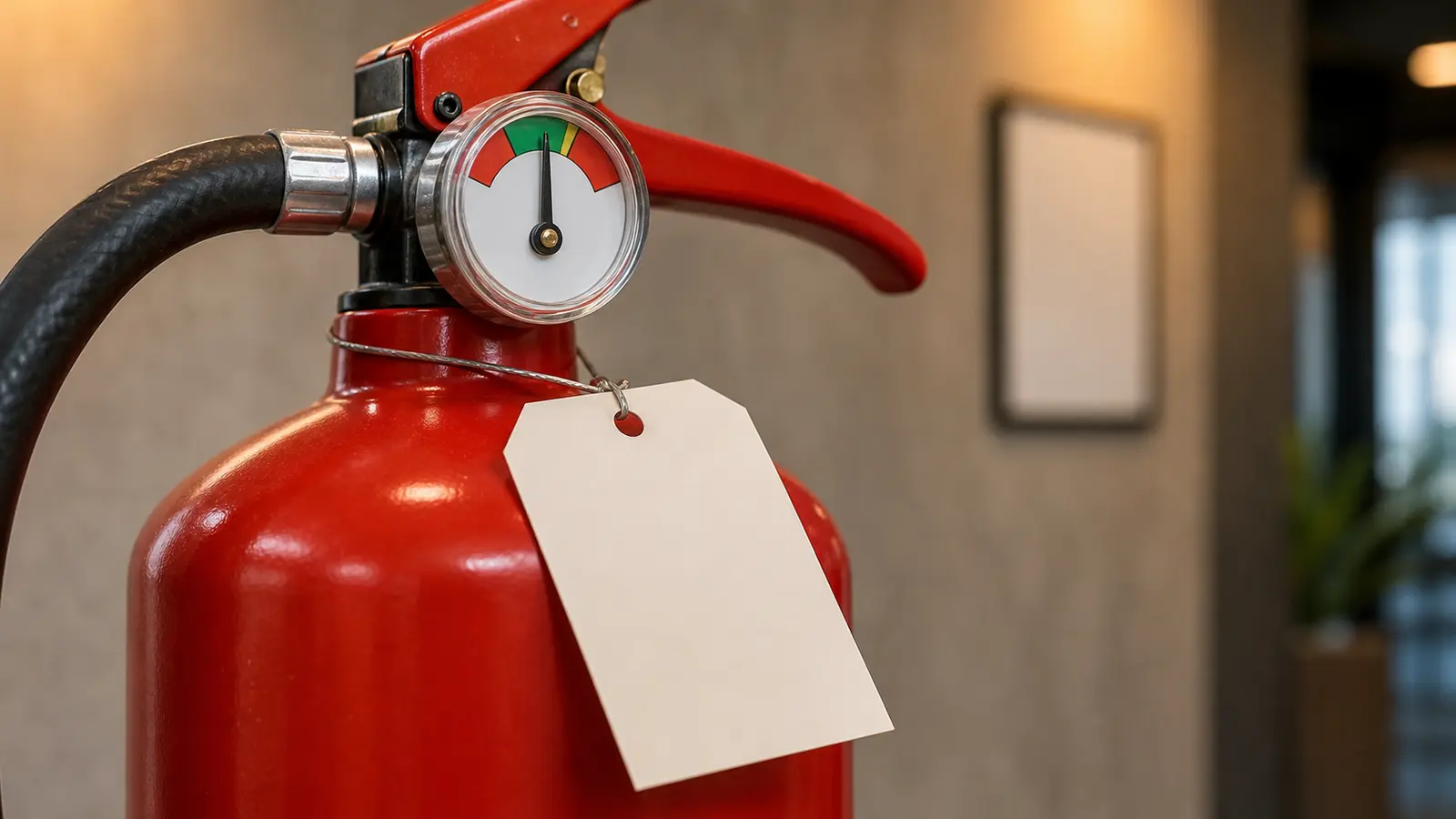
The operational check (the annual one) is a visual and functional inspection – the technician checks the pressure, hose condition, trigger mechanism, and mounting. The periodic pressure vessel test (after 3 or 5 years depending on the type) is more thorough – the vessel undergoes a pressure test and internal condition check. It is carried out by a specialized facility.
Sources for This Article
The information in the article is based on the current wording of these regulations (verified against the official e-Sbírka):
- Act No. 89/2012 Coll., Civil Code – Section 2800, paragraph 2 (if the breach of duty had a substantial influence on the occurrence of the insured event, its course, or on the increase in the extent of its consequences, the insurer has the right to reduce the insurance payout proportionately to this influence).
- Act No. 133/1985 Coll., on Fire Protection – Section 4 (categories of activities according to fire risk), Section 15 (fire safety documentation), and Section 16 (fire safety training).
- Decree No. 246/2001 Coll., on Fire Prevention – Section 7 (operational check of fire safety equipment), Section 9 (inspections and tests of fire extinguishers), and Section 23 (fire safety training intervals).
Specific inspection intervals for fire alarm systems, hydrants, and emergency lighting stem from technical standards (ČSN 34 2710, ČSN 73 0873, ČSN EN 671-3, ČSN EN 50172) and manufacturer documentation, not directly from the decree. The scope of the insurance payout is always governed by the specific insurance contract, its terms and conditions, and exclusions, and this article does not replace the assessment of a specific case. Regulations may be amended.