
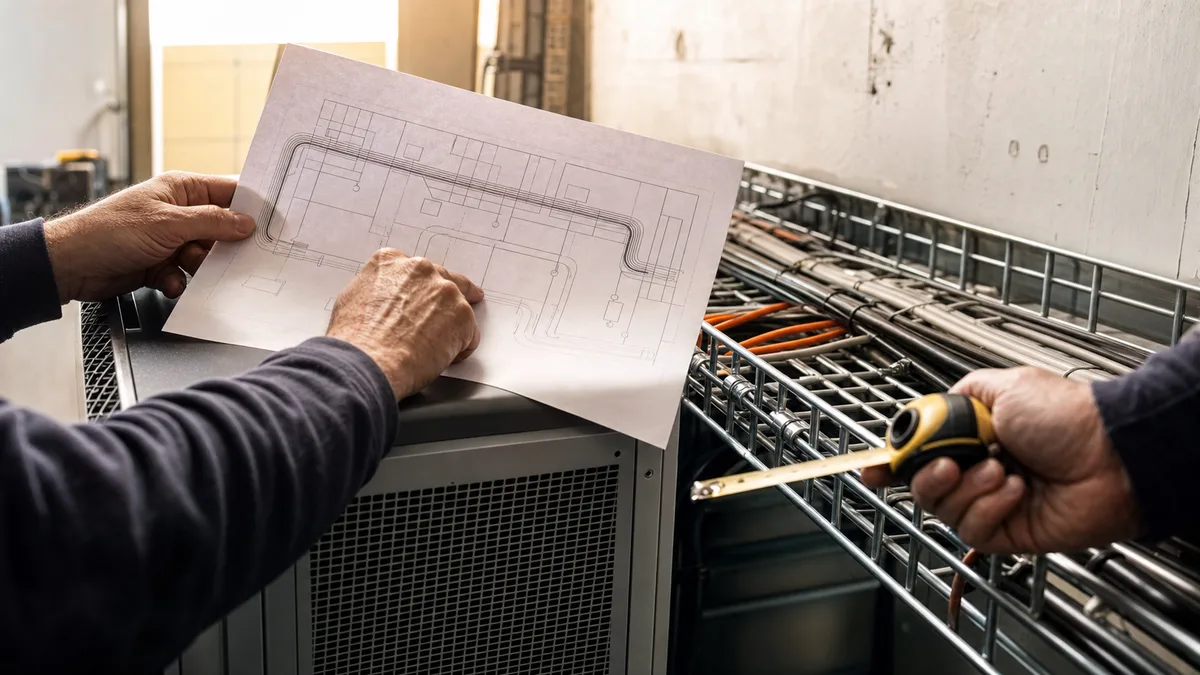
After an electrical inspection, a company is left with an inspection report and the feeling that the paperwork is done. But the inspection report is only one layer. Act No. 250/2021 Sb., on occupational safety in connection with the operation of designated technical equipment, works with two broader concepts as well: technical documentation (průvodní dokumentace — the documents supplied with the equipment) and operating documentation (provozní dokumentace). Both apply to ordinary company wiring, switchboards and machinery — and both go missing more often than any other records a company keeps for its building.
Companies without them usually find out at the worst possible moment: the inspector starts tracing what exactly is being inspected, the inspection drags on and gets more expensive, and the report gains a finding that the documentation does not match reality. Let’s go through what belongs in each type of documentation, why the inspector wants to see it, and what to do when no records for the building can be found at all.
The short answer
Technical documentation is the set of documents supplied with the equipment by the manufacturer or supplier — manuals, wiring diagrams, as-built documentation. Act No. 250/2021 Sb. defines it in Section 2 as documents supplied in the Czech language that must remain available throughout the entire operating life of the equipment. It is not something you throw out with the switchboard packaging once the building is approved for use.
Operating documentation, by contrast, is everything that comes into being during operation: records of inspections, checks and tests, records of repairs and maintenance, proof of operator qualifications, inspection schedules and other documents depending on the nature of the operation. The inspection report is just one item within it.
In practical terms: technical documentation says how the equipment is built, operating documentation proves how you look after it. Both are typically assessed during an official inspection and in an insurance claim.
Technical documentation: what the manufacturer and supplier provided
For a company building, the core of the technical documentation consists of as-built records for the electrical installation — wiring diagrams, descriptions of switchboards and individual circuits, layouts of cable routes. Add to that the manuals and technical documentation for switchboards, machinery, charging stations or backup power supplies, as handed over by the manufacturer or the installation contractor.
Two practical notes from the field:
- A “design” is not automatically an “as-built”. The original design documentation captures intent. If routes and circuits changed during installation or later modifications and nobody recorded the changes, what you are holding describes an installation that does not exist. For both inspection and maintenance, what counts is documentation matching the actual state.
- Documentation belongs to the equipment, not to a person. When the diagrams sit in a former maintenance technician’s inbox, or with an electrical contractor that has since gone out of business, from the operator’s point of view it is as if they did not exist. It pays to take them over, store them, and hand them on whenever the contractor changes.
The records for an installation usually also include the external influences assessment protocol (protokol o určení vnějších vlivů) — we cover that separately below, because it has the biggest impact on inspection costs.
Operating documentation: what accumulates during operation
Think of operating documentation as a folder that grows with every year of operation. For electrical equipment it typically contains:
| Document | What it contains | What you will need it for |
|---|---|---|
| Inspection reports | initial and periodic inspections with measured values and conclusions | the basic proof of safe operation during an official inspection or insurance claim |
| Records of checks and tests | checks between inspections, RCD tests, thermal imaging | evidence of care for the equipment in the periods between inspections |
| Records of repairs and maintenance | who repaired or replaced what, and when | explains differences against the diagrams, background for the inspector |
| Proof of qualifications | certificates and authorisations of people working on the equipment | shows that only competent persons touch the equipment |
| Inspection and check schedule | intervals by equipment type and environment | tracking deadlines, budget planning |
| Operating log, where kept | daily or per-shift records in more complex operations | reconstructing events after a fault or injury |
The scope varies with the size and nature of the operation — an office-based company will not keep an operating log for a substation, a production hall with its own transformer station will. The purpose is always the same, though: it must be possible at any time to show what condition the equipment is in, who looks after it, and when the prescribed tasks were carried out. What the inspection report itself should look like to hold up in this folder is covered in our article on what an inspection report must contain.
The external influences assessment protocol: an unremarkable document with a big impact
External influences are, put simply, the conditions in which the installation works: dust, humidity, temperature, fire risk from the materials being processed, mechanical stress. They determine how the installation must be built in a given space — and, together with the type of equipment, how often individual parts of the site are inspected. Specific intervals by environment are covered in the article on how often to have an electrical installation inspected.
The assessment results in an external influences assessment protocol (in older records, a “protokol o určení druhu prostředí”, an environment classification protocol). And this is precisely the document that is missing most often in practice — in older buildings it frequently was never drawn up at all, in newer ones it was lost when the use of the premises changed.
Why that matters: without the protocol the inspector has no basis for judging whether the installation matches its environment, and in practice intervals are then derived conservatively — that is, on the shorter side, with a denser inspection regime and higher costs. And if you change how a space is used (a warehouse becomes a workshop, an office becomes a paint shop), the original classification of influences no longer applies and should be updated.
Why the inspector wants to see the documentation
ČSN 33 1500, the basic standard for inspections of electrical equipment, assumes the inspector has records available during the inspection: as-built documentation of the equipment, external influences assessment protocols, the previous inspection report, and records of checks and fault rectification. Under defined conditions the standard also allows a preventive maintenance regime, where the operator plans part of the equipment care under its own internal rules — but that makes it all the more dependent on those rules and their fulfilment being documented.
What happens when the records are not there:
- The inspection takes longer. The inspector has to trace and identify circuits, verify where each outgoing line runs, and adjust the scope of measurement accordingly. You pay for the inspector’s time.
- The report is full of qualifications. A missing diagram, unlabelled circuits or a non-existent external influences protocol will show up among the findings — and with them the obligation to address them. How to read such findings and what to fix first is described in the article on how to read an electrical inspection report.
- A weaker position when damage occurs. In an insurance claim, the question is how the operation was documented. Gaps in the documentation give the insurer arguments — more on that in the article on missing inspections and the insurer.
The duty to operate designated electrical equipment safely and demonstrably lies with the operator — it follows from Act No. 250/2021 Sb. and Government Regulation No. 190/2022 Sb., which for designated electrical equipment assumes that both technical and operating documentation is available throughout the entire operating life. So this is not a formality “for the inspector”: it is part of the same legal framework as the inspections themselves.
What to do when documentation for the building is missing
Typical situations: you bought an older hall and all you got from the previous owner were the keys. You moved into leased premises where nobody can find anything. Or a long-serving maintenance technician left and everything they “kept in their head” went with them. A workable procedure looks like this:
- Take stock of what exists. Go through the archive, the building approval records, the last inspection reports, contracts with electrical contractors. Contact the previous owner, the building manager and the installation contractors — the documentation is often sitting with them.
- Survey the actual state. Whatever cannot be found has to be newly documented: identification of switchboards, labelling of circuits, updated diagrams. For smaller premises this is days of work, not months — and records drawn up once will serve for years.
- Determination of external influences. For spaces where the protocol is missing or no longer matches today’s use, a new assessment is prepared. The inspection regime follows from it.
- Schedule and record-keeping. Build an inspection and check plan with specific dates on top of the reconstructed records, and name the person responsible for filing them.
In practice, the best time to fill the gaps is during a periodic inspection: the inspector, who is walking and measuring the installation anyway, documents the actual state in a single visit. That is exactly how we do it as part of our electrical inspection service — and if you are dealing with a building with no records whatsoever, send us a no-obligation enquiry with the address and a brief description of the operation; we will propose the scope of both the documentation work and the inspection from a single supplier, so you are not paying twice for the same site visit.
Refurbishments and new installations are a chapter of their own: there, as-built documentation arises naturally at handover and is verified by the initial inspection. The cheapest documentation is the documentation you request from the contractor at handover — tracking it down years later always costs more.
How to keep documentation alive
Filling the gaps once is not enough if the records stop matching reality a year later. The proven minimum rules:
- every intervention in the installation (a new circuit, a rerouting, a switchboard replacement) is recorded and reflected in the diagrams,
- whenever the use of a space changes, the determination of external influences is reviewed,
- all protocols, reports and records are filed in one agreed place — not in individual people’s inboxes,
- when the responsible employee leaves or the contractor changes, handover of the documentation is treated as a separate item,
- once a year the whole set is reviewed and reconciled against the inspection schedule.
It is dull discipline, but a cheap one. An hour spent updating a diagram after rerouting a circuit is incomparably cheaper than a day of an inspector’s time tracing unlabelled outgoing lines a year later.
Frequently asked questions
Is the inspection report the same thing as operating documentation?
No. The inspection report is the outcome of one specific inspection and is just one item within the operating documentation. That is broader — it also includes diagrams, the external influences assessment protocol, records of checks and maintenance, and local operating rules.
What if the external influences assessment protocol never existed?
In older buildings this is a common situation. The protocol can be drawn up retrospectively — usually by a specialist working with the inspector during the next inspection. Without it, there is no way to show why the installation in a given space was built the way it was, and the inspector has nothing on which to base the intervals.
How long must documentation be kept?
Throughout the entire operating life of the equipment. Under Section 2(g) of Act No. 250/2021 Sb., the technical documentation must be available for the whole operating life; inspection reports are worth keeping at least until two further inspections have been carried out, so that the trend in the equipment’s condition remains visible.
Is documentation in electronic form enough?
Yes, provided it is legible, complete and available to whoever needs it — the operators, the inspector and the authorities. It is practical to keep at least a printed diagram by the switchboard, because in a power outage nobody can reach files on a server.
Sources
- Electrical inspections – the SOHE service for companies.
- What an inspection report must contain – what the inspection report itself should include, a key item of operating documentation.
- How to read an electrical inspection report – what the findings mean, including missing documentation, and how to set priorities.
- How often to have an electrical installation inspected – inspection intervals by environment, which the external influences assessment protocol feeds into.
- Act No. 250/2021 Sb. – the Act on occupational safety in connection with the operation of designated technical equipment; Section 2 defines technical and operating documentation.
- Government Regulation No. 190/2022 Sb. – the regulation on designated technical electrical equipment, as amended.
- ČSN 33 1500 – electrotechnical regulations, inspections of electrical equipment; the basis for carrying out inspections.
The legal position was verified as of 24 July 2026. Both Act No. 250/2021 Sb. and Government Regulation No. 190/2022 Sb. are applied as currently in force.
This text is informational and does not replace legal advice. The specific scope of documentation needs to be set according to the actual operation, the type of equipment, the environment and a risk assessment.
Not sure what should exist for your electrical installation — or do you know that almost nothing does? We combine reconstructing the documentation with an inspection in a single visit, so you get both the records and a valid report from one supplier. Send us a no-obligation enquiry or write to info@sohe.cz and we will agree on a scope that fits your operation.