
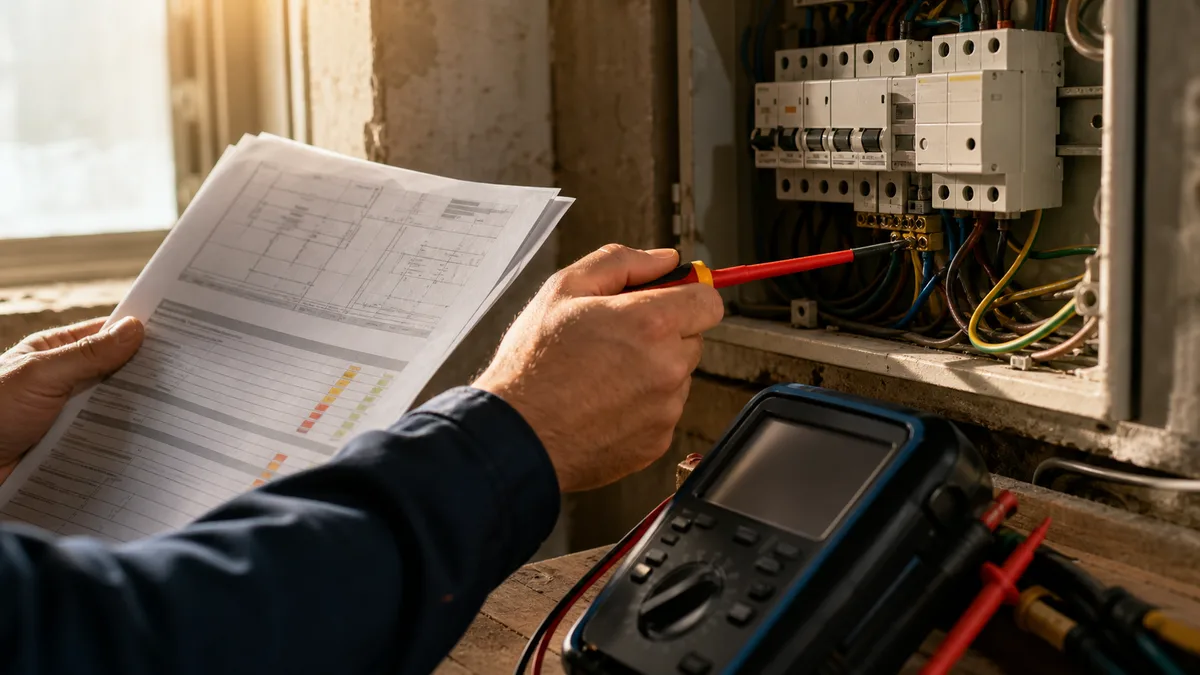
An electrical inspection report usually lands on your desk as several pages of tables, abbreviations and measured values. But a business owner doesn’t care about the number of lines — they care about whether they can keep operating, what is dangerous and what can wait. And this is exactly where mistakes happen: defects get judged by their number rather than by what they mean for protection against injury, fire and failure. This article shows how to read the report from the conclusion, how to sort the findings by risk and how to document that you have dealt with them.
Start with the conclusion, not the number of defects
Don’t read the inspection report starting from the first page of measurement tables. First find the inspection technician’s written conclusion. For designated electrical equipment, the report states whether the equipment is safe to operate; if it is not, the technician gives reasons for that conclusion.
The scope of the inspection is just as important. A conclusion that “the equipment is safe to operate” may apply only to the office part of the building, a single distribution board or a specific production line — on its own it does not mean the whole premises passed the inspection.
So check four things in the report:
- what exactly the technician inspected,
- which areas or parts were excluded from the inspection,
- whether the equipment is safe to operate,
- what defects, restrictions and recommendations the report lists.
An inspection report describes the condition at the time of the inspection. It is not a guarantee that the installation will stay safe until the next inspection date without maintenance and repairs.
What to do as soon as you receive the report
Before you forward the whole document to an electrician with a “please fix” note, split the findings into three working groups according to how quickly you need to respond.
| Priority | How to recognize the defect | What to do |
|---|---|---|
| Immediate safeguarding | Accessible live parts, a damaged distribution board, an overheated joint, a non-functioning protective device, or an explicit conclusion that the equipment is not safe to operate | Take the affected part out of service, disconnect it or secure it according to instructions from a qualified person |
| Quick repair | The defect reduces the effectiveness of protection, but the technician does not require the whole installation to be shut down | Arrange a repair date and, until then, put reasonable operating restrictions in place |
| Documentation and organization | Missing circuit labelling, an out-of-date diagram, an undocumented previous repair or a missing external-influences report | Complete the documentation and assign a responsible person and a deadline |
The number of defects on its own says nothing about their seriousness. A single defect in the protection against electric shock can matter more than ten missing labels.
Some technicians and software use their own severity markings — letters, numbers or colour groups. Czech law, however, does not set a single universal scale for all inspection reports. If you see codes such as A, B, C or other abbreviations in the report, check what they mean in that specific document; don’t rely on the colour or the sequence number alone.
What the most common defects mean
A technical entry often doesn’t tell a business owner what problem might arise during operation. The overview below will help you get your bearings — but it does not replace an assessment of your specific installation by a qualified person.
| Entry in the report | What it means in operation | Typical priority |
|---|---|---|
| Accessible live part or missing cover | You can touch a part under voltage — a broken socket, a loose cover, an uncovered spot in the distribution board. | Prevent access immediately and ensure disconnection |
| Interrupted or non-compliant PE protective conductor | In the event of a fault, the equipment’s metal casing may not be reliably connected to the protective system. | High — do not use the affected circuit without an expert assessment |
| Non-compliant fault-loop impedance | In the event of a fault, the circuit breaker may not disconnect the circuit within the prescribed time; yet the socket appears to work. | Prompt expert resolution |
| Residual current device does not trip or has non-compliant parameters | The protective device may fail to do its job in the event of a fault; pressing the TEST button does not replace a measurement. | High |
| Low insulation resistance | Insulation damaged by age, moisture, mechanical impact or a faulty connected appliance. | Depends on the value and location; requires tracing the cause |
| Thermally damaged terminal or conductor | A common cause is a loose joint — the higher contact resistance generates heat and the damage keeps getting worse. | Take the affected part out of service and repair it without delay |
| Overcurrent protection unsuitable for the conductor cross-section | The circuit breaker or fuse may not protect the wiring against overload as it should. | Quick repair after checking the cross-section, installation method and load |
| Missing labelling of the distribution board or circuits | During a fault, staff may switch off the wrong circuit; maintenance and future inspections become harder. | Complete within a short planned deadline |
| Documentation does not match reality | You cannot reliably compare what was built with the design, and maintenance relies on incorrect records. | Schedule a survey and an update |
These measurements rely on the requirements for protection against electric shock under ČSN 33 2000-4-41: the fault-loop impedance must be low enough for the circuit breaker or fuse to disconnect a faulty circuit within the prescribed time, and a residual current device intended to protect people (up to 30 mA) is tested for both its tripping current and its tripping speed. Pressing the TEST button on the RCD only checks the mechanism, not these values.
The most common findings concern distribution boards — what is measured on them and what tends to be a typical defect is covered in the article distribution board inspections.
An older design is not a defect simply because a newer technical solution exists today. In the report, distinguish an actual failure to meet a requirement from a recommendation to modernise — for a defect, the report should state which specific requirement of a regulation or standard was not met.
Which defects lead to taking part of the installation out of service
For designated electrical equipment, the operating regulations assume that a condition posing an immediate threat to work safety or operation is disconnected from the power supply and secured against reconnection; if disconnection is not possible, the repair is carried out without undue delay. This principle stems from the operator’s duty to keep designated electrical equipment in a safe condition under Act No. 250/2021 Coll. and from the requirements of Government Regulation No. 190/2022 Coll.
Taking equipment out of service does not necessarily mean shutting down the whole company. A defect is usually limited to a single circuit, machine, socket or part of a distribution board. But the scope of safe disconnection should not be decided by an administrative employee based on the name of the defect — let a person with the appropriate professional qualification determine it.
If the report contains the sentence “the equipment is not safe to operate”, don’t just request a standard quote with a date several weeks out. First clarify with the inspection technician:
- which part should not be used,
- how to take it out of service safely,
- whether a temporary technical measure can be put in place until the repair,
- how it will be verified that the repair has restored a safe condition.
By when to fix the defects
There is no universal deadline of 10, 30 or 60 days for all defects in an inspection report. For designated technical equipment, Act No. 250/2021 Coll. assumes that the operator will fix defects that threaten safe and reliable operation without undue delay — so the specific approach is derived from the risk, the inspection conclusion and the operating conditions. A faulty RCD in a wet environment is judged differently from an illegible label on a locked distribution board.
For your internal records, add to each item a responsible person, a deadline and any temporary measure. The phrase “handed over to maintenance” is not enough. If the repair cannot be done straight away, also record the reason for the delay and how you reduced the risk in the meantime.
How to get a usable repair price
A price can’t be reliably set from the number of defects. An item such as “non-compliant insulation condition” may mean replacing a short damaged cable, but it may also mean gradually tracing a fault across several branches of the installation.
In your request for a quote, send:
- the entire inspection report, including its scope and measured values,
- photos of the affected distribution boards and equipment,
- information on when operation can be shut down,
- a request to break the price down into diagnostics, materials, labour and final verification,
- a list of the defects the contractor should mark as fixed in their output.
Where the cause is unclear, ask first for the price of diagnostics and only then for the repair budget. A single-figure quote with no defined scope can end in extra work or in repairing the visible symptom instead of the real cause.
How to document that a defect has been fixed
An invoice on its own that reads “electrical work as agreed” is weak evidence. You need to link the original defect with the measure that was carried out.
The handover or service record should contain:
- the defect number from the inspection report,
- a description of the repair carried out,
- the date and location of the work,
- identification of the person or company that did the work,
- the results of the necessary measurements and functional tests,
- any remaining operating restrictions.
A full new inspection is not needed after every terminal tightening or label replacement. The scope of verification depends on the work and the nature of the defect. For a change to the installation, an intervention in protective measures, or an original conclusion that the equipment is not safe to operate, have it determined in advance whether a measurement and a repair report will suffice, a partial verification, or a follow-up inspection.
Do not rewrite the original inspection report. Keep it together with the repair documents, the measurement results and any follow-up report.
How to recognize a well-prepared inspection report
A usable report lets you locate a defect, understand it and commission the repair. A warning sign is vague entries such as “the electrical installation does not comply with standards” without stating the location, the breached requirement and the impact on the conclusion. What a good report should contain is covered in more detail in the article what an inspection report must include; in short, check whether the document contains:
- a precise definition of the inspected equipment,
- the inspections, tests and measured values carried out,
- the measuring instruments used,
- an unambiguous location for each defect,
- a reference to the breached requirement of a regulation or standard,
- an understandable conclusion on operating safety,
- an assessment of the defects from the previous inspection.
If you can’t tell from the text whether you should restrict operation, ask the inspection technician for a written clarification. It is not advisable to replace an unclear result with your own interpretation.
What you risk by putting off repairs
The biggest risk is not the entry in the document itself, but knowingly continuing to operate with a known defect. In the event of an injury, fire, inspection by the authorities or an insurance claim, the question is then not only whether an inspection exists, but also how the company responded to the findings.
An inspection report filed away in a binder with no record of remediation does not prove that you kept the equipment in a safe condition afterwards. How a missing inspection or unresolved defects affect the settlement of an insurance claim is covered in the article a missing inspection and the insurer — the outcome depends on the specific insurance terms and on the connection between the defect and the damage, so it cannot be generalised in advance.
Sources this article draws on
- Electrical installation inspection – a SOHE service.
- What an inspection report must include – what a good inspection report should contain and how to spot an incomplete or vague document.
- Distribution board inspections – what is measured on a distribution board and what tends to be the most common defect.
- A missing inspection and the insurer – how a missing inspection or unresolved defects affect the settlement of an insurance claim.
- Act No. 250/2021 Coll. – the act on occupational safety in connection with the operation of designated technical equipment; it establishes the operator’s duty to keep designated electrical equipment in a safe condition and to fix defects without undue delay.
- Government Regulation No. 190/2022 Coll. – requirements for ensuring the safety of designated electrical equipment and its operation, including how to handle equipment in a dangerous condition.
- ČSN 33 2000-4-41 – requirements for protection against electric shock (disconnection of a faulty circuit within the prescribed time, residual current devices); the standard is not freely available.
This text is for information only and does not replace legal advice. The specific arrangements for fixing defects from an inspection report, deadlines and verification of remediation need to be set according to your actual operation, the manufacturer’s documentation, the environment of use and a risk assessment.
Not sure what in your inspection report needs immediate safeguarding and what can safely wait? Electrical installation inspection from SOHE also includes a clear explanation of the findings and preparation of the repair brief. Send us the whole report together with the measured values via our no-obligation enquiry or to info@sohe.cz and we’ll get back to you with the next steps.