
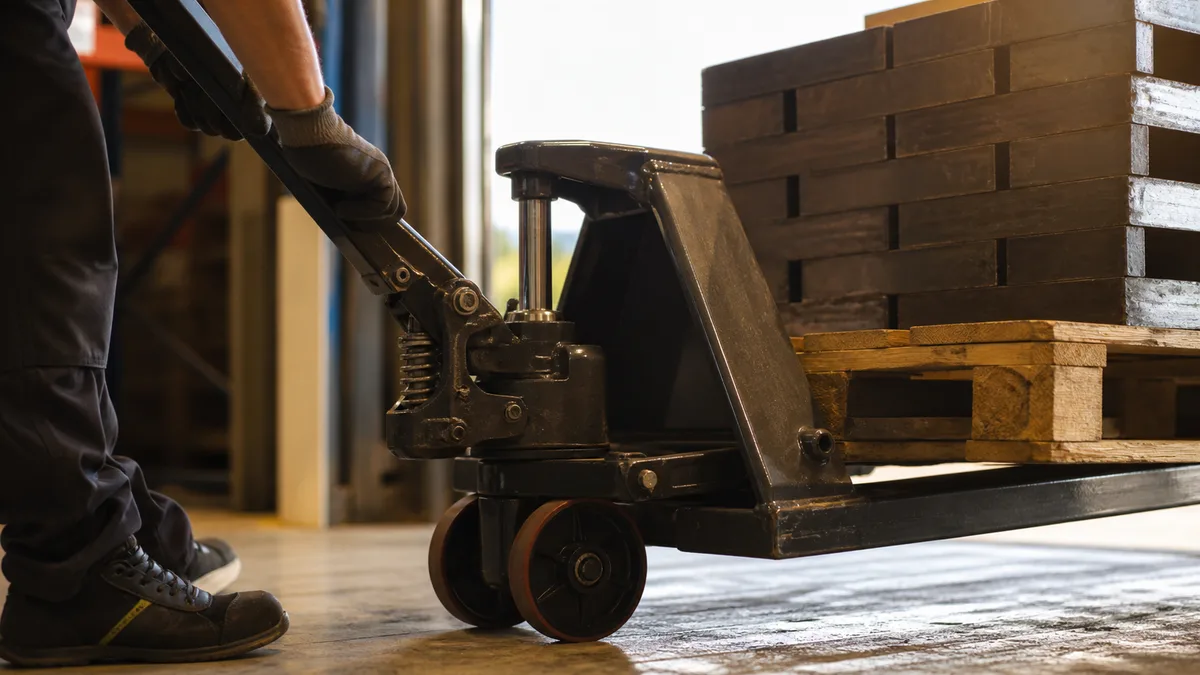
The compliance calendar of a typical company includes an electrical installation revision, fire extinguisher checks, and occupational safety and fire protection training. The compressor in the corner of the workshop, the band saw, the pillar drill or the manual pallet truck in the warehouse are almost never on it. Yet they are subject to a separate requirement with its own deadline — nobody talks about it simply because it hasn’t changed in years.
Government Regulation No. 378/2001 Sb. took effect on 1 January 2003 and has since seen only an editorial correction, no substantive amendment. So it never gets its “premiere” in the round-ups of legislative news published every spring. The obligation, meanwhile, has been running unchanged the whole time.
What Section 4 of Government Regulation No. 378/2001 Sb. says
The essential sentence is a single one. Under Section 4(2), a follow-up check of equipment must be carried out at least once every 12 months, to the extent laid down by the local operational safety rules — unless a special legal regulation, the accompanying documentation or a standard value sets a different scope and frequency for follow-up checks.
That deadline is therefore a minimum, not a fixed standard. The manufacturer’s instructions for a press or a woodworking machine may prescribe checks more often and in a specific scope — in which case the instructions govern.
This builds on Section 4(1)(c) of Act No. 309/2006 Sb., under which machinery, technical equipment, means of transport and tools are to be regularly and properly maintained, checked and subjected to revisions. The Act says “regularly”; the government regulation adds the specific deadline and mechanism.
Act No. 309/2006 Sb. was last amended by Act No. 318/2025 Sb., effective from 1 November 2025. That amendment, however, did not touch this part — it targeted risk factors, controlled zones and duties on construction sites. So if you read somewhere that “the requirements for machinery changed last autumn”, they did not.
A check under NV 378/2001 Sb. is not a revision
This is the most common source of confusion and of needlessly paid invoices. A check under NV 378/2001 Sb. and a revision of designated technical equipment are two different regimes — but not two boxes into which a machine falls either one way or the other. A single machine can be subject to both at once.
| Check under NV 378/2001 Sb. | Revision of designated equipment | |
|---|---|---|
| What it covers | the operation and use of machinery, technical equipment, appliances and tools in general | equipment classified as designated — electrical, gas, pressure, lifting; may also be a part of a machine |
| Interval | at least once every 12 months unless set otherwise | according to the relevant government regulation and the equipment’s classification |
| Who sets the scope | the manufacturer’s accompanying documentation, a special legal regulation or a standard value; within those limits the employer, via the local operational safety rules | the implementing regulation to Act No. 250/2021 Sb. |
| Qualification of the person | not specified by the regulation | specified by regulation (a revision technician with the relevant authorisation) |
| Legal basis | NV No. 378/2001 Sb. | Act No. 250/2021 Sb. and NV No. 190–193/2022 Sb. |
| Relationship to the other regime | applies even to a machine that is also designated equipment | comes on top of the NV No. 378/2001 Sb. requirements, does not replace them |
From this follows a practical conclusion that many suppliers won’t tell you: the regulation does not specify who performs the follow-up check. It requires neither a revision technician nor an external firm’s stamp. For an ordinary machine, your own employee can handle it, provided they understand the machine, have the manufacturer’s instructions to hand and document the check in a record. The employer’s duty is to ensure the person is competent for the given activity — not that they hold a particular certificate.
But that applies only to the part governed by NV No. 378/2001 Sb. If the machine is also designated equipment — or contains such equipment — the revision of the designated part must be carried out by a revision technician with the relevant authorisation, and an in-house check will not substitute for it.
An external supplier makes sense where you lack knowledge of the machine, where the equipment is hazardous, or where you need someone to set up the system for the first time and draft the local operational safety rules. Similar logic applies to revisions of appliances, which some companies handle in house.
Which machines fall under the regulation and when the designated equipment regime is added
Under Section 1, the regulation applies to the safe operation and use of machinery, technical equipment, appliances and tools — unless a special legal regulation sets the requirements differently. That reservation, however, is read far too broadly. The footnote to Section 1 points to sector-specific regimes: the Mining Activities Act and the Railways Act. Designated technical equipment is not among them.
The footnote to Section 4(2), by contrast, refers precisely to the regulations on designated pressure and lifting equipment — and does so as an example of a situation where a special regulation sets a different scope and frequency for follow-up checks. The equipment therefore does not drop out of the regulation’s scope; only the interval and scope of the check change.
The same conclusion follows from the other direction. Act No. 250/2021 Sb. does not list Government Regulation No. 378/2001 Sb. among the exceptions in Section 1(2), and in Section 2(a) it defines designated technical equipment as pressure, lifting, electrical or gas equipment, which may also form part of a machine. A hydraulic press, a compressor with an air receiver or a machine tool with a switchboard therefore remain machines under NV No. 378/2001 Sb. — revisions under their own regulation simply come on top.
The designated technical equipment regime under Act No. 250/2021 Sb. covers electrical (NV No. 190/2022 Sb.), gas (NV No. 191/2022 Sb.), pressure (NV No. 192/2022 Sb.) and lifting equipment (NV No. 193/2022 Sb.). For these you additionally follow their own intervals and qualification requirements — for electrical equipment typically the intervals under ČSN 33 1500.
NV No. 378/2001 Sb. therefore covers practically the entire machine park of a small company: circular and band saws, pillar drills, lathes, milling machines, grinders, sheet metal benders, manual hydraulic presses, compressors, mixers, woodworking machines, chainsaws, brush cutters and pallet trucks.
For some of them, though, you cannot say without knowing the parameters whether the designated equipment regime also applies. A compressor with a pressure vessel may be designated pressure equipment, a forklift or an electric pallet truck lifting equipment, a machine with its own switchboard electrical equipment. What decides is the design, the parameters — pressure, volume, load capacity, lift, voltage — and the accompanying documentation, not the machine’s name. The assessment therefore has to be done for each individual item.
The regulation adds specific requirements in five annexes — for equipment for lifting loads and workers, for lifting and moving suspended loads, for mobile equipment, for equipment for the continuous transport of loads and for fixed storage equipment for bulk materials. Annex No. 3, for instance, addresses protection against the consequences of overturning in mobile equipment, including restraint systems — precisely what an inspector looks for first on a forklift.
And what about the office? Administrative operations do not fall outside the regulation — Section 1 speaks of machinery, technical equipment, appliances and tools without any exception for offices, and Section 4(2) ties the follow-up check to every piece of equipment. What differs is the scope and the manner, not the existence of the obligation: it is set proportionately to the risks, the manufacturer’s accompanying documentation and standard values, and for ordinary office equipment it comes out at the minimum. A substantial part of the requirements is covered by revisions of electrical appliances and tools, but they cannot be declared a complete substitute across the board — the minimum requirements under Section 3(1) (guards, controls, emergency stops, risk factors) aim at more than just electrical safety. So if someone offers you an “annual machinery check” for a purely administrative operation, ask which equipment it is supposed to cover and what will be checked on it.
Scope of the check: documentation and regulations first, only then the company’s own rules
The regulation does not spell out the scope of the check, but neither does it leave it to the employer’s free discretion. The order of sources is fixed.
First in line, under Section 4(1), comes the manufacturer’s accompanying documentation — the check is carried out in the scope and at the frequency it sets. Only where the manufacturer is unknown or the accompanying documentation is unavailable does the employer set the scope via the local operational safety rules. Section 4(2) follows the same logic: the twelve-month interval and the scope under the local rules kick in only “unless a special legal regulation, or the accompanying documentation or standard values, set a different scope and frequency for follow-up checks”.
The company’s own rules also have a floor. Under Section 3(1)(a), the employer sets out the requirements in the local operational safety rules “at least to the extent given by the standard value” — so you cannot go below the standard, but you can go stricter.
The instrument is the local operational safety rules, which Section 2(g) defines as an employer’s set of rules governing in particular the working and technological procedures for using the equipment and the rules for the movement of equipment and workers around the workplace.
So it is not a document into which the company writes whatever suits it. It fills gaps where a binding regulation, the manufacturer’s instructions or a standard do not sufficiently determine the procedure, and elsewhere it translates them into a form usable on the shop floor. The practical consequence: you start with an inventory of machines and by tracking down the instructions, because those determine what actually needs to go into the local rules — and what is already settled elsewhere.
The regulation also distinguishes two terms that get mixed up in practice:
- Accompanying documentation (Section 2(e)) — the set of documents from the manufacturer or importer: instructions for assembly, handling, repairs, maintenance, and for initial and follow-up periodic checks and revisions, including instructions for replacing parts. It arrives with the machine.
- Operating documentation (Section 2(f)) — the accompanying documentation plus the record of the most recent or extraordinary revision or check. It comes into being and grows on your premises.
Under Section 4(3), the operating documentation is kept for the entire period the equipment is in operation. So it is not “five years” nor “until the next check” — as long as the machine stands in the workshop and is used, its documentation exists.
For an older machine without paperwork, the local operational safety rules are then the sole source of the scope — this is exactly the situation Section 4(1) is aimed at, where the manufacturer is unknown or the documentation is missing. Missing instructions therefore do not cancel the obligation; they merely shift the determination of the scope onto you. Which, with a lathe made in the 1970s that has had three owners, is everyday reality.
The same logic runs through all safety documentation — we described the context and the minimum scope in the article on workplace safety documentation for a small company. If you keep putting off writing the local operational safety rules because you don’t know where to start, we will draft them and set up the schedule of checks for you — after that, a company can usually keep it running on its own.
What labour inspectors will be looking at on machinery in 2026
The State Labour Inspection Office publishes its programme of inspection campaigns every year. For 2026, it plans at least 8,700 inspections in the area of occupational safety and designated technical equipment, and names the sectors: manufacturing and engineering, construction, timber extraction and processing, the tertiary sector, agriculture and food production.
For a machine park, these are the points from the programme that matter most:
- carrying out the most recent or extraordinary checks and revisions of technical equipment within the set intervals and adhering to the scope set by the manufacturer’s documentation,
- the functionality of guards and interlocks on machinery,
- the marking of safety elements, such as emergency STOP buttons,
- for powered trucks across all sectors, safe use including interchangeable attachments in accordance with the manufacturer’s instructions, adherence to the load chart and technical condition,
- for electrical equipment, checks and revisions especially of older machines and equipment and the state of the accompanying and operating documentation,
- in food production and catering, the existence of local operational safety rules and safety during the cleaning and sanitation of process equipment.
Two things on that list are worth noting. Powered trucks are inspected across sectors — not only in manufacturing, but also in a wholesaler’s warehouse or at a builders’ merchant. And with older machines, inspectors look at the documentation, that is, at exactly what a thirty-year-old grinder usually lacks.
The penalty framework is in Act No. 251/2005 Sb., on labour inspection. Under Section 30(1)(r), a legal entity or self-employed person commits an offence by failing to meet the duties for ensuring the proper condition of the production and working means and equipment in use, as laid down by Act No. 309/2006 Sb. and Government Regulation No. 378/2001 Sb.; under Section 30(2)(c), a fine of up to CZK 1,000,000 may be imposed for that offence. That is the upper limit of the range, not the usual fine — the actual amount depends on the seriousness, the consequences and the circumstances. How such an inspection proceeds and what to prepare for it, we cover in the article on an inspection by the labour inspectorate.
European Machinery Regulation 2023/1230: it doesn’t touch routine operation, but substantial modification is another matter
In 2026 you will start hearing about Regulation (EU) 2023/1230 of the European Parliament and of the Council on machinery. It applies from 20 January 2027 and replaces Directive 2006/42/EC, transposed into Czech law as Government Regulation No. 176/2008 Sb. — which has its end of effect set in e-Sbírka for 19 January 2027.
What matters is who it targets: the placing of machinery on the market, that is, manufacturers, importers and distributors. It neither cancels nor changes the operator’s duty to carry out follow-up checks under NV No. 378/2001 Sb. Machinery placed on the market under the existing rules before that date may continue to be supplied.
One route, however, does pull the operator into the regulation’s regime as well. Under Article 18, anyone who carries out a substantial modification of machinery or a related product is deemed to be a manufacturer and assumes the manufacturer’s obligations under Article 10 — including conformity assessment. Substantial modification is narrowly defined in Article 3(16): it must be a modification not foreseen or planned by the manufacturer that affects safety to such an extent that it calls for new guards or protective devices with an intervention in the safety control system, or for additional measures on account of stability and mechanical strength. The relief in the third subparagraph of Article 18 applies only to non-professional users — so it does not cover a company.
In practical terms: routine use of a machine, maintenance and replacement of parts in accordance with the instructions generally do not give rise to new manufacturer’s obligations. But intervening in the design, converting the drive, adding a function or linking machines into a single line can trigger assessment under the regulation — and it is worth discussing such a modification in advance with the manufacturer or a conformity assessment specialist.
So if someone tries to sell you a service on the grounds that “new European rules for machinery apply from 2027, you must have new documentation”, ask them to show the specific provision that applies to you as an operator. For a company that merely uses machines and does not intervene in their design, it is hard to find.
Price, and how to spot a supplier who does the work
The price is determined by the number and type of machines, the availability of manufacturer’s instructions and, above all, by whether you already have the local operational safety rules or they still have to be written. The first year therefore usually costs more than the following ones — you are paying for setting up the system, not for a walk-around. Quotes come either per item or as an hourly rate plus a call-out fee, so two prices cannot be compared without knowing the scope.
Before you sign, check four things:
- The scope for specific machines. The supplier should want to see the list of equipment and the instructions, not send a flat rate based on headcount.
- The form of the output. A record for each machine with the defects found and deadlines, to be filed in the operating documentation — not a single blanket confirmation that “the check was performed”.
- What you get in writing. The local operational safety rules are your document and must stay with you in a usable and updatable form.
- Tie-ins to other services. If the contract penalises you for not ordering training or another service from the same supplier, read the terms carefully. In the safety business, that is no rarity.
If you have never done the checks
Back-filling records for previous years makes no sense and will satisfy nobody. The sensible approach is a one-off:
- Draw up a list of machines and equipment including the year of acquisition and track down the instructions.
- For each item, assess on the basis of its design, parameters and documentation whether it is also designated technical equipment — or whether it contains such equipment. Don’t remove it from the list; just note alongside it the revisions and intervals under its own regulation.
- For each machine, write down what the manufacturer’s instructions, a special regulation or a standard say about the scope and frequency of the check — those take precedence.
- Draw up, or have drawn up, the local operational safety rules for whatever those sources do not determine.
- Carry out the first check and set up the operating documentation for each machine.
- Enter the dates into the annual schedule alongside the electrical work, fire extinguishers and training, so they don’t drop out next year.
That last point is the only part that genuinely saves money. Aligning the dates into a single schedule means one call-out instead of three — and above all one document in which you can see what is coming up.
Sources for this article
- Occupational safety and health – a SOHE service.
- An inspection by the labour inspectorate – how an inspection proceeds, what the inspector wants to see and how to prepare for it.
- Workplace safety documentation for a small company – the minimum scope of documentation into which follow-up machinery checks fit.
- Can we do appliance revisions ourselves? – where in-house capability ends and professional competence is required.
- Government Regulation No. 378/2001 Sb. – detailed requirements for the safe operation and use of machinery, technical equipment, appliances and tools; Sections 1 to 4 and Annexes 1–5.
- Act No. 309/2006 Sb. – further occupational safety and health requirements; Section 4 on requirements for production and working means and equipment.
- Act No. 251/2005 Sb. – on labour inspection; Section 30 governs offences in the field of occupational safety and the ranges of fines.
- Act No. 250/2021 Sb. – on occupational safety in connection with the operation of designated technical equipment; Section 1(2) (exceptions) and Section 2(a) (definition of designated equipment that may form part of a machine).
- Government Regulation No. 190/2022 Sb. – designated electrical equipment.
- Government Regulation No. 191/2022 Sb. – designated gas equipment.
- Government Regulation No. 192/2022 Sb. – designated pressure equipment.
- Government Regulation No. 193/2022 Sb. – designated lifting equipment.
- Government Regulation No. 176/2008 Sb. – technical requirements for machinery; with effect ending on 19 January 2027.
- Regulation (EU) 2023/1230 – on machinery; Article 3(16) (substantial modification) and Article 18 (the status of manufacturer for whoever carries one out); applies from 20 January 2027.
- Act No. 318/2025 Sb. – amendment to Act No. 309/2006 Sb., effective from 1 November 2025.
- The intervals for revisions of designated electrical equipment are governed by ČSN 33 1500; standards are not freely available, and the text can be consulted at the ČAS agency.
This text is for information only and does not replace legal advice. The specific regime for checks of machinery and technical equipment needs to be set according to actual operations, the manufacturer’s documentation, the environment of use and the risk assessment.
Not sure which machines in your workshop fall under NV No. 378/2001 Sb., which of them additionally come under the designated equipment regime, and what belongs in the local operational safety rules? We will draw up the documentation, carry out the first check and enter the dates into your annual schedule alongside revisions and occupational safety. Ask us for a no-obligation quote or write to info@sohe.cz — an approximate list of equipment and the year of acquisition is enough.