
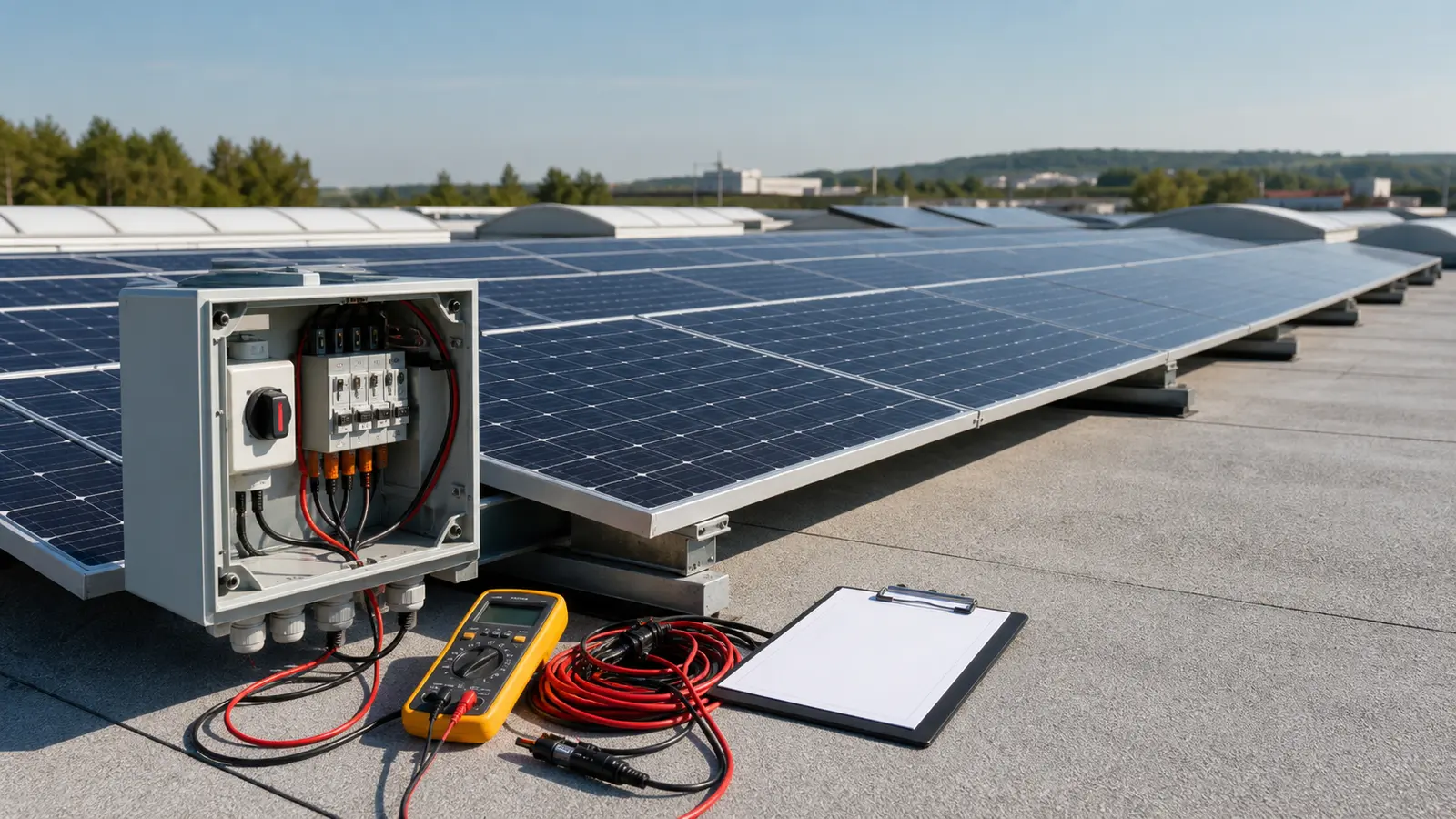
Why Commercial Photovoltaics Cannot Do Without Inspections
Photovoltaic (PV) systems on the roofs of production halls, warehouses, or administrative buildings are no longer an exception. Companies install them to save on energy costs and meet ESG goals. However, less is said about the fact that, from a legislative perspective, they are designated technical equipment (DTE) subject to periodic inspections – just like electrical installations, lightning protection systems, or lifts. This obligation applies not only to large solar parks but also to smaller commercial installations on roofs or facades.
What the Legislation Says: PV Systems as Designated Technical Equipment
The legal framework for PV inspections consists of several regulations. The foundation is Act No. 250/2021 Coll. on occupational safety in connection with the operation of designated technical equipment, which also applies to the electrical part of photovoltaic systems. The implementing regulation is Government Decree No. 190/2022 Coll., which sets out requirements for designated electrical equipment and their inspections.
Specifically for photovoltaics, Decree No. 114/2023 Coll. is important, as it regulates requirements for electrical installations with direct current voltage – i.e., the DC side of a PV system, where voltage commonly reaches hundreds of volts and, in larger installations, over 1,000 V DC. This part of the system poses a significant safety risk because a DC arc during a fault does not extinguish as easily as an AC arc and can cause a fire.
Inspections are carried out according to the ČSN 33 2000 series of standards and related EN standards for PV systems. Requirements for the certified electrical inspector are set by Government Decree No. 194/2022 Coll. – specifically, they must hold a certified electrical inspector certificate with the appropriate scope (E2A for low voltage, E3A for lightning protection systems, and others depending on the system configuration). The certified electrical inspector certificate is valid for 5 years, and after it expires the holder must pass a new examination (Section 11(3) of Act No. 250/2021 Coll.).
What to Watch Out For: DC Side, Connectors, and Panel Degradation
The greatest risks in commercial PV systems are concentrated in several areas:
- DC wiring and connectors – poor-quality or improperly fitted MC4 connectors are the most common cause of faults and fires. During an inspection, tightening, seal condition, presence of oxidation, and correct dimensioning are checked.
- DC arc – unlike an AC circuit, a DC arc does not self-extinguish at zero crossing. Even a small spark on a damaged connector or cable can lead to a fire, especially on roofs with combustible construction.
- Panel degradation – thermographic inspection reveals so-called hot spots, micro-cracks, or faulty bypass diodes, which reduce performance and can be a safety risk.
- Earthing and overvoltage protection – a rooftop PV system increases the risk of a lightning strike. Inspection of the lightning protection system (LPS) and checking surge protective devices (SPDs) are integral parts of safe operation.
Neglecting any of these points can lead not only to production outages but also to serious accidents. And in the event of a claim, insurers are specifically interested in valid inspection reports.
Inspection Intervals and What Regular Servicing Entails
The intervals for periodic PV inspections are based on the nature of the environment and the type of equipment. Generally, the electrical part of a PV system is subject to the same intervals as other electrical installations in the given building – for standard premises without increased danger, this is typically 5 years; for environments with higher risk (dust, humidity, chemical influences), the interval is shortened.
For lightning protection systems (LPS), the intervals according to ČSN EN 62305-1 to 4 ed.2 apply:
- Protection class LPL I and II: complete inspection every 2 years, visual check every year
- Protection class LPL III and IV: complete inspection every 4 years, visual check every year
In addition to the inspections themselves, it is advisable to carry out regular servicing: panel cleaning, structural checks, tightening connections, and reading inverter diagnostics. While these tasks are not an inspection in the legislative sense, they directly affect the safety and yield of the power plant.
What Risks Arise from Neglecting Obligations
A PV operator without a valid inspection report faces several risks:
- Sanctions from the labour inspectorate – according to Act No. 250/2021 Coll., the fine for operating uninspected DTE can reach up to CZK 2,000,000.
- Problems with the insurer – if damage occurs (fire, injury) and it emerges that the inspection was not carried out or was invalid, the insurer may reduce or completely refuse the claim settlement.
- Jeopardising subsidies – many subsidy programmes condition the payment of support on submitting the initial inspection and a commitment to periodic checks.
A PV inspection is therefore not a formality but a key document proving that the operator fulfils legal obligations and protects property and employees.
How We Handle PV Inspections at SOHE
At SOHE, we take a comprehensive approach to photovoltaic system inspections. We don’t just deal with the “paperwork” – we check the actual technical condition of the installation, from the panels through the DC wiring to the connection into the building’s switchboard. Because we handle both electrical installation inspections and OHS for companies, we can link the PV inspection with the overall occupational health & safety documentation – from risk assessments to operating procedures.
Inspections are carried out by Jiří Cach, a certified electrical inspector with a valid certificate according to Government Decree 194/2022, including scopes for low voltage and lightning protection systems. The output is an inspection report that is fully compliant with legislation and will stand up to scrutiny by the labour inspectorate and in dealings with insurers.
Need to find out the condition of your commercial photovoltaic system? Write to us at info@sohe.cz, call +420 724 689 762, or use our non-binding enquiry form. We will arrange a date, review the documentation, and propose the scope of the inspection tailored exactly to your installation.