
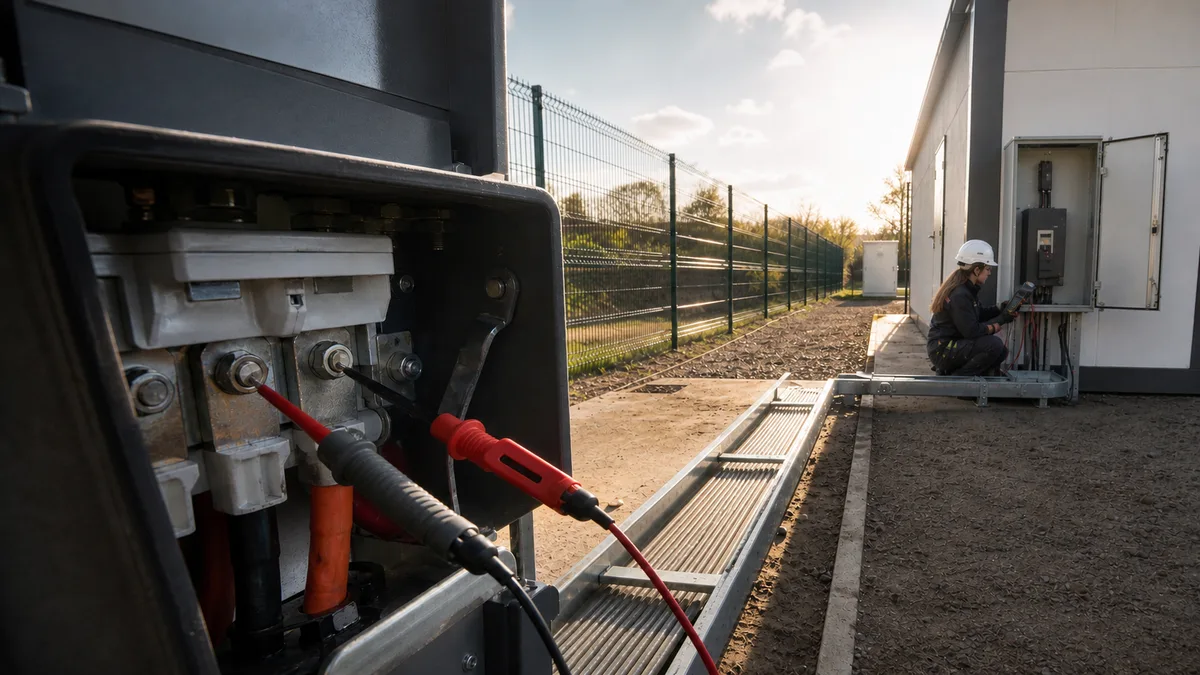
A company that has added batteries to the photovoltaic plant on its warehouse roof usually asks a single question: how long until it pays for itself. That it has also changed the building’s electrical installation and its fire scenario tends to sink in only at the next inspection — or during an insurance claim. Storage is not an appliance bolted to the wall. It is a source that holds energy overnight, over the weekend, and at the moment when the main breaker is off and the plant on the roof has produced nothing for hours.
Yet you will not find an item called “battery storage inspection” in the regulations. And that is where most of the confusion comes from — from “there is no inspection for batteries” all the way to “it has to be inspected every year”. Let us go through where the obligation actually comes from, what gets checked on storage beyond a standard electrical inspection, why a lithium fire is fought differently from a burning switchboard, and what to read in your policy before the damage happens.
Where the obligation to inspect storage comes from
A battery is part of the building’s electrical installation. It has no line of its own in the regulations because it does not need one — what applies to the rest of the equipment applies to it. The obligation has three layers and each has a different trigger.
A new or modified part of the installation. Adding storage to an existing plant is a modification of the installation, not maintenance. Before being put into service, the affected part is verified by an initial inspection — without it the installation is not finished work, even if everything lights up and the app shows a charge percentage.
Periodic inspection of designated electrical equipment. Requirements for designated technical electrical equipment are set out in Act No. 250/2021 Sb. and implementing Government Regulation No. 190/2022 Sb. The interval does not follow from the fact that these are batteries — it follows from the type of space and the external influences. Where more than one interval applies to a piece of equipment, the shortest one prevails. The regulations also allow an operator with a documented and observed preventive maintenance schedule to adjust the intervals; the limits need to be read from the current wording of the regulation and from the schedule itself, not from memory. We covered electrical installation inspection intervals separately in more detail.
Manufacturer’s instructions. Storage manuals routinely prescribe their own service tasks and intervals — checking the torque of power connections, cleaning cooling paths, updating firmware, calibrating the state of charge. These are service tasks, however: they are performed according to the manufacturer’s procedure and are not automatically part of an electrical inspection, which we go into in the next section. And these instructions are not optional extras; insurance terms often put them on the same footing as regulations and standards. We will get to that below.
Watch out for the second point. Because of the risk of fire, a space with batteries is often classified differently from the surrounding operation, and the interval for the affected part may therefore be shorter than for the rest of the building. What decides is the protocol determining external influences, not an on-site estimate by the technician — and once storage has been added it is worth having it reassessed, because it was drawn up for an operation without batteries.
What gets checked on storage beyond a standard inspection
First, two things that commonly get merged into one need to be separated. An inspection is the examination, measurement and testing of the electrical installation and its equipment according to regulations and standards; it is performed by an inspection technician with the appropriate authorisation, and the output is an inspection report. Service and diagnostics according to the manufacturer’s documentation — functional tests of individual BMS protections, state-of-charge calibration, parameter changes, firmware updates or torquing power connections to the prescribed value inside the assembly — are separate tasks. They often require the manufacturer’s service authorisation, software and tools, and they are not automatically part of an inspection; they show up in the inspection report more in the sense that the technician verifies their records and documentation. For each area below we therefore state who usually performs it. What always decides is the documentation for the specific assembly and the scope of the work ordered — with some systems the manufacturer reserves a given task for its authorised service only.
For the photovoltaic part, the procedure follows ČSN EN 62446-1+A1 (7/2023 edition) and ČSN 33 2000-6 ed. 2 — standard 62446-1+A1 itself excludes energy storage systems and hybrid systems from its scope, so it covers only the PV part. That is precisely why stationary lithium batteries bring ČSN EN IEC 62485-5 for the safe operation of stationary Li-ion batteries and ČSN EN IEC 62933-5-2 for grid-connected energy storage systems into play. In practice this means seven areas that have no counterpart in a routine switchboard inspection.
- The DC side and connections — inspection technician. An under-torqued connection has a higher contact resistance and heats up in proportion to the square of the current. With a PV plant the current stops at night; with a battery it does not — it discharges into the operation even when the roof is dark. On top of that comes a property the AC side does not have: a DC arc does not pass through zero, so it will not extinguish itself. A chapter of its own is MC4-type connectors from different manufacturers mated crosswise — mechanically they hold, but no manufacturer guarantees the contact pressure of such a pair.
- Tightening torques and mechanical condition — inspection technician by examination, torquing by service according to the manual. Bolted connections on battery terminals have a tightening torque prescribed in the manual, and over-tightening deforms the contact just as reliably as under-tightening. The inspection technician assesses the condition of the connections by examination, by measurement and from documented service records; torquing inside a battery assembly itself is a task performed according to the manufacturer’s procedure and with many systems only its authorised service may carry it out. This area also covers strain relief of cable bundles, bending radii and protection against chafing on a sheet-metal edge.
- BMS, inverter and firmware — functional tests of protections, calibration and updates by service; the inspection technician verifies settings and documentation. Whether the overvoltage, undervoltage and cell temperature protections actually respond is tested using the manufacturer’s procedure and its diagnostic tool — as are state-of-charge calibration and firmware updates. The inspection technician verifies that communication between battery and inverter is running, that the combination used is on the list manufacturers publish for their assemblies, and that a record exists of the service tasks and firmware versions. An incompatible pairing often only shows up in limit states — during deep discharge or when switching to backup mode.
- Behaviour during a grid outage — the inspection technician tests it, setting the parameters is a service task. Whether island mode really does separate the installation from the distribution grid and what happens to the batteries when voltage returns. Changing the inverter settings is an intervention according to the manufacturer’s documentation, not an inspection item.
- The environment — inspection technician. Temperature, ventilation, ingress protection for outdoor installations, clearance from combustible materials and separation from workplaces. Temperature is not cosmetic: lithium cells should not be charged below freezing, because instead of intercalating into the anode structure the lithium plates out on its surface, forms dendrites and permanently degrades both safety and capacity. In an unheated building or an outdoor enclosure, the check therefore has to cover whether the assembly has its own heating, or whether the control unit blocks charging below zero.
- Disconnection and marking for emergency response — inspection technician. Switching off the inverter does not remove the voltage inside the battery stack — the cells remain live, and with high-voltage assemblies that means hundreds of volts. Both the documentation and the on-site marking should make it clear where the stack is, how it is disconnected and what stays live after disconnection.
- Interface with the lightning protection system — inspection technician; for the design and calculation of separation distance, the designer. Whether the whole assembly sits within the protected volume under ČSN EN IEC 62305 ed. 3 (for the protected volume specifically part 3, effective from 1 January 2026; the existing ed. 2 applies in parallel until 31 October 2027) and whether the separation distance is maintained.
Specific assemblies differ more than they appear from the outside. Modular systems built from blocks — Huawei LUNA2000 with 5 kWh modules, BYD Battery-Box, Pylontech, Sungrow or GoodWe — follow a different checking logic from a single compact unit: what gets tracked is the number and consistency of modules in the stack, their balancing, and whether someone added a module of a different generation during a later expansion. If you are not sure whether the last report covered the battery at all, we do PV inspections including storage and tell you in advance what to have ready — and what needs to be ordered from the manufacturer’s service, so that the time is not spent hunting for manuals.
Why lithium is a different risk from a switchboard
A lithium cell can go into thermal runaway: above a certain temperature the layer on the electrode begins to decompose exothermically, then the electrolyte follows, the released heat warms the neighbouring cell and the chain continues. Combustion produces toxic fumes — fluorinated electrolyte yields hydrogen fluoride, among other things — and flammable gases that can accumulate in an enclosed space. Hence the emphasis on ventilation and on the fact that such a fire cannot be dealt with in a short intervention: it needs prolonged cooling and can reignite after it has been suppressed.
The chemistry makes a lot of difference. Most storage installed with company photovoltaics today is built on LFP (LiFePO4). Compared with the previously more common NMC it comes out better in fire safety terms, and there is a clear reason: the phosphate cathode structure is more thermally stable and during thermal decomposition it generally releases far less oxygen than the layered oxides that feed the fire themselves.
| Indicative comparison | LFP (LiFePO4) | NMC |
|---|---|---|
| Onset of thermal runaway | begins at a higher temperature | begins earlier, at a lower temperature |
| Energy released during runaway | substantially lower | higher |
| Oxygen release from the cathode | generally far less | more; the released oxygen supports combustion |
The comparison is deliberately qualitative. The temperature at which thermal runaway begins differs for both chemistries depending on cell construction and format, state of charge, age and above all on the test method, so it cannot be quoted as a general parameter of the chemistry — the figures always hold only for a specific cell and a specific test. The practical conclusion stands: LFP tolerates overheating better, but it is flammable too — and the difference between a good and a bad installation is greater than the difference between the chemistries.
That this is not theory was shown by a case this May. According to the fire service’s initial reports, on 14 May 2026 in Nová Paka a container storage unit roughly 4 × 10 metres in size with hundreds of LiFePO4 cells caught fire; crews cooled the batteries through the container shell using a cutting system, gradually opened the container up and advised local residents not to ventilate because of the fumes. A technical fault was given as the preliminary cause — but the fire service’s initial report is not the final conclusion of the investigation, and that was not available to us at the time of writing. After inspection, the damage was revised from an initial estimate of 20 million korun to roughly half that; that too is a figure from interim information. A circumstance that matters for anyone building: the installation had not yet been put into service at that point. The risk therefore exists before anyone issues you a first inspection report.
What has changed in the regulations around storage
Storage installed before 2025 may have been built to considerably looser rules than those an inspection technician and fire authority apply to it today. Three shifts affect company batteries the most.
Shut-off devices as fire safety equipment. The amendment to the fire prevention decree (No. 246/2001 Sb.), effective from 1 January 2026, classified Central Stop and Total Stop devices as fire safety equipment. That is not a formality: fire safety equipment is subject to operability checks, and documentation of them is generated — under Section 7 of Decree No. 246/2001 Sb. at least once a year, unless the manufacturer, verified design documentation or a fire hazard assessment sets a shorter interval. Before you set your calendar accordingly, verify the classification for your specific installation in the current wording of the decree and in the building’s fire safety design.
A dedicated standard for photovoltaic fire safety. Since 2024 the pre-standard ČSN P 73 0847 (Fire protection of buildings – Photovoltaic systems) has been in force, and it also touches on storage as part of the system: siting, clearances, marking, disconnection and conditions for emergency response. A pre-standard is not binding in itself, but it is the yardstick by which what counts as today’s state of the art is judged.
Electricity storage as a licensed activity. The Energy Act (No. 458/2000 Sb.) now recognises electricity storage as a separate activity requiring a licence from the Energy Regulatory Office. In the wording effective from 1 August 2026, under Section 3(3)(c) a licence is required for storing electricity in equipment with an installed capacity above 100 kW connected to the transmission or distribution grid; under point (d) it is required regardless of capacity wherever another electricity storage installation is connected at the same supply point. Under Section 3(5) a holder of an electricity generation licence has an exemption — it may store without a separate licence only if the total installed capacity of the connected storage installations is no more than 1.2 times the installed capacity of the generating plant. Three parameters therefore decide: the installed capacity of the storage, the presence of another storage unit at the same supply point, and the ratio to the capacity of your own generating plant. All three need to be checked, not just the first. The thresholds and the terms of the exemption have moreover changed with the latest amendments — in the wording effective as of 1 January 2024 electricity storage was not a licensed activity at all and generation had a 50 kW threshold — so for your specific assembly go by the current wording of the act, and where anything is unclear turn directly to ERÚ (the Energy Regulatory Office), not to an article from the year your plant was installed.
What your insurer will want
There is a lot of exaggeration about this online. The sentence “without an inspection your insurer will not pay” does not appear in insurance terms. What does appear in them you can read for yourself — insurers publish them, and it is worth doing before a claim rather than after one.
There is only one usable approach: open your own policy and the insurance terms attached to it, and find three things in them.
- How the maintenance and inspection obligation is worded. What is it measured against — only legislation and technical standards, or the manufacturer’s instructions as well? That last variant is crucial with batteries: a neglected service interval from the manual can then be a breach of obligation even where no interval under the regulations has yet expired.
- Whether the terms contain an exclusion or limitation for photovoltaic plants and their accessories, or specifically for storage batteries and electrochemical cells. If such a provision is there, a PV plant with storage may not be covered simply because you own it — and it needs to be written into the policy explicitly.
- Whether the sum insured has been increased by the price of the batteries and whether the storage is described within the set of insured property in a way that leaves no room for a dispute about its inclusion after a loss.
The wording differs between insurers, between one insurer’s products and between versions of the terms, and no general article can substitute for it. The only answer that applies to you is the one in your documents — and where anything is unclear, a written statement from the insurer, not an interpretation off the internet.
On reduced settlements: under Section 2800(2) of Act No. 89/2012 Sb. the insurer may reduce the settlement if the breach of obligation had a material effect on the occurrence of the insured event, its course, on the increase in the extent of its consequences or on the ascertainment or determination of the amount of the settlement — and in proportion to that effect. Section 2800 itself therefore ties a reduced settlement to a demonstrated effect of the breach; the actual claim, however, also depends on the policy, the exclusions and the circumstances of the loss (refusal of settlement is dealt with separately in Section 2809). The trouble is that with a fire that started at an under-torqued connection on the DC side, the connection is easy to find. We covered the more general situation in a piece on what a missing inspection means for an insurance settlement.
The price and how to tell the work was done properly
A periodic photovoltaic inspection including travel runs to a few thousand korun on the market, higher for assemblies with storage and service. The price is pushed up by the number of strings and switchboards, accessibility, distance, the size of the storage and the amount of documentation that has to be tracked down. A quote for a few hundred usually means nothing will be measured.
How to tell a usable output:
- The report contains measured values, not just a statement of “no defects” — insulation resistance, continuity, voltage, and on the DC side polarity as well.
- The technician asked for the battery and inverter manufacturer’s documentation and refers to it — including prescribed tightening torques and firmware versions, where the text makes clear what they verified themselves and what they are taking from a service record.
- Defects are graded by severity with a note on what has to be dealt with immediately. How to read such a record is covered in our article on what defects in an inspection report mean.
- The report names the space and external influences from which the date of the next inspection follows.
- It covers not just the panels and inverter, but also the disconnection devices and marking — doubly so from 2026 onwards.
Before the technician arrives, have ready the design documentation and schematics, the protocol determining external influences, the battery and inverter manuals, previous inspection reports, the settings protocol and service records, the building’s fire safety design and documentation of fire safety equipment checks. Anything that has to be tracked down on site lengthens the work and makes it more expensive.
Sources for this article
- Photovoltaic plant inspections – a SOHE service.
- PV inspections: the obligation, intervals and risks – where the obligation to inspect photovoltaics comes from and how often it repeats.
- Fire safety of rooftop PV – disconnection, marking and conditions for emergency response at a rooftop plant.
- Maintenance and checks of a PV plant in operation between inspections – what the operator keeps an eye on between inspection dates.
- Act No. 250/2021 Sb. – on occupational safety in connection with the operation of designated technical equipment; the framework for designated electrical equipment.
- Government Regulation No. 190/2022 Sb. – requirements for designated electrical equipment and periodic inspection intervals by space and external influences.
- Decree No. 246/2001 Sb. – on fire prevention; operability checks of fire safety equipment and documentation of them.
- Act No. 458/2000 Sb. in the wording effective from 1 August 2026 – the Energy Act; Section 3(3)(c) and (d) on the electricity storage licence and Section 3(5) on the exemption for holders of an electricity generation licence.
- Act No. 89/2012 Sb. in the wording effective from 1 January 2026 – the Civil Code; Section 2800(2) on reducing an insurance settlement following a breach of obligation, Section 2809 on refusal of settlement.
- Interim information from the fire service on the response to the container battery storage fire in Nová Paka on 14 May 2026 – the source of data on the course of the response, the preliminary cause and the damage estimate; the final conclusion of the investigation was not available at the time of writing.
- Technical standards cited in the text: ČSN EN 62446-1+A1, ČSN 33 2000-6 ed. 2, ČSN EN IEC 62485-5, ČSN EN IEC 62933-5-2, ČSN P 73 0847 and ČSN EN IEC 62305 ed. 3 (ed. 2 in parallel until 31 October 2027). The standards are not freely available; their texts are obtained from the Czech Standardization Agency (Česká agentura pro standardizaci).
This text is informational and does not replace legal advice. The specific regime of inspections and checks for battery storage needs to be set according to actual operation, the manufacturer’s documentation, the environment of use and a risk assessment.
Having your photovoltaics inspected this year and unsure whether the storage will make it into the report? We do PV inspections including storage with measurements, references to the manufacturer’s documentation and defects graded by severity — not with a stamp and the sentence “no defects”. Write via our no-obligation enquiry form or to info@sohe.cz and we will agree on a date and price in advance.