
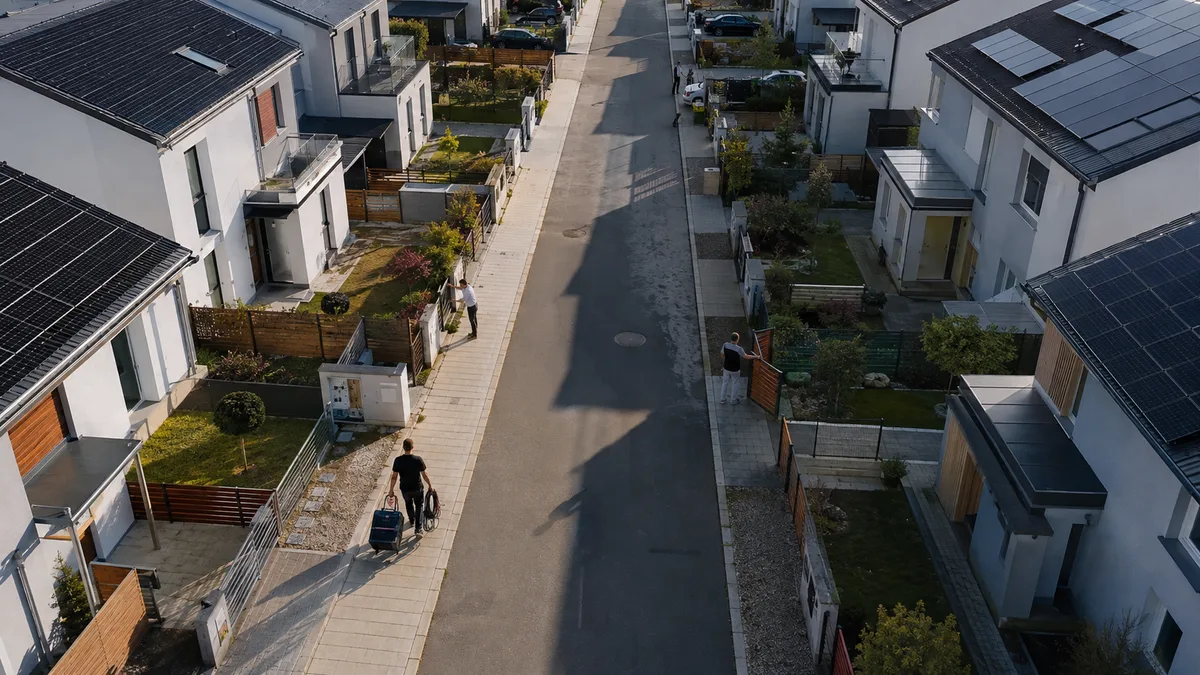
A typical situation: a developer completed eighteen detached houses in 2021 and 2022, each with rooftop photovoltaics. The handover documents for every house include an initial inspection report. Since then, the systems have been generating electricity, their owners have been monitoring production in an app, and no one has opened the files. Now one of the owners has asked when the next inspection is due—and the property manager has discovered that none of those eighteen folders contains a one-sentence answer.
The same question comes from municipalities with PV systems on a school, a fire station, and two municipal apartment buildings, as well as from an owners’ association whose system supplies the common areas. It also comes from the owner of a single house whose initial inspection took place in the summer of 2022 and who wants to know whether they should already have taken action.
The answer has two parts: when the interval expires and how to organise the work across a group of installations so that it does not require twenty separate visits. This article covers both. We have a separate article on the obligation and risks explaining what a PV inspection involves and why particular attention is paid to the DC side.
Quick answer
The basic maximum intervals for periodic inspections of designated electrical equipment are set out in Annex No. 4 to nařízení vlády č. 190/2022 Sb., as amended. They are classified by the type of building and premises, not by the technology—the word “photovoltaics” does not appear anywhere in the annex.
Three things follow from this:
- There is no single universal inspection interval for PV systems. A system on the roof of a production facility and one on the roof of a detached house fall under different rows of the same table—or possibly under none at all.
- A shorter interval specified in the accompanying documentation takes precedence. Under § 7 odst. 2 of the regulation, if the accompanying documentation specifies a periodic inspection or check interval shorter than the one established by the inspection, maintenance, and testing schedule, the interval in the accompanying documentation applies.
- If the annex does not specify an interval, it must be found elsewhere. Its final sentence states that designated electrical equipment for which the annex does not specify an interval must be inspected at the intervals laid down in other legal and related occupational health and safety regulations.
You will therefore find the specific interval for your house not in the table but in the inspection report: under § 10 odst. 1 písm. n) of the regulation, every inspection report must include a recommended date or interval for the next inspection. For a group of homes built as part of the same development, this is generally good news—their initial inspections were performed around the same time, so the next inspection becomes due for all of them together and can be completed in a single visit.
When the interval starts and what Annex No. 4 says
The interval runs from the most recent inspection, not from final building approval or the date the system was commissioned. For homes completed in 2021–2022, the most recent inspection is the initial inspection whose report the installation contractor handed over with the equipment and accompanying documentation—the handover of both is covered by § 6 odst. 3 of the regulation.
The interval itself is not determined on an ad hoc basis. Under § 7 odst. 1, designated electrical equipment may be operated only if its condition has been verified through examination, testing, checks, and inspections at the intervals established by an inspection, maintenance, and testing schedule prepared for that purpose. Under § 7 odst. 5 písm. d), that schedule must set inspection intervals in accordance with Annex No. 4.
The relevant rows of the annex are:
| Building or premises | Maximum interval |
|---|---|
| Buildings intended for administrative activities | 5 years |
| Buildings intended for manufacturing, education (schools and nursery schools), accommodation (hotels, hostels, campsites, and other accommodation facilities), and medical purposes | 3 years |
| Electrical equipment in a building whose fire safety design allows more than 200 people to be present | 2 years |
| Areas with a risk of fire or explosion | 3 years |
| Wet areas and areas with a permanent presence of corrosive or polluting substances | 1 year |
| LPS protecting critical systems | 2 years |
| LPS protecting other buildings or equipment | 4 years |
The table is subject to additional rules without which it can easily be misread:
- If multiple intervals apply, use the shortest one. Where equipment is subject to more than one inspection interval, the shortest applicable interval must be used.
- The year matters, not the exact day. A periodic inspection must be carried out during the calendar year in which the prescribed interval from the most recent inspection expires; this does not apply to intervals of one year or less. An initial inspection performed in March 2022 with a five-year interval therefore means that the next inspection may take place at any time during 2027, not necessarily by 31 March 2027.
- A preventive maintenance schedule can extend the interval. Operators that have a preventive maintenance schedule and use regular checks and maintenance to minimise risks associated with operating electrical equipment may set periodic inspection intervals of up to twice the standard length in that schedule.
- A shorter manufacturer’s interval takes precedence. See § 7 odst. 2 above. The manuals for inverters and certain types of optimisers specify inspection intervals shorter than anything listed in the table.
- An LPS also requires an annual visual check. The annex states that all LPS equipment must undergo a visual check at least once a year to verify that it is not visibly damaged. If a house has a lightning protection system, it follows its own inspection cycle independently of the photovoltaic system.
What about a detached house?
Annex No. 4 does not explicitly mention detached houses. It contains no row for “residential buildings” or “detached houses”—the table deals with administration, manufacturing, education, accommodation, healthcare, assembly spaces, and environmental conditions. The interval must therefore be determined from the accompanying documentation, the assessment of external influences that forms part of the accompanying documentation under § 6 odst. 3 písm. a), and the previously quoted final sentence of the annex concerning other regulations.
The practical implication for the owner of a single house is this: do not look for the interval in the table. Open the initial inspection report from 2022 and find the recommendation for the next inspection. Under § 10 odst. 1 písm. n), it should be included. If it is missing or the report cannot be found, that is the first issue to resolve—without it, the technician has no baseline against which to compare measurements during the next inspection.
For property managers and municipalities, the implication is different: a single group of buildings may have different inspection intervals. Eighteen detached houses may follow one regime, a municipal administrative building another, and a nursery school on the same street a third. Dividing the buildings into groups is the first step, not a detail to deal with at the end.
What is checked during a periodic PV inspection?
The scope of the inspection is not arbitrary. Under § 7 odst. 3 of the regulation, an inspection of designated electrical equipment must include an examination and tests within the scope specified in Annex No. 1 to the regulation, unless the manufacturer has set different or additional requirements. For a rooftop photovoltaic system, this means checking the following in practice:
- The DC side. Panels and their mounting, the condition and routing of cables, connectors—especially points where connectors from two different manufacturers have been joined—isolators, protective devices and surge protection devices, and insulation resistance measurements.
- The inverter. The condition of the equipment, cooling and contamination, reported faults, the tightness and condition of terminals, and compliance with the manufacturer’s instructions.
- The AC side and connection to the building’s electrical installation. Protective devices, protection against electric shock, and components used to switch off and isolate the system.
- Earthing and bonding. The mounting structure, panel frames, and connection to the lightning protection system, where one is installed on the building.
- Documentation. Under § 10 odst. 1 písm. h), the inspection report must list the documents used for the inspection and evaluate them in relation to one another. Under písm. m), it must also evaluate records concerning the rectification of defects found during the previous inspection. Both are difficult without the initial inspection report and operating records.
The technical standard ČSN EN 62446-1 covers the documentation, testing, and inspection of photovoltaic systems. Standards are not freely available, so we mention it here only by name.
One issue is often overlooked when dealing with groups of houses: under § 6 odst. 4 of the regulation, an inspection must also be carried out when there is a change to the parameters of protection against overload and short circuits, protection against electric shock, or protection against the effects of atmospheric and static electricity. If someone has since added a battery or wallbox, or replaced the inverter, that is a separate reason for an inspection and should not wait for the current periodic interval to expire. We discuss what owners can do themselves between inspections in our article on PV maintenance and checks during operation.
A group of homes: how to organise the work
- One date for the entire group. If the initial inspections fall within a period of one or two years, their intervals will expire around the same time. Schedule the inspection for the first year in which it is due for all the houses, rather than arranging each one separately.
- A standard scope and one report template. For installations of the same type, every report should contain the same items in the same order. Otherwise, it is difficult to determine whether a defect is systemic—such as the same installation error across the entire development—or local.
- Resolve roof access before setting the date. Detached houses often lack anchor points, leaving the technician with nowhere to attach fall-protection equipment. Address this once for the whole street rather than separately at each house on the day of the inspection. We explain what the client must provide and why an inspection technician may refuse to climb onto a roof in our separate article on roof access.
- Keep the documents for each house in a separate folder. Include the initial inspection report, accompanying documentation including the assessment of external influences, the single-line diagram, the inverter type and output, the number and type of panels, and a list of subsequent modifications.
- Plan the schedule by street, not alphabetically. Walking distance between houses matters, as does knowing who will let the technician inside to reach the switchboard and inverter. For houses that have already been sold, occupants must be notified and their presence arranged in advance—and they should be warned that the power will need to be switched off briefly.
- One unit price for installations of the same type. If twenty houses were built to one design with the same inverter and the same number of panels, it makes little sense to price each one individually. Houses modified since final building approval belong in a separate group with their own price.
- A separate report for every house. The homeowner owns the equipment and needs the report—for their own records, for a potential sale, and for the next inspection. The property manager receives a summary table listing the house, date, conclusion, defects, and recommended interval for the next inspection.
A note on responsibility: the obligations under § 7 of the regulation apply to the operator of the designated electrical equipment. For houses that have already been sold, this is generally not the developer or property manager but the homeowner. A group order is therefore an organisational service that saves owners money and time, not an assumption of their obligations. In an apartment building where the PV system supplies the common areas, the inspection is usually ordered by the owners’ association.
What to prepare before requesting a quotation
The more information you can provide from this list, the more accurate the quotation will be and the less time the site visit will take:
- the number and addresses of the buildings, ideally grouped by street;
- the year of the initial inspection for each building and copies of the reports, if available;
- the building type for each item—detached house, apartment building, school, administrative building, or production facility;
- installed capacity, number and type of panels, and inverter make and model;
- whether the installation includes a battery, wallbox, or optimisers;
- whether the building has a lightning protection system and when it was last inspected;
- the type and pitch of the roof and whether it has anchor points or other fall-protection measures;
- a list of modifications made after the initial inspection, including work performed by someone other than the original installation contractor;
- contact details for the person who will provide access to the technical room or switchboard on site.
How we handle it at SOHE
We carry out group PV inspections for developers, municipalities, owners’ associations, and property managers as a single project: we review the documentation, divide the buildings into groups by type and scope, prepare a street-by-street schedule, and arrange one date for the entire group. Each building receives its own inspection report, while the client receives a summary listing the dates of the next inspections.
We can respond quickly in Brno and the South Moravian Region and work throughout the Czech Republic by arrangement. The price depends on the installed capacity and number of installations; for a group of identical homes from a single development, we use a standard unit price. During the same visit, we can inspect the building’s lightning protection system and electrical installation alongside the photovoltaic system, avoiding a second round of calls to homeowners. You can find service details on the PV Inspection and Servicing page, indicative prices in our price list, and request an exact quotation through our no-obligation enquiry form.
Sources for this article
- PV Inspection and Servicing – a SOHE service.
- PV inspection: statutory obligations, intervals, and risks for commercial systems – why the electrical part of a photovoltaic system is designated electrical equipment and what is checked on the DC side.
- PV maintenance and checks during operation: what to do between inspections – monitoring, visual checks, and the operating log used as a basis for the next inspection.
- An inspection technician cannot access the roof: what a company or owners’ association must provide – fall protection and anchor points without which the inspection cannot proceed as scheduled.
- Nařízení vlády č. 190/2022 Sb., as amended – concerning designated electrical technical equipment and requirements for ensuring its safety. The article cites § 6 odst. 3 and odst. 4 (handover of documentation and the initial inspection report; inspection following changes to protective measures), § 7 odst. 1, 2, 3 and 5 (the inspection, maintenance, and testing schedule; precedence of a shorter interval stated in the accompanying documentation; the scope of inspection under Annex No. 1), § 10 odst. 1 písm. h), m) and n) (required contents of an inspection report, including the recommended interval for the next inspection), and Annex No. 4 (basic maximum periodic inspection intervals, supplementary rules, and the final sentence concerning equipment for which the annex does not prescribe an interval).
- The technical standard ČSN EN 62446-1 for the documentation, testing, and inspection of photovoltaic systems is mentioned by name only; standards are not freely available.
This article is for informational purposes and does not constitute legal advice. The specific inspection and checking regime for a photovoltaic system must be determined according to its actual operation, the manufacturer’s documentation, the operating environment, and the risk assessment.
Do you have photovoltaics on multiple homes or buildings and are unsure when the periodic inspection is due? Send us a list of addresses with the year of the initial inspection and the installation type, and we will propose a date, scope, and standard unit price. Email info@sohe.cz or use our no-obligation enquiry form; service details are available on the PV Inspection and Servicing page.