
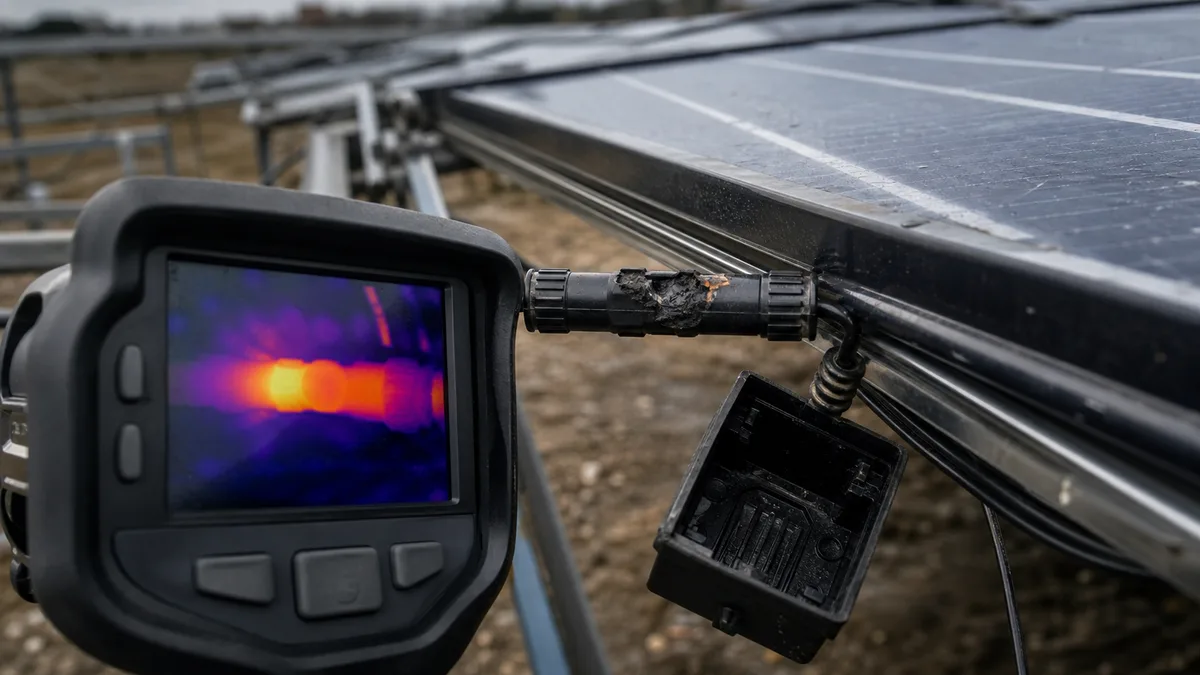
A solar PV inspection report describes the state of the plant on one specific day. But years pass between two inspections — and in the meantime a rooftop installation goes through dozens of storms, a summer full of dust and pollen, a winter with ice, and thousands of temperature cycles that work away at every bolt and connector. If nobody looks after the plant between inspections, it usually shows up first in the output figures and later in an inspection report full of defects.
This article is not about inspection intervals — we covered those in our piece on mandatory PV inspections. This one is about the operating routine in between: what to watch in the monitoring data, what to look for during a visual inspection, when panel cleaning is worth it, and above all who on your own maintenance team may touch what.
Why look after a PV system between inspections
The electrical part of a solar PV system is a designated technical installation under Act No. 250/2021 Sb. (Coll.), as amended, and Government Regulation No. 190/2022 Sb. (Coll.), as amended. The operator is responsible for keeping the installation in a safe condition — and that is not a condition confirmed by a stamp once every few years, but an ongoing one. An inspection is a checkpoint, not maintenance.
The practical reasons, though, are even more convincing than the legal ones:
- Small defects grow. A loose MC4 connector first simply runs hotter. Then it starts burning the contacts and raising the contact resistance — and at the end of that curve is a DC arc that will not extinguish by itself. Between “tighten the connector” and “put out the roof fire” there are typically many months in which somebody could have spotted the defect.
- Output losses are silent. A shaded or dirty string does not raise an alarm. It simply produces less, while the plant looks as if it is working. Without a comparison against expected output, nobody finds out.
- The insurer asks about care, not just paperwork. After a loss event, the claims adjuster wants to know how the plant was operated and maintained. Alongside the inspection report, a documented routine of checks is the second document that substantially improves the operator’s position.
Output monitoring: the cheapest check, and you already have it
Every modern inverter measures and logs. Yet most companies only open their monitoring data at the moment the plant stops producing altogether — which is a shame, because monitoring is free and reveals defects long before the eye can see them.
What is worth watching in practice:
- Comparing strings against each other. Strings with comparable orientation and tilt should produce comparably. If one consistently lags by a few per cent, it typically has shading, dirt, a faulty bypass diode or a connector problem.
- The trend, not just the moment. A one-day fluctuation means nothing. A sustained drop against the same period last year (once the weather is factored out) is a signal to go and look.
- Inverter error messages and restarts. Repeated insulation resistance faults or earth fault messages are not cosmetic — they point to a problem on the DC side and belong in the hands of an electrician.
- Alerts. Most monitoring platforms can send an e-mail when a string or inverter drops out. Setting them up takes minutes and turns a week-long outage into an hour-long one.
Good internal practice: one designated person opens the monitoring once a week, compares output against expectations once a month, and writes both down briefly. It needs no more than that.
Visual inspection: what to look for on the roof and in the switchboard
A visual check without intervening in the installation is the foundation of operational care. In practice an interval of once every three to six months works well, depending on the environment — plus an extra check after every strong wind or storm.
What to focus on during a walk-round:
- Connectors and cabling. Hanging or sagging cables, cables resting against sharp sheet-metal edges, cracked UV-degraded conduit, connectors lying where water collects. Anything burnt or deformed is a reason to call a technician immediately.
- Mounting structure fixings. After every strong wind, check whether panels have shifted or clamps or ballast blocks on ballasted structures have worked loose. Vibration and temperature cycles can loosen bolts even without a gale.
- Panels. Cracked glass, delamination, brown patches (traces of local overheating), persistent dirt along the bottom edge of the panels.
- Shading and vegetation. A tree that cast no shadow at the time of installation may well do so three seasons later. On ground-mounted installations, grass and self-seeded growth; on rooftops, new equipment on the roof — an air-conditioning unit or an antenna can cost a string more output than anyone would expect.
- Switchboards. From the outside: intact enclosure, seals, no traces of moisture or insects, legible labels. Surge protective devices (SPDs) have status indicator windows — red means replace, and that is not a job for a layperson.
- The area around the plant. Birds’ nests under panels, flammable material stored next to the inverter, blocked access to the DC isolator.
One important boundary: a visual inspection means looking, not opening. As soon as it involves removing a cover, taking measurements or tightening a live connection, maintenance work ends and work for an electrician begins.
Panel cleaning: when it makes sense and how not to get it wrong
There is no universal answer along the lines of “clean once a year”. In a dust-free environment with a sufficient panel tilt, rain does most of the work. Conversely, at a plant next to a field, a gravel pit, a busy road or under a bird flight path, the soiling shows up measurably in the output — and it is precisely the monitoring data that shows whether cleaning will pay for itself.
When cleaning typically does make sense: a visible continuous film of dust or pollen, bird droppings (spot soiling creates local overheating), lichen and moss along the bottom edge of panels on low-tilt installations.
How not to get it wrong:
- follow the panel manufacturer’s instructions — an unsuitable procedure can void the warranty,
- use soft brushes and water without aggressive chemicals, not a pressure washer aimed at the frames and connectors,
- do not clean baking-hot panels with cold water at midday — thermal shock does glass no good; early morning is the better choice,
- and above all: work on a roof is work at height, with all the fall protection requirements that entails. Money saved by cleaning in-house without fall arrest is not a saving.
After a gale, a storm or hail
An extraordinary inspection after extreme weather is a discipline of its own — when to shut the plant down, what to check and when to call for an extraordinary inspection are described in detail in our article PV systems after a storm or hail. For your operating routine, take one rule from it: after every event that shook the roof, do an extraordinary walk-round and write it up, even if “nothing was found”. It is precisely these records that build the series you will later rely on with your insurer.
Who on the maintenance team may touch what
The most common operational mistake at company PV systems: a handy maintenance worker who “knows his way around electrics” tightening connectors and changing fuses. Yet professional competence for work on electrical installations is governed by Government Regulation No. 194/2022 Sb. (Coll.), as amended, which distinguishes, among others, between an instructed person, an electrician and an inspection technician.
For day-to-day PV operation, that means roughly the following split:
| Activity | Who can handle it |
|---|---|
| Watching the monitoring, entries in the operating log | anyone designated by the operator |
| Visual walk-round without intervening in the installation | instructed maintenance worker |
| Panel cleaning without dismantling | instructed worker (plus fall protection for work at height) |
| Opening the switchboard, measurements, tightening connections, replacing SPDs or connectors | electrician qualified under Government Regulation No. 194/2022 Sb. (Coll.) |
| Inspection of the electrical installation | inspection technician with the relevant certificate |
Instructing staff is not a formality for the filing cabinet: maintenance people need to know where the DC isolator is, what to photograph during a walk-round and whom to report findings to — and equally, where their remit ends. The DC side of a PV system is live whenever the sun is on the panels. A switched-off inverter does not mean dead cables; we went through the details in our article on fire safety of rooftop PV systems, including the switching and disconnection requirements covered by separate fire safety regulations.
The operating log: making the next inspection faster and cheaper
Everything described above is only worth something if it leaves a trace. A simple operating log is enough — a notebook or a shared spreadsheet — recording:
- the date and result of each regular walk-round (including “nothing found”),
- the monthly output comparison and any deviations,
- extraordinary events (storm, outage, error message) and what was done about them,
- electrician interventions: what, when, who,
- panel cleaning and inverter servicing.
An inspection technician handed a log with two years of records works faster, and the report carries more weight — they know what happened to the installation and do not have to reconstruct it after the fact. And in dealings with an insurer, the log is proof of the care of a prudent manager, something that missing or box-ticking documentation cannot substitute for.
Who will handle it for you when you have no one for the job
A smaller company often has nobody to assign it to: no maintenance worker, no electrician on the team, and nobody opening the monitoring. For operations like these, an annual PV inspection service contract makes sense — an external technician carries out a walk-round at an agreed interval, evaluates the monitoring data, recommends or arranges cleaning, keeps an eye on the surge protection status and also tracks the date of the next inspection so it does not lapse.
At SOHE we build this model around having the same supplier do both electrical inspections and the regular checks: a technician who knows the plant from those walk-rounds inspects it faster and without surprises. If you would like to set up a servicing routine for your PV system — from a one-off inspection to a year-round contract with deadline tracking — send us a no-obligation enquiry with the plant’s output rating, the roof type and the year it was commissioned. We will come back with a proposed scope and a tailored price.
Sources for this article
- Electrical inspections – a SOHE service that also covers inspections and checks of solar PV plants.
- PV inspections: legal obligation, intervals and risks – the legal framework, inspection intervals and penalties; this article follows on from it with the operating routine in between.
- Fire safety of rooftop PV systems – switching off, disconnection and fire prevention on the DC side.
- PV systems after a storm or hail – extraordinary checks after extreme weather and documentation for the insurer.
- Act No. 250/2021 Sb. – the Act on occupational safety in connection with the operation of designated technical installations, as amended.
- Government Regulation No. 190/2022 Sb. – requirements for designated technical electrical installations, as amended.
- Government Regulation No. 194/2022 Sb. – professional competence for carrying out work on electrical installations, as amended.
The legal position was verified as of 10 August 2026 (Act No. 250/2021 Sb.), and as of 14 July 2026 for Government Regulations No. 190/2022 Sb. and No. 194/2022 Sb.; both regulations are applied as amended. The walk-round and cleaning intervals and the scope of monitoring given in this article are recommended operating practice, not statutory deadlines — the specific regime needs to be set according to the environment, the manufacturer’s documentation and a risk assessment of the given installation.
This text is informational in nature and does not replace legal advice or an inspection report.
No staff of your own for regular solar PV checks? We will set up an annual servicing routine for you — inspections, monitoring evaluation and inspection deadline tracking from a single supplier. Send us a no-obligation enquiry or write to info@sohe.cz and we will agree a scope to suit your installation.