
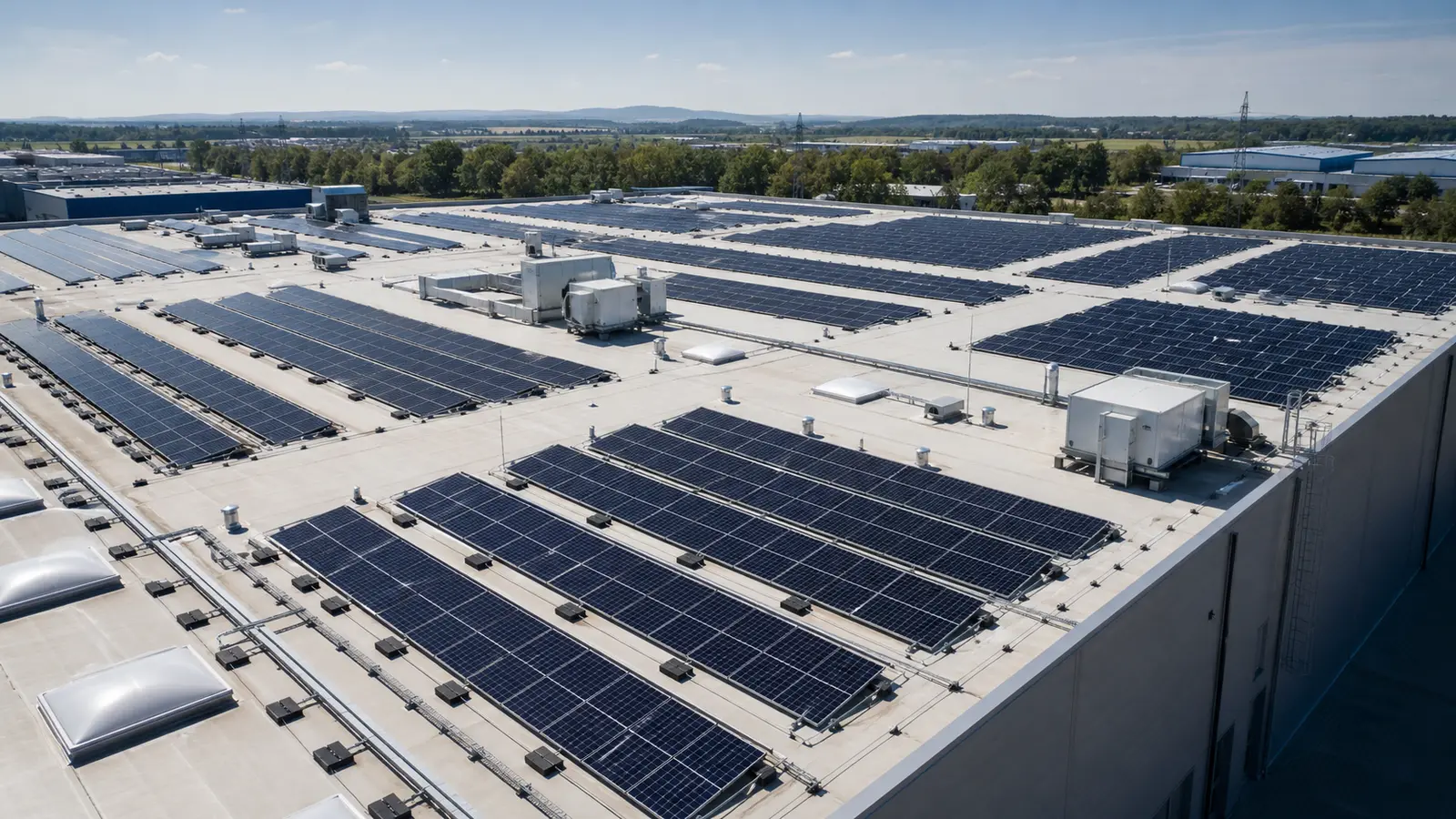
Photovoltaics on Company Rooftops: Inspection, Lightning Protection, Fire Safety, and Insurance
Rooftop photovoltaic (PV) systems on halls, warehouses, or administrative buildings can reduce energy costs. However, they also add another piece of designated technical electrical equipment, DC wiring on the roof, requirements for safe shutdown, and new links to the lightning protection system (LPS), insurance, and subsidies.
Consider this article a guide. In five sections, it summarizes what an operator of a commercial rooftop PV system must monitor and links to more detailed articles on inspections, fire safety, lightning protection systems, and insurance.
The most important rule: for a PV system, having a “certificate from the installation company” is not enough. You need an initial inspection, as-built documentation, a clear shutdown procedure for emergencies, and a plan for periodic inspections. Without these, problems can arise during an official check, an insurance claim, or subsidy settlement.
Quick Answer: 5 Things You Must Address for a Commercial Rooftop PV System
- PV System Inspection – initial inspection before commissioning, then periodic inspections based on the environment, documentation, and operation.
- Fire Safety and Disconnection – an accessible disconnecting device, shutdown of the building or part of it, safe DC voltage levels where the requirement applies.
- Lightning Protection System (LPS) and Surge Protection – LPS assessment, protective zone for panels, SPDs on both the DC and AC sides.
- Insurance – inspections and documentation are not a formality; the insurer may examine them in the event of a claim.
- Subsidies and Operational Documentation – keep the initial inspection report, schematics, project design, fire safety documents, and service records.
For renewable energy power plants with an installed capacity up to 50 kW, requirements for safe installation are addressed by Decree No. 114/2023 Coll. For larger commercial installations, safety is assessed on a project basis, according to the fire safety design, technical standards, and requirements of the distribution network operator or other authorities.
1) PV System Inspection: Don’t Start Without an Initial Inspection
The electrical part of a photovoltaic system is designated technical electrical equipment. Before commissioning, it requires an initial inspection; subsequently, periodic inspections are carried out based on the environment, operating conditions, and documentation. The framework is set by Act No. 250/2021 Coll. and Government Decree No. 190/2022 Coll., while the technical implementation follows the ČSN 33 2000 series and related standards for PV systems.
The inspection may only be performed by a certified electrical inspector with a valid certificate for the relevant scope. For a commercial PV system, this typically involves the scope for low-voltage electrical equipment (E2A); if the lightning protection system or lightning protection is being inspected simultaneously, you also need the corresponding E3A scope. A certified electrical inspector’s certificate is valid for 5 years.
According to: Act No. 250/2021 Coll., Government Decree No. 190/2022 Coll., Government Decree No. 194/2022 Coll., ČSN 33 2000.
→ Details on inspection intervals, types of inspections, and risks: PV System Inspection: Obligation, Intervals, Risks
2) Fire Safety and PV System Disconnection
For a rooftop PV system, the most sensitive part is the direct current (DC) side: connectors, cables, disconnectors, and wiring under the panels. If a DC arc occurs, it does not behave the same as a fault in a standard AC circuit. Therefore, it is crucial to address shutdown, disconnection, and the condition of cable routes during the design phase, not after installation.
Decree No. 114/2023 Coll. applies to renewable energy power plants up to 50 kW and, in §3, mainly addresses:
- Disconnection of the consumption point from all power supply directions – the disconnecting device must be accessible, marked, and protected against unauthorized use.
- PV system on a building – in addition to the above, shutdown and disconnection must be ensured according to ČSN 73 0848 for electrical equipment in the building or part of it.
- A safe level of DC voltage – in any part of the DC wiring, unless the exception for renewable sources up to 10 kW on a family house applies.
For a commercial installation up to 50 kW, therefore, expect that you will typically need to address the requirement for safe DC voltage. Technically, this could involve a remotely controlled DC disconnector, rapid shutdown, or another solution based on the system design.
According to: Decree No. 114/2023 Coll. § 3, ČSN 73 0848, fire safety design.
→ Details on fire shutdown, rapid shutdown, and prevention: Fire Safety of Rooftop PV Systems
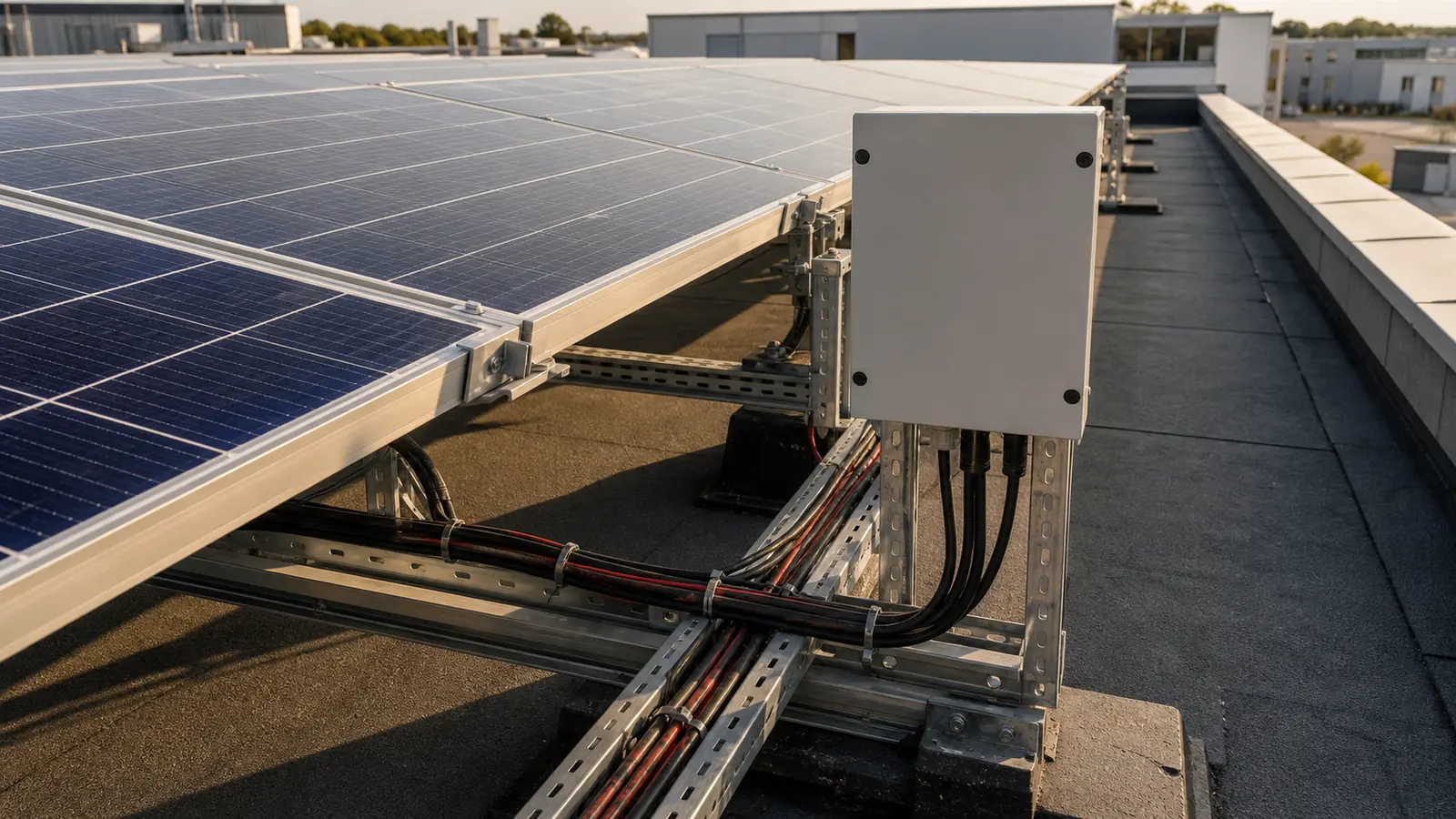
3) Lightning Protection System (LPS) and Surge Protection: PV Changes the Roof
Solar panels themselves are not a reason for lightning to strike a roof. However, they change the roof’s geometry, add metal structures, cable routes, and electronics to the area where lightning protection is addressed. Therefore, it must be verified whether the panels lie within the protective zone of the air-termination system, whether adequate separation distances are maintained, and whether the equipotential bonding is correctly designed.
For a PV system, address at least the following:
- External lightning protection (LPS) – the air-termination system, down conductors, and earthing must account for the panels, mounting structure, and new technologies on the roof.
- Surge protective devices (SPDs) – on the DC side between the panels and the inverter, and on the AC side towards the building’s installation.
- Link to the project design and risk analysis – especially for halls, taller buildings, detached buildings, or buildings with sensitive technology.
The LPS inspection for standard buildings is most often carried out every 4 years, and for critical buildings or higher protection classes every 2 years; a visual inspection should be performed annually. The exact inspection interval is determined by the documentation and LPS classification.
According to: ČSN EN 62305, Government Decree No. 190/2022 Coll., project documentation.
→ Details on LPL classes, inspection intervals, and SPDs: Lightning Protection System Inspections – How Often and According to What
4) Insurance: Without an Inspection, Your Position is Weaker
If damage occurs (fire, overvoltage, short circuit, technology damage), the insurer will want to know the condition of the PV system and what documentation exists for it. The initial inspection report, periodic inspections, as-built documentation, service records, and records of defect rectification are commonly examined.
According to § 2800 (2) of the Civil Code, the insurer may reduce the indemnity if a breach of duty had a substantial influence on the occurrence of the insured event, its course, the increase of its consequences, or the determination of the indemnity amount. It is not an automatic rejection, but a missing inspection significantly worsens the operator’s ability to prove they acted properly.
Are you just arranging insurance for the PV system? The insurer may require the initial inspection and project documentation already during the policy setup or when extending the insurance contract.
According to: Act No. 89/2012 Coll., § 2800 (2); insurance terms and conditions.
→ Details on what the insurer examines and how to protect yourself: Missing Inspection and Insurance
5) Subsidies and Documentation: Operation Gets Expensive Without Records
Subsidy programs vary, but for PV systems, the initial inspection, invoices, technical documentation, handover protocol, and sometimes photo documentation or a connection confirmation are often required. Without these documents, there can be a problem with the payment or subsequent subsidy audit.
Keep the following in one folder:
- initial PV system inspection report and all periodic inspections,
- as-built documentation, wiring diagram, and PV system passport,
- shutdown and disconnection schematic for intervention and building management,
- fire safety documents, if they were prepared,
- records of service, thermography, and defect rectification,
- documents for the subsidy and connection to the distribution grid.
What to Prepare Before Requesting a PV System Inspection
A certified electrical inspector can better price and plan the work when given basic information in advance:
- PV system capacity in kWp and the number of inverters,
- whether a battery or backup mode is included,
- location of panels, inverter, DC disconnectors, and main switchboard,
- the last inspection report and project documentation,
- information on whether the building has an LPS and when it was last inspected,
- description of changes since the last inspection: PV system expansion, inverter replacement, battery addition, roof repairs,
- requirements from the insurer, subsidy program, or site manager.
How SOHE Can Help You
We conduct PV system inspections nationwide (whole Czech Republic) with our headquarters in Brno. SOHE’s advantage is that we don’t just handle one isolated document – we can interconnect electrical, lightning protection, fire safety, and OHS.
- PV System Inspection – initial and periodic inspections according to documentation and operating conditions.
- Thermographic Inspection of Panels and DC Connections – helps detect hot spots, faulty connectors, and overheating.
- Disconnection and LPS Check – we verify the PV system’s link to shutdown, LPS, and surge protection.
- Operational Documentation – we help compile the documents required by the insurer, subsidies, and internal building management.
Frequently Asked Questions
How often must a commercial PV system inspection be performed? An initial inspection is performed before the PV system is commissioned. A periodic inspection of the electrical part is determined by the environment, documentation, and operation; for standard administrative buildings, a five-year interval is often used as a basis, while it may be shorter for more demanding environments. The LPS for standard buildings is most often inspected every 4 years, and for critical buildings or higher protection classes every 2 years.
Must a commercial PV system have a firefighter’s switch? For power plants up to 50 kW, Decree No. 114/2023 Coll. addresses an accessible and marked disconnecting device, and for a PV system on a building, also shutdown and disconnection according to ČSN 73 0848. For larger installations, the project design, fire safety design, and technical standards decide.
When is rapid shutdown or safe DC voltage addressed? Decree No. 114/2023 Coll. requires achieving a safe DC voltage level for power plants up to 50 kW; an exception exists for renewable sources up to 10 kW on a family house. A commercial rooftop PV system up to 50 kW therefore typically addresses this point. The specific technical solution is determined by the project design.
Does rooftop photovoltaics increase the risk of a lightning strike? A PV system changes the roof’s geometry and adds conductive structures and cabling. Therefore, it is necessary to assess the LPS, protective zone, separation distances, and surge protection. This is not a simple general statement – the risk analysis and project design are decisive.
Will a missing inspection affect insurance or a subsidy? Yes, it can. For insurance, it depends on the connection between the breach of duty and the damage; for subsidies, it depends on the specific program’s conditions. The initial inspection, project design, and as-built documentation are among the documents you want to have on hand.
Who is authorized to perform a PV system inspection? Only a certified electrical inspector with a valid certificate for the relevant scope, typically E2A for the low-voltage electrical part and E3A for the lightning protection system. A certified electrical inspector’s certificate is valid for 5 years.
Sources for This Article
Text status: 5. 7. 2026, according to the current wording of regulations.
- Inspection of designated electrical equipment and certified electrical inspector certification: Act No. 250/2021 Coll., Government Decree No. 190/2022 Coll., Government Decree No. 194/2022 Coll.; ČSN 33 2000.
- Requirements for the safe installation of renewable sources up to 50 kW, shutdown and disconnection, safe DC voltage: Decree No. 114/2023 Coll. (§ 1, § 3) and commented version by MIT/Fire Rescue Service.
- Lightning and surge protection: ČSN EN 62305; cable routing and fire safety of buildings: ČSN 73 0848.
- Reduction of insurance indemnity for breach of duty: Act No. 89/2012 Coll. (§ 2800 (2)).
Do you have photovoltaics on your company roof and want to be sure it’s safe, insurable, and compliant with documentation? We will check the PV system inspection, disconnection, thermography, and LPS – and link it with OHS and fire safety. We are based in Brno and operate nationwide (whole Czech Republic).
- PV System Inspection – initial and periodic photovoltaic inspections
- Non-binding Inquiry
Email us at info@sohe.cz or call +420 724 689 762.