
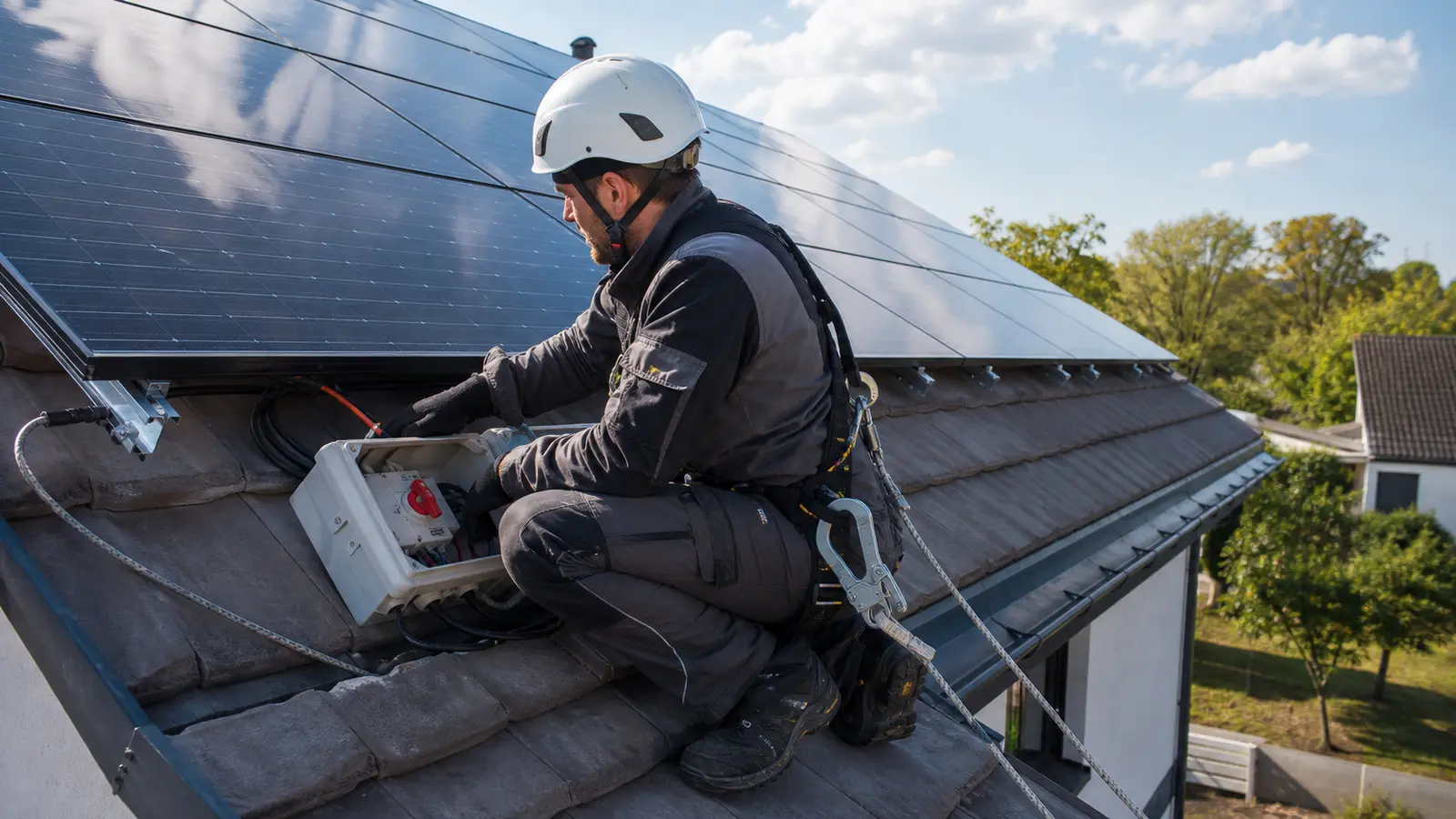
Fire Safety of Rooftop PV Systems: Shutdown, Disconnection, and Fire Prevention
Rooftop photovoltaics are not inherently a problem. The risk mainly arises where the DC side is poorly designed or maintained: DC connectors, cables, disconnectors, wiring under panels, and the connection to the lightning protection system. When a fire starts, firefighters face a critical complication – even after the inverter is switched off, the panels and cables on the roof can continue to generate dangerous DC voltage.
This article explains what fire safety means for rooftop PV systems, what Decree No. 114/2023 Coll. requires, why simply switching off the inverter is not enough, and how to prevent fires through inspection, thermography, and DC connection checks. Inspection obligations and intervals are covered in detail in our article on PV inspections; here we focus on shutdown, disconnection, and fire prevention.
Quick Answer
A rooftop PV system must be capable of being clearly shut down and disconnected during an emergency. Decree No. 114/2023 Coll. requires an accessible and labelled disconnecting device; for PV systems on buildings, it also requires the ability to shut down electrical equipment within the building according to ČSN 73 0848, and for selected installations, achieving a safe DC voltage level. In practice, this means well-designed disconnectors, rapid shutdown where required, proper documentation, regular inspection, and checking connectors and cable routes.
Why Rooftop Photovoltaics Catch Fire
The main culprit is not the panel. It is the direct current (DC) side and the behaviour of a DC electric arc. With alternating current, the circuit regularly passes through zero – the grid has 50 Hz, so the arc has a natural “extinguishing window” and goes out when interrupted. Direct current has no zero point. Once a spark jumps, the arc continues to burn, and the temperature at the discharge point quickly rises to hundreds or even over a thousand degrees.
Where exactly does it occur? Here are the three highest-risk locations:
- DC connectors (MC4) – poorly snapped, loose, or oxidised connections. Even slight play or corrosion increases the contact resistance enough for the connection to start heating up. A few months are enough for the connector to melt.
- Damaged cables – insulation worn through by a sharp edge of roofing, an overtightened clip, or a rodent. This creates a leakage current or short circuit.
- Hot spots on panels – micro-cracks in cells, faulty bypass diodes. One cell stops producing, the rest of the panel pushes current into it, and it overheats. The substrate under the panel can ignite – especially on a combustible roof structure.
And the combustible roof itself is the second key factor. Wooden boarding, older asphalt strips, polystyrene insulation – when a DC arc ignites the substrate, the fire spreads hidden beneath the panels. Firefighters see it late. And when they do see it, they cannot simply spray water on it without careful consideration.
What the Law Says About Shutdown and Disconnection (Decree 114/2023)
Decree No. 114/2023 Coll. sets out requirements for the safe installation of electricity generation plants from renewable sources with an output of up to 50 kW. This covers the vast majority of rooftop and residential PV systems, including smaller commercial installations (§ 1 of Decree 114/2023 Coll.).
From a fire safety perspective, three requirements are crucial:
Disconnecting Device in an Accessible Location (§ 3(1))
The supply point must be capable of being disconnected from all power sources. The disconnecting device must be located in an accessible place, visibly labelled, and secured against unauthorised or accidental use. In practice, this most often means a main switch in the meter switchboard – ideally labelled “PV – Main Switch” and lockable.
For firefighters: they arrive at the house, disconnect the entire PV system with one action, and know the inverter is de-energised from the grid side. But the panels continue to generate power.
Shutdown of Equipment in the Building According to Fire Safety Standard (§ 3(2))
A PV system on a building must also have a disconnecting device that enables the shutdown of electrical equipment in the building according to ČSN 73 0848 (Fire Safety of Buildings – Cable Distribution Systems). This requirement is not just about disconnecting the generation plant from the distribution grid – it is about ensuring all electrical distribution systems in the building, including cable routes where the PV system runs, can be safely shut down. The goal is simple: firefighters must be able to get the entire building into a state where they can enter and extinguish the fire without the risk of electric shock.
Safe DC Voltage – Rapid Shutdown (§ 3(3))
The installation must ensure a safe DC voltage level is achieved in any part of the DC distribution system. This is the “rapid shutdown” principle – a system that, upon activation (by a switch or automatically), reduces the voltage on the DC side to a safe limit within a few seconds. The panels themselves do not stop producing, but electronics at the level of individual panels or strings break the circuit into safe segments.
Exception: this obligation does not apply to PV systems up to 10 kW installed capacity on a family home (§ 3(3)). So, if you have 8 kWp on your roof and it is a family home, the law does not require rapid shutdown. For commercial installations or larger domestic systems (10–50 kW), it does.
Why Firefighters Need This
Imagine a standard response to a roof fire. Firefighters arrive, want to climb up, dismantle the roofing, and extinguish with water. But on the roof are panels that, in daylight, continue to generate voltage – even after the inverter is switched off. The DC side from the panels to the inverter remains live as long as light falls on the cells. It looks like it’s off, but it isn’t.
Without a clearly labelled disconnector and without functional rapid shutdown (where required), the intervention is dangerous. If firefighters on site assess that a safe intervention is not possible, they may limit themselves to protecting surrounding buildings and let the roof burn in a controlled manner. It is not their fault – it is the consequence of a poorly designed or non-compliant installation.
How to Prevent a Fire
Quality installation is fundamental. Most PV fires start at DC connectors. Use original MC4 connectors from the same manufacturer as the panels, crimp them with the correct tool, and do not mix brands. Connections must not be mechanically stressed; cable routes must be protected against abrasion and rodents.
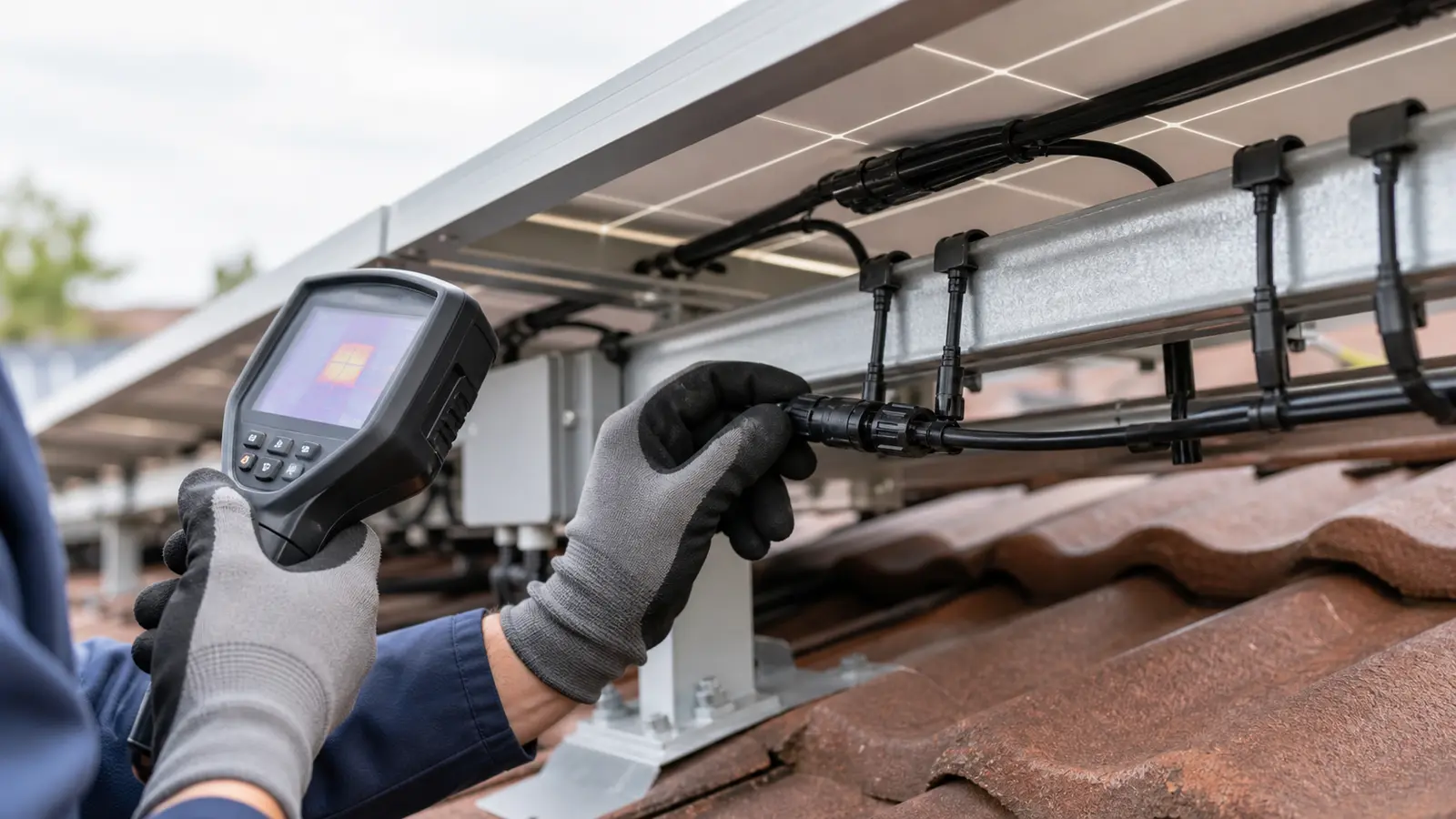
Thermographic inspection from time to time will reveal a problem before it starts a fire. A thermal camera will detect an overheated connector, a hot cell (hot spot), a faulty bypass diode, or contact resistance in a joint – all as a temperature anomaly compared to the surroundings. A visual inspection often misses this.
Regular inspection of the PV electrical installation is key. The framework is set by Act No. 250/2021 Coll. and the related Government Regulation No. 190/2022 Coll.; the inspection may only be carried out by a certified electrical inspector with a valid certificate of the appropriate scope (E2A for low voltage, or E3A for lightning protection systems). Details including intervals and obligations are covered in our separate article on PV inspections.
Lightning protection and surge protection – a PV system on the roof significantly increases the area that can be struck by lightning. The building must have adequate external protection (LPS – Lightning Protection System) and internal surge protective devices (SPD) on both the DC and AC sides. Lightning protection system inspection intervals are governed by ČSN EN 62305: for LPL classes I and II, it is 2 years; for LPL III and IV, it is 4 years. More on intervals can be found in the article on lightning protection inspections.
PV Fire Safety Checklist
When checking a rooftop PV system, go through at least these points:
- Is the main PV switch accessible, labelled, and protected against accidental use?
- Is it clear from the documentation what the switch disconnects and what may remain live?
- Does the installation meet the requirement for shutting down equipment in the building according to ČSN 73 0848?
- For systems over 10 kW, or for non-residential installations, is safe DC voltage / rapid shutdown addressed, if the requirement applies?
- Are DC cables routed without abrasion, sharp edges, hanging loops, and with protection against mechanical damage?
- Are connectors of the same type, correctly crimped, and without signs of overheating?
- Do you have the initial and periodic inspection report, as-built documentation, and a shutdown schematic for emergency response?
If you don’t know the answer to any point, don’t wait for an insurance claim. Often, a technical check, thermography, and supplementary documentation are all that’s needed.
Insurance and Liability
When a roof burns down and the investigation points to a technical fault in the PV system, the insurance company will start asking questions. About inspection reports, installation certificates, compliance with Decree 114/2023 Coll. A missing or invalid inspection can lead to a reduction in the insurance payout. It is not automatic, but insurance companies use this mechanism – and the larger the damage, the more closely they look.
Beyond insurance, there is also the labour inspectorate – Act No. 250/2021 Coll. allows it to impose a fine of up to CZK 2,000,000 for serious breaches of occupational safety regulations. For entrepreneurs and companies, these sanctions are actually imposed.
Frequently Asked Questions
Does my rooftop PV system need a firefighter’s switch? Yes. According to § 3(1) of Decree 114/2023 Coll., the supply point must be disconnectable from all power sources; the switch must be accessible, labelled, and secured against unauthorised use. For PV systems on buildings, the requirement for shutting down equipment in the building according to ČSN 73 0848 (§ 3(2)) also applies.
Does this apply to a small domestic system too? For the rapid shutdown obligation (§ 3(3)), there is an exception for PV systems up to 10 kW on a family home – there, the law does not require safe DC voltage. However, the disconnecting device and shutdown according to the fire safety standard (§ 3(1) and (2)) always apply, regardless of output.
Why isn’t switching off the inverter enough? The inverter only disconnects the AC side. The DC side from the panels to the inverter remains live as long as light falls on the panels. That is why a disconnector on the DC side is needed – or ideally rapid shutdown, which breaks the circuit right at the panels.
How do I identify a faulty connector? Visually, almost not at all – if melting or discolouration is visible, it’s too late. Only a thermographic inspection during operation will reliably show it: a faulty connection glows significantly more on a thermal camera than its surroundings.
Is this related to inspection? Directly. The PV electrical inspection verifies the condition of the entire installation, including disconnectors and protective devices. Without a valid inspection, you don’t know if your system complies with fire safety regulations. We have elaborated more in the article on PV inspections.
Sources for This Article
Text status: 3 July 2026, according to the current wording of regulations.
- Requirements for safe shutdown and disconnection of PV systems up to 50 kW, shutdown of equipment in the building (ČSN 73 0848), and safe DC voltage (exception up to 10 kW on a family home): Decree No. 114/2023 Coll. (§ 1, § 3)
- Framework for safety and inspections of designated electrical equipment, sanctions, and certified electrical inspector certificates: Act No. 250/2021 Coll. and Government Regulation No. 190/2022 Coll.
- Lightning protection system inspection intervals according to LPL classes: ČSN EN 62305; cable distribution systems and fire safety of buildings: ČSN 73 0848.
Want to be sure your rooftop PV system isn’t waiting for a disaster? We will check the electrical and fire safety of your PV system – inspections, thermography, disconnector checks according to Decree 114/2023 Coll., and lightning protection. We are based in Brno and operate nationwide.
- Electrical Inspections – inspections of designated electrical equipment and PV systems
- Non-binding Inquiry
Email us at info@sohe.cz or call +420 724 689 762.