
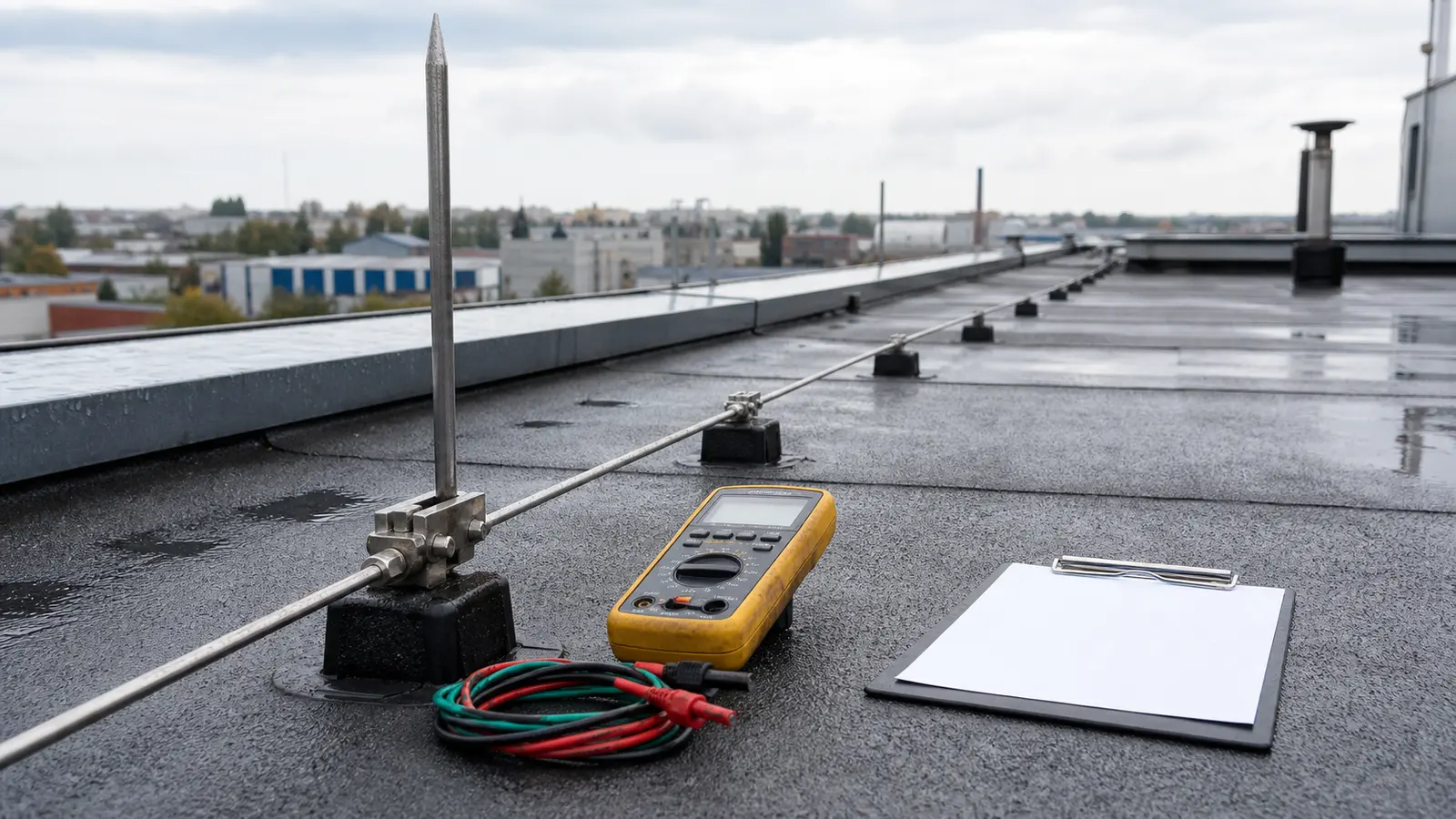
As a business or organisation, you are legally required to keep your property in a safe condition. This is especially important when it comes to lightning protection: a failed system puts not only property at risk, but lives above all. Let us examine how often your lightning protection system must be inspected under the applicable standard and exactly what the inspection technician checks.
What the standard says: ČSN EN 62305 and inspection intervals
The principal standard governing lightning protection is the ČSN EN 62305 series (ed. 2), specifically Part 3, which addresses physical damage to structures and life hazards. This standard divides structures into four lightning protection levels (LPLs) according to the degree of risk. The required inspection frequency depends on the assigned LPL.
The intervals for periodic inspections of an LPS (Lightning Protection System) are as follows:
- Protection levels LPL I and II (high-risk structures such as chemical plants, hospitals and premises with an explosion risk): a complete inspection every 2 years
- Protection levels LPL III and IV (ordinary commercial and administrative buildings, production halls without special risks and apartment buildings): a complete inspection every 4 years
- Visual inspection (for all protection levels): every year
- Critical systems (structures where an LPS failure would have fatal consequences): a complete inspection and visual inspection every year
A visual inspection is a basic examination that may also be carried out by a trained member of your staff. A complete inspection, however, may only be performed by an inspection technician holding a valid certificate, specifically with E3A scope (příloha 3 NV č. 190/2022 Sb.). Under § 11 odst. 3 zákona č. 250/2021 Sb., the certificate is valid for five years, so make sure that the technician you appoint has valid documentation.
If you are unsure which protection level applies to your building, contact us. We will assess it and establish an optimal inspection schedule in full accordance with the standard.
What is checked during a lightning protection inspection
An LPS inspection involves far more than checking whether a piece of wire is missing from the roof. It is a comprehensive examination of the entire system, which consists of three main parts. Each has its own specific requirements and potential faults.
Air-termination system
This is the part that intercepts the lightning strike, typically comprising air rods, conductors along the roof ridge or a meshed conductor network. During the inspection, we check:
- Mechanical damage, corrosion and loose connections
- Correct attachment to the building envelope
- Whether the air terminals are sufficiently high and correctly positioned in relation to the protected parts of the building
- Whether newly installed equipment, such as ventilation systems, antennas or photovoltaic panels, encroaches on the protected area of the air-termination system
Additional rooftop installations are a common source of problems. A business may have photovoltaic panels or air-conditioning equipment installed without considering whether these components extend beyond the protected zone and require their own air-termination protection.
Down conductors
Down conductors carry the lightning current from the air-termination system to the earthing system. We check:
- The continuity and integrity of all down conductors (a broken down conductor means the protection is ineffective)
- The security of connections and clamps, including the measured connections at test joints
- Sufficient separation from combustible parts of the building
- Visible identification and protection against mechanical damage at ground level
In production halls and warehouses, down conductors are often damaged during material handling or by forklift trucks. An annual visual inspection should detect such damage in good time.
Earthing and surge protection devices
This part cannot be checked by sight alone. Instrument measurements are required:
- Earth resistance measurement – the result must comply with the values required by the standard for the relevant protection level. High resistance means that the lightning current has no safe path to earth.
- Inspection of surge protection devices (SPDs) – both visually and by measurement. SPDs protect internal electrical installations and appliances against overvoltage, which may occur even when lightning strikes the power grid away from the building. A defective or missing surge protection device is a serious risk in commercial premises containing sensitive electronics.
Why businesses should not underestimate inspections
Operators of production halls, warehouses and office buildings often assume that “lightning will not strike here anyway.” However, damage is not caused solely by direct strikes. A surge in the electrical network following a nearby lightning strike can easily destroy a server room, production line or security system. If the lightning protection system is not working, the insurer may reduce or completely refuse the insurance payout.
Another risk is the liability of the company’s statutory representative. If an injury or death occurs as a result of a neglected inspection, the company director or owner may be held responsible. For legal entities and self-employed individuals, penalties under zákona č. 251/2005 Sb. o inspekci práce may reach up to CZK 2,000,000.
A lightning protection inspection is also closely related to the overall condition of the building’s electrical installation. During routine inspections, we often identify problems that fall within the scope of electrical installation inspections, ranging from outdated distribution boards to missing residual-current devices. It therefore makes sense to have both inspections performed at the same time by a single provider.
What to do if the system fails the inspection
After the inspection, you will receive a report listing all identified faults. Each fault is classified according to its severity. Minor faults, such as missing labels, do not prevent continued operation but must be remedied before the next inspection. Serious faults, such as a broken down conductor or high earth resistance, mean that the system is not performing its function and require immediate corrective action.
Rectifying faults does not necessarily mean completely rebuilding the system. Partial repairs, replacement of corroded components or the addition of surge protection devices are often sufficient. Once the repairs have been completed, we will carry out a follow-up inspection to confirm that everything is in order.
Indicative cost of a lightning protection inspection
The price depends on the size of the building and the number of down conductors and test joints. For a smaller office building or shop, the indicative price is between CZK 1,000 and CZK 3,000. The cost is higher for large industrial sites with multiple buildings and complex air-termination systems and always depends on the specific scope of work. We will prepare an exact quotation after receiving a non-binding enquiry and details of the property.
Frequently asked questions: lightning protection inspections
How often must a lightning protection system be inspected? Under ČSN EN 62305 ed. 2, the interval for a complete LPS inspection depends on the lightning protection level: every 2 years for LPL I and II (high-risk structures) and every 4 years for LPL III and IV (ordinary commercial and administrative buildings). We recommend carrying out a visual inspection every year.
Who is authorised to inspect a lightning protection system? A complete inspection may only be performed by an inspection technician holding a valid certificate under NV č. 194/2022 Sb. with E3A scope. A visual examination may also be carried out by a trained member of your staff.
What are the consequences of not having a valid lightning protection inspection? Operating designated technical equipment without a valid inspection completed within the prescribed interval is considered a safety hazard. If damage occurs, the insurer may complicate the claims process, while the labour inspection authority may impose a fine of up to CZK 2,000,000 under zákona č. 251/2005 Sb.
Are you confident that your lightning protection system will pass its inspection without any faults? If you are unsure or the next periodic inspection is approaching, contact us. We will arrange a complete LPS inspection, including measurements and the legally required documentation. Email us at info@sohe.cz or call +420 724 689 762. We will treat your property with the same care as if it were our own.