
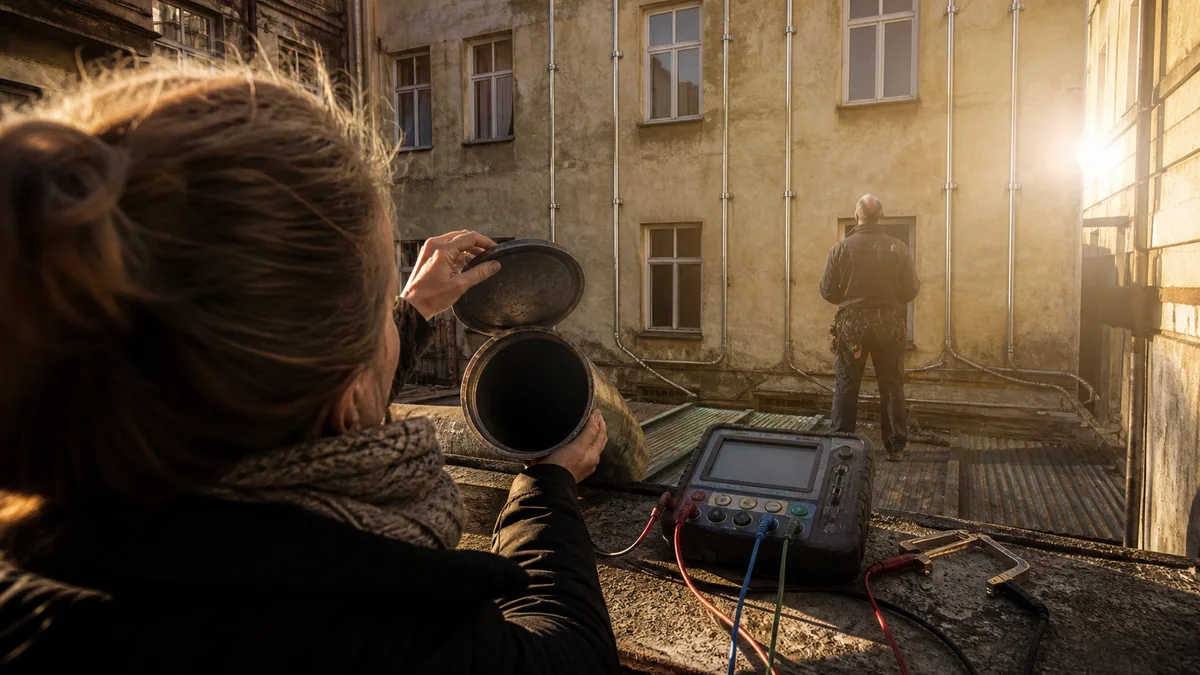
The measurements are done, the technician climbs down off the roof and opens a laptop in the car. The air-termination system looks continuous, the test joints could be unscrewed, the measured value looks reasonable. And yet the report ends up with the one caveat the owner expected least: there is no lightning protection documentation for the building, some requirements therefore could not be verified, and the scope of the assessment is limited as a result.
It sounds like bureaucratic fussiness. It isn’t. An inspection is a comparison of the actual state with the way the installation was meant to look — and with no records, part of what the technician finds has nothing to be held up against. That does not mean the inspection is called off: it is carried out to the extent that can be verified on site, and the report must list both the missing documentation and the specific items that could not be assessed because of it. How big that gap turns out to be depends on what documents were once issued, what can be tracked down or restored, and what is verifiable directly on the installation. The technician can see six down-conductors, but has no way of telling whether there were supposed to be six or eight. The earth resistance can be measured, but there is no telling whether the reading comes from a foundation earth electrode in the concrete or from a ring electrode that somebody cut a piece out of during a refurbishment, leaving the rest of the system hanging off one corner of the building. We will go through exactly what the technician is missing, where that duty sits in the regulations and where it does not, and how documentation is reconstructed for an older building.
A lightning protection system is designated equipment, not “a wire on the roof”
Before we get to the documentation, a sentence about where the duty actually comes from — even people in the trade get this wrong. It is not in ČSN: under § 4(1) of Act No. 22/1997 Sb., a Czech technical standard (ČSN) is not generally binding. The ČSN EN 62305 series is a recognised way of demonstrating compliance, not the source of the obligation.
The source lies elsewhere. The general duty to maintain, check and inspect equipment follows from § 4 of Act No. 309/2006 Sb. For lightning protection there is an additional regime — designated technical electrical equipment under Act No. 250/2021 Sb. and Government Regulation No. 190/2022 Sb. In § 3(1) the latter classes equipment for protection against atmospheric and static electricity — i.e. lightning protection — as designated equipment, and in § 7(5)(d) it ties the intervals for periodic inspections to its Annex 4. How the interval differs by type of building is covered in our article on lightning protection inspection intervals.
One boundary is worth stating straight away, because it is where most of the mistakes happen. The very title of Act No. 250/2021 Sb. ties it to occupational safety, and § 20(1) speaks of the operator — a legal entity or a self-employed person operating designated equipment. Applicability is therefore determined by who the operator is, how the building is used, and whether there is a connection with business activity or work; neither headcount nor building type is the sole criterion. A self-employed person with not a single employee falls under the Act. A family house used purely privately, by contrast, does not in itself create the duty, and the owner is governed rather by obligations under the Building Act and by whatever the insurance policy stipulates — yet that same house may serve as a business base, and the situation changes. Rented property is similar: letting by a private, non-business individual does not in itself trigger the designated-equipment regime, whereas it does apply to a company warehouse, a school or a building operated by a legal entity. Anyone claiming it works the same way everywhere is oversimplifying.
What the technician reads from the documentation, and why measurement doesn’t replace it
A lightning protection system (LPS) is not a set of random wires. It is a design in which four things hang together: the LPS class, the density and layout of the air-termination system, the number and spacing of the down-conductors, and how the earthing is built. Change one and the rest stop adding up. The documentation is the only place where that design can be read.
And this is not a matter of paperwork. A foundation earth electrode embedded in the concrete of the footings cannot be inspected visually — the only record that it is there and how it was built lies in the design documents and in the initial inspection report. The separation distance between the lightning protection system and metal parts of the structure cannot be eyeballed; it is calculated, among other things, from the number of down-conductors and the geometry of the building, i.e. from figures the technician will not establish up on the roof. And the mesh size of the air-termination system is assessed against the LPS class set by the risk assessment — without it, the technician has no way of knowing whether five metres is too much or fine.
| What is missing from the documentation | What cannot be assessed as a result | How it can be supplied |
|---|---|---|
| Risk assessment and the assigned LPS class | Whether air-termination spacing and the number of down-conductors match the design | A new risk assessment to ČSN EN 62305-2 when the documentation is drawn up |
| Drawing of the air-termination system and down-conductors | Whether a down-conductor is missing or was never there | A survey of the actual state and new drawings |
| Description of the earthing system (type, material, installation) | What the measured value actually represents and where the break is | Section-by-section measurement; for concealed parts, the initial inspection report or building documentation |
| Basis for the separation distance | Whether new metal structures on the roof need bonding | Recalculation from the building geometry and the number of down-conductors |
| Record of changes to the building | Whether the present state is still the one designed | An addition to the as-built documentation |
Changes to the building are in fact the commonest reason the original paperwork stopped being valid even where it did survive. When a façade is insulated, the down-conductors disappear under the insulation and the test joint ends up behind a little door nobody — not even the caretaker — has a key to. When roofing is replaced, the air-termination system is laid again, sometimes a few air terminals short. On warehouses the down-conductors run along the cladding, and when the cladding is replaced it happens that one or two are never reinstated. A rooftop photovoltaic array adds metal structures and DC cabling to a space that was designed to be empty — and that changes both the separation distance assessment and the arrangement of surge protection. On top of that, the components of a lightning protection system are covered by the ČSN EN 62561 series; on older installations, proof of what is actually mounted on the roof tends to be the one missing piece of the puzzle.
Older buildings: which yardstick actually applies
A building from the 1980s was not designed to ČSN EN 62305. Older lightning protection systems in this country were built to ČSN 34 1390, now withdrawn, which worked on different logic — it knows neither LPS classes nor today’s risk calculation procedure, and arrives at the placement of air terminals and down-conductors by a different route.
It does not follow that every old lightning protection system should be torn down and rebuilt. An existing installation is assessed against how and to what it was built; a new standard does not in itself invalidate an old installation. A modification or reconstruction of the system is a different matter — there the design follows current rules.
And this is exactly where it becomes clear why the documentation is irreplaceable. The technician needs to know which yardstick to pick up. Without the date of installation, without a technical report and without a drawing, there is nowhere to get one — and the report then issued contains a caveat about the undetermined scope. What an inspection report has to contain in order to stand up is set out in our article on the requirements for an inspection report.
When there is no documentation: what the regulations say
Act No. 250/2021 Sb. anticipates this situation in § 20. Missing accompanying or operating documentation — where it was in fact issued — counts among the conditions endangering the safe operation of designated equipment (§ 20(3)(c)). At the same time, the very same section allows for the documentation simply not being available: under § 20(4), in such a case the operator sets the scope of the checks on the equipment by means of a local operating rule for occupational safety and health.
It is worth saying out loud what this does not solve. The local operating rule concerns only the scope of the checks, not the intervals — those continue to follow from § 7(5)(d) of Government Regulation No. 190/2022 Sb. and its Annex 4, and the duty to produce an inspection within the prescribed interval remains. Above all: this rule does not substitute for missing design or operating documentation. It is not an escape route, it is a working arrangement for checks until the records are supplied. What belongs in the operating documentation for electrical equipment we cover separately.
The second line runs through the Building Act, and it needs splitting into two things. Under § 167 of Act No. 283/2021 Sb., the owner’s duties include maintaining the structure throughout its existence and keeping documentation corresponding to its actual construction, or a pasport stavby (a simplified as-built record of the building). The duty to obtain a pasport, however, sits elsewhere: under § 245(1) it applies where the documentation has not survived or is not in a proper state and the structure was permitted. A lightning protection system is a permanent part of the building, so it falls within this reasoning too — with one caveat. A pasport captures the building construction and need not in itself contain everything needed to assess and inspect an LPS: the protection class backed by a risk assessment, the drawing of the air-termination system and down-conductors, the description of the earthing system. Those records are obtained separately and a pasport will not replace them.
What the regulations do not contain is a calendar deadline. There is no “supply it within thirty days” time limit here; the duty is continuous, and in practice it comes to a head at the periodic inspection, because that is where missing records first show up.
Insurance calls for restraint too. The regulations tell you nothing about how a particular insurer will treat a claim — that is governed by the policy and its terms, which for buildings routinely include a duty to maintain equipment in line with regulations and to produce inspection records. How such a dispute unfolds and what has to be evidenced in it is covered in our article on a missing inspection and the insurance payout. For an inspection by the labour inspectorate (inspektorát práce) or the fire service, something simpler applies: an inspection report carrying a caveat that part of the scope could not be assessed for want of records reads differently from a report with no caveats.
A procedure that makes sense
1. Search first, draw second. The first stop is the archive of the building authority (stavební úřad), not a designer. For prefabricated apartment blocks the documentation tends to be with the former manager or the housing cooperative, for a purchased warehouse with the previous owner, in companies in the file left by the previous technician. An old initial inspection report often has a schematic attached that is enough as a starting point. Drawing from scratch something that is sitting in a records office is needlessly expensive.
2. Survey the actual state. Routes of the air-termination conductors, the number and position of down-conductors, test joints, materials and cross-sections, visible parts of the earthing, photographic records. For inaccessible parts — the earth electrode underground, a down-conductor behind insulation — the record should also note that they are not accessible and why.
3. Calculate what can be calculated. LPS class from the risk assessment, separation distance, assessment of surge protection where the building has any.
4. Turn it into a usable record, not a pile of photos. A technical report and drawings that go into the building’s operating documentation and get used at every subsequent inspection. From that moment on, the technician has something to compare against.
5. Hand it over before the inspection, not on site. If the records only turn up while the technician is standing on the roof, there will be a second call-out.
If you have nobody on site for steps two and three, lightning protection inspection is our everyday work and a survey of the actual state is part of it — and, importantly, we say up front what is missing for the building and what can stand in for it, rather than at the end of the report. As a rough guide from practice: basic reconstruction (redrawing) of lightning protection documentation for an ordinary smaller building comes to around CZK 10,000; for large or complex buildings the price depends on the scope, and we quote an exact figure after a site visit and according to what has survived from the original records.
Sources
- Lightning protection inspections – a SOHE service.
- Lightning protection inspection: how often – periodic inspection intervals and what determines them for a given building.
- Lightning protection and the ČSN EN 62305 standard – what the standard covers and how to find your way around its parts.
- Photovoltaics on a company roof – what changes on the roof once a PV system is added.
- Act No. 250/2021 Sb. – occupational safety in connection with the operation of designated technical equipment; definition of the operator in § 20(1), conditions endangering safe operation, and the scope of checks set by a local operating rule under § 20(4) where documentation is not available.
- Government Regulation No. 190/2022 Sb. – definition of designated electrical equipment including protection against atmospheric electricity, and periodic inspection intervals in Annex 4.
- Act No. 309/2006 Sb. – general duty to maintain, check and inspect equipment.
- Act No. 283/2021 Sb. – the Building Act; owner’s duties including maintenance and retention of documentation (§ 167) and the duty to obtain a pasport stavby where documentation has not survived (§ 245).
- Act No. 22/1997 Sb. – technical requirements for products; a Czech technical standard (ČSN) is not generally binding.
- ČSN EN 62305 (series) – lightning protection: LPS classes, risk assessment, design of the air-termination system, down-conductors, earthing and separation distances; the series is moving to ČSN EN IEC 62305 ed. 3 (part 1 effective from 1 November 2025, part 3 from 1 January 2026), with the existing ed. 2 valid in parallel until 31 October 2027.
- ČSN EN 62561 (series) – requirements for lightning protection system components.
- ČSN 34 1390 – the older Czech lightning protection standard, withdrawn on 1 February 2009 and replaced by the ČSN EN 62305 series; cited here only as historical context for systems installed before that date.
This text is for information only and does not replace legal advice. The specific inspection regime and documentation scope for a particular building need to be set according to actual operation, the manufacturer’s documentation, the operating environment and a risk assessment.
Dealing with a lightning protection inspection on a building whose documentation has not survived? Our lightning protection inspections include a survey of the actual state and a clear statement of what is missing for the building — before it ends up as a caveat in the report. Email info@sohe.cz or send us a no-obligation enquiry with the address of the building and its approximate year of construction, and we will come back to you with a date and a price.