
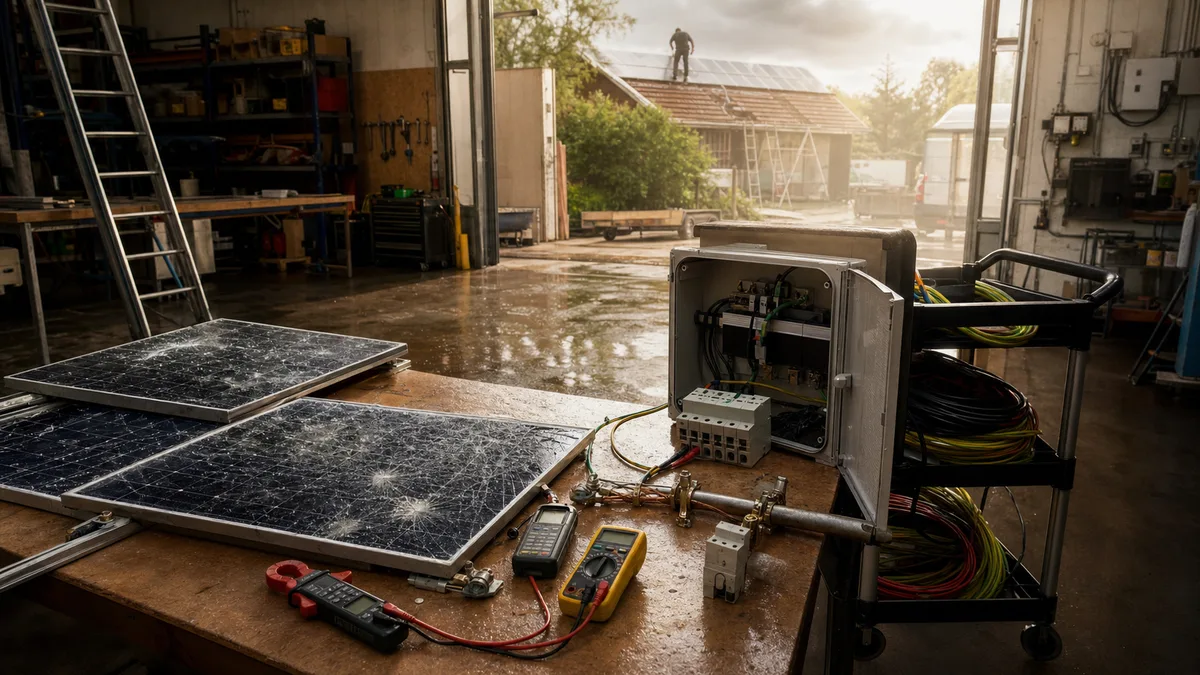
The storm passes, the roof is quiet, the inverter has a green light, and production continues. Yet this alone is not proof that the photovoltaic system is in order — just as it’s not true that an inspection technician must come out after every thunderclap. Something else is decisive: whether a specific event could have impacted the equipment in such a way that its safe state has changed.
The difference between “lightning struck a tree two blocks away” and “the lightning rod’s down conductor is torn off the roof” is fundamental, and each case leads to a different procedure. We’ll walk through the symptoms where operation should not be resumed, what to do immediately after an event, how to decide based on what actually happened, and when it makes sense to order a check versus an extraordinary inspection.
When to shut down the PV system and not restart it yourself
A storm alone does not trigger an extraordinary inspection. What matters is whether a lightning strike, power surge, mechanical damage to panels, water ingress, or failure of protective elements could have occurred.
It is appropriate to shut down operation and not restart the equipment yourself if you notice at least one of the following conditions:
- smell of burning, smoke, crackling, or unusual heating of any part of the installation,
- visibly broken panel, deformed frame, or loose mounting structure,
- damaged cables, connectors, distribution board, or inverter,
- water ingress into electrical parts — distribution board, inverter, cable glands,
- repeated tripping of a circuit breaker, residual current device, or DC switch,
- insulation fault, surge protection fault, or abnormal voltage reported by the inverter,
- obvious lightning strike to the building or its immediate surroundings,
- damage to the lightning rod — torn-off down conductor, loose connection, shifted or bent air terminal.
For company equipment, the employer is obligated under Section 4 of Act No. 309/2006 Coll. to ensure that machinery, equipment, and tools are suitable for the work they will be used for in terms of occupational safety and health, and are equipped with protective devices. A suspicion of a dangerous defect cannot therefore be resolved by clearing the error message on the inverter — which is unfortunately the first reflex we encounter in operations.
What to do immediately after an event
People first, then the site. Do not climb onto a wet roof, and do not touch damaged panels, cables, or metal structures. In case of smoke, fire, or immediate danger, the first call goes to the fire department, not a service company.
If the PV system can be safely shut down according to the manufacturer’s manual or the company’s emergency procedure, perform the prescribed shutdown. Do not improvise in the distribution board. And most importantly: panels generate DC voltage in daylight even after the inverter and main circuit breaker are turned off — a shut-down building does not mean a voltage-free roof.
Then:
- Record the date, time, and course of the event — when the storm passed, what you heard and saw, when the equipment went down.
- Take photos of the panels from the ground, the roof, distribution boards, inverter, and surge protection indicators (colored windows on modules).
- Save error reports and production export from the monitoring system — data from the inverter is only stored for a limited time on some systems.
- Note which circuit breakers or protective devices tripped, including the sequence, if you know it.
- Inform the building manager, the person responsible for the electrical equipment, and the insurer.
- Before dismantling damaged parts, check what documentation the insurance company requires.
Do not repeatedly reset circuit breakers and residual current devices. A protective device tripping is information about a fault, not an operational inconvenience to be bypassed.
How to decide based on what happened
| Situation | Recommended Action | What the Check Should Include |
|---|---|---|
| Direct or probable close-range lightning strike | Do not operate the PV system until it has been checked | PV system, distribution boards, surge protection devices, lightning rod, and grounding |
| Broken panels or deformed frames after a hailstorm | Cordon off the hazardous area, shut down the affected part | Panels, DC cabling, connectors, mounting structure, and roof covering |
| Water ingress into the inverter or distribution board | Do not turn on the equipment | Insulation condition, covers, glands, terminals, and extent of water impact |
| Insulation, arc, or surge fault on the inverter | Do not clear the error, call in a qualified person | DC strings, connectors, cables, protective devices, and inverter |
| Decreased production from one string | Compare data before and after the event | String voltage and current, panels, connectors, optionally thermography |
| Only a grid outage, with no other symptoms | Verify grid status and inverter reporting | Further check according to the error found |
| Storm in the vicinity, no strike and no change in operation | Ground-level visual check and monitoring check | Professional inspection if a deviation is found or if documentation requires it |
Low production on its own is not proof of damage. The result is influenced by cloud cover, panel temperature, shading, and power limitation by the inverter at high temperatures. What is truly suspicious is a new and persistent difference between comparable strings, or an error that appeared exactly at the time of the event.
What a technician should check on the photovoltaic system
A post-storm check should not end with a glance at the inverter’s indicator light. The scope depends on the type of event and the power plant’s design, but generally includes:
- panels, frames, mounting, and cable routes,
- DC connectors and cable strain relief,
- distribution boards, disconnect switches, fuses, and terminals,
- condition of surge protection devices on both DC and AC sides,
- continuity of protective conductors and equipotential bonding,
- insulation resistance,
- polarity and voltage of individual strings,
- function of protective and disconnecting devices,
- inverter error history and operational data.
Depending on findings, string current measurement, insulation fault tracing, or thermographic inspection may follow. A thermal camera is useful with sufficient irradiance and load — a shot of cold panels after rain might not reveal a cell that only overheats during production.
DC connectors are a separate chapter. The “MC4” designation is commonly used as a generic name for the entire category, but visually similar connectors from different manufacturers are not necessarily intended for interconnection — these are products with their own type test, not a universal standard. Crossed combinations, improper crimping, or loose connections increase contact resistance, causing the connection to heat up. Storm winds and handling during repair work are exactly the moment when a loose connection will reveal itself.
What remains hidden after a hailstorm
Hail doesn’t have to pierce the panel. It can cause microcracks in cells, damage to encapsulation, damage to the backsheet, or stress on the frame. The panel still produces power, and the defect only appears later — through performance degradation, moisture ingress, or localized overheating.
A visual inspection will find visible damage. Hidden defects may require thermography, comparison of electrical parameters, or possibly electroluminescence imaging. Not every power plant needs all these methods after a normal hailstorm — the technician should explain why they are proposing a specific test and what the result will prove. A proposal for measurements costing tens of thousands “just to be sure” without justification is just as suspicious as a blanket “everything’s fine.”
An electrical technician does not, at the same time, assess structural damage. Dented roofing, damaged waterproofing, the structural integrity of the load-bearing structure, or loose roof elements should be inspected by a roofer or building specialist — for a photovoltaic system on a business roof, this often represents greater damage than the panels themselves.
Why the lightning rod should be checked separately
The photovoltaic system, lightning protection, and surge protection form an interconnected system. A strike can damage the power plant even if there is no trace of a discharge on the panels — energy can enter the installation through the grounding system, equipotential bonding, or induction into cable loops.
For the lightning rod, the following are mainly checked:
- position and mechanical condition of air terminals,
- integrity of down conductors and connections,
- connection to the grounding system,
- changes on the roof and compliance with the designed layout,
- equipotential bonding and the relationship of the PV structure to the air terminal system,
- condition of coordinated surge protection devices.
The colored indicator on a surge protection device reveals a disconnected module, but does not confirm the condition of the entire installation. Similarly, an undamaged air terminal does not prove that all down conductors, connections, and protective devices inside the building are intact. We discuss design principles and standard intervals in the article Lightning rod inspection: how often according to ČSN EN 62305. After a storm, however, a different question is key — whether the specific event could have altered the system’s ability to perform its protective function.
When a check is enough and when to request an extraordinary inspection
A check serves to find a fault and determine the repair. An inspection is a formal assessment of the equipment’s safety, carried out by an inspection technician to an appropriate scope, culminating in an inspection report.
Government Regulation No. 190/2022 Coll. governs inspections of reserved electrical equipment — initial and periodic. The term “extraordinary inspection” comes from technical practice and standards: it is used for an inspection following an extraordinary event or intervention on the equipment, i.e., where the safe state has changed or cannot be proven. It is not the case that an extraordinary inspection must follow every storm. If one is carried out, it is customary to state the reason for its execution and the precisely defined scope in the report.
It is reasonable to arrange an extraordinary inspection particularly when:
- a lightning strike or extensive surge occurred,
- the check revealed damage affecting electrical safety,
- significant repair or replacement of electrical parts took place,
- the safe state cannot be proven by a simple service check,
- the operational documentation, the responsible person, or the insurer requires it.
Whether an inspection should follow and to what extent should be decided by an inspection technician based on the actual impact — not by a service company’s standard price list. Furthermore, an installation company must not substitute a service report for an inspection report; these are documents with different content and different responsibilities. We discuss regular intervals and obligations for photovoltaics in the article PV system inspection: obligation, intervals, and risks.
What to prepare for the insurance company
Notify the insurer of the event without undue delay, according to the policy terms of your specific contract. Before any repair, document the original condition, provided this does not endanger people or increase the damage.
Prepare:
- insurance policy number and claim number,
- dated photos and videos,
- original PV system design and handover documentation,
- initial and subsequent inspection reports,
- service reports and maintenance records,
- production data export and error logs,
- a technician’s statement on the probable cause,
- an itemized repair estimate,
- a list of replaced parts and their serial numbers.
Do not dispose of damaged components without an agreement with the insurer — they may be needed for assessment and determining the cause. We write in more detail about how documentation factors into claim settlement in the article Missing inspection and the insurance company.
A missing inspection alone does not mean every claim will be denied, nor does a valid inspection guarantee payout. The deciding factors are the policy terms, the scope of coverage, and the link between the condition of the equipment, any breach of obligations, and the occurrence or extent of the damage.
What a check costs and what an offer should contain
For a smaller commercial PV system, the price depends mainly on the scope: basic post-event diagnostics are roughly in the thousands of crowns, whereas an inspection with complete measurements, a protocol, lightning rod check, thermography, or complex roof access will cost more. A concrete price without a defined scope has nothing to compare against.
An offer should state:
- which parts of the PV system and lightning rod the technician will check,
- what measurements they will perform,
- whether work on the roof and travel are included,
- whether you will receive a service report or an inspection report,
- whether the price includes thermography and a follow-up check after repair,
- who will carry out the repair of any found defects.
A suspiciously cheap “inspection” without measurements and a clear scope can substantiate neither safe operation nor the cause of damage for the insurance company.
How to recognize a usable inspection output
An inspection report should identify the equipment, state the scope of the inspection, the reference documents used, and the measuring instruments. It should include the performed actions, measured values, identified defects, and a conclusion on whether the equipment is safe for operation from a safety perspective. For an extraordinary inspection, the reason for its execution should also be stated.
The sentence “PV system checked, everything in order” is not sufficient as an output. The document should make it clear whether the technician checked just the inverter, or also the DC side, distribution boards, surge protection devices, and lightning protection. We discuss everything an inspection report should contain in the article Essentials of an inspection report.
Sources for this article
- PV system inspection – service by SOHE.
- PV system inspection: obligation, intervals, and risks – regular intervals and obligations of a photovoltaic operator.
- Lightning rod inspection: how often according to ČSN EN 62305 – intervals and scope of lightning protection system checks.
- Missing inspection and the insurance company – how documentation factors into insurance claim settlement.
- Act No. 309/2006 Coll. – act regulating further requirements for occupational safety and health; Section 4 governs requirements for machinery, technical equipment, and tools used at work.
- Government Regulation No. 190/2022 Coll. – on reserved technical electrical equipment and requirements for ensuring their safety; governs inspections of reserved electrical equipment (initial and periodic). The term “extraordinary inspection” is not in the regulation — it is used in technical practice and standards for an inspection following an extraordinary event or intervention on the equipment.
- ČSN EN 62305 – series of standards for lightning protection (design, implementation, and inspection of the lightning protection system).
The text is for informational purposes and does not replace a legal opinion. The specific regime of checks and inspections for a photovoltaic power plant after a storm or hailstorm must be set according to actual operation, manufacturer’s documentation, environment of use, and risk assessment.
Not sure if your PV system needs just a visual check after a storm, or an extraordinary inspection? We’ll look at your monitoring, error reports, and the condition of your installation, and tell you straight what the scope of the check should include and why — we do PV system inspections including lightning rod and surge protection devices. Write to us at info@sohe.cz or send a non-binding inquiry and we’ll schedule a date.