
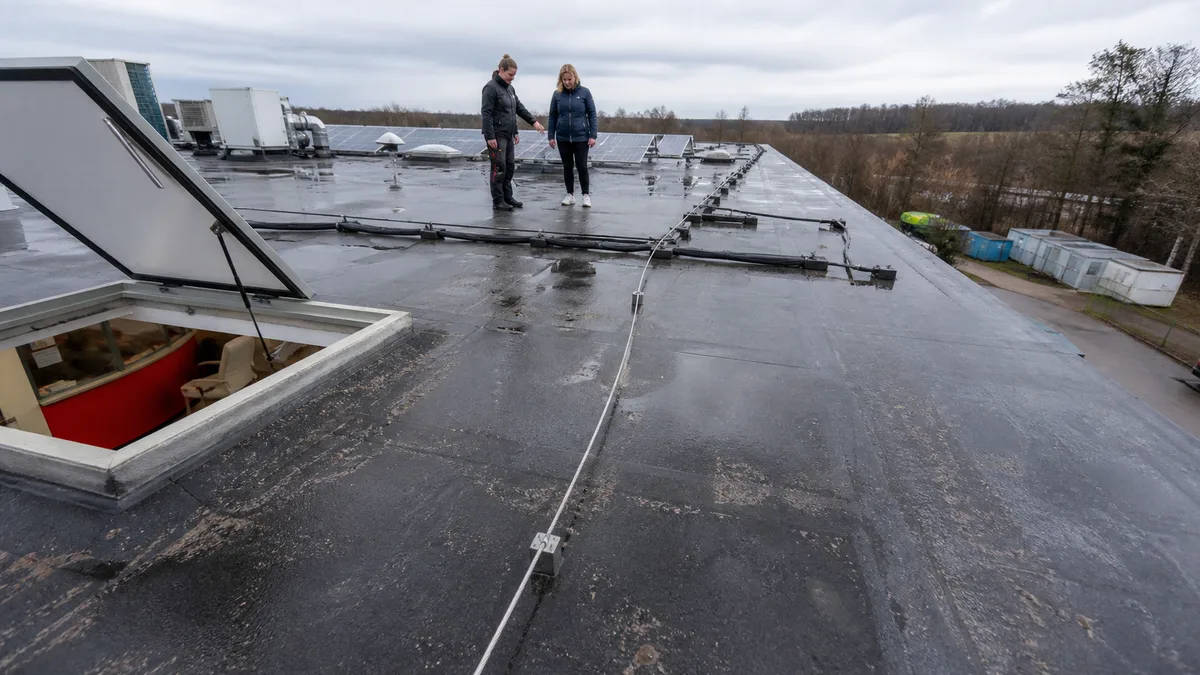
The short answer: A technician inspecting a lightning protection or photovoltaic system is an employee while on the roof and is therefore subject to nařízení vlády č. 362/2005 Sb. Their employer must provide fall protection wherever the workplace or access route is more than 1.5 metres above the surrounding level—preferably using guardrails, barriers, or a platform, and only then a harness attached to a designated anchor point. If there is nowhere to attach the harness, the roof access does not work, there is a risk of falling through a skylight, or there is a thunderstorm or ice, the technician will not go up and the inspection will be postponed or remain incomplete. You can prevent this by preparing the access route, keys, roof information, anchor-point documentation, and, for a PV system, access to the disconnect switches.
A technician arrives to inspect a lightning protection system, but the maintenance worker with the key to the roof access is on holiday. When the hatch is finally opened, it leads to a flat roof with a wet membrane, no parapet, and no anchor point. The technician measures the earth electrodes at the test joints, records what could be seen from the ladder, and leaves with the intention of returning. The client sees this as obstruction; in reality, the technician has merely complied with a regulation that gives their employer no alternative.
Why the technician refuses to climb up: the threshold is 1.5 metres, not a “high-rise building”
Nařízení vlády č. 362/2005 Sb. requires employers, under § 3 odst. 1, to take measures against falls, falling through, or slipping at all workplaces and access routes more than 1.5 metres above the surrounding level. A single-storey industrial building is therefore just as much a workplace at height as a tower block. The regulation has been in force since 4 October 2005 without a single amendment—the rules have not changed in twenty years, but roofs have: photovoltaic systems, ventilation equipment, and air-conditioning units have been added, along with more reasons to access them.
The regulation also determines the order in which protective measures are to be used. Under § 3 odst. 2, collective protection—guardrails, barriers, covers, scaffolding, or work platforms—takes priority. Under § 3 odst. 3, a harness and rope may be used only where the nature of the work rules out collective protection or where collective protection would not be practical. A harness alone solves nothing: under Part II, point 5 of the regulation’s annex, the anchor point must be designated in the work procedure or by a professionally qualified employee and must be sufficiently resistant in the direction of a potential fall. A chimney or ventilation duct is not an anchor point unless it has been assessed as such.
Roofs are covered separately in Part VI of the annex. Employees must be protected against falling over an unprotected edge, slipping on slopes exceeding 25 degrees, and falling through the roof structure—not only around the perimeter, but also through skylights and service openings. On slopes exceeding 45 degrees, personal protective equipment must be used in addition to roof ladders. Protection against falling through is required wherever there is no guarantee that the roof covering can support a person and their tools; corrugated sheets and polycarbonate skylights are typical examples.
The exemption rarely applies when inspecting a lightning protection system. Under § 3 odst. 4 písm. a), fall protection is not required on a continuous surface with a slope of up to 10 degrees if the workplace is marked off by a barrier at least 1.5 metres from the unprotected edge. However, air-termination conductors and down conductors typically run along parapets and at corners—precisely within the zone that the technician must not enter without protection. The same applies to PV arrays installed close to the edge.
Weather conditions are equally decisive. Part IX of the annex lists the situations in which an employer must suspend work at height: thunderstorms, rain, snow or ice formation, strong winds (above 8 m/s on suspended platforms, mobile scaffolds, and ladders over 5 metres; otherwise above 11 m/s), visibility below 30 metres, and temperatures below −10 °C.
What about a ladder? Under Part III of the annex, a ladder may be used only where safer equipment is not justified and only for short-term, physically undemanding work. It must extend at least 1.1 metres beyond the landing, and a technician whose feet are more than 5 metres above the ground must use personal protective equipment. A fixed access ladder with a hatch is better—provided the hatch can be opened.
Table: roof obstacles, what to provide, and who is responsible
| Obstacle encountered by the technician | What to provide before the appointment | Who typically handles it |
|---|---|---|
| Locked roof access, corroded ladder, or jammed hatch | working roof access and keys held by someone who will be on site on the day of the inspection | owner, property manager, or SVJ board |
| Flat roof without a parapet, guardrail, or anchor points | documentation for the anchoring system and a record of its latest inspection; otherwise, a platform or temporary barrier | the client provides the information and equipment; the technician’s employer decides how protection will be arranged |
| Pitched roof over 25° without walkways or roof ladders | ladders or walkways secured at the work location, anchor points, and a harness for slopes over 45° | client (walkways and anchors are part of the roof), contractor (work procedure) |
| Skylights, openings, or fragile roofing | mark them, cover them with load-bearing covers, or fence them off, and warn the technician in advance | client |
| Activity below the roof edge (pavement, car park, entrance) | cordon off the danger zone—when working at a height of 3 to 10 metres, at least 1.5 metres from the vertical line beneath the edge—or stop activity in the area | client together with the contractor |
| PV system: live array, obstructed DC disconnect switch, or missing string diagram | access to inverters and disconnect switches, as-built documentation, and an agreed shutdown | PV system operator |
Who is responsible for what: the contractor, the client, and the SVJ
The technician’s employer bears the obligations arising from nařízení vlády č. 362/2005 Sb.: selecting the protection method, providing and inspecting harnesses, delivering training under Part XI of the annex, preparing a work procedure that identifies anchor points, and deciding when work must be suspended. The employer—not the client—therefore decides whether the technician will access the roof.
A client who is also an employer has obligations under zákoník práce. Under § 101 odst. 3, employers whose employees perform duties at the same workplace must inform one another in writing about risks and adopted measures and cooperate in ensuring safety. Under § 103 odst. 1 písm. g), the client must ensure that employees of another employer receive the necessary information and instructions before work begins—how to access the roof, where the skylights are, how to shut down the photovoltaic system, and what to do in the event of a fire. We describe how this works in practice in our article on external contractors at your workplace.
The společenství vlastníků (SVJ) usually has no employees, but under § 5 odst. 1 písm. b) of nařízení vlády č. 366/2013 Sb., the roof, “including the infill of access openings, insulation, lightning protection systems, and walkways,” is a common part of the building. The condition of the roof access, walkways, and anchoring system is therefore the responsibility of the person responsible for managing the building, while their installation must be approved by the owners’ assembly—ideally in the year when roof repairs are planned, not a week before the inspection.
How roof access affects the price and duration of an inspection
An inspection of a lightning protection or PV system involves more than taking measurements at the test joints. Under § 2 písm. c) of zákon č. 250/2021 Sb., an inspection is an assessment of equipment safety through examination, testing, or measurement—and the visual examination of the air-termination system, joints, and down conductors, or the connectors and string combiner boxes of a photovoltaic system, takes place on the roof. Time on site increases with every protective measure required: putting on a harness, switching between anchor points, or working from a platform. A second visit and the use of a platform are both charged separately. We examine the main factors affecting the price in our article on how much a lightning protection inspection costs.
When the inspection cannot be completed because of access
The technician records in the report what was and was not completed and why—for example, “air-termination system not visually examined; roof lacks fall protection.” Such a report describes the actual situation, but it does not replace a complete inspection or extend the deadline. We discuss the intervals for each protection class in our article on how often a lightning protection system must be inspected.
Lightning protection and photovoltaic systems are both vyhrazená elektrická zařízení under § 3 odst. 1 of nařízení vlády č. 190/2022 Sb. (písm. a) electrical installations and electricity-generating equipment; písm. b) equipment providing protection against the effects of atmospheric electricity). Under § 6 odst. 4 písm. c), the same regulation also requires an inspection whenever the characteristics of the protection against atmospheric electricity change. Roof repairs, replacement of the roof covering, or installation of a PV system therefore also provide an opportunity to add roof access and an anchoring system. The applicable requirements are covered by ČSN EN 795, while roof design principles are set out in ČSN 73 1901-1; the design must be prepared by a qualified designer.
Autumn and winter: why you should schedule the inspection during a dry spell
Adverse conditions listed in Part IX of the annex—rain, snow, ice, fog reducing visibility below 30 metres, and temperatures below −10 °C—are common from October to March, while daylight hours are also shorter. A lightning protection inspection due in January should therefore be scheduled for autumn with sufficient contingency, not for the first week of January. A PV system inspection may additionally require a production shutdown.
This is not merely a formality. According to a press release issued by Státní úřad inspekce práce on 27 April 2025, there were 70 fatal occupational accidents in the Czech Republic in 2024. Falls from height—from stairs, ladders, access structures, roofs, terraces, and platforms—were the second most common cause, accounting for seven cases.
What not to do
- Do not build an improvised access route for the technician. Under § 3 odst. 6 of the regulation, unstable objects and objects intended for other purposes—such as buckets, barrels, chairs, or tables—must not be used to raise the working position.
- Do not rely on a sentence in the contract. A clause stating that “the contractor is fully responsible for occupational health and safety” does not release a client who is also an employer from the obligations under § 101 odst. 3 and § 103 of zákoník práce.
- Do not order an “inspection from the ground.” A report prepared without examining the roof is incomplete and will not qualify as a full inspection for an insurer or regulatory authority.
- Do not assume anchor points are safe simply because “they are there.” Without documentation and an inspection record prepared in accordance with the manufacturer’s instructions, the technician cannot use them.
- For a PV system, do not assume that switching off the inverter makes the roof safe. The DC side remains live in daylight; we explain how the system is disconnected in our article on fire safety for rooftop PV systems.
Frequently asked questions
From what height must the technician use fall protection?
Under § 3 odst. 1 of nařízení vlády č. 362/2005 Sb., from 1.5 metres above the surrounding level; above water or life-threatening substances, fall protection is required at any height.
Is it enough to lend the technician a harness and rope?
No. Personal protective equipment must be provided by the technician’s employer and, under Part II of the regulation’s annex, must be used with a designated anchor point. Without an anchoring system or a platform, there is nowhere to attach the harness.
Is an SVJ required to install anchor points?
Nařízení vlády č. 362/2005 Sb. places the obligation to provide fall protection on the employer, not the building owner. Without an anchoring system, parapet, or guardrail, however, the technician will either be unable to access a flat roof or will have to work from a platform—affecting the cost of every inspection and repair. Under nařízení vlády č. 366/2013 Sb., the roof, including its access points and walkways, is a common part of the building; the owners’ assembly decides whether to install an anchoring system on it.
Who pays for the platform or scaffolding?
The regulations do not specify this; it is a contractual matter. In practice, it is ordered either by the client, who knows the building, or by the contractor as a separate item in the quotation—clarify this before the appointment.
Sources used for this article
- Lightning protection inspections – a SOHE service.
- PV system inspections – a SOHE service.
- Lightning protection documentation for an older building – the paperwork obstacle that can affect the same site visit and how to resolve it.
- How much a lightning protection inspection costs – the factors affecting the price, including roof access and the use of a platform.
- External contractors at your workplace – communicating risks to the technician before work begins.
- Nařízení vlády č. 362/2005 Sb. – work at height and above unprotected drops; in force since 4 October 2005 without amendments; § 3 and Parts II, III, V, VI, IX, and XI of the annex.
- Zákon č. 262/2006 Sb. – zákoník práce; § 101 odst. 3 and § 103 odst. 1 písm. g).
- Zákon č. 250/2021 Sb. – occupational safety in the operation of vyhrazená technická zařízení; the definition of an inspection in § 2 písm. c).
- Nařízení vlády č. 190/2022 Sb. – vyhrazená technická zařízení elektrická; § 3 odst. 1 and § 6 odst. 4.
- Nařízení vlády č. 366/2013 Sb. – bytové spoluvlastnictví; common parts of a building under § 5.
- ČSN EN 795 (83 2628) – Prostředky ochrany osob proti pádu – Kotvicí zařízení; issued February 2013.
- ČSN 73 1901-1 (73 1901) – Navrhování střech – Část 1: Základní ustanovení; issued October 2020.
- VÚBP – Desatero správného navrhování kotvicího zařízení pro údržbu na střechách se sklonem do 10° – priority of collective protection and safe access to anchor points.
- SÚIP – V loňském roce výrazně poklesl počet smrtelných pracovních úrazů – press release dated 27 April 2025, presenting data for 2024.
This article is for information purposes only and does not constitute legal advice; the legal position was verified as of 28 August 2026. The specific arrangements for safe roof access must reflect actual operating conditions, the manufacturer’s documentation, the environment in which the equipment is used, and the risk assessment.
Do you need an inspection of a lightning protection or photovoltaic system but are unsure whether the roof is ready? Before the appointment, we will send you a checklist covering everything to prepare—roof access, keys, anchor points, and disconnect switches—so a second visit is not required. Order a lightning protection inspection or PV system inspection through our no-obligation enquiry, or email info@sohe.cz.