
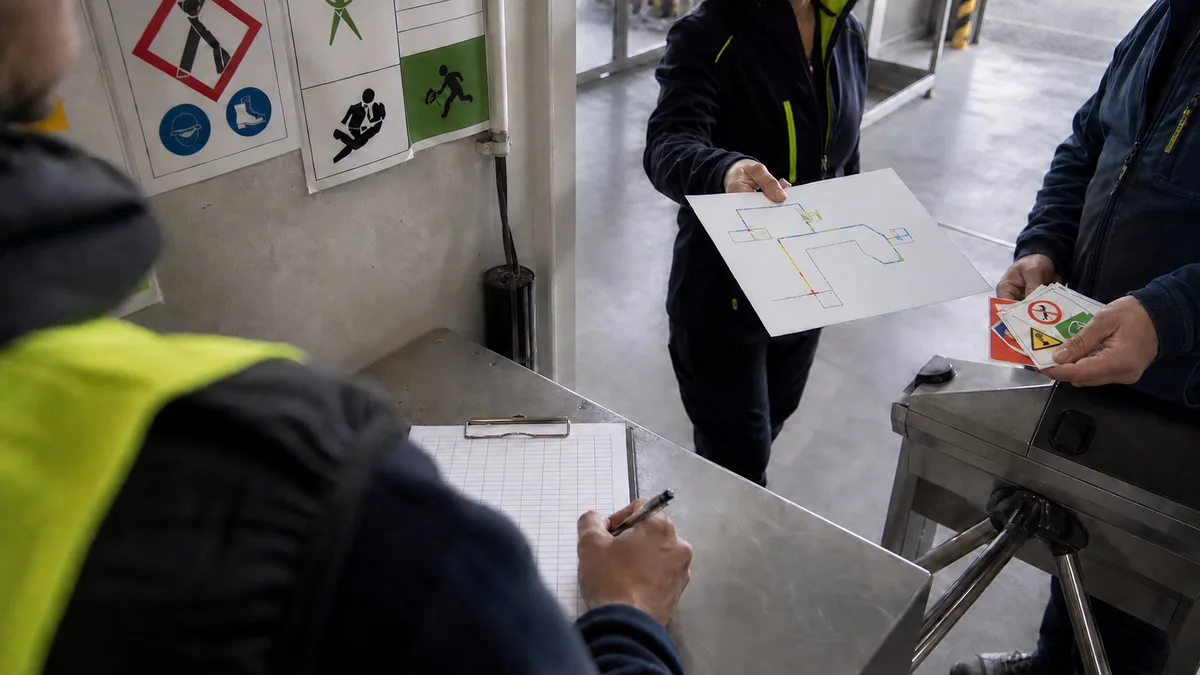
Every morning, half a dozen people who are not on your payroll pass through reception. A lift service technician, two HVAC installers, an agency temp assigned to dispatch, and a self-employed cleaner with her own company registration number. They all sign the visitor log, receive a vest and go to work. The question that determines everything arises only when one of them gets hurt: how were they supposed to know where they were not allowed to go?
Disputes over training external workers are almost never about whether the contractor trained its people. It usually did—but often only for their own work and the risks they bring with them. Yet the law also requires the other half: training must relate to the work performed and to the risks of the workplace where that work is carried out. By definition, the contractor cannot know that second half until you provide it: what lies behind the door to your electrical switch room, where the forklift that appears without warning travels, and what that audible alarm means.
We will explain exactly where the dividing line lies for contractors, agency workers and self-employed workers, what a mutual exchange of risk information should contain, who handles an injury, and how the reporting process changed in January 2026.
A short answer on the division of responsibilities
Employers provide training to their own employees—so in the case of a contracting company, the contractor does so. Under Section 103(2) of the zákoník práce, however, the employer must provide training relating to the work performed and to the risks employees may encounter at the workplace where the work is carried out. This therefore includes risks arising from your operations—and the contractor can learn about them only from you.
The legal basis for this exchange is Section 101(3) of the zákoník práce (zákon č. 262/2006 Sb.): where employees of two or more employers perform tasks at the same workplace, the employers must inform each other in writing about risks and the measures adopted to protect against them, and they must cooperate in ensuring occupational health and safety. Each employer must also ensure that its activities and the work of its employees are organised and performed in a way that protects the employees of other employers as well.
Two words in that paragraph carry the full weight of the obligation. Mutually—meaning the information flow is not one-way, and having the contractor sign your log is not enough. And in writing—meaning an oral agreement in the yard does not prove compliance.
Each party must then communicate the information received internally: under Section 101(4)(b), an employer must inform its employees about risks and measures communicated by other employers. The contractor must therefore include the relevant risks provided to it when informing and training its own personnel. Section 101(3) itself does not require anyone to train another employer’s employees—your direct obligation towards them is set out elsewhere. Under Section 103(1)(g), you must ensure that employees of another employer working at your workplaces receive before starting work suitable and adequate occupational health and safety information and instructions, including information on the measures adopted, particularly for firefighting, first aid and evacuation. Depending on the specific conditions, you must supplement this with local instructions, rules for access and movement, and other measures applying to your operations.
It is worth noting to whom the law assigns these duties: to the employer, not to the “workplace operator” in general. Where a person is not an employer—typically a self-employed worker with no employees—the scope is different and is governed by Section 12 of zákon č. 309/2006 Sb.
The division is different for agency workers, and this is where people most often get it wrong. The agency remains the employer, but the user undertaking assigns, organises, directs and supervises the work—and in doing so also assumes responsibility for creating favourable working conditions and ensuring occupational health and safety under Section 309(1) of the zákoník práce.
Contractors, agency workers and self-employed workers are not the same
| Who arrives | Who provides the training | What you must do | Who handles an injury |
|---|---|---|---|
| Employee of a contracting company | their employer—the training must relate to the work performed and also to the risks of the workplace where the work is carried out (Section 103(2)), including the risks you have communicated | exchange risk information in writing under Section 101(3) and, before work begins, provide information and instructions under Section 103(1)(g)—access and movement rules, evacuation, first aid and measures adopted | the injured person’s employer records, investigates and reports the injury; you notify that employer without undue delay and allow it to participate (Section 105(1)); you may also incur separate liability if you breached your own duties |
| Agency worker | the agency, as the employer, provides the general part; the user undertaking provides the part linked to the specific work and workplace under Section 309(1) | brief the worker directly on the risks, procedures and equipment, and monitor compliance with the rules | the agency remains the employer; the user undertaking is responsible for the conditions it created at its workplace |
| Self-employed worker | has no employer to provide employee training | communicate local risks and instructions as specifically as you would to anyone else—Section 101(5) applies to all natural persons present at the workplace with your knowledge | compensation is not assessed as an employee occupational injury, but this does not eliminate the liability of the employer operating the workplace |
Allocating tasks in a contract is useful, and we recommend doing so—it determines who will physically perform each task and who will pay for it. It does not transfer statutory duties. A clause stating that “the contractor shall ensure OHS in full” in a purchase order does not change anything that Section 101(3) requires of you.
What a written exchange of risk information should contain
The law does not prescribe a standard form. The document must, however, be usable for the specific contract. A generic two-page “risk handover protocol” distributed unchanged to everyone proves little more than that you knew the obligation existed. The document should include:
- the identities of the client, contractor and any subcontractor—including the names of the people who will attend;
- where, when and what work will be performed, and what is excluded from its scope;
- who directs the work and who coordinates OHS measures between the parties;
- risks arising from your operations: movement of material-handling equipment, electrical switch rooms, automatic machine start-up following a signal from the control system, traffic at loading bays, noise, chemicals and confined spaces;
- risks introduced by the contractor: welding and grinding as ignition sources, work from an elevated platform, opening a live electrical cabinet, removing guards, or shutting down equipment used by someone else;
- how equipment will be disconnected and secured against unexpected start-up;
- required personal protective equipment, work permits, supervision and designated restricted areas;
- the evacuation signal, assembly point, procedure for calling first aid and reporting an emergency;
- the handover date, names of the responsible persons and confirmation by both parties.
The most common gap is not in the document itself—it is in its useful life. When the scope of work changes, the risks change too. A permit to service HVAC equipment does not cover subsequently ordered welding work on the roof, even if the same person performs it on the same day. The second gap concerns subcontractors: you exchange risks with the company you contracted, but a third party arrives on site and you only learn about it from the receptionist.
Work on a machine also requires two documents that the contractor has no other way to obtain: the manufacturer’s accompanying documentation and the místní provozní bezpečnostní předpis under Section 2 of nařízení vlády č. 378/2001 Sb. The latter is, by definition, yours—it regulates the operating and technological procedures for using the equipment and the rules governing the movement of equipment and employees at workplaces. We discuss its relationship with periodic inspections in our article on inspections of machinery and technical equipment under NV 378.
Why a signature on an attendance sheet is not enough
A signature proves attendance. It does not prove content. Within a few minutes, the documentation should make it clear which risks a particular person was informed about, for what work and at which workplace, who provided the information, and how their understanding was verified.
This does not mean duplicating the entire training provided by the contractor’s employer. Your part is communicating the risks and providing a site-specific induction—and this should be short, specific and relevant. A technician arriving to service rooftop photovoltaic panels needs to know the access route to the roof and what equipment to use, where skylights and other fall-through hazards are located, where and how the array is isolated, whether anyone else will be moving below it, and what to do in the event of a fire. A general office OHS course covers none of these points. Rooftop installations also involve fire safety considerations, which we discuss separately in our article on fire safety for rooftop photovoltaic systems.
Scale the induction to the level of risk, not the length of the visit. Replacing printer toner and working inside an electrical cabinet may look identical in the visitor log; they should not look identical in the documentation. We discuss the content and documentation of employee training in more detail in our article on when to repeat OHS training and what it should contain.
Training the agency coordinator is not enough for agency workers
This is where companies make systematic mistakes. Instructions are sent to the agency’s HR coordinator with a request to “pass them on to the workers,” and she does so—by email, the day before they start, in a format no one opens.
Under Section 309(1) of the zákoník práce, the user undertaking assigns tasks to the agency worker. It also organises, directs and supervises the work, issues instructions, ensures occupational health and safety, and creates favourable working conditions. The agency provides the general part and verifies that the worker meets the requirements for the agreed work—but only your company knows your production line, your pedestrian routes, your type of forklift and your restricted areas. The SÚIP position on OHS training in agency employment reaches the same conclusion.
The temporary assignment agreement should therefore also clarify the responsibilities that tend to disappear between the two parties in practice: who supplies and records personal protective equipment, who provides practical instruction and supervises it, who arranges the occupational health examination and verifies medical fitness, where training records are kept, and what happens when the worker’s assignment changes. The final point is particularly deceptive—an agency worker moved from packing to operating a pallet truck is in a different role with different risks, even though it is the same person in the same building.
“Working at their own risk” does not protect you when dealing with a self-employed worker
A self-employed worker with no employees does not provide employee training to themselves. That does not mean they fall outside your obligations.
Under Section 12 of zákon č. 309/2006 Sb., selected occupational health and safety duties also apply to a self-employed person—specifically to the extent provided by Sections 101(1), (2) and (5), 102, 104 and 105 of the zákoník práce. The duty to train other people is not among them; the zákoník práce links that duty to employer status. Section 101(5) of the zákoník práce also extends an employer’s duty to ensure occupational health and safety to all natural persons present at its workplaces with its knowledge.
The extent of that provision was demonstrated by the Nejvyšší soud in judgment 21 Cdo 1325/2025. The case was uncomfortably ordinary: a cleaner was instructed to wash the windows in every unlocked room; one of those rooms was an unsecured high-voltage switch room, resulting in an electric shock. The employer operating the workplace could not escape liability by arguing that the cleaner was a self-employed subcontractor.
The practical conclusion is almost banal, yet often forgotten: before a self-employed worker enters the site, clarify the scope of the work, communicate local risks and define the areas they must not enter—not only on paper. A locked switch room and a warning sign compliant with ČSN ISO 3864-1 will do more for safety than another signature beneath a declaration.
If the boundary between “our” and “their” workplace is becoming blurred—and in a production building with five contractors, it almost always does—we can help you define it: we will review your operations, assessed risks and machinery, and prepare both a mutual risk exchange protocol and an induction outline tailored to your actual operations and the way you commission work.
Who is liable when an external worker is injured
For an employee of a contractor, their own employer is first in line. Under Section 269(1) of the zákoník práce, an employer must compensate an employee for damage or non-material harm arising from an occupational injury where the damage or non-material harm occurred during the performance of work duties or in direct connection with them. This is strict liability—fault is not examined, only whether the conditions for possible exemption under Section 270 are met.
The same employer also fulfils the record-keeping and reporting duties: it maintains the accident book, prepares the accident report and submits it to the authorities. When an employee of another company is injured at your workplace, your role is to provide information and cooperation—under Section 105(1) of the zákoník práce, you must notify the injured person’s employer without undue delay, allow it to participate in investigating the causes and inform it of the investigation findings.
This does not mean that an injury at your workplace otherwise has nothing to do with you. If you breached one of your own duties—for example, by failing to separate a pedestrian route from forklift traffic, leaving a switch room unlocked, or issuing an instruction that exposed a contractor to a risk they did not know about—you may incur liability in addition to that of the direct employer. This was precisely the legal basis at issue in the judgment cited above.
For an agency worker, the agency handles the employee’s claim as their employer. Any settlement between the agency and the user undertaking then depends on their relationship and contractual arrangements; SÚIP has also published an overview of agency employment.
What to do immediately after an injury
First provide first aid and prevent further danger—this is the only step that cannot wait. Documentation comes afterwards.
Do not alter the state of the workplace unless necessary to rescue people, prevent further damage or eliminate a hazard. Record the time and place, the activity being performed, the names of witnesses, the instructions preceding the incident, the equipment used and the available documentation for that equipment. Photograph the scene before it is cleared. Inform the injured person’s employer and allow it to participate in the investigation. Do not attempt to settle the question of fault at the scene by signing a pre-written declaration brought by one of the parties.
Since 1 January 2026, reporting injuries and submitting accident reports has been governed by nařízení vlády č. 322/2025 Sb., which replaced NV č. 201/2010 Sb. The principal operational change concerns the format: accident reports are submitted electronically through the Portál inspekce práce.
Distinguish between two separate obligations:
- Reporting a serious or fatal injury under Section 5(1) of the regulation must be done without undue delay—to the oblastní inspektorát práce or, for activities subject to supreme supervision, to the obvodní báňský úřad. You do not wait for the accident report to be completed.
- Submitting the accident report must be done no later than 15 working days from the date on which the employer learned of the occupational injury (Section 6(1); under Section 7, the same deadline applies to submission to Policie České republiky and the health insurance provider). Reports are not submitted for injuries involving no incapacity for work or incapacity lasting no more than three calendar days.
Both obligations fall on the employer of the injured employee, not the party at whose workplace the injury occurred. Under Section 3(2) of the regulation, where an employee has been sent to work for another employer or temporarily assigned, both employers record the injury in their accident books. We describe the exact process step by step in our article on what to do immediately after an occupational injury and how to maintain an accident book.
How much it costs and how to recognise a suitable offer
The price does not depend on the number of external workers. It depends on the number of workplaces, the types of activities, the presence of technical risks and how frequently contractors change. A site with two permanent service companies and a building visited by thirty contractors over the course of a year are two different assignments.
A general online OHS course typically costs a few hundred Czech crowns per person. It does not, however, include a workplace inspection, a bilateral risk assessment or the establishment of a work permit system—and that is precisely the part no one can complete for you by clicking through a course. We discuss where online training is sufficient and where it is not in our article on when e-learning will satisfy the labour inspectorate.
Ask for the following items to be priced separately in the offer:
- an inspection of the workplace and a list of risks to be communicated externally;
- a mutual risk exchange protocol template suitable for your types of contracts;
- an induction outline scaled to the risk level of the work;
- rules for recording people at the workplace and issuing access permissions;
- a procedure for changes in the scope of work and for injuries;
- training for managers who commission contractors and accept completed work—this is usually the most underestimated item because these are the people who allow workers onto the site.
An offer consisting of a generic presentation and an attendance sheet is a warning sign. A competent provider first asks who will be working, where, with what equipment and who will direct the work.
Five checks before allowing a contractor onto the site
- You know who will arrive—including subcontractors and the names of the specific individuals.
- A written bilateral exchange of risks has been completed for this particular contract, rather than relying on last year’s generic document.
- Workers received the information and instructions before starting work, not afterwards.
- A person has been appointed to coordinate the work and has the authority to stop it.
- You have a record of what was communicated, to whom and when.
Sources for this article
- Školení BOZP a PO – a service provided by SOHE.
- OHS training for employees: when to repeat it and what it should contain – the content, frequency and documentation of training for your own employees.
- Occupational injury in a company: what to do immediately and how to maintain an accident book – the process from first aid to recording and reporting.
- Inspections of machinery and technical equipment under NV 378 – accompanying documentation and the místní provozní bezpečnostní předpis in practice.
- Zákon č. 262/2006 Sb. – zákoník práce; Section 101 (duties where multiple employers operate concurrently and towards persons at the workplace), Section 103(1)(g) and (2) (information and instructions for employees of another employer and the content of training), Section 105 (duties in the event of an occupational injury), Sections 269 and 270 (compensation for occupational injuries), and Section 309 (the position of the user undertaking in agency employment).
- Zákon č. 309/2006 Sb. – additional OHS requirements; Section 12 extends selected duties to self-employed persons.
- Nařízení vlády č. 378/2001 Sb. – requirements for operating machinery and equipment; Section 2 defines accompanying documentation and the místní provozní bezpečnostní předpis.
- Nařízení vlády č. 322/2025 Sb. – since 1 January 2026, governs the recording and reporting of occupational injuries and the submission of accident reports; Section 3(2) (accident books for employees sent to another employer or temporarily assigned), Section 5 (reporting without undue delay), and Sections 6 and 7 (submitting a report within 15 working days from the date on which the employer learned of the injury).
- ČSN ISO 3864-1 (01 8011) – Grafické značky – Bezpečnostní barvy a bezpečnostní značky – Část 1: Zásady navrhování bezpečnostních značek a bezpečnostního značení (vydání 12/2012, účinnost od 1. 1. 2013).
This article is for informational purposes and does not constitute legal advice. The specific arrangements for exchanging risk information, providing inductions and coordinating between employers must be tailored to the actual operations, the manufacturer’s documentation, the operating environment and the risk assessment.
Do you regularly have external workers at your workplace and are unsure whether your documentation covers them? We will review your operations, prepare a mutual risk exchange protocol and an induction outline, and train the managers responsible for receiving contractors—our OHS and fire safety training begins with precisely this review. Send us a non-binding enquiry or email info@sohe.cz to arrange a date.