
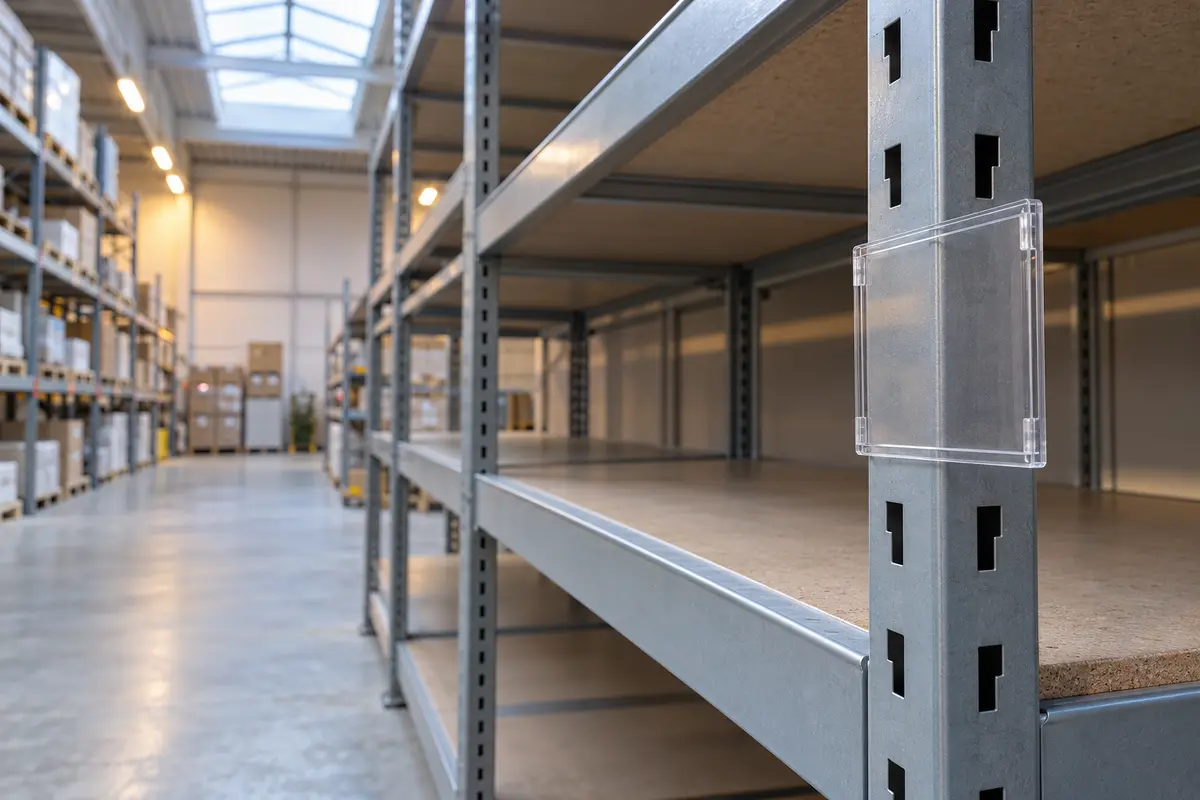
You must not use unlabelled racking based on your own estimate of its load capacity. Under point 10.2 of the annex to nařízení vlády č. 101/2005 Sb., o podrobnějších požadavcích na pracoviště a pracovní prostředí, racks must be permanently marked with plates stating the maximum load capacity of a bay and the maximum number of bays in a column. The dimensions and types of load units, as well as the way they are placed in the rack, must also comply with the rack’s accompanying documentation (e-Sbírka — Nařízení vlády č. 101/2005 Sb.). If this information is missing, there is no lawful basis for saying, “It should probably hold about 400 kilos.” Either obtain the information from the manufacturer’s documents or take the rack out of service until it has been assessed by a competent person.
What information must be displayed on the rack
The requirement does not establish general rules for “any shelving”; it specifies the labelling required under part 10, point 10.2 of the annex to nařízení vlády č. 101/2005 Sb. The rack must carry permanent markings showing two figures:
- Maximum load capacity of a bay — the maximum weight that may be stored in a single bay or shelf in the particular configuration.
- Maximum number of bays in a column — the number of levels that may be safely arranged one above another in that configuration.
The same point adds two conditions governing storage: the dimensions and types of load units, such as pallets and crates, and the method used to place them in the rack must comply with the rack’s accompanying documentation, while materials must be stored so that they cannot slip or collapse during either loading or removal. Under § 3 odst. 3 písm. d) of the same regulation, workplace equipment must be securely fixed against unintended movement before it is put into service. SÚIP expressly concludes from this that racks must also be secured against movement. Under § 3 odst. 4 písm. a), the employer determines the timing and scope of rack inspections with regard to the rack’s design, the manufacturer’s recommendations and the way it is used. After an alteration—adding levels, changing heights or spans, or using the components in a different arrangement—you must therefore verify that the documentation covers the new configuration and that the information on the plate is still correct. An alteration does not automatically invalidate the plate: what matters is documented compliance of the specific assembly, not merely the type of profile used.
Decision process when the plate is missing
The following procedure is my practical step-by-step guide to resolving the situation. It is not a list of statutory duties but a recommended sequence that separates the search for reliable information from any further loading:
- Stop loading the affected rack. Do not move goods unnecessarily, but do not add any new loads until the relevant figures are known. Workers will usually have no way of recognising that this particular rack is uncertain.
- Try to find the manufacturer’s documents. Look for an asset number, purchase order, invoice, project documentation from a reinstallation, previous inspection reports or instructions supplied by the vendor. SÚIP states that warehouse rack inspections rely on manufacturer documentation, the appointment of a responsible person and documented inspections (SÚIP — Storage and racking in the workplace).
- If you find the documents, verify that they match the actual assembly. Documentation for a five-level rack tells you nothing about your six-level rack. The entire configuration must match, including the number of bays, spans, anchoring and, where applicable, the arrangement of beams.
- If you cannot find the documents, contact the manufacturer or distributor. They may be able to retrieve the necessary information from production records or type-test documentation and provide the correct labelling.
- If the manufacturer cannot substantiate the information either—for example, because the rack is of unknown origin, the manufacturer no longer exists or the documentation is unavailable—take the rack out of service. Ask a warehouse racking specialist to determine the next steps. Do not load the rack again without documented figures for the actual assembly. If these cannot be obtained, the rack may need to be replaced. The cited legislation does not prescribe a universal qualification such as a “machinery conformity assessor” for this situation.
- Return the rack to service only after it has been permanently relabelled and the storage method has been documented.
Table: what information you have and what follows from it
| Situation | What to do | Can the rack be used? |
|---|---|---|
| The plate is present and the configuration matches the documentation | Check that loading complies with the figures on the plate | Yes, provided all other safe-use conditions are also met |
| The plate is present, but the rack has been altered | Verify that both the documentation and the marked figures cover the new assembly | Only after compliance has been confirmed; stop adding loads while the figures remain unverified |
| The plate is missing, but the manufacturer’s documents exist | Obtain the figures from the documents and restore the plate for the corresponding configuration | Yes, after the information has been added |
| The plate is missing, but the manufacturer can be identified | Contact the manufacturer and provide the rack’s identification details | Yes, after the information has been added |
| The plate is missing, the origin is unknown and no documentation exists | Have the rack assessed by a competent person or take it out of service | Only after assessment |
| The plate was copied from another rack of the same type without checking the documents | Insufficient—the figures must apply to the specific rack and configuration | No |
The table highlights one point worth stressing: neither another rack’s plate nor an estimate is an acceptable solution. Copying the labelling from the same rack type in a different configuration produces figures unsupported by documentation for the specific unit, defeating the entire purpose of the label (e-Sbírka — Nařízení vlády č. 101/2005 Sb.).
Example: an altered rack in a spare-parts warehouse
Imagine a spare-parts warehouse where, during a reorganisation, the operations supervisor dismantled two shorter rack assemblies and used their components to build one taller unit with six levels instead of the original four. The plate showing the bay load capacity remained attached to an end frame.
The approach that failed. The supervisor tried to carry the figures over: the original bays had a load capacity of 350 kg, so the new assembly would “definitely be fine too” because it used the same uprights and beams. That conclusion did not hold. The bay load capacity and the number of bays in a column apply to a verified configuration. Adding two levels created a different rack for which no figures had been issued. The warehouse manager discovered the problem during a walk-through after noticing that the upper shelves were visibly deflecting more under the goods than those elsewhere in the warehouse, and stopped further loading.
The solution. The company contacted the distributor from which it had bought the racks several years earlier. Using the profile identification and the original order, the distributor retrieved the production documentation and established two facts. First, the documentation contained no permitted maximum bay load for a six-level assembly with that span because this configuration was not among the documented arrangements. Second, the maximum number of bays in a column for the purchased system was five. The rack was therefore rebuilt as a five-level assembly with a load capacity documented by the manufacturer.
Verification of the outcome. After the alteration, the distributor added a new permanent plate with figures matching the actual assembly and attached an extract from the documentation, including a table of permitted configurations, to an email. The company entered three details in its records: (1) the new plate and its location, (2) the configuration to which the figures applied, including the number of bays, and (3) the fact that no figures existed for a six-level assembly, meaning that such an arrangement must never be introduced unnoticed in the future. This closed the loop—but only for this rack and this configuration. Nothing from this example can be generalised to other racks, other spans or other warehouses.
Floor load capacity is a different figure
Two different figures are easily confused. The load capacity of a rack bay and the load capacity of the warehouse floor are separate requirements. Point 10.1 of the annex to the regulation requires warehouses to display signs in clearly visible locations stating the maximum permissible floor load. It also requires employers not to load parts of a building beyond their proven load capacity, which is determined by the building structure rather than the racking system (e-Sbírka — Nařízení vlády č. 101/2005 Sb.). A rack can have correctly labelled bays and still overload the floor—for example, where the warehouse is located on a suspended floor with a lower permissible load. The floor capacity can be found in the building’s project documentation or obtained from the building manager, and it is not replaced by the rack’s load-capacity plate.
Manual storage at height and aisles
Point 10.1 of the annex to NV č. 101/2005 Sb. further states that manual storage in racks at heights above 1.8 m must be carried out from safe work equipment, such as a ladder, stepladder, mobile access stairway or work platform—not by climbing on the beams. The article ladder before use: what to check explains what to inspect before using a ladder. Under point 10.3, the aisle between racks must remain permanently unobstructed and, where materials-handling vehicles use it, must be at least 0.4 m wider than the maximum width of the vehicle or its load.
Practical recommendations versus legal duties
To make the distinction clear:
- The legal duty is to mark the rack permanently with a plate stating the maximum load capacity of a bay and the maximum number of bays in a column, and to store goods in accordance with the rack documentation. This follows from nařízení vlády č. 101/2005 Sb. and does not depend on my recommendations (e-Sbírka — Nařízení vlády č. 101/2005 Sb.).
- My recommendation is to keep a simple record of rack assemblies: the rack’s identification, its configuration, a reference to the documentation, a photograph of the plate and the date on which the information was added. The legislation does not expressly require such a record, but it can save days of searching after an alteration or during an inspection. In this context, SÚIP highlights the role of the responsible person and the documentation of warehouse rack inspections (SÚIP — Storage and racking in the workplace).
- I also recommend keeping a list of prohibited configurations—assemblies that are not permitted by the documentation. A formalised prohibition works better than relying on employees’ memories.
A brief service note
If you need help organising safe procedures and follow-up warehouse inspections, arrange occupational safety support for businesses from SOHE. Any specialist determination of the load capacity of a particular structure is a separate matter and is not an outcome of a routine occupational safety inspection.
Frequently asked questions
Does every rack need a plate, or is one plate per assembly sufficient?
The legislation requires racks to be permanently marked with the maximum load capacity of a bay and the maximum number of bays in a column. In practice, it is sensible to label every free-standing assembly so that the figures for the rack in question are immediately visible. Choose the exact location in accordance with the documentation and workplace layout.
What if the manufacturer no longer exists, but the rack looks sturdy?
Appearance is not a valid basis for specifying load capacity. Without documentation and an identifiable manufacturer, the rack must be assessed by a competent person or kept out of service. An estimate based on the rack “looking strong” is unsupported.
Can I use the plate from an adjacent rack of the same type?
If the configuration is genuinely identical and covered by the same manufacturer documentation, the figures may be transferred on the basis of those supplied documents. If the assemblies differ in their number of bays, spans or anchoring, first verify that the documentation also covers that variant. Do not transfer the figures without such evidence.
Does the plate also cover the floor load capacity?
No. Floor load capacity is a separate figure governed by point 10.1 of the annex to nařízení vlády č. 101/2005 Sb., while rack labelling is governed by point 10.2. Both figures must be correct, but neither replaces the other.
Who is responsible for ensuring that the rack is labelled?
The employer is responsible for workplace conditions through designated responsible persons. SÚIP highlights this arrangement in connection with warehouse rack inspections. The particular person appointed under your internal rules is an organisational decision, but that appointment does not remove the labelling requirement itself.
Sources and scope
- SÚIP — Storage and racking in the workplace (https://suip.gov.cz/vsechny-clanky/-/asset_publisher/BwIpyjT9IXe0/content/skladovani-a-regaly-na-pracovisti) — description of manufacturer documentation, responsible persons and warehouse rack inspection records.
- e-Sbírka — Nařízení vlády č. 101/2005 Sb., o podrobnějších požadavcích na pracoviště a pracovní prostředí (https://e-sbirka.gov.cz/sb/2005/101) — annex, points 10.1 to 10.3: floor load capacity, manual storage above 1.8 m, rack labelling, storage in accordance with documentation and aisles; § 3 odst. 3 písm. d) and odst. 4 písm. a).
Sources verified on 7 October 2026. This text reflects the law in force on the verification date; it does not guarantee that the legislation will remain unchanged, establish the suitability of any specific equipment or constitute instructions for work on machinery, electrical installations or fire-safety systems. For new or disputed claims, the current wording of the legislation—not this article—is authoritative.