
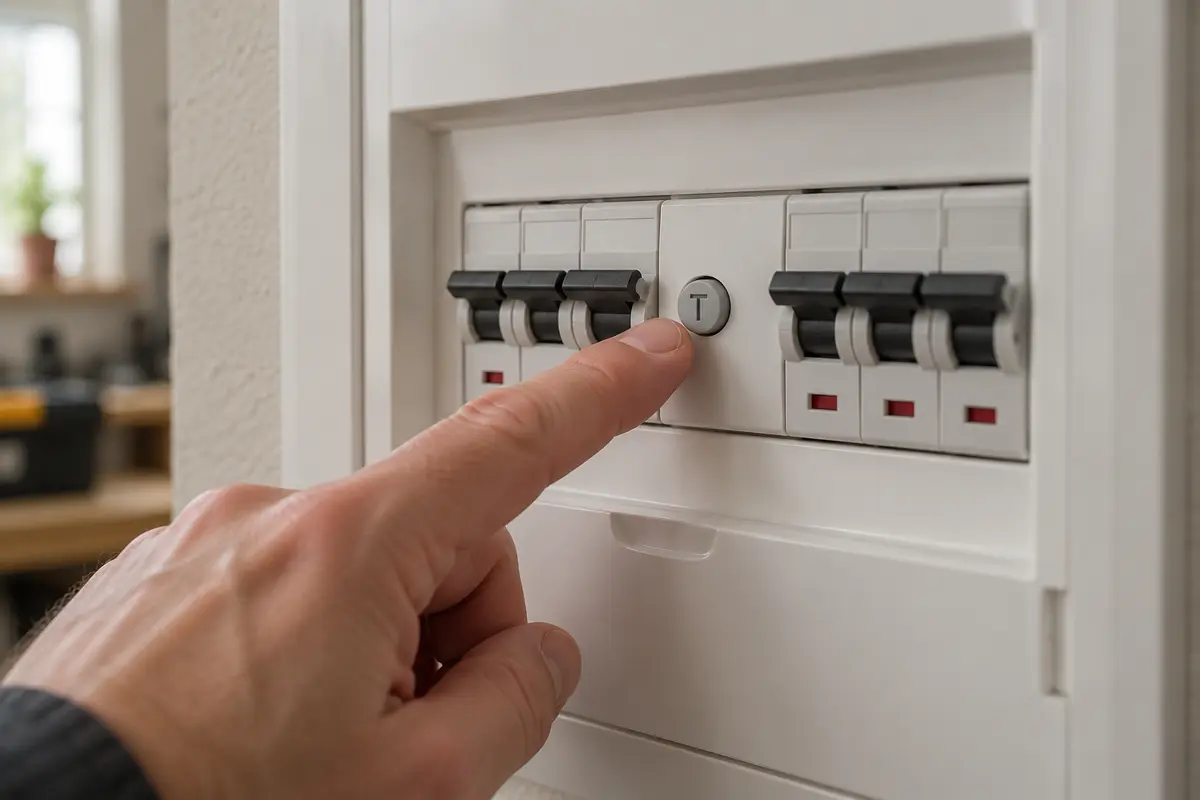
The T or Test button on a residual current device (RCD) checks its response during a user test performed in accordance with the manufacturer’s instructions. It does not replace an electrical inspection or measurements of tripping parameters. Before pressing it, arrange for the protected circuits to be disconnected safely. If the result is unexpected, do not attempt further work inside the distribution board; report the situation to a qualified electrician.
This procedure is intended for someone responsible for organizing a routine check of an accessible control in a workplace. It does not authorize anyone to remove a cover, alter wiring, or test unfamiliar equipment. The documentation for the specific RCD and local operating procedures take precedence. If you cannot safely determine what the device will disconnect, have a qualified professional clarify this first.
Tripping the device does not prove that all circuits are safe
In its answer to a frequently asked question, ABB describes pressing the T/Test button: a functioning RCD should trip and disconnect the protected circuit, after which its lever is reset. ABB also recommends testing RCBOs and AFDD arc-fault protection devices in the same way. According to ABB, an RCD in a typical domestic installation must trip at a residual current of 30 mA. However, the button’s response only provides information about this test of the specific device, not about every socket or the entire installation.
The button’s response alone does not reveal the actual tripping time, all protection parameters, or a fault that did not manifest during the test. Do not try to bridge this gap with your own experiment involving a conductor, socket, or human contact. A professional assessment requires the appropriate procedures and measuring equipment.
Nařízení vlády č. 190/2022 Sb. stipulates in § 7 odst. 3 that an inspection and test must be carried out during the electrical inspection of designated electrical equipment to the extent specified in příloha č. 1, unless the manufacturer has set different or additional requirements. An item that is not technically feasible for the specific equipment, or is not justified for verifying safety, does not have to be performed. Testing under část B of the annex includes measurements such as automatic disconnection of the power supply, while RCDs are tested by activating the test control if they have one, by the method prescribed by the manufacturer, or by a procedure under technical regulations, technical documents and technical standards. Pressing the button is therefore only one part of an electrical inspection, not a substitute for it. § 10 specifies the contents of the inspection report, including its scope, a list of measuring instruments, the operations performed, measured values, and the conclusion. A note stating “T tripped” is not such a report.
Before the test, determine who and what will be disconnected
Start with the device, not a calendar reminder. Identify its markings from the outside and consult the instructions. If there are several RCDs, it must be clear which one you are going to test. The similar appearance of an adjacent module or a colleague’s recollection that “this is probably the office” is not sufficient.
Prepare a list of the activities that will be affected. In an ordinary office, these may include computers, the network, and unsaved work. In an industrial or commercial environment, other equipment may have its own shutdown and start-up procedure. This article does not specify how to shut down machinery or other technology. The responsible person must select a procedure appropriate to the actual equipment and its documentation.
Agree on a time when interrupting the power supply will not create another hazard. Inform the affected employees and ensure that work is saved as appropriate for the operation. For equipment requiring continuous or safety-critical power, do not schedule a test simply because the button is easy to reach. The consequences of an outage must be addressed first.
Backup power may also allow equipment to continue operating after the RCD trips. A monitor that remains on is therefore not reliable proof that the RCD failed to disconnect the supply. Any unclear relationship between circuits and backup sources should be investigated by the appropriate qualified person, not by repeatedly pressing devices at random.
Safe procedure for a user test
- Confirm that you have identified the correct device and an accessible button intended for user testing. Do not remove a protective cover or seal.
- Confirm the agreed shutdown conditions. Do not begin the test if someone is still using the affected equipment or if the operational consequences have not been addressed.
- Perform the test as described in the instructions. Observe the response of the device and the predetermined protected circuit, not a random appliance in another room. ABB recommends leaving appliances plugged into sockets on the tested circuit so that the disconnection is clearly visible, such as a lamp or night light.
- If the result is as expected, restore the system in accordance with the instructions and local procedure. Check the necessary equipment; resetting the lever alone does not prove that the entire operation has been restored.
- Record the result in an appropriate local log. If there is a discrepancy, describe what you actually observed rather than offering your own diagnosis.
Do not connect improvised loads for demonstration purposes, other than an ordinary appliance, and do not attempt to bypass the protection so that work can continue. This procedure does not replace the documentation for the specific model. If you do not understand the instructions or the device does not behave as expected, leave further checks to a qualified professional.
| Observation | Safe next decision |
|---|---|
| The RCD responded and the affected operation was restored as planned | Record this test; do not confuse it with an inspection of the entire installation. |
| The lever responded, but it is unclear which circuit was disconnected | Do not confirm the result for an unidentified circuit. Have the actual circuit relationship clarified. |
| The device did not respond during a properly prepared test | Treat the result as requiring professional attention; do not open the distribution board or bypass the protection. |
| The power supply cannot be restored safely, or the device trips again after resetting | Do not continue forcing it back on repeatedly. Address the situation with an electrician in accordance with the local safety procedure. |
The table is a practical decision guide, not a diagnosis of the cause. Failure to trip may require the test conditions and the device to be checked. ABB states that a device which fails to trip must be replaced, but assessment of the specific situation and any intervention must be left to a qualified person.
Take the interval from the documentation, not from a neighbour
ABB recommends testing its devices every six months, while also noting that the frequency varies by manufacturer and ranges from one to six months. Do not automatically apply the six-month interval to every RCD in the company; some products may require more frequent testing. Special designs may also use a different testing method. For example, ABB offers RCDs with automatic testing that do not disconnect connected appliances during the test.
If the instructions are missing, locate them using the exact device model or ask a qualified person to supply them. Until the matter has been clarified, do not draft a universal company policy based solely on a general article. The manufacturer’s instructions and local operating conditions contain specific requirements that a general web article cannot replace.
Include tests in a register that identifies the specific device, the responsible person, and the prescribed procedure. This is a recommendation for organizing work clearly. We are not claiming that every workplace must use this particular form or that completing a register alone fulfils every obligation.
Example scenario: the button behaves differently than expected
This is an illustrative scenario, not a customer case study. The manager of a small office schedules a test of an RCD labelled as protecting the office socket circuits. The employees save their work, but the manager does not clarify in advance which part of the power supply has backup protection. Some equipment continues operating after the device trips. The manager wants to record that the RCD failed to disconnect the supply.
There is not yet enough evidence for that conclusion. The manager observed the device respond and saw equipment continue running, but did not verify the relationship between them. The test should not be extended by randomly switching off other parts of the installation. Instead, the manager should record what actually happened and arrange for the labelling and power-supply relationships to be checked professionally.
In this example, the unsuccessful branch does not automatically mean that the RCD is faulty. The problem is that the verification of the result was not properly prepared. Once the situation has been clarified, a new test can be scheduled under unambiguous conditions if it is appropriate according to the documentation and professional assessment. If unexpected behaviour of the device itself is confirmed, the professional should address the equipment, not merely the wording used in a form.
What to give the electrician and what counts as complete
Provide the device identification, location, test time, source documents used, and an exact description of what you observed. Also state any operational constraints and anything that remains unknown. A photograph of the accessible front panel may help with identification, but it must not become a reason to remove a cover or enter a hazardous area.
After professional attention, obtain an explanation of the result and the appropriate documentation for the work performed. Distinguish between restoring the ability to perform the user test, confirming that a specific fault has been corrected, and carrying out an electrical inspection. These outcomes are not interchangeable. The required scope will be determined by a professional according to the equipment and the work actually performed. The article on how an electrical installation inspection is carried out in a company explains what an inspection technician actually does and what they need from the company.
User checks, documentation, and professional verification of the installation can be coordinated when requesting an electrical inspection from SOHE. Prepare a list of the equipment and operational constraints so that an appropriate scope can be agreed.
Frequently asked questions
Does tripping with the button mean that the entire installation is compliant?
No. It confirms the response during a specific user test; it does not provide an inspection conclusion for the entire installation.
Does the six-month interval apply to every RCD?
No. Six months is ABB’s recommendation; according to ABB, manufacturers specify intervals ranging from one to six months. Check the documentation for the specific device.
If the device fails to trip, may I open the distribution board and look for the cause?
Not under this user procedure. Any intervention requires the necessary professional qualifications and safe working conditions.
Why does the monitor remain on after the RCD trips?
It may, for example, be powered by a backup source or another circuit. This observation alone does not establish the cause; the actual power-supply relationship must be verified.
Is a record of the button test sufficient instead of an inspection report?
No. An inspection report has a professional scope and contents specified by § 10 NV 190/2022 Sb.; a user test record does not replace it.
Sources and scope
- ABB — How to test an RCD: test-button response and differences between manufacturers’ intervals.
- e-Sbírka — Nařízení vlády č. 190/2022 Sb.: § 7 odst. 3, příloha č. 1, and the inspection report contents under § 10.
Sources verified on 7 October 2026. The text distinguishes source requirements from our own practical recommendations; it does not replace the instructions for a specific device or a professional assessment of the installation.