
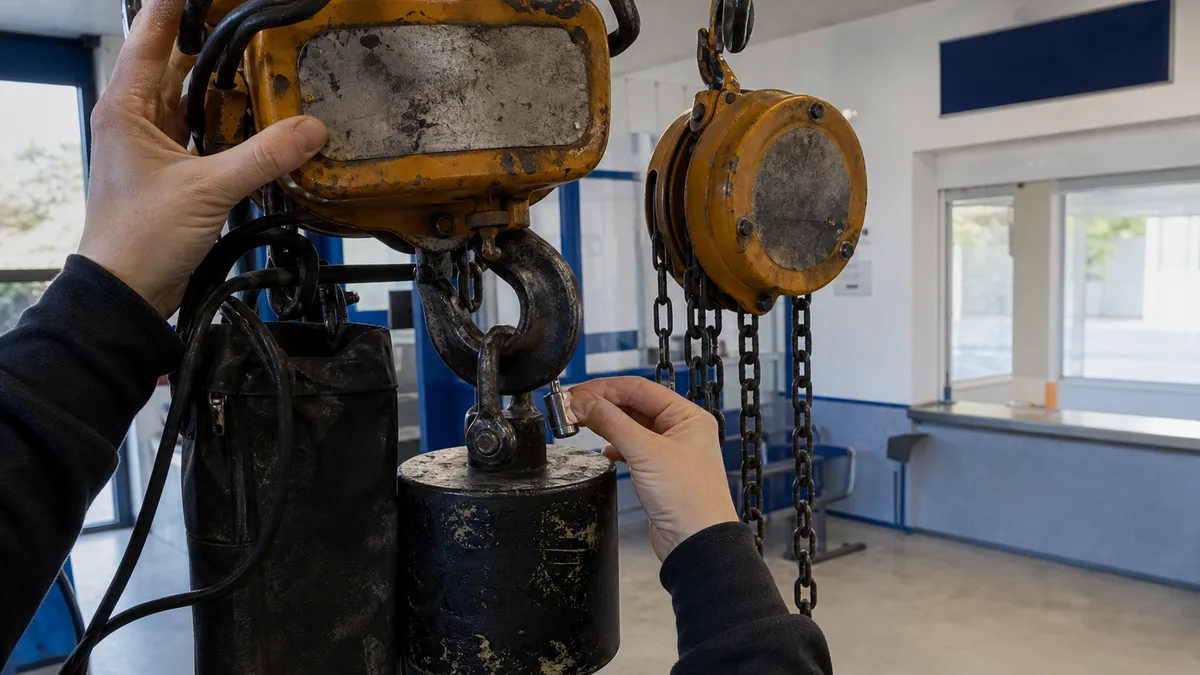
A two-tonne powered chain hoist hangs in the workshop, a forklift stands by the loading bay, a two-post vehicle lift sits in the garage, and once a year someone hires a scissor lift to replace the lights. When inspections come up, suppliers receive a one-line request: “We need inspections for all our lifting equipment.” Three quotations come back, differing by tens of percent, and none makes clear what is included in the price. Yet the question that untangles the issue is not how much the work costs, but which of these machines is actually designated lifting equipment.
Several mutually contradictory claims circulate about lifting equipment: that anything capable of lifting a load is designated equipment; that a forklift is inspected like a crane; or that regular servicing by a supplier, followed by a maintenance report, settles the matter. The legislation draws the boundaries differently. The distinction affects not the servicing price but who may sign the report and what the report must demonstrate.
We will examine what nařízení vlády č. 193/2022 Sb. classifies as designated lifting equipment and which parameters determine that classification, why a single kilogram can make the difference, what is excluded and which rules apply instead, how an examination, inspection, thorough inspection and test differ, who may perform them, and what information you need to prepare before quotations can meaningfully be compared.
The parameter on the nameplate matters, not the word “lift”
One facility may contain four machines that all lift something, yet each may be subject to a different regime. Designated lifting equipment is defined by nařízení vlády č. 193/2022 Sb. Such equipment must be assigned to a class and undergo the prescribed examinations, inspections, thorough inspections and tests, while specialist work on it cannot be carried out by just any service technician. Equipment that falls outside the list is not exempt from obligations; instead, it is governed by the general rules for the safe operation of work equipment under nařízení vlády č. 378/2001 Sb. and by the manufacturer’s requirements.
You can complete the initial classification at your desk with the manufacturer’s nameplate and manual in front of you. Look for four details: the type of drive, rated capacity, lifting height and design. None of these is a matter of opinion.
What qualifies as designated lifting equipment
In summary, the following applies; the list in the regulation is authoritative:
| Equipment | When it qualifies as designated lifting equipment |
|---|---|
| A powered crane, lifting appliance or mobile lifting appliance, including a chain hoist | rated capacity exceeds 1,000 kg |
| The same equipment with manual drive | rated capacity exceeds 5,000 kg |
| A powered work platform | lifting height exceeds 1.5 m; the list also includes mobile, suspended and mast-climbing work platforms |
| A lift that forms a permanent part of a building | capacity exceeds 100 kg and lifting height exceeds 2 m |
| A construction hoist | intended to carry people and loads |
| A storage and retrieval machine | has a vertically moving operator station, including its transfer equipment |
For a storage and retrieval machine, the commercial product name is not enough. What matters is whether the operator station moves vertically. A fully automated storage and retrieval machine with no operator riding on it is not covered under this item, and its design must be assessed separately.
For work platforms, the catalogue sheet is the most common source of confusion. Manufacturers and hire companies routinely advertise the working height, meaning the operator’s reach. By convention, this is approximately two metres higher than the lifting height or platform floor height. A platform advertised with a working height of 3.5 m may therefore be close to the 1.5 m lifting-height threshold, not far above it. Look for the decisive figure in the manual and on the nameplate of the specific version, not in a brochure covering the entire model range.
“Exceeds” does not mean “from”. One kilogram makes the difference
The thresholds in the regulation are not expressed as “from” or “at least”. The legislation uses the word exceeds, which has a significant practical effect because common hoist capacities follow the standardised series of 500, 1,000, 1,600, 2,000, 3,200 and 5,000 kg. Three of these figures — 1,000, 3,200 and 5,000 kg — fall exactly on thresholds used by the regulation. They sit on the boundary, not beyond it.
A powered hoist with a capacity of exactly 1,000 kg therefore does not cross the threshold on the basis of this parameter. A machine rated for 1,250 kg does. The same logic applies to 5,000 kg for manual lifting appliances, 1.5 m for work platforms and both limits applicable to lifts. If you record the capacity as “about one tonne”, you discard the very information on which the entire classification depends.
The second point is that the equipment’s rated parameter is decisive, not the weight of the loads you normally lift. A hoist rated for 2,000 kg does not cease to be designated equipment merely because it has only lifted crates weighing up to 500 kg for years.
What is not designated lifting equipment — and which rules apply instead
The regulation also contains an explicit list of exclusions. Under that list, designated lifting equipment does not include, for example:
- lift trucks, handling trucks, powered industrial trucks and rough-terrain trucks, including ordinary forklifts,
- platforms and equipment for lifting vehicles,
- stairlifts and inclined lifting platforms,
- loaders and multifunctional lifting equipment,
- tail lifts on goods vehicles,
- mechanical ramps, extending ladders and winches,
- equipment used to sling, suspend and grip loads, unless it is a permanent part of the lifting equipment.
Capacity alone is not decisive here. A two-post lift in a vehicle repair shop remains outside the list even if it lifts a car weighing several tonnes. The entire category is excluded, not merely machines below a particular limit.
Exclusion from the list does not mean operation without inspections. Under § 4 odst. 2 nařízení vlády č. 378/2001 Sb., work equipment must undergo a subsequent inspection at least once every 12 months, within the scope specified by the local operational safety rules, unless special legislation, accompanying documentation or applicable standards specify a different scope or frequency. For forklifts and vehicle lifts, this is the usual starting point for the schedule, and the manufacturer’s instructions often require shorter intervals. We examine this regime in more detail in our article on inspections of machinery and technical equipment under NV 378/2001 Sb.
Lifting accessories — chains, textile slings, hooks and spreader beams — are not exempt from obligations either. Their examinations are governed by the same general regime and the manufacturer’s instructions. For textile slings, a visual check before use is standard practice because a severed fibre or abraded cover cannot be identified reliably from a metre away.
Class I and Class II: classification determines the contractor, not the interval
Designated lifting equipment is further divided into two classes, as specified by § 4 nařízení vlády č. 193/2022 Sb. The dividing line is based on the type of equipment, type of drive and rated parameters — not on how frequently or heavily the machine is used.
Class I includes:
- powered cranes and lifting appliances with a capacity exceeding 3,200 kg,
- manually operated cranes and lifting appliances with a capacity exceeding 5,000 kg,
- construction hoists for carrying people and loads,
- storage and retrieval machines with a vertically moving operator station, including their transfer equipment.
Class II includes:
- powered cranes and lifting appliances with a capacity exceeding 1,000 kg and up to 3,200 kg,
- lifts that form a permanent part of a building, with a capacity exceeding 100 kg and a lifting height exceeding 2 m,
- mobile elevating work platforms with a lifting height exceeding 1.5 m.
Verify the classification of each individual machine directly against § 4 of the regulation, not merely against a sentence in an article. The classification determines the authorisation required by the company you engage for a thorough inspection and the professional qualification required by the technician who attends the site.
What the class does not determine is the crane inspection interval. That is derived from the crane group, its design, operating load, environment and the manufacturer’s documentation. Class and group are two different concepts, yet they are routinely confused in requests for quotations.
Examination, inspection, thorough inspection and test — four different activities
These are not interchangeable names for the same task. They differ in scope, output and who may perform them.
| Activity | What it involves | Who normally performs it |
|---|---|---|
| Pre-use examination | visual examination and functional testing at the start of the shift, with an entry in the operating log | an operator holding valid authorisation |
| Inspection or routine examination | assessment of condition, wear and the operation of protective and safety features between thorough inspections | an authorised employee or service technician in accordance with the local operational safety rules |
| Thorough inspection | assessment of the equipment’s overall condition against its documentation and applicable legislation, resulting in a thorough inspection report | an inspection technician holding a certificate for the relevant equipment type and scope |
| Test | verification of load capacity and protective functions using a test load | a certified inspection technician, with a suitable test load and operational support provided |
Specific intervals are set out in the annex to nařízení vlády č. 193/2022 Sb. according to the type of equipment and, for cranes, the group to which the machine belongs. Simply copying the longest interval from the annex is not enough. Three factors commonly shorten it in practice:
- Manufacturer’s documentation. A shorter interval specified in the manual takes precedence over whatever you enter in your schedule. The manual therefore belongs in the equipment file, not forgotten in a drawer.
- Operation and environment. A storage and retrieval machine running three shifts, a platform in a freezer, a crane in a steelworks or a crane operating outdoors cannot follow the same cycle as a hoist used twice a month in a dry assembly hall.
- Work performed on the equipment. A substantial modification, relocation where a change in technical or functional characteristics cannot be ruled out, or repair following overloading, a collision or another exceptional event triggers an extraordinary test or a post-repair test under § 8 nařízení vlády č. 193/2022 Sb. This means specialist work is required before the next scheduled date. A dismantled crane or construction hoist may be returned to service after relocation only once it has been tested. However, this does not automatically start a new routine cycle: subsequent dates are determined by the specific activity performed, the intervals under the regulation, accompanying documentation and operating rules.
When preparing next year’s schedule, add each item of lifting equipment to the 2027 inspection schedule as a separate row with its serial number, rather than as a single entry reading “lifts, 4 units”.
Who may sign a thorough inspection report or test report
Two documents are involved, and they are routinely confused. A certificate is issued to an individual: it demonstrates that the inspection technician is professionally qualified for the relevant type and scope of equipment, and it is valid for five years. An authorisation is issued to a business: under § 7 zákona č. 250/2021 Sb., installation, repairs, thorough inspections and tests of designated technical equipment may be supplied only by a legal entity or self-employed individual holding an authorisation under § 8 and 9 of the same Act, which is valid for ten years. One document cannot replace the other. A certified technician working for a company that lacks authorisation for the relevant scope presents the same problem as an authorised company sending a technician without the required certificate.
Both certificates and authorisations are issued by the authorised organisation, which under zákon č. 250/2021 Sb. is Technická inspekce České republiky, and it maintains remotely accessible registers for both. You can therefore verify both documents yourself before signing an order. The fact that a supplier services hydraulic systems, replaces chains and issues a maintenance report does not in itself replace a thorough inspection report.
Review six points before placing an order:
- does the supplier hold authorisation under zákon č. 250/2021 Sb. for the activity you require — thorough inspections, tests, repairs or installation — and for your type of equipment,
- does the technician who will attend hold a valid certificate, and does its scope cover your type of equipment,
- does the quotation distinguish between an inspection, thorough inspection and test, or does it call everything an “inspection”,
- does it take the manufacturer’s documentation and actual operating conditions into account,
- who will provide the test load and arrange the operational shutdown,
- what will the deliverable be — a report precisely identifying the equipment, the defects found and the assessment result.
The statement “we inspect all lifting equipment” without specifying the scope of authorisation is not enough to select a supplier. It is grounds for a follow-up question.
What to prepare so that quotations can be compared
The price cannot be determined fairly from the number of machines alone. Inspecting a work platform involves a different scope of work from thoroughly inspecting an overhead travelling crane or conducting a test that requires a suitable load and an operational shutdown. Record the following for each item of equipment:
- manufacturer, model, serial number and year of manufacture,
- rated capacity and lifting height — stated numerically, not estimated,
- type of drive,
- date placed into service,
- manual and accompanying documentation,
- previous examination, inspection and test reports,
- records of repairs, relocations or parameter changes,
- number of shifts, environment and normal method of use.
A comparable quotation should then state which activities it includes and whether the price covers travel, document review, test loading and preparation of the reports. The lowest price without a description of scope often means a basic inspection where you expected a thorough inspection or test.
An older crane is not assessed against today’s design requirements
An overhead travelling crane from the 1980s is not assessed during a thorough inspection as if it had been manufactured this year. Under § 3 odst. 5 zákona č. 250/2021 Sb., until it is reconstructed, the condition of designated technical equipment placed into service under earlier legislation is assessed according to the legislation valid and effective when it was placed into service.
This does not exempt it from today’s operational obligations. Record-keeping, maintenance, examinations, inspections and specialist activities all continue to apply. The problem with older machines usually lies elsewhere: the date they were placed into service, their original documentation and records of subsequent modifications are often missing. Without them, it is difficult to determine which requirements should be used to assess their condition.
A practical approach for a small business
Do not start by placing an order. Start with an inventory: list every machine that lifts something, together with its type, capacity, lifting height and drive. Then divide the list into designated lifting equipment under nařízení vlády č. 193/2022 Sb. and other work equipment. Only after this classification can the necessary activities, responsible persons and deadlines be assigned.
The outcome of cooperation with an occupational health and safety provider should not be a folder full of generic policies, but a schedule showing, for each machine, who performs the pre-shift examination, who carries out the inspection, when the thorough inspection or test is due, and where the relevant document is stored. The scope of these activities must be based on actual operations, as explained in our article on occupational health and safety risk assessment in the workplace. If you do not feel confident classifying the equipment and preparing the schedule yourself, we can do it for you: we will review the nameplates and documentation on site, classify the equipment and provide a schedule of deadlines that you then only need to monitor.
Sources for this article
- Occupational health and safety for businesses – a service provided by SOHE.
- Inspections of machinery and technical equipment under NV 378/2001 Sb. – how subsequent inspections work for equipment that is not designated equipment.
- 2027 inspection schedule – deadlines for electrical equipment, lightning protection systems and occupational health and safety in one place.
- Occupational health and safety risk assessment in the workplace – the basis for determining the scope of inspections and measures in a specific operation.
- Zákon č. 250/2021 Sb. – occupational safety in connection with the operation of designated technical equipment; the framework for authorisations, certificates, the authorised organisation and the assessment of older equipment.
- Nařízení vlády č. 193/2022 Sb. – defines designated lifting equipment, its classes and the intervals for examinations, inspections, thorough inspections and tests.
- Nařízení vlády č. 378/2001 Sb. – detailed requirements for the safe operation and use of machinery and technical equipment, including subsequent inspections under § 4 odst. 2.
- ČSN 27 0142 and ČSN ISO 9927-1 – testing and inspection of cranes and lifting appliances in service (the standards are not freely available).
This text is provided for informational purposes and does not constitute a legal opinion. The specific regime for examinations, inspections, thorough inspections and tests of lifting equipment must be established according to actual operations, the manufacturer’s documentation, the operating environment and the risk assessment.
Do you need to classify your lifting equipment fleet into designated and other equipment and prepare a schedule that will also stand up to an inspectorate audit? Our occupational health and safety services for businesses begin with an equipment inventory based on nameplates and end with deadlines and assigned responsible persons. Email info@sohe.cz or send us a non-binding enquiry — we will get back to you with the scope and price.