
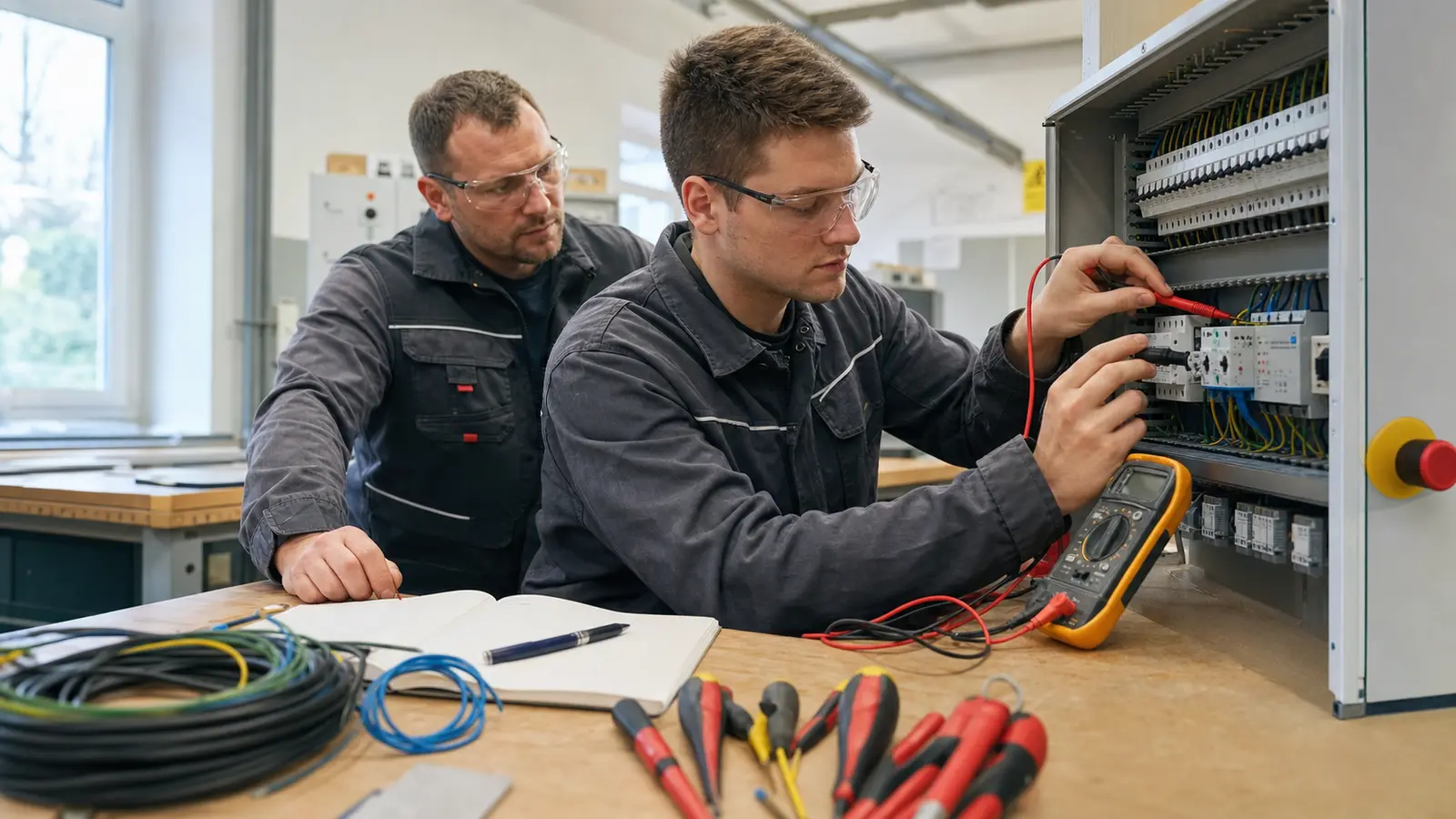
Decree 50 is still the most common phrase people use when searching for electrical qualifications. Legally, however, it has been invalid since 1 July 2022. It was replaced by Act No. 250/2021 Coll. and Government Regulation No. 194/2022 Coll., which work with professional competence under §4, §6, §7, and §8.
This article is a practical guide on how to obtain electrical paragraphs for the first time today: which education is recognised, when experience must be documented, how the exam works, and who issues the certificate. If you already have the qualification and are dealing with renewal, continue to the article on renewal and re-examination of electrical competence. If you first want to clarify the differences between the levels, the overview of professional competence in electrical engineering will help.
Quick Answer
Today, you do not obtain electrical paragraphs under Decree 50, but primarily under Act No. 250/2021 Coll. and GR No. 194/2022 Coll. The most common path to independent work is electrician under §6: the applicant must be over 18, have full legal capacity, and be medically fit, hold a recognised professional qualification, have experience set according to risks, complete training, and pass both the written and oral parts of the exam before a three-member committee. In each part, they need at least 80%. The certificate for §6 and §7 is valid for 3 years. A certified electrical inspector under §8 additionally requires a TIČR certificate valid for 5 years.
Under Which Law Paragraphs Are Now Obtained
The old Decree No. 50/1978 Coll. was repealed on 1 July 2022. Its famous “paragraphs” – everyone used to boast about having a “six” or an “eight” – disappeared along with it. Today, two regulations take centre stage:
- Act No. 250/2021 Coll., on occupational safety in connection with the operation of designated technical equipment (DTE) – this sets the personal prerequisites, the framework for exams, the intervals, and the obligations of employers and self-employed persons alike. In this article, we use the current wording effective from 1 November 2025.
- Government Regulation No. 194/2022 Coll. (as amended by No. 175/2024 Coll., effective from 1 July 2024) – this details specific requirements for professional competence, training, examinations, and individual levels.
For completeness: the scopes of electrical competence (E1A, E2B, etc. – i.e., voltage and environment type) are defined by a separate GR No. 190/2022 Coll. on designated electrical equipment. For example, inspections of lightning protection systems fall under scope E3A.
So, when someone says today, “I need electrical paragraphs,” they are actually talking about obtaining professional competence under §4, §6, §7, or §8 of GR 194/2022. Let’s introduce them.
Four Levels of Professional Competence
The current system recognises four levels of professional competence for work on electrical equipment. Each corresponds to a different level of responsibility:
- Instructed person (§4 GR 194/2022) – may independently operate electrical equipment and perform defined work; more demanding tasks only under the supervision of a knowledgeable person. They do not sit a formal exam under §9 before a committee, but must complete instruction and knowledge verification by a knowledgeable person.
- Electrician (§6 GR 194/2022) – independent work on electrical equipment. Must already pass an exam before a three-member committee.
- Senior electrician (§7 GR 194/2022) – additionally may manage activities, manage operations, and design designated electrical equipment, provided the design work is not subject to authorisation under other legislation.
- Certified electrical inspector (§8 GR 194/2022) – may perform inspections of designated electrical equipment within the scope of their valid certificate from TIČR.
No “I have a five, I have a six” – that was jargon from the repealed decree. Today, you are an electrician under §6, a senior electrician under §7, or a certified electrical inspector under §8. A detailed comparison of the competencies of individual levels can be found in our article on professional competence. Here, we move on – to how to reach the relevant level.
The Simplest Entry: Instructed Person (§4)
If someone does not have an electrical engineering education but needs to move around electrical equipment or work with it in a permitted regime, the path may lead through an instructed person under §4 GR 194/2022. This is not a formal exam under §9 before a three-member committee, but knowledge is verified.
How does it work? The employer provides training covering OHS regulations for work on electrical equipment, the sources and causes of risks, and first aid for electric shock. After training, an authorised knowledgeable person verifies the knowledge and draws up a signed record. For a “passed” assessment, at least 80% of correct answers is required.
The content and scope of instruction are determined by the employer. The interval for repetition is set by the record – but no longer than 3 years (according to §19(3)(b) of Act 250/2021). So, the training is repeated periodically.
This is the fastest path for a cleaner in a substation, a machinist operating equipment with an electrical part, or a temporary worker on a construction site. However, they cannot work independently on live electricity – for that, you already need an electrician.
Path to Electrician (§6) Step by Step
An electrician under §6 GR 194/2022 is the first level of a knowledgeable person for independent activity. However, the certificate is not a universal licence for any electrical work whatsoever. Its scope must correspond to the actual activities, voltage, and environment.
Step 1: Determine the required scope
First, clarify what the person is actually to do: installation, maintenance, repairs, measurement, or, for example, work on lightning protection. The scope is also determined by voltage and by whether it concerns objects without explosion hazard or with explosion hazard. The examination committee may limit the certificate according to the activities actually performed.
Step 2: Meet the personal prerequisites
According to §19 of Act No. 250/2021 Coll., an applicant for §6 or §7 must:
- be at least 18 years old,
- have full legal capacity,
- be medically fit for the activities performed.
Step 3: Document your professional qualification
A recognised route is in particular:
- Secondary or tertiary professional electrical education from the field group 26 – Electrical Engineering, Telecommunications, and Computer Technology.
- University education in the field of electrical engineering.
- Other education that substantively meets the requirements for electrical engineering education; if this is not evident from the document, confirmation from the school or the Ministry of Education may be needed.
- A duly obtained full professional qualification published in the National Qualifications Framework in the relevant field group.
Beware of offers labelled merely as a “Decree 50 retraining course”. A course is an educational process, not automatically a full professional qualification. Before enrolling, verify the exact qualification code, the final examination, and the document you will actually obtain. A mere certificate of course attendance does not satisfy the education requirement.
Only for §6 may the responsible person, after a risk assessment, also recognise a single professional qualification under §6(7) GR 194/2022. Such a document is limited to precisely defined activities, a voltage of no more than 1 kV AC or 1.5 kV DC, objects without explosion hazard, and a specific legal entity or self-employed person. For a senior electrician under §7, this exception is not sufficient.
Step 4: Determine experience and supervision
For an electrician under §6, there is no single fixed nationwide length of experience. The minimum experience is set by the responsible person in the local operational safety regulation according to education, intended activities, and assessed risks.
For a person without electrical engineering experience, this regulation must establish supervision by a knowledgeable person with at least two years of experience for a period of at least one year. However, the regulation does not explicitly stipulate that the entire year must always be completed before the exam. The specific procedure, permitted activities, and record of experience must therefore be set out in writing in advance by the responsible person and aligned with the conditions of the examination committee.
Step 5: Complete the training and prepare documents
The training must correspond to the actual scope of work. It includes in particular safety regulations, first aid for electric shock, work and technological procedures, the risks of specific equipment, and local operating instructions.
Before the exam, depending on the situation, you submit the original or a certified copy of the qualification document, proof of experience, and, where applicable, confirmation from the school or the Ministry of Education. For the limited route under §6(7), a written document from the responsible person is also required.
Step 6: Pass the written and oral parts
The exam consists of:
- a written test with at least ten questions,
- an oral interview focused on the test result, the professional subject matter, procedures, and risks.
The oral part can only be taken after a successful written test. In both the written and oral parts, the applicant must achieve at least 80% of correct answers. The exam takes place before a three-member committee; the chair of the committee is responsible for conducting it and for the correctness of the certificate.
Step 7: Check the issued certificate
The certificate is not issued automatically by the employer, nor by a self-employed person to themselves. It is issued by the chair of the examination committee on behalf of the legal entity or self-employed natural person with whom the exam is taken. It must correctly define the scope of professional competence. It is valid for three years.
The cost and length of preparation are not set by law. They vary according to the provider, the entry qualification, and the scope of the exam.
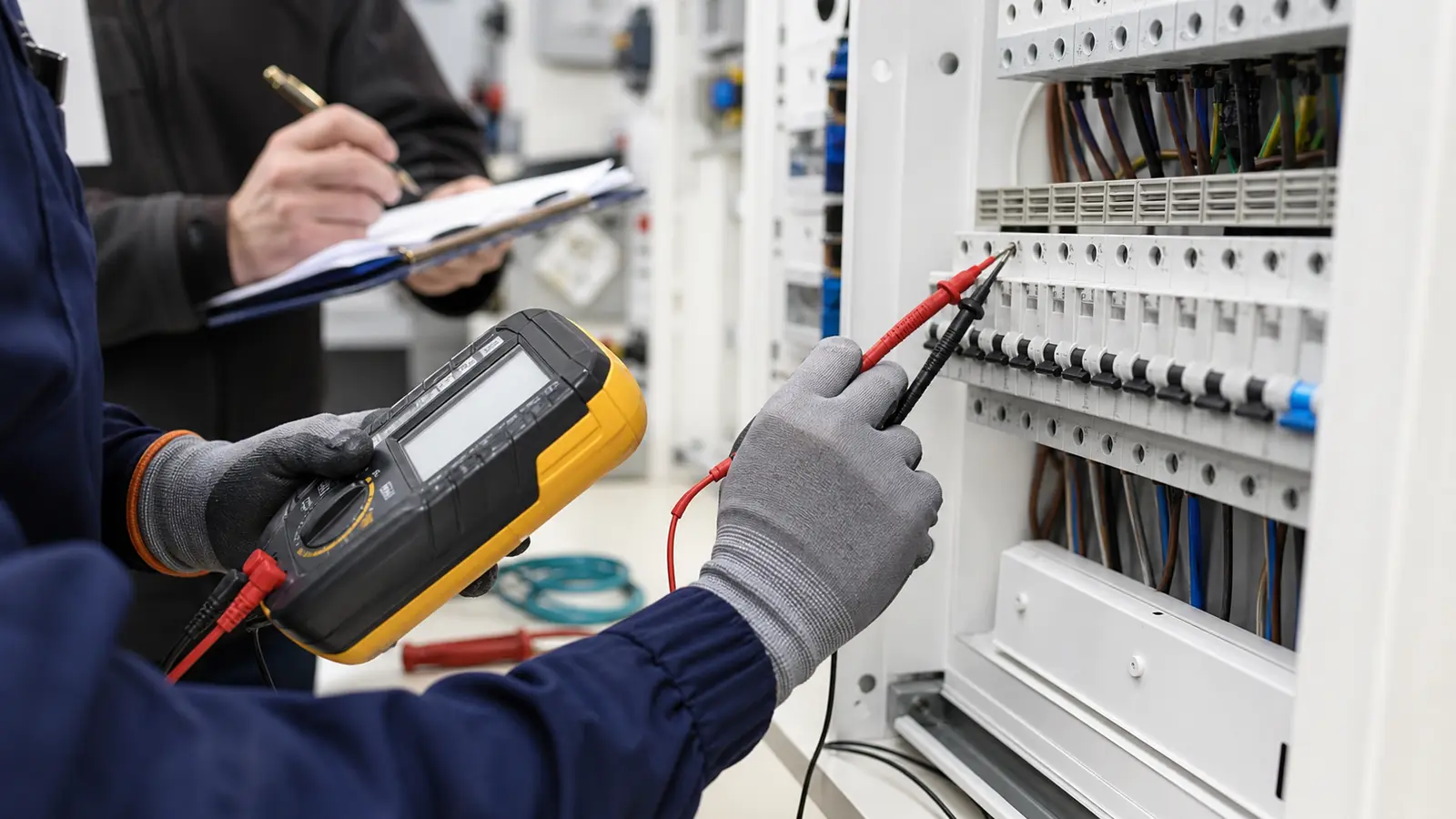
Senior Electrician (§7)
A senior electrician under §7 GR 194/2022 must have a professional qualification under §2(a), complete training, and successfully pass the exam under §9. The limited route based solely on a single professional qualification under §6(7) is not sufficient for §7. In addition, they need demonstrable experience, for which the regulation sets fixed minimum periods according to scope:
- 2 years for scopes E2A and E3A,
- 3 years for E1A, E2B, and E3B,
- 4 years for E1B.
Of this, at least 1 year must be on equipment of the relevant type and voltage. Before the exam, experience is documented by an employer’s confirmation or a sworn statement. It is advisable to state the period, job position, type of equipment, voltage range, activities performed, and environment A or B.
Prior holding of a §6 certificate is not stated in the text of §7 as a separate formal condition. However, the applicant must document corresponding professional experience gained in a legally permitted regime and meet all other conditions. In common practice, they usually gain it while working as an electrician under §6.
The certificate is issued by the chair of the examination committee and is valid for 3 years. A senior electrician may perform the activities of an electrician, manage activities, manage operations, and design designated electrical equipment only if the design work is not subject to authorisation under other legislation. Section 7 on its own does not authorise performing inspections of designated electrical equipment.
Certified Electrical Inspector (§8) – Top of the Pyramid
A certified electrical inspector under §8 GR 194/2022 is the highest. To become one, a person must first be a senior electrician (so education, the §9 exam, and experience according to the previous point). In addition, the law requires experience for a certified electrical inspector according to scope:
- for E1A and E2A: 4 years,
- for E3A: 2 years,
- for E1B and E2B: 4 years for type A and 1 year for type B,
- for E3B: 2 years for type A and 1 year for type B.
And then the main thing – they must obtain a valid inspection certificate. This is issued by TIČR (Technical Inspection of the Czech Republic) as an authorised organisation and is valid for 5 years. An inspection of designated electrical equipment may only be performed by a certified electrical inspector holding a valid certificate of the corresponding scope.
If your company needs inspections, see our electrical inspection service – we handle them completely.
Who Issues Your Paragraph
This is a practical detail where many people get lost. The answer depends on the level:
- Electrician (§6) and senior electrician (§7): The exam is arranged by the legal entity or self-employed natural person for the people who perform the relevant work for them. A self-employed person must arrange it for themselves. However, the exam always takes place before the relevant three-member committee, and the certificate is issued by the chair of the committee on behalf of the entity where the exam is held. A self-employed person cannot re-examine themselves without a committee, nor issue the certificate to themselves. The exam may take place in the company or at an external provider; the latter must have the provision of training and examination or knowledge verification within its scope of business.
- Certified electrical inspector (§8): The certificate is issued exclusively by TIČR. There, you really go “to the authority” – or rather, to the authorised organisation.
A clear obligation arises from this for the employer: according to §3 GR 194/2022, they must ensure that only professionally competent persons work on electrical equipment, and for persons under §4, §6, and §7, they must ensure periodic training – according to internal regulations, and if none exist, then at least once a year.
A Personal Certificate Is Not a Business Authorisation
A certificate of an electrician under §6 or a senior electrician under §7 confirms the professional competence of a specific individual. On its own, however, it does not authorise a company or a self-employed person to carry out, as a contractor, the installation, repair, inspection, or testing of designated electrical equipment.
For these activities, the business entity must hold the relevant authorisation under §7 to §9 of Act No. 250/2021 Coll. and §5 of GR No. 190/2022 Coll. Under the current law, this authorisation is valid for 10 years. For inspections, a personal certificate of a certified electrical inspector of the corresponding scope is additionally required. So these are three distinct things: the personal competence of the worker, the authorisation of the business entity, and, for inspections, also the certificate of the certified electrical inspector.
What About the Old Decree 50?
The old categories under Decree No. 50/1978 Coll. were transitionally converted to the corresponding new levels. For ordinary qualifications under its §5 to §8, however, the original decree required re-examination at least once every three years. The last such exam taken before the decree was repealed on 1 July 2022 could therefore, without subsequent re-examination, cover a period no longer than until 30 June 2025.
In July 2026, therefore, ordinary professional competence can no longer be maintained solely by an original document issued before 1 July 2022. A separate transitional regime under §24 of Act No. 250/2021 Coll. may apply to old certificates of certified electrical inspectors and to business authorisations. More about renewal can be found in our article on the validity of electrical competence.
And beware of “decree” retraining courses. Not every course leads to a full professional qualification recognisable under §2(a) GR 194/2022. What matters is the exact qualification code, the prescribed exams, and the resulting document, not the marketing name of the course. Even a duly obtained full professional qualification does not replace the exam under §9.
When It Makes Sense to Handle It Through SOHE
We most often help companies that need to quickly and verifiably get people into the correct regime: new maintenance workers, production with its own electrical maintenance, employees moving near switchboards, or self-employed persons who need to renew their certificate and align the scope with actual activity.
Before training, we will ask you for existing certificates, a description of the workplace, the scope of activities, and information on whether it will be an instructed person, electrician, or senior electrician. Based on that, we will propose preparation, the exam scope, and the documents you will need for inspection.
How SOHE Helps
At SOHE, we are technicians, not lawyers. We understand what electrical competence means in practice – from a screwdriver to an inspection report. For companies and individuals in Brno and nationwide, we provide:
- Training and exam preparation for all levels – from instructed person to senior electrician. Including first aid, including model tests.
- Instruction of persons under §4 – quickly, with a complete record and scope definition.
- In-company exams – we take care of the examination committee chaired by a certified electrical inspector.
- Inspections of electrical equipment – we have our own certified electrical inspectors for this.
See our employee training, or send a non-binding inquiry directly. We will get back to you and arrange a tailored solution.
Frequently Asked Questions
Do I need an electrical school to work as an electrician? Not necessarily. Besides a classic electrical secondary school or electrical faculty, you can also have another field that substantively meets the requirements for electrical engineering education, or a full professional qualification from the National Qualifications Framework (see the five routes under §2(a) GR 194/2022).
How many years of experience do I need to become an electrician? There is no single fixed period for §6. The exact length is determined by the responsible person in the local operational safety regulation according to risks. For a person without experience, it must establish at least one year of supervision by a knowledgeable person who has at least two years of experience. The regulation does not explicitly stipulate that the entire year must always precede the exam; the specific procedure therefore needs to be set out in writing in advance and aligned with the examination committee.
Where do I take the exam – at an authority? The exam for §6 and §7 is arranged by the employer, or a self-employed person must arrange it themselves, for example with a qualified external provider. It always takes place before a three-member committee, and the certificate is issued by its chair on behalf of the entity where the exam is held. The certified electrical inspector’s certificate is issued by TIČR.
Is a retraining “Decree 50 course” enough for me? Not automatically. A mere certificate of course completion is not enough. Verify whether the result will really be a full professional qualification in the relevant group of the National Qualifications Framework, what its code is, and which exams you must pass. You then take the exam under §9 GR 194/2022 separately.
What if I only have an old paper under Decree 50? For ordinary qualifications under §5 to §8, the old decree required re-examination at least once every three years. In 2026, therefore, an original document issued before 1 July 2022 is no longer sufficient on its own without subsequent re-examination. Old certificates of certified electrical inspectors and business authorisations may have a different transitional regime. Details can be found in our article on re-examination.
Is a personal §6 or §7 certificate enough for a self-employed person to take on electrical jobs? Not always. If a self-employed person or a company carries out, as a contractor, the installation, repair, inspection, or testing of designated electrical equipment, they need, in addition to the personal qualification of the workers, the relevant authorisation of the business entity. For inspections, a corresponding certified electrical inspector’s certificate is also required.
What the Article Is Based On
The legal status was verified as of 21 July 2026. We use GR No. 194/2022 Coll. and GR No. 190/2022 Coll. in the wording effective from 1 July 2024; Act No. 250/2021 Coll. in the wording effective from 1 November 2025.
- Education (§2), competence levels, instructed person (§4), electrician (§6), senior electrician (§7), certified electrical inspector (§8), training and exam (§9): Government Regulation No. 194/2022 Coll.
- Repeal of Decree 50/1978, validity of the knowledgeable person’s certificate (3 years, §19(2)), the certified electrical inspector’s certificate (5 years, §11(3)), repetition of instruction (§19(3)), and provision of exams by the employer (§19(4)): Act No. 250/2021 Coll.
- Designated electrical equipment and scopes E1A–E3B: Government Regulation No. 190/2022 Coll.
- Full professional qualifications and their exact requirements: National Qualifications Framework, for example Electrician 26-99-H/08
- Practical information from the state supervisory authority: SÚIP – professional competence in electrical engineering
- Public register of certified electrical inspectors and professionally competent persons: Technical Inspection of the Czech Republic
The article serves as a general practical overview, not as a binding legal opinion. The specific scope of activities, experience, supervision, and authorisation must always be assessed according to the workplace, equipment, and evaluated risks.
Are you dealing with how to obtain or supplement electrical qualifications in your company? We prepare your people from instructing persons to exams for electricians and also ensure inspections of designated equipment. We operate in Brno and nationwide.
- Employee training – instruction and exam preparation
- Electrical inspections – inspections of designated electrical equipment
- Non-binding inquiry
Write to info@sohe.cz or call +420 724 689 762.