
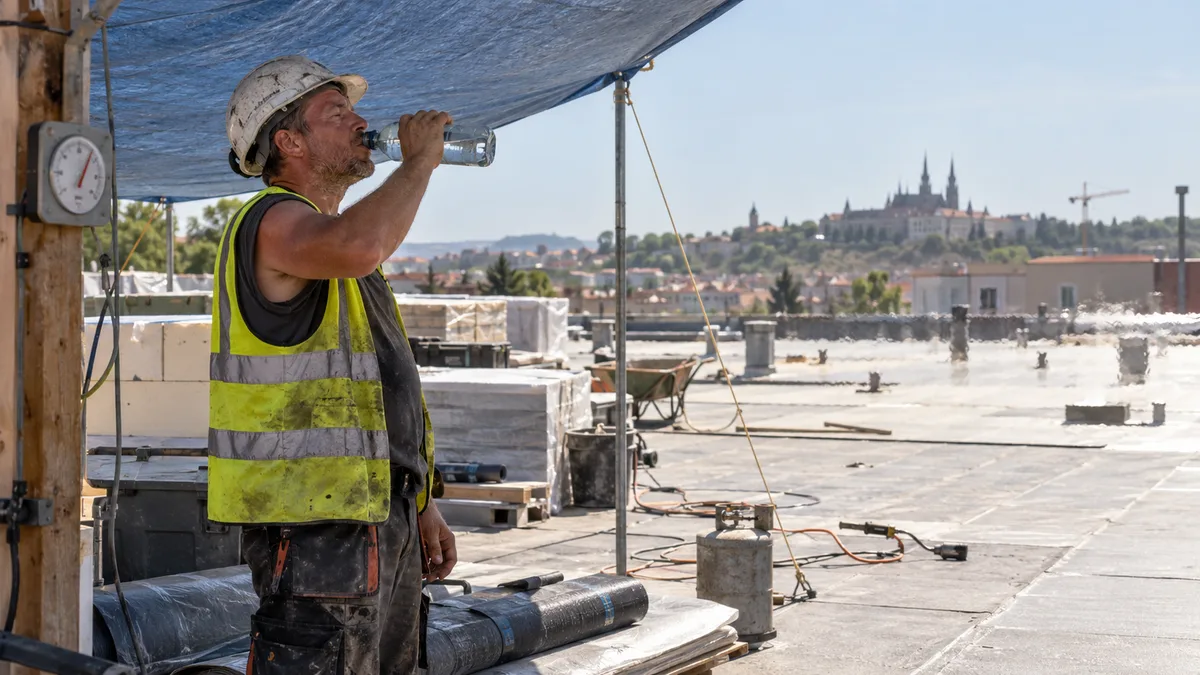
Two people work on the same summer day, but they do not face the same level of risk. An installer works on a scorching roof in protective clothing, a warehouse worker works near loading-bay doors with limited airflow, and a production-line operator cannot leave their station unless someone replaces them. The outdoor temperature alone does not capture these differences.
On 18 September 2026, the European Agency for Safety and Health at Work drew attention to a discussion paper on the unequal effects of climate change on workers. A Czech summary by the BHP portal was published on 23 September 2026.
According to EU-OSHA, climate change is already affecting occupational safety and health across the EU by increasing the number of accidents, causing adverse health effects and reducing productivity. The paper draws on specialist literature and data from the 2025 OSH Pulse survey.
Neither text introduces a new universal temperature limit or a special deadline for Czech companies to revise their documentation. The key question is different: does the current risk assessment reflect the actual tasks, shifts and ability of workers to respond when conditions deteriorate?
The Same Weather Does Not Mean the Same Occupational Risk
EU-OSHA goes beyond the general observation that higher temperatures can affect work. The paper examines inequalities based on workers’ gender, migration status, age, socioeconomic circumstances and occupational characteristics.
In practice, this means that a single “high temperature” entry covering an entire workplace may fail to capture important differences. The outcome is influenced by factors such as:
- the location and duration of exposure,
- the physical demands of the task,
- protective clothing and other personal protective equipment,
- the ability to pause, postpone or relocate the work,
- the time of day and shift organisation,
- the worker’s experience and the quality of supervision,
- the clarity of instructions and the ability to report problems.
This is not a new list of statutory employee categories. It is a practical filter for checking whether a broadly defined measure actually works for a particular job.
Which Workplaces to Assess First
It makes sense to start with workplaces where climatic conditions combine with another hazard or where workers cannot easily change their pace or place of work.
| Job or situation | What to examine during the assessment |
|---|---|
| Outdoor installation and construction work | Direct sunlight, physical exertion, access to shade and the option to change the order of tasks |
| Work on roofs or at height | Hot surfaces, glare, wind, wet conditions and their effects on safe movement |
| Hot indoor workplaces | Conditions directly next to the furnace, machine or process heat source, rather than only the temperature in the office |
| Warehousing and supply operations | Movement between indoor and outdoor environments, manual handling and access to breaks |
| Time-critical production | Whether the worker can be relieved, the pace adjusted or the hazardous task interrupted |
| New and young workers | Training, supervision and the ability to recognise deteriorating conditions in time |
| Agency and migrant workers | Whether training, instructions and procedures for reporting problems are easy to understand |
| Workers with greater health vulnerabilities | Whether measures can be adapted to the specific work and occupational health recommendations |
The table is not a universal risk assessment. A company can use it as a checklist, but the resulting measures should reflect the specific workplace and task.
Why One Sentence About Heat Is Not Enough
A rooftop installer faces solar radiation, physical exertion, protective clothing and the need to move safely at height at the same time. Strong winds or a wet surface will also change the risk of falling. For an employee in a production hall, the decisive factors may instead be radiant heat from the production process and an inability to leave an interconnected production line.
Conditions may also differ between morning and afternoon shifts. The same task may not proceed in the same way if one team can reschedule the work while another is constrained by an incoming delivery, line operations or the presence of other trades.
For outdoor work, climatic risks should therefore be considered alongside the rules for the specific activity. For roof work, this may include checking safe access, as discussed in Roof Access for Lightning Protection and Solar PV Inspections. On construction sites, the organisation of shared workplaces and the coordination of trades must also be assessed; a basic overview is provided in Construction Site OSH: Employer Obligations.
How to Review the Current Risk Assessment
There is no automatic need to create a separate “climate policy.” It is usually more useful to review the current risk assessment task by task.
-
Break the work down by location and activity. Labels such as “production” or “outdoor work” are too broad. Separate roof work, supply operations, loading, welding, warehousing and workstations near heat sources, for example.
-
Describe combined risks. Identify where heat, solar radiation, wind or poor air quality coincide with physical exertion, work at height, protective clothing or equipment operation.
-
Compare individual shifts. Determine whether they differ in temperature, exposure duration, staffing levels or the availability of relief workers.
-
Check whether measures are workable. A break is not a practical measure if the worker cannot leave their station or no replacement is available. The same applies to rescheduling work if operations do not actually allow it.
-
Review the instructions with workers. Ask whether they know who decides when working arrangements should change, whom to notify about problems and what to do if conditions suddenly deteriorate.
-
Incorporate changes into training. General information about hydration cannot replace instructions tailored to a specific task, location and shift. The relationship between documentation and training is discussed in OSH Training for Employees: When to Repeat It.
If a company needs to inspect its workplaces, distinguish actual exposures and translate the findings into documentation and training, the review can be included in our Occupational Safety and Health Services for Companies.
What a Useful Outcome Should Look Like
The outcome of the review should not be merely another general sentence added to a table. The documentation and related instructions should make it clear:
- which jobs and workplaces are affected by the risk,
- under which conditions working arrangements change,
- who monitors the situation and who may decide to interrupt or relocate the work,
- which technical and organisational measures are available,
- how workers are informed about the procedure,
- when the effectiveness of the measures will be verified in actual operations.
The starting point remains an assessment of the specific work, rather than a single universal threshold for every occupation. The process for preparing and updating an assessment is described in Workplace OSH Risk Assessment.
In Brief
The paper published by EU-OSHA on 18 September 2026 highlights that climate-related factors do not affect all occupations and groups of workers equally. For employers, it provides an incentive to review actual exposures, shift organisation, access to breaks and the clarity of instructions. It does not itself introduce a new universal temperature limit or a special deadline for updating documentation.
Frequently Asked Questions
Did EU-OSHA Introduce a New Temperature Limit in 2026?
No. Neither the EU-OSHA announcement nor the Czech BHP summary sets out a new universal temperature limit.
Do Companies Have a New Deadline for Updating Risk Assessments?
The cited sources do not establish any new universal deadline. The paper encourages companies to check whether their current assessments reflect actual working conditions.
Does This Topic Apply Only to Outdoor Work?
No. Exposure can also be significant in production halls, warehouses and workplaces with process heat sources. Conditions at the workstation itself are what matter, not only the outdoor temperature.
Is It Enough to Add “Heat” to the Documentation?
An entry labelled “heat” alone is generally not enough. The assessment must reflect specific tasks, locations and shifts. The employer must also assess compliance with the applicable requirements of nařízení vlády č. 361/2007 Sb., kterým se stanoví podmínky ochrany zdraví při práci (government regulation laying down occupational health protection conditions), particularly those concerning heat stress, work–rest schedules, safety breaks and protective beverages.
What Should the Review Produce?
Specific measures linked to the work task, clearly assigned responsibilities, an understandable procedure for changing conditions and appropriate employee training.
Sources for This Article
- Occupational Safety and Health Services for Companies – a service provided by SOHE.
- Workplace OSH Risk Assessment – the process from dividing work into activities to checking the effectiveness of measures.
- Construction Site OSH: Employer Obligations – considerations for outdoor work and shared workplaces.
- OSH Training for Employees – linking occupational risks to training content.
- EU-OSHA: Climate Change and OSH – an announcement concerning the unequal effects of climate change on workers.
- BHP: Změna klimatu a BOZP – a Czech summary of the topic.
This article is for informational purposes and does not constitute legal advice. Measures addressing climate-related risks must be tailored to actual operations, work activities and the findings of the risk assessment.
Do you need to check whether your risk assessment and training reflect outdoor work, hot workplaces or shift organisation? We will tailor the scope of our Occupational Safety and Health Services for Companies to your specific workplaces and activities. Send us a no-obligation enquiry or email info@sohe.cz.