
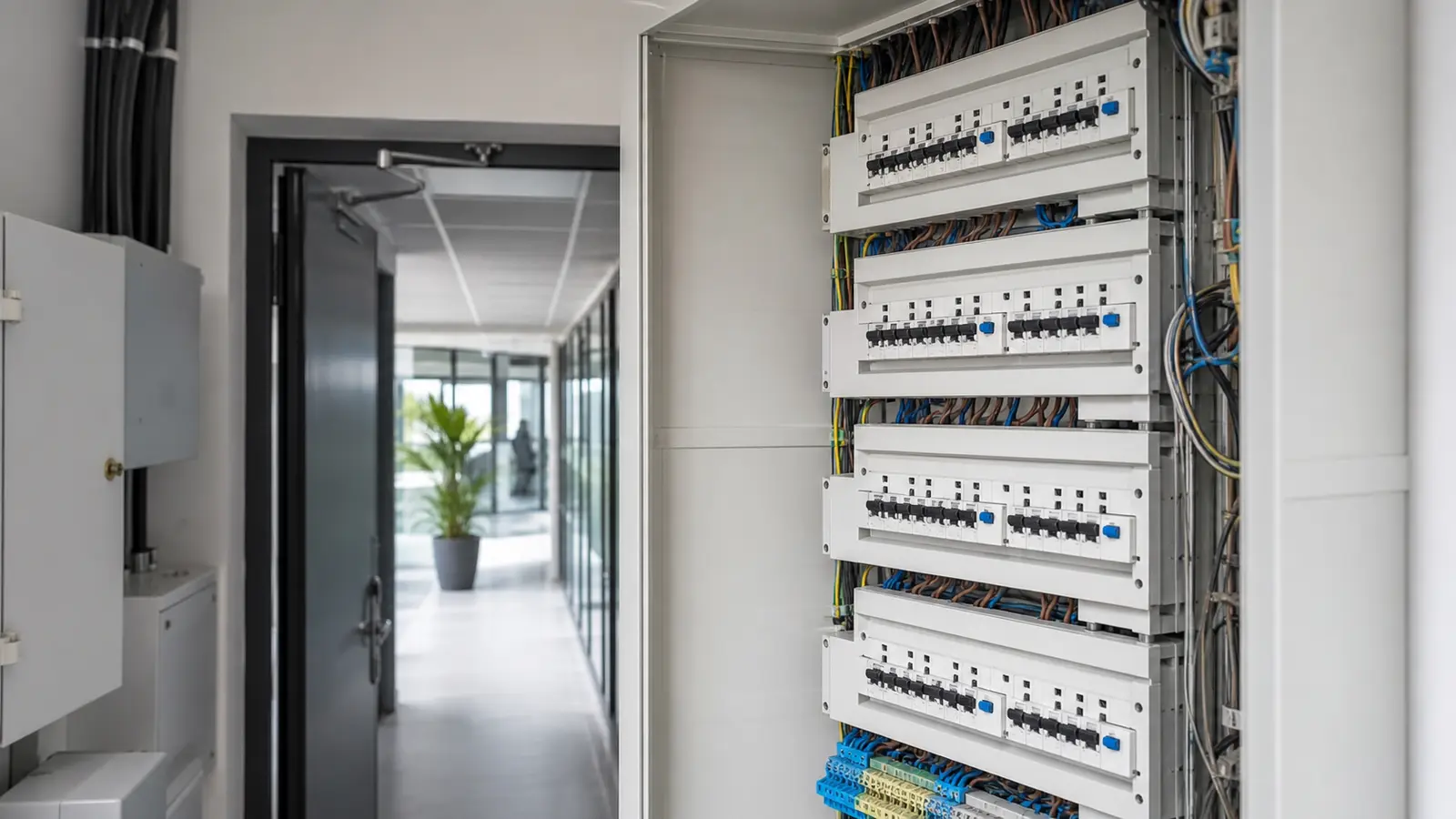
Electrical Inspections in Offices, Administrative Buildings, and Apartment Buildings
An office, administrative building, or apartment block seems like an ordinary environment. That’s precisely why electrical inspections are often postponed: new circuits are added to the switchboard, extension leads pile up in offices, the basement is damp, and someone has meanwhile damaged the lightning protection system on the roof while installing air conditioning. During an inspection or after an incident, the question then becomes who should have ordered the inspection – the company, the building owner, the tenant, or the homeowners’ association (SVJ).
We have detailed the general inspection intervals according to the environment in our article on inspection intervals under ČSN 33 1500. Here, we focus on the segment of offices, administrative buildings, and apartment buildings: what to inspect, which intervals are typically used, and where to watch out for liability.
Quick Answer – What and How Often to Inspect
For designated electrical equipment, the basic intervals primarily stem from Annex No. 4 of Government Regulation No. 190/2022 Coll.; ČSN 33 1500, the building documentation, and the external influences report then help determine the specific scope and any shortening of intervals.
In an administrative building, office, or common areas of an apartment building, you typically monitor four areas:
- Electrical installation and switchboards – for administrative activities, generally once every 5 years, unless it is an environment with increased risk.
- Lightning protection system (LPS) – for standard buildings, a complete inspection is most often carried out once every 4 years, for critical buildings or higher protection classes once every 2 years; a visual check is done annually.
- Electrical appliances and extension leads – in an office, typically once every 24 months, according to ČSN 33 1600 ed. 2 and the method of use.
- Emergency lighting – intervals are based on the project design, fire safety solution, and standards (ČSN EN 1838, ČSN EN 50172, ČSN 34 2710), not on a single universal legal interval.
The specific interval is always determined by the certified electrical inspector based on actual operation, external influences, and documentation. The five-year interval for an office does not automatically apply to a kitchenette, damp basement, utility room, or space with a higher concentration of people.
What All Gets Inspected in a Building
Electrical Installation and Switchboards
The core of a periodic inspection. The inspector goes through the main and sub-switchboards, checks the tightness of connections, the condition of circuit breakers and residual current devices (RCDs), circuit labeling, loop impedance, continuity of protective conductors, insulation condition, and consistency with the documentation.
In offices, the focus is mainly on socket and lighting circuits, kitchenettes, server corners, and areas with higher loads. In an apartment building, common areas are checked: corridors, basements, pram rooms, utility rooms, lighting, switchboards for common consumption, and connections to the lift or other technologies. A drying room, damp basement, or older cellar may no longer be a normal environment – and therefore may have a shorter interval.
Lightning Protection System (LPS)
If the building is equipped with a lightning protection system, it must be maintained in an operable condition and regularly checked. An inspection according to ČSN EN 62305 does not just address the “wire on the facade,” but the entire lightning protection system: the air-termination system, down conductors, earthing, bonding, and overvoltage protections.
For standard administrative buildings and apartment buildings, you will often encounter a complete inspection interval of 4 years. For buildings with higher risk, sensitive technology, or a stricter protection class, the interval is shortened. An annual visual check is practical even for standard buildings, as it easily reveals a broken down conductor, a loose clamp, or an intervention on the roof after the installation of a photovoltaic (PV) system, antenna, or air conditioning.
Electrical Appliances and Tools
Computers, monitors, printers, kettles, microwaves, portable lamps, and extension leads fall under checks and inspections according to ČSN 33 1600 ed. 2. In an office environment, an interval of 24 months is often used for standard appliances. For handheld power tools, loaned appliances, or equipment under heavier use, the interval may be shorter.
The appliance agenda is underestimated mainly by tenants: the landlord handles the building, but the kettle, the extension lead under the desk, or the charger in the meeting room is typically the responsibility of the company using the space.
Emergency Lighting
Larger administrative buildings, escape routes, and publicly accessible spaces may have a duty to provide emergency lighting according to the project design and fire safety solution. Inspection intervals are not a single simple table for all buildings. In practice, functional tests, battery checks, and annual duration tests are set according to the project, operating conditions, and the luminaires used.
Larger units such as lifts, fire alarm systems (EPS), evacuation public address systems, or fire safety equipment are handled by specialized suppliers. They do not fall under a standard electrical installation inspection, but they should be tracked together in the operational records so the administrator does not have to handle each deadline separately.
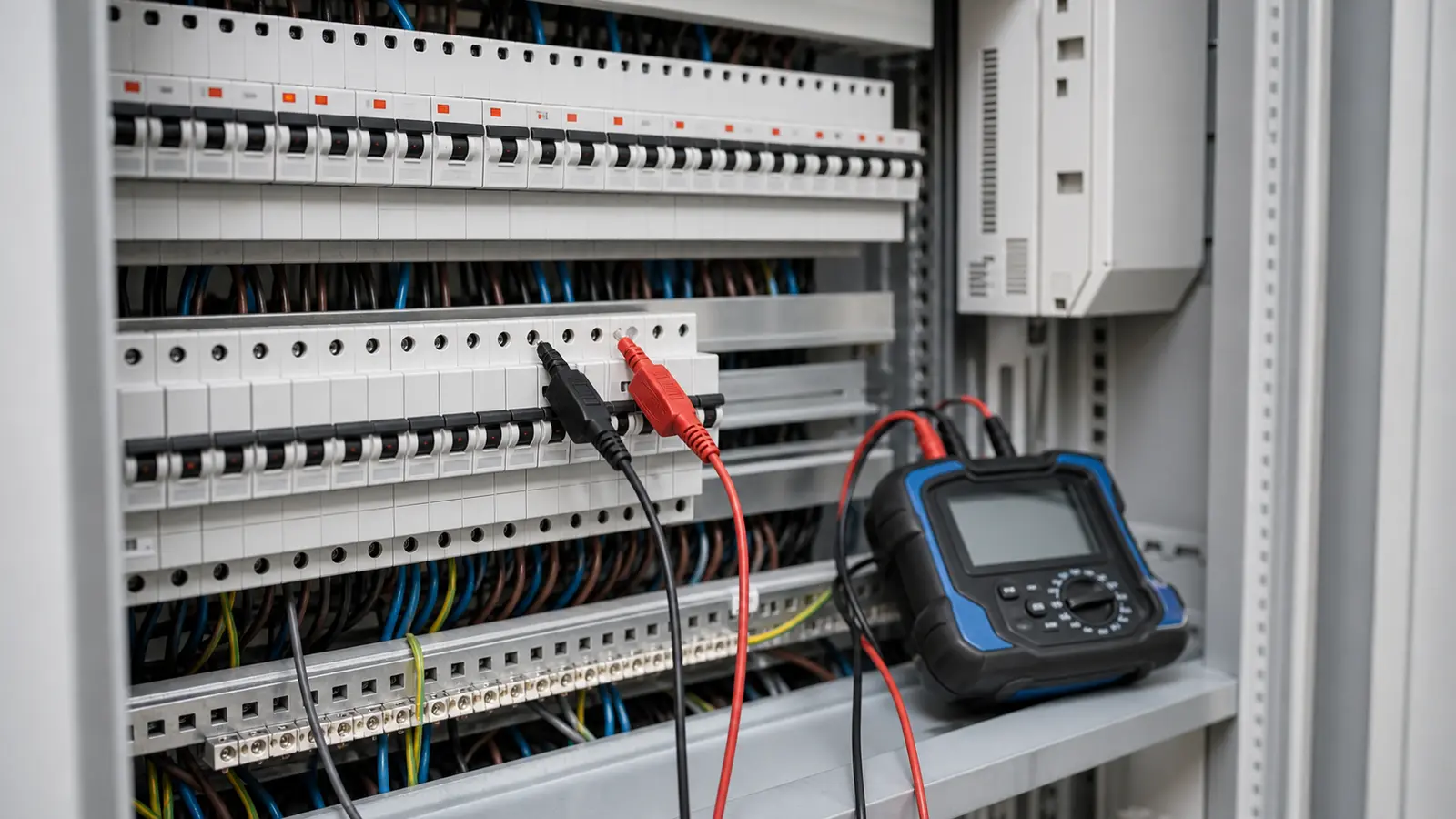
Intervals for Normal Environments – Overview
| Space / Equipment | Typical Periodic Inspection | Basis |
|---|---|---|
| Office, administration without increased risk | 5 years | GR 190/2022 Coll., Annex No. 4; ČSN 33 1500 |
| Common areas of an apartment building in a normal environment | 5 years | GR 190/2022 Coll.; ČSN 33 1500 |
| Spaces for education, accommodation, or medical purposes | 3 years | GR 190/2022 Coll., Annex No. 4 |
| Building or part of a building with more than 200 people | 2 years | GR 190/2022 Coll., Annex No. 4 |
| Damp spaces, permanent corrosive influences, problematic basement | 1 year or shorter depending on conditions | GR 190/2022 Coll.; external influences report |
| Lightning protection system for a standard building | 4 years (complete), annual visual check | ČSN EN 62305; GR 190/2022 Coll. |
| Lightning protection system for a critical building or higher protection class | 2 years (complete), annual visual check | ČSN EN 62305; GR 190/2022 Coll. |
| Electrical appliances in an office | usually 24 months | ČSN 33 1600 ed. 2 |
If multiple influences act on one piece of equipment, the shortest applicable interval is decisive. The certified electrical inspector can also recommend a shorter interval for an older installation, frequent faults, missing documentation, or after an intervention in the switchboard.
Who is Responsible for Inspections
For offices and administrative buildings, the equipment operator is responsible. If the company is also the building owner, it handles the inspections itself. If it is a tenant, the lease agreement and actual use of the space are decisive. Typically, inspections of the fixed electrical installation and lightning protection system are assigned to the landlord, while appliances and extension leads are the tenant’s responsibility. If the contract does not address this, clarify it before an inspection or incident occurs.
For an apartment building, the homeowners’ association (SVJ) or unit owners bear responsibility for the common areas. Common areas include corridors, staircases, basements, pram rooms, utility rooms, switchboards for common consumption, and other parts of the building outside individual flats. Inside a flat, the owner handles their own equipment, unless it involves an intervention in a common part or an establishment with its own obligations.
Deadlines are tracked by the operator, not the certified electrical inspector. By agreement, SOHE can provide a reminder of an upcoming inspection, but the responsibility for records, ordering, and rectifying defects remains with the operator or administrator.
Initial Inspection and Change of Use
A new electrical installation, switchboard reconstruction, addition of new circuits, or a fundamental change in technology requires an initial inspection before commissioning. Caution is needed when changing the use of a space: when a flat becomes an office, surgery, accounting firm, or another type of establishment, the load, operating regime, and responsibility change. In practice, you almost always want to have documented proof that the electrical installation is suitable for the new purpose – through an initial inspection of the new or modified part, or possibly an extraordinary inspection of the existing installation according to the extent of the change.
We have detailed initial inspections in a separate article: Initial Electrical Inspection Before Commissioning.
What the Risks Are Without an Inspection
For serious breaches of obligations in the area of designated technical equipment, the labour inspectorate can impose sanctions according to Act No. 251/2005 Coll.; for some offences by legal entities and self-employed individuals, the upper limit is CZK 2,000,000 (§ 33). For fire safety obligations, the Fire Rescue Service (HZS) may also get involved, but it deals with a different set of regulations than the electrical inspection itself.
In the event of a claim, the insurance company may investigate whether a missing or expired document influenced the origin of a fire, injury, or the extent of the damage. According to § 2800(2) of the Civil Code, this does not mean an automatic refusal of payment – the decisive factor is the link between the breach of duty and the damage. However, for the operator, a valid inspection report is crucial evidence that they addressed the technical condition in a timely manner.
Checklist for a Building Administrator or Homeowners’ Association (SVJ)
Before ordering an inspection, prepare:
- the last inspection report for the electrical installation, lightning protection system, and possibly appliances,
- project documentation, switchboard schematics, and the external influences report, if they exist,
- a list of switchboards, utility rooms, basements, kitchenettes, and common areas,
- information on changes since the last inspection: reconstructions, new circuits, PV system, air conditioning, server room,
- for leased spaces, the division of responsibilities between the landlord and tenant,
- a list of defects from the last inspection and proof of their rectification.
The better the documentation the inspector receives in advance, the less time will be lost searching on-site, and the more accurate the recommendation for the next interval will be.
How SOHE Can Help
At SOHE, we handle inspections in Brno and nationwide (whole Czech Republic) – from electrical installations and lightning protection systems to appliances in offices, establishments, and apartment buildings. For administrative buildings and homeowners’ associations, it makes the most sense to combine multiple agendas into one appointment:
- One supplier for electrical, lightning protection, and appliances – less coordination and clearer documentation.
- Interval tracking – by agreement, we will remind you of the next inspection deadline.
- Clear output – report conclusion, defects, and recommended steps without unnecessary translation of technical language.
- Link to occupational health & safety (OHS) and fire safety – for company buildings, we can integrate inspections into the overall safety documentation.
Frequently Asked Questions
How often is an electrical inspection needed in an office? For administrative activities in a normal environment, generally once every 5 years. If the space includes a damp kitchenette, utility room, server room, older basement, or other increased influence, the interval may be shortened. The actual condition and building documentation are always decisive.
Who pays for inspections in a homeowners’ association (SVJ) – the owner or the tenant? The SVJ or unit owners are responsible for common areas (corridors, basements, switchboards, staircases), and costs are usually covered from the building management fund. Inside a flat, the responsibility lies with the flat owner. If the flat is used as an office or establishment, liability needs to be addressed according to contracts and actual operation.
Does an administrative building have to have its lightning protection system inspected? If the building has a lightning protection system, it must be maintained and inspected. The complete inspection interval for standard buildings is often around 4 years, for critical buildings or higher protection classes around 2 years. A visual check is performed annually.
We are changing a flat into an office – what about the inspection? Don’t just deal with the nameplate on the door. A change of use can mean a different load, a different operating regime, and different safety requirements. Depending on the extent of the change, you will need an initial inspection of the new or modified part, or possibly an extraordinary inspection of the existing installation as a basis for safe use.
What about emergency lighting – how often is it checked? Intervals are based on the project design, fire safety solution, manufacturer’s instructions, and standards (ČSN EN 1838, ČSN EN 50172, ČSN 34 2710). In practice, regular functional tests and annual duration tests are set, but the specific plan should correspond to your building.
What the Article is Based On
Text status: 4. 7. 2026, according to the current wording of regulations and standards.
- Periodic inspection intervals for designated electrical equipment according to environment and purpose: GR No. 190/2022 Coll. (especially Annex No. 4), ČSN 33 1500.
- Initial inspections and technical requirements for electrical installations: ČSN 33 1500, ČSN 33 2000-6.
- Framework for designated electrical equipment, operator responsibility, and certified electrical inspector certificate: Act No. 250/2021 Coll., GR No. 194/2022 Coll..
- Sanctions in the area of designated technical equipment: Act No. 251/2005 Coll. (§ 33).
- Change of building use: Act No. 283/2021 Coll., Building Act.
- Lightning protection system: ČSN EN 62305. Appliances: ČSN 33 1600 ed. 2. Emergency lighting: ČSN EN 1838, ČSN EN 50172, ČSN 34 2710.
- Insurance payment upon breach of duty: Act No. 89/2012 Coll., Civil Code (§ 2800(2)).
Do you manage an office, administrative building, or apartment building and want to have your inspections in order? We provide inspections of electrical installations, lightning protection systems, and appliances, including interval tracking – and under one roof, also OHS and fire safety. We are based in Brno and operate nationwide (whole Czech Republic).
- Electrical Inspections – initial and periodic inspections
- Non-binding Inquiry
Write to info@sohe.cz or call +420 724 689 762.