
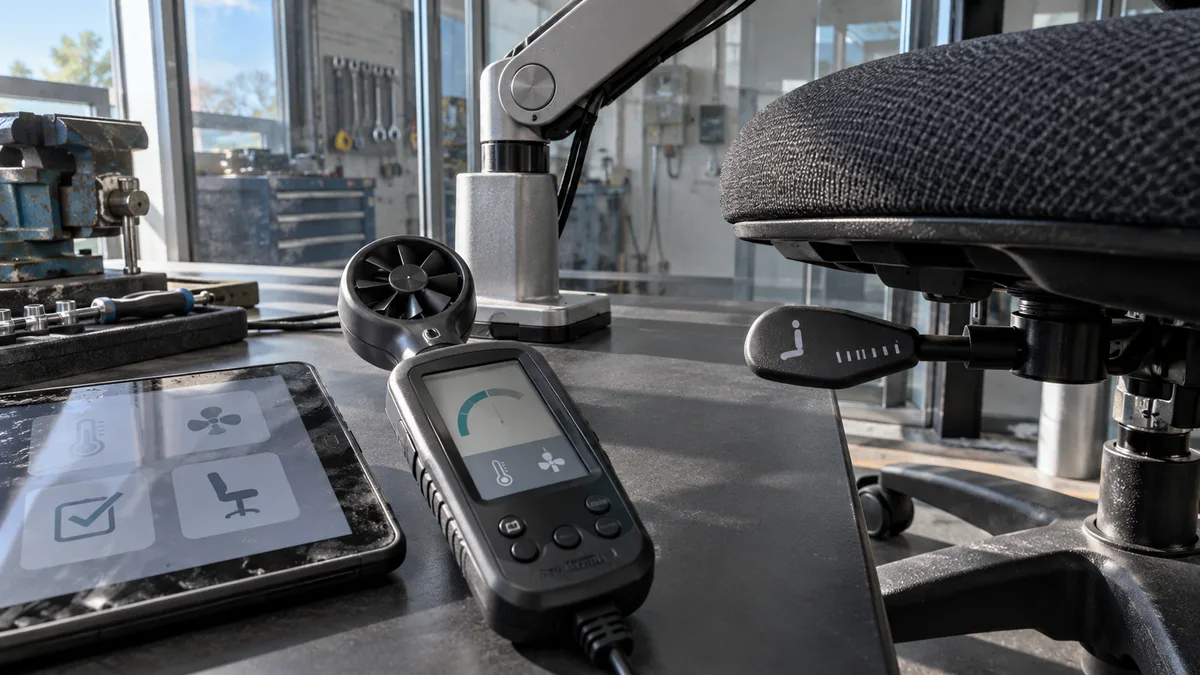
A managing director completes an online questionnaire, flags several problems and saves some notes. But this alone does not establish whether the meeting room overheats in the afternoon, employees adjust their office chairs correctly or the receptionist knows what to do when faced with an aggressive visitor.
On 28 September 2026, the European Agency for Safety and Health at Work (EU-OSHA) highlighted a new online interactive risk assessment tool developed specifically for offices, OiRA Office. The Czech BHP portal also reported on the new tool the following day.
OiRA Office can provide companies with a framework for identifying risks and planning preventive measures. However, the publication of the tool does not in itself constitute new Czech legislation. Completing the online assessment also does not automatically prove that the assessment reflects the company’s specific office and all its activities.
What OiRA Office covers
According to the EU-OSHA announcement, the tool guides users step by step through identifying risks and finding preventive measures. It focuses primarily on:
- workstation ergonomics,
- lighting,
- ventilation,
- work organisation,
- psychosocial risks,
- harassment,
- workplace violence.
Its main benefit is its broad scope. The review does not stop at monitor height, chairs and cables under desks. It also addresses the distribution of work, prolonged work pressure, relationships between colleagues and the availability of procedures for reporting inappropriate behaviour.
For a general methodology on incorporating these findings into a company system, see OHS Risk Assessment in a Company: How to Prepare It.
Where the office tool’s scope ends
OiRA Office is suitable for offices, reception areas, meeting rooms and administrative facilities. It can also help when relocating, changing workstation layouts or introducing hot-desking.
However, the office tool alone does not cover risks in warehouses, workshops, production areas or technical rooms, nor work at height or tasks performed at customer sites. If a company has both offices and service operations in the same building, the result cannot automatically be presented as an assessment of the entire organisation.
Neither of the published reports suggests that completing the tool alone confirms compliance with all requirements applicable to a particular Czech workplace. The actual operations, equipment used and work activities remain decisive.
What to check in the workplace
The tool can draw attention to an issue. However, an on-site inspection is needed to determine the actual conditions.
| Area | What the tool may reveal | What to verify in the office |
|---|---|---|
| Ergonomics | unsuitable layouts or differing employee needs | screen position, chair adjustment, legroom and equipment used |
| Lighting | insufficient light or distracting glare | the specific working position and conditions under both natural and artificial light |
| Ventilation | complaints about draughts, heat or stale air | conditions when the office is normally occupied and at different times of day |
| Work organisation | frequent interruptions, unclear tasks or inadequate cover for absences | the actual division of responsibilities and employees’ experiences |
| Psychosocial risks | sources of prolonged pressure or conflict-prone management | how the people affected perceive their working conditions |
| Harassment and violence | missing procedures for reporting and handling incidents | whether employees know the procedure and can use it safely |
For example, an online questionnaire will not detect that afternoon sunlight falls directly on a screen, the air conditioning blows onto one workstation or a receptionist has no way to call for help. Such findings only emerge by combining the tool, a workplace inspection and employees’ experiences.
How to conduct the initial review
The initial review does not need to be an extensive project. It should, however, result in specific, verifiable tasks:
- Define the rooms, work activities and employee groups covered by the review.
- Go through the topics with someone familiar with the office’s day-to-day operations.
- Involve employees and record specific situations, not just “yes” and “no” answers.
- Verify every significant finding on site.
- Assign a responsible person, deadline and follow-up method to each proposed measure.
- Compare the result with the existing risk assessment, training and OHS documentation.
- Once measures have been completed, check whether working conditions have actually changed.
EU-OSHA recommends involving employees so that the assessment reflects their actual working conditions. Answers provided solely by the managing director or office manager may fail to reveal problems affecting individual workstations.
What to include in OHS documentation
It makes sense to include findings that have been verified at the specific workplace in the company’s documentation. The record should make it possible to identify:
- where and during which activity the problem occurs,
- which employees may be affected,
- what measures the company already uses,
- what needs to be changed,
- who is responsible for the task and by what deadline,
- how the implementation of the measure will be checked.
The statement “ergonomics were assessed” does not indicate which workstation was evaluated or what was found. It is equally inadequate to mark a psychosocial risk as resolved simply because the company has an internal policy. What matters is whether people know the procedure, can use it and whether the company is able to handle a report effectively.
The links between assessments, training and operational records are summarised in OHS Documentation for a Small Company: What You Need.
When to seek professional assistance
A professional assessment is particularly advisable when the office is combined with a warehouse or workshop, employees also work away from a fixed workplace, conditions differ significantly between branches or it is unclear how to turn general recommendations into specific measures.
Repeated health problems, conflict situations, layout changes and changes to work organisation also require particular attention. OiRA Office can identify topics that need to be examined, but it has no knowledge of the company’s operations or the circumstances of individual cases.
If you need to verify the tool’s findings in the workplace and incorporate them into your company documentation, we can address this as part of our OHS services for companies. The outcome should be an overview of specific risks and measures, not merely a completed online questionnaire.
How to recognise a useful outcome
A useful finding can be linked to a specific location or activity. It includes a proposed measure, an assigned responsibility, a deadline and a method of verification. Employees were given an opportunity to describe the actual conditions, and their feedback was evaluated.
A generic list with no connection to the workplace, priorities or next steps is a weak outcome. Completing OiRA Office alone does not prove that the company has implemented the proposed measures or that the tool covered risks outside the office.
In brief
OiRA Office is an online tool highlighted by EU-OSHA on 28 September 2026 for systematically identifying risks in office environments. Companies can use it as a structured checklist, but they need to verify the findings in the workplace and link them to their own risk assessment, measures and OHS documentation.
Frequently asked questions
Is OiRA Office a new obligation for Czech companies?
No. EU-OSHA’s publication of the tool does not in itself introduce a new Czech legal obligation. It is an aid for conducting a structured review of risks in office environments.
Does OiRA Office replace a company’s risk assessment?
Not automatically. The tool can provide a framework and highlight relevant topics, but the outcome must reflect the company’s actual activities, premises and employees.
Should employees be involved?
EU-OSHA recommends involving them. Employees can describe conditions and situations that company management may not notice during a one-off inspection.
Does the tool also cover warehouses or workshops?
According to the published description, OiRA Office focuses on office environments. Risks in warehouses, workshops, production areas or work performed outside the office need to be assessed separately and to an appropriate extent.
What happens after completing the assessment?
The findings need to be verified in the workplace, with specific measures, responsible persons and deadlines assigned. The implementation of the measures and their links to the risk assessment, documentation and training should then be checked.
Sources for this article
- OHS services for companies – a service provided by SOHE.
- OHS Risk Assessment in a Company: How to Prepare It – the process from identifying activities to checking the measures adopted.
- OHS Documentation for a Small Company: What You Need – an overview of related documentation and operational records.
- EU-OSHA: Is your office safe and healthy? Ask OiRA – announcement of the OiRA Office tool dated 28 September 2026.
- BHP: Is your office safe and healthy? Ask the OiRA tool – Czech report on the new tool dated 29 September 2026.
This article is for information purposes only and does not constitute legal advice. An office risk assessment must be tailored to the actual operations, premises and activities performed by employees.
Do you need the findings from OiRA Office verified in the workplace and incorporated into OHS arrangements for your company? Send us a no-obligation enquiry or email info@sohe.cz.