
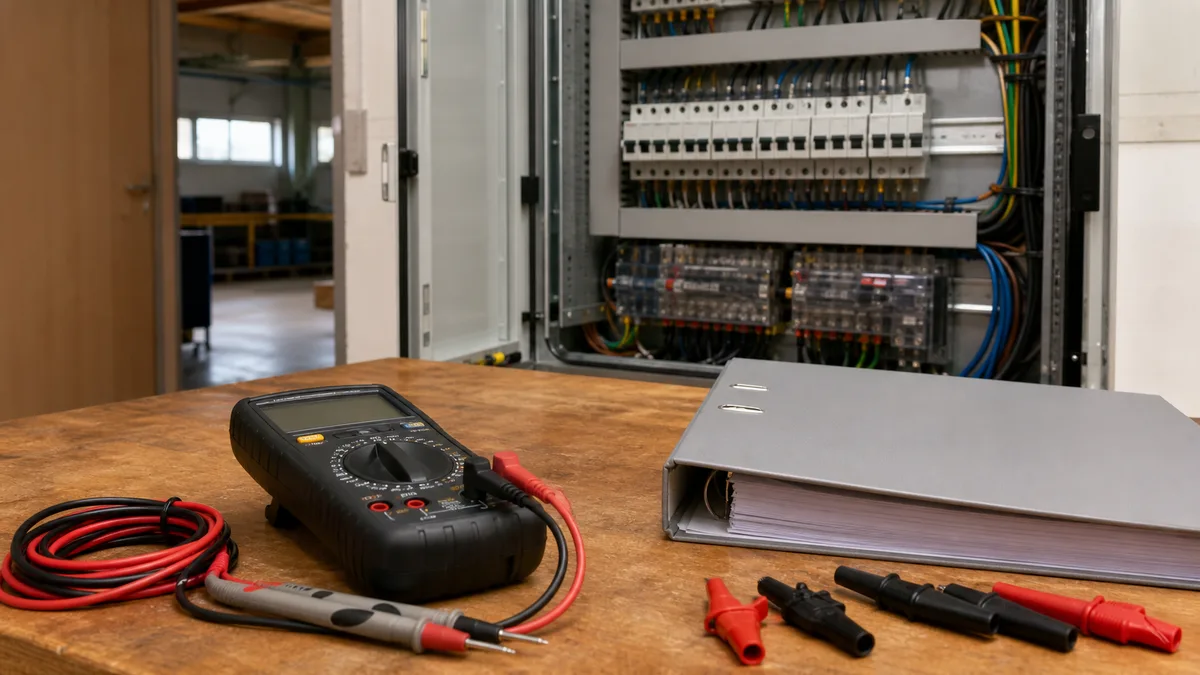
“Do we need an electrical installation inspection?” This is a question usually asked by company owners or condominium association (SVJ) committees only when an inspection authority or insurer comes knocking. The answer does not lie in a single order — the obligation to perform an inspection stems from the operator’s general responsibility for safe operation and is specified by technical standards. This article summarizes where this obligation comes from, how often to repeat the inspection, who is authorized to carry it out, and what to address during a reconstruction, relocation, or photovoltaic installation.
Where the obligation to inspect electrical installations arises from
You won’t find a single paragraph in Czech law that orders “perform an electrical installation inspection.” The obligation arises indirectly, through the responsibility for the safe operation of equipment — but its legal basis differs depending on who operates the facility.
A company with employees has it from its position as an employer. The Labour Code (Act No. 262/2006 Coll.) in Section 101 obliges the employer to ensure occupational safety and health; Act No. 309/2006 Coll. in Section 4 then requires technical equipment to be regularly and properly maintained, checked, and inspected. These regulations target the OSH area, meaning employers — don’t apply them directly to operators without employees.
An SVJ or property owner without employees stands on a different basis. The obligation here stems from the owner’s general liability for damage caused by the item (Civil Code) and from the duty to maintain electrical equipment in a serviceable and safe condition, which is presupposed by fire protection regulations and the technical standards themselves. The Labour Code paragraphs don’t belong here, but the practical result is the same: without a regular inspection, you cannot retroactively prove a safe state.
The specific intervals for repeating the inspection are, in both cases, supplemented by the technical standard ČSN 33 1500. Simply put: the legislation says “maintain the equipment in a safe state and document it,” the standard says “document it with an inspection within a given interval.” When you lack an inspection and damage occurs, proving a safe state retroactively is very difficult.
Responsibility for the condition of the electrical installation lies with the operator — whether a company, an SVJ, an executive, or an authorized person — and it lasts throughout the entire operation period. An inspection is a tool to fulfill and document this responsibility, regardless of which regulation it derives from. It’s not a stamp on the wall: it is a document that, on a specific day, a professionally qualified technician inspected the wiring, measured it, and recorded its condition.
What an electrical installation inspection entails
The inspection technician goes through the building in sections, checking and measuring:
- the main switchboard — condition and dimensioning of protection, conductor dimensions, transition resistances, covers, and labels,
- sub-distribution boards on floors or in facilities,
- socket and lighting circuits — fault loop impedance, functionality of residual current devices (RCDs), condition of sockets and switches,
- earthing and bonding — interconnection of metal structures, bathrooms, and machines,
- visual condition of cable routes, boxes, luminaires, and machine connections.
It’s not measured by eye. The fault loop impedance must be low enough for the circuit breaker or fuse to disconnect the faulty circuit within the prescribed time; the RCD is tested for tripping current (for personal protection up to 30 mA) and disconnection speed. The result may not just be “compliant” / “non-compliant” — it’s often a list of defects with a deadline for rectification: missing covers, overloaded circuits, non-functional RCDs, or old aluminum wiring with degraded insulation.
How often to repeat the inspection: intervals according to the environment
The interval for periodic inspections is governed by the environment and the type of building. The intervals are set by ČSN 33 1500 and distinguish among basic, normal, and more demanding environments (damp, dusty, corrosive-aggressive, with fire or explosion risk). As a guide:
| Environment / Building type | Indicative interval |
|---|---|
| Offices, administrative and residential buildings (basic and normal environment) | 5 years |
| Schools, hotels, restaurants, accommodation facilities | 3 years |
| Assembly spaces for more than 250 persons (halls, department stores) | 2 years |
| Workshops, warehouses, and facilities with increased dust or moisture | 3 years |
| Wet and chemically aggressive environments | 1 year |
| Temporary site distributions | 6 months |
The values are indicative. The inspection technician may specify a shorter interval in the inspection report if the condition of the installation requires it — for example, for a switchboard with incipient corrosion or for aluminum wiring from the 1960s to 1980s. This is not extra bureaucracy but a professional risk assessment, and you should treat the shortened interval from the report as binding. A detailed breakdown of intervals according to environment and operation can be found in the article How often electrical installation inspection.
Regardless of the interval, an inspection is also appropriate:
- before putting new or reconstructed installations into operation (initial inspection),
- after extending or modifying switchboard connections,
- after a fire, lightning strike, flooding, or other extraordinary event,
- when taking over a building from the previous owner or tenant,
- whenever there is reasonable suspicion of a fault.
Who is authorized to perform the inspection
An electrical installation inspection is carried out by an inspection technician holding a valid certificate of professional competence according to Government Regulation No. 194/2022 Coll. The certificate has a defined scope — a technician focused on appliances will not inspect a lightning rod or photovoltaics, and vice versa. A regular electrician who installs and repairs the installation cannot perform the inspection unless they hold this certificate.
When choosing, ask about three things:
- Scope of the certificate — whether the technician is authorized to inspect the exact type of equipment you need (building electrical installations, lightning rods, machines).
- Experience with similar buildings — inspecting an administrative floor differs from inspecting a joinery workshop with sawdust extraction and 400 V machines.
- What is included in the price — the actual measuring instruments, the inspection report, photo documentation and schematic, and whether the site visit is billed separately.
Beware of suspiciously cheap offers. “An entire facility inspection for a few hundred in cash” usually means a visual glance without measuring individual circuits — and such a paper has no value as a document either during an inspection or with the insurance company.
What the inspection report should contain
The inspection report is not just a measurement log — it has a prescribed structure according to ČSN 33 1500 and ČSN 33 2000-6. It should include in particular:
- identification of the operator and the building,
- identification of the inspection technician, including the certificate number and its validity,
- date of inspection and due date for the next inspection,
- list of used measuring instruments (type, serial number, calibration date),
- list of inspected equipment — switchboards, circuits, sockets, machines,
- measured values and their evaluation,
- list of identified defects with classification by severity,
- overall conclusion and the date of the next inspection.
Treat the report with a clearly stated interval as a schedule for the next check. For a company with multiple buildings and types of equipment, it is worthwhile keeping records — electronically or in a physical binder — so that no interval lapses on you.
What are the consequences of a missing inspection
There is no direct fine for a “missing inspection” per se — no regulation explicitly names it that way. However, the Regional Labour Inspectorate may impose a fine for non-compliance with OSH duties under Act No. 251/2005 Coll., on labour inspection, and a missing inspection is often evidence that these duties were not fulfilled. The amount depends on severity, and for OSH violations, it can reach hundreds of thousands of crowns.
In practice, the problem arises in three situations:
- Labour Inspectorate inspection. Finds expired inspections and orders corrective measures with a deadline. If the inspection is still missing during the next check, a fine may follow. The course of an inspection is analyzed in the article Labour Inspectorate inspection.
- Property damage, typically an electrical fire. When settling a claim, the insurance company examines whether the equipment was maintained in a safe state; a valid inspection from the last prescribed interval is a key document here. How a missing inspection affects the payout is analyzed in the article Missing inspection and the insurance company.
- Employee injury. The investigation examines whether the employer did everything required for risk prevention. Without an inspection, you cannot document the condition the installation was in, which worsens your position.
How much an inspection costs
The price is governed by the scope and complexity, not by the area in square meters. The deciding factors are the number of switchboards, the number of socket and lighting circuits, the difficulty of the environment, and primarily the state of the documentation. A clear installation with schematics can be measured quickly; an undocumented building where the technician has to trace circuits and open boxes means more hours and a higher price. You can save by bundling — if you also get appliances inspected simultaneously, you avoid a second site visit. What factors influence the price and how to read a quote is analyzed in the article Electrical inspection price in a company.
When to order an inspection and how to prepare
Don’t leave the order for the last week before the interval expires — a good technician tends to be busy, and an appointment often needs to be arranged several weeks in advance. It pays to prepare before the inspection:
- Documentation — previous inspection reports, switchboard schematics, electrical installation plans, if they exist.
- Access to all switchboards — unlocked, with clear surroundings without stacked material in front of the doors.
- A list of changes since the last inspection — new machines, office remodelling, additionally added circuits.
- A list of appliances and machines, if you also want appliance inspection at the same time.
Schedule the appointment outside of full operation. The technician needs to switch off individual circuits, test RCDs, and measure loop impedance — this cannot be done during production. A Friday afternoon, weekend, or a day with limited operation is often suitable.
Inspection after reconstruction and when relocating
Relocations and renovations deserve special attention. When you take over a space from a previous tenant, you don’t know the condition they are handing over the electrical installation in — and lease agreements often transfer the responsibility for inspections to the tenant immediately upon handover. Practical procedure:
- Request a valid inspection report from the landlord, ideally not older than the interval for the given type of space.
- If they don’t have it, insist on an inspection before moving in — ideally at the landlord’s expense.
- The scope should minimally include the main switchboard, wiring to sockets and lights, functionality of RCDs, and the condition of protection devices.
Similarly after a reconstruction, even a partial one. Did you add two offices and run new circuits? Request an initial inspection from the electrician for the new part and have them assess whether the new circuits have altered parameters in the main switchboard — such as feeder overload or disrupted selectivity of protection.
When the inspection reveals defects
The inspection usually ends with one of three results:
- Without defects — the installation is compliant, the next inspection interval is set.
- With defects to be rectified — the technician lists the defects and sets a deadline for rectification; after the repair, a follow-up inspection is carried out.
- With immediate danger — the technician may recommend disconnecting part of the installation until repair. This is rare, but happens with switchboards at fire risk or with exposed live parts.
The most common findings in company facilities:
- Missing or non-functional RCDs in spaces with sinks or in damp areas, where additional protection with a tripping current up to 30 mA is required.
- Undersized protection after subsequent modifications — “hard-wired” circuits for which the original feeder was not dimensioned.
- High transition resistances at connections, typically in older aluminum wiring from the 1960s to 1980s: aluminum slowly “flows” under terminal pressure (cold flow), the connection loosens, its resistance increases, and it heats up under load — hence the fire risk.
- Missing covers on switchboards and junction boxes, damaged sockets and switches.
- Insufficient bonding and earthing of additionally installed metal structures.
Electrical installation inspection and photovoltaics
If you have photovoltaics on the roof, another dimension comes into play. The inverter is an electrical device that affects the entire building installation, and the electrical installation inspection should include its connection — specifically the connection method to the main switchboard, surge protective devices (SPD) on both the DC and AC sides, the functionality of the photovoltaic disconnection, and its influence on the selectivity of protection devices. The inspection of the PV system itself is a separate task, but it is closely related to the electrical installation inspection, so scheduling them together is advantageous.
What the article is based on
- Electrical installation inspection – SOHE service.
- Essentials of the inspection report – what the report must contain and how to understand it.
- Inspection when relocating a company – what to require from the landlord when taking over a space.
- PV inspection: obligation, intervals, risks – when and how to inspect rooftop photovoltaics.
- Act No. 262/2006 Coll. – Labour Code; Section 101 obliges the employer to ensure occupational safety and health.
- Act No. 309/2006 Coll. – on ensuring further OSH conditions; Section 4 requires regular maintenance, checks, and inspections of technical equipment (employer regime).
- Act No. 89/2012 Coll. – Civil Code; establishes the owner’s liability for damage caused by an item (relevant for SVJs and property owners without employees).
- Act No. 133/1985 Coll. – on fire protection; presupposes maintaining electrical equipment in a serviceable and safe condition.
- Act No. 251/2005 Coll. – on labour inspection; under which the Inspectorate imposes fines for violations of OSH duties.
- Government Regulation No. 194/2022 Coll. – on requirements for professional competence in electrical engineering; under which the inspection technician is certified.
- ČSN 33 1500 and ČSN 33 2000-6 – technical standards setting inspection intervals and procedures (not freely available).
This text is for informational purposes and does not replace legal advice. The specific electrical installation inspection regime must be set according to actual operation, manufacturer’s documentation, the environment of use, and a risk assessment.
Not sure if your electrical installation is in good condition and when to schedule the next inspection? Electrical installation inspection by SOHE covers switchboards, circuits, and earthing, and you will receive an inspection report with a clear interval for the next check. Request a non-binding inquiry or write to info@sohe.cz — we will get back to you with a date and indicative scope.