
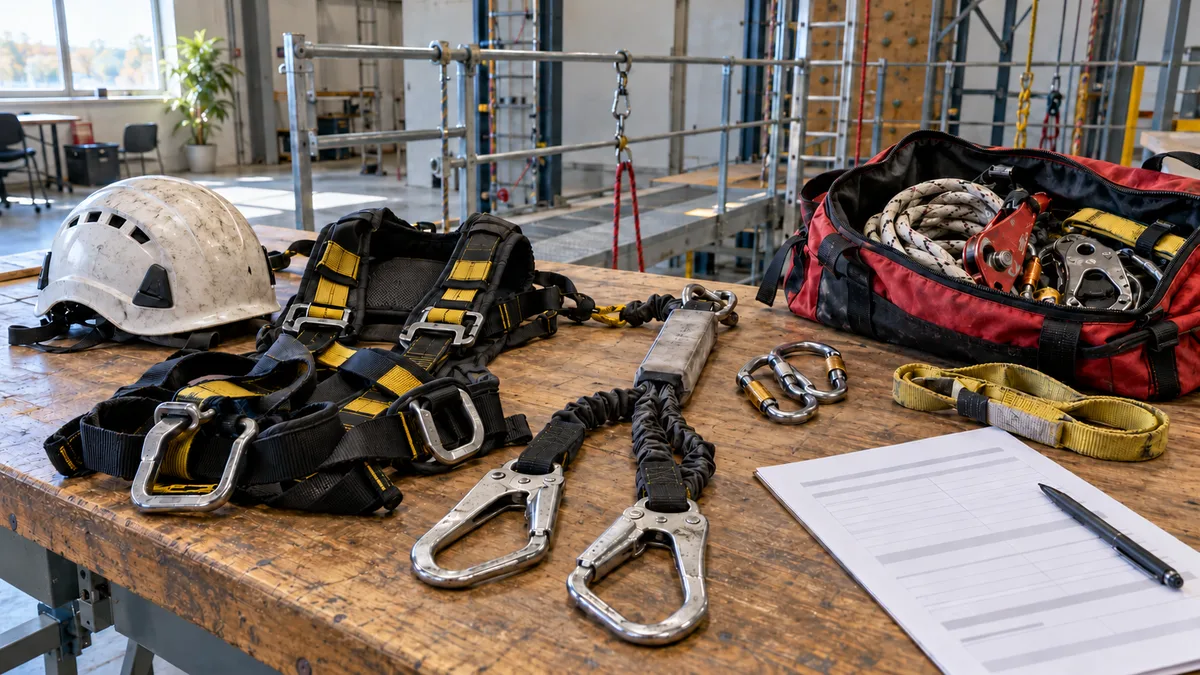
Work at height does not begin only when someone steps onto a roof. In a warehouse, it may involve replacing a light fitting from a ladder, working near the top of a rack or carrying out maintenance from a mobile elevating work platform. In production, risks may arise when accessing a walkway, a hopper or an area above a production line. What matters is the specific location, the working procedure and the potential consequences of a fall.
Under § 1, Nařízení vlády č. 362/2005 Sb., o bližších požadavcích na bezpečnost a ochranu zdraví při práci na pracovištích s nebezpečím pádu z výšky nebo do hloubky, governs the work organisation and working procedures that employers must provide at workplaces where employees are exposed to the risk of falling from height or into an open drop, as well as detailed requirements for technical equipment used for this work. A job title alone is therefore not enough. Businesses need to assess the actual tasks, access routes, work equipment and rescue options.
When general training alone is not enough
A general health and safety presentation cannot address an unprotected edge above a production line, a fragile rooflight or the first use of a fall arrest system without a rescue plan. A separate assessment is also appropriate when an employee is expected to work regularly from a ladder even though the task requires force, both hands or handling a large component.
In these situations, our occupational health and safety services for businesses begin with a review of the locations and tasks. We then propose suitable protection and working procedures, followed by training, knowledge assessment and supporting documentation. A health and safety assessment does not replace an anchor point design, the equipment manufacturer’s instructions or a specialist inspection of a work platform’s technical condition.
When fall protection is required
Under § 3(1) of nařízení vlády č. 362/2005 Sb., employers must take technical and organisational measures to prevent employees from falling from height or into a drop, falling through a surface or slipping, or to arrest their fall safely. The regulation requires these measures:
- at workplaces and on access routes at any height above water or substances that could endanger life or health in the event of a fall, for example through burns, scalding, acute poisoning or suffocation;
- at all other workplaces and on access routes more than 1.5 metres above the surrounding level, or where the open drop below exceeds 1.5 metres.
The 1.5-metre threshold does not establish that a lower workplace is safe: these workplaces must also be assessed when identifying and evaluating risks under § 102 of zákon č. 262/2006 Sb., zákoník práce. Nor does this threshold provide an exemption for work above water or hazardous substances. Each location needs to be assessed for its surface, surrounding equipment, openings, obstacles, access and the consequences of a potential fall.
Collective protection takes priority
Under § 3(2) of nařízení vlády č. 362/2005 Sb., fall protection must primarily be provided through collective protective measures. Examples include guardrails, opening covers, safety nets, scaffolding and work platforms.
Under § 3(3), personal fall protection equipment is used where the nature of the work rules out collective protection, or where collective protection is not practical in view of the nature, expected scope and duration of the work and the number of employees affected, or does not provide sufficient protection for the employee.
| Situation | First question | Follow-up solution |
|---|---|---|
| Regular maintenance above a production line | Can permanent access, a working platform or guardrails be provided? | Consider PPE after assessing collective protection options |
| An opening or rooflight along the route | Can it be covered, guarded or avoided by changing the working route? | Personal fall protection according to the specified procedure |
| A brief task from a work platform | Is the platform suitable for the task, environment and manufacturer’s instructions? | Additional protection according to the risks and specified procedure |
| Access to the top of a rack | Is suitable work equipment available with a stable working position? | Use a ladder only for tasks for which it is suitable |
A harness does not replace missing guardrails or compensate for unsuitable access. If the risk assessment identifies a need for PPE, the business must specify the system, connection method, conditions of use, inspections and rescue procedure. For guidance on selection and records, see PPE in the workplace: equipment lists, policies and issue records.
A ladder is not suitable for every task
Part III of the annex to nařízení vlády č. 362/2005 Sb. permits only short-duration work on ladders that is not physically demanding and uses hand tools. When climbing, descending or working on a ladder, employees must face the ladder and be able to maintain a secure handhold and reliable support. Only loads weighing up to 15 kilograms may be carried up or down a ladder, unless specific legislation provides otherwise. Employees working with their feet more than 5 metres above the ground must use personal fall protection equipment.
In practice, this means distinguishing between the following:
- a brief inspection or minor task using light tools may be suitable for a ladder after the conditions have been assessed;
- regular repairs, work requiring greater force or a long-term working position will generally require more suitable equipment;
- loads heavier than 15 kilograms must not be carried up or down a ladder;
- working with the feet more than 5 metres above the ground requires personal fall protection equipment.
Ladders must be inspected according to their instructions for use. The regulation does not set a single inspection interval for every ladder type and use. Businesses therefore need to identify their ladders, know the manufacturers’ instructions and assign responsibility for inspections. Before using a ladder, check its condition and the conditions of use against the manufacturer’s instructions.
A mobile elevating work platform is more than a more convenient ladder. Work-at-height training does not establish the equipment’s technical condition or replace its required checks, inspections or tests.
What work-at-height training should cover
Part XI of the annex to nařízení vlády č. 362/2005 Sb. requires employee training of sufficient scope. It specifically identifies work at height and above open drops exceeding 1.5 metres where employees cannot work from fixed, safe working platforms, work on mobile elevating work platforms, work on ladders at heights above 5 metres and the use of personal fall protection equipment.
A syllabus for warehouse, production or maintenance staff should therefore reflect their actual roles and cover at least:
- specific locations and tasks involving a risk of falling or falling through a surface;
- situations requiring protection above the 1.5-metre threshold and at any height;
- choosing collective protection before personal fall protection;
- conditions for ladder use, including the prohibition on carrying loads heavier than 15 kilograms up or down a ladder and the 5-metre threshold for foot position;
- working procedures for the platform, roof, walkway or rack being used;
- the specific PPE, how to put it on, connect it and use it according to the instructions;
- stopping work when a defect is found, conditions change or protection is missing;
- emergency response and rescue;
- methods for assessing theoretical knowledge and practical skills.
A written test can assess some knowledge, but it cannot by itself show whether an employee can put on a harness correctly, recognise an unsuitable anchor point or stop work safely. The assessment method should match the task and the equipment used.
Fall protection requires a rescue plan
Part II, point 9 of the annex to nařízení vlády č. 362/2005 Sb. also links the use of personal fall protection equipment to employee training in its use, particularly emergency rescue procedures.
Showing employees how to fasten the buckles is therefore not enough. A workable procedure should answer at least these questions in advance:
- who will call for help and who is authorised to begin the rescue;
- what rescue equipment is available on site;
- how a rescuer will reach the suspended worker;
- how nearby operations will be stopped and further danger prevented;
- which parts of the procedure employees have practised.
The rescue arrangements depend on the workplace and the system used. A rescue near a storage rack requires different preparation from one beneath a factory roof or at a work platform. A generic sentence in a syllabus, without reference to the location and equipment, is not a practical rescue procedure.
What to include in training records
Under § 103(2) and (3) of zákon č. 262/2006 Sb., zákoník práce, employers must provide training relevant to the work performed and its risks, and determine its content, frequency, knowledge assessment methods and record-keeping arrangements. Part XI of the annex to nařízení vlády č. 362/2005 Sb. does not prescribe a single form or a document called a “work-at-height card”.
A record that provides evidence of the training may include:
- the employer, workplace, date and scope of training;
- participants’ names and job roles;
- the trainer’s identity;
- a syllabus linked to specific activities and internal procedures;
- identification of the ladders, platforms and types of PPE used, where these were covered by the training;
- a record of practical training and the rescue procedure;
- the method used to assess knowledge and practical skills;
- assessment results and the procedure to follow if someone does not pass;
- confirmation of attendance or another traceable record;
- the criteria the business used to determine when further or additional training is needed.
An attendance sheet headed “work at height” does not, on its own, show whether the training addressed the actual workplace, specific work equipment and a workable rescue procedure.
How often training should be repeated
Nařízení vlády č. 362/2005 Sb. does not set a uniform interval for refresher work-at-height training. Under § 103(3) of zákon č. 262/2006 Sb., zákoník práce, the employer determines the frequency according to the nature and severity of the risks.
New or supplementary training may also be needed following a change in job assignment or type of work, the introduction of new technology or work equipment, a change in working procedures or other circumstances that significantly affect occupational health and safety. A fixed annual or two-year interval therefore cannot be presented as a general requirement of this regulation.
A certificate described as a “work-at-height card” may form part of the records. By itself, however, it does not replace a risk assessment, a safe workplace, a task-specific syllabus, practical training or knowledge assessment.
Checklist for businesses
- Have you listed tasks performed above 1.5 metres and above open drops exceeding 1.5 metres?
- Have you included work above water and hazardous substances, regardless of height?
- Have you assessed guardrails, covers, nets, scaffolding or platforms before choosing PPE?
- Do you use ladders only for short-duration work that is not physically demanding?
- Do you ensure that loads heavier than 15 kilograms are not carried up or down ladders?
- Do you provide personal fall protection for employees working on ladders with their feet more than 5 metres above the ground?
- Do you inspect ladders according to their instructions for use?
- Does the training reflect actual roles, workplaces and equipment?
- Do users of personal fall protection equipment have a prepared and practised rescue procedure?
- Do the records include the syllabus, practical training and assessment results?
- Can you justify the training frequency based on risks and operational changes?
Sources used in this article
- Occupational health and safety services for businesses – a service provided by SOHE.
- PPE in the workplace: equipment lists, policies and issue records – selecting, allocating and recording protective equipment.
- Nařízení vlády č. 362/2005 Sb. – requirements for fall protection, ladder use, PPE and training.
- Zákon č. 262/2006 Sb. – zákoník práce, particularly the rules on the content, frequency, assessment and documentation of occupational health and safety training.
This article is for information only and does not replace legal advice. Work-at-height arrangements must be based on actual operations, the manufacturer’s documentation, the environment in which equipment is used and the risk assessment.
Need to assess work at height and arrange training and supporting documentation? Explore our occupational health and safety services for businesses or send a no-obligation enquiry. You can also email info@sohe.cz.