
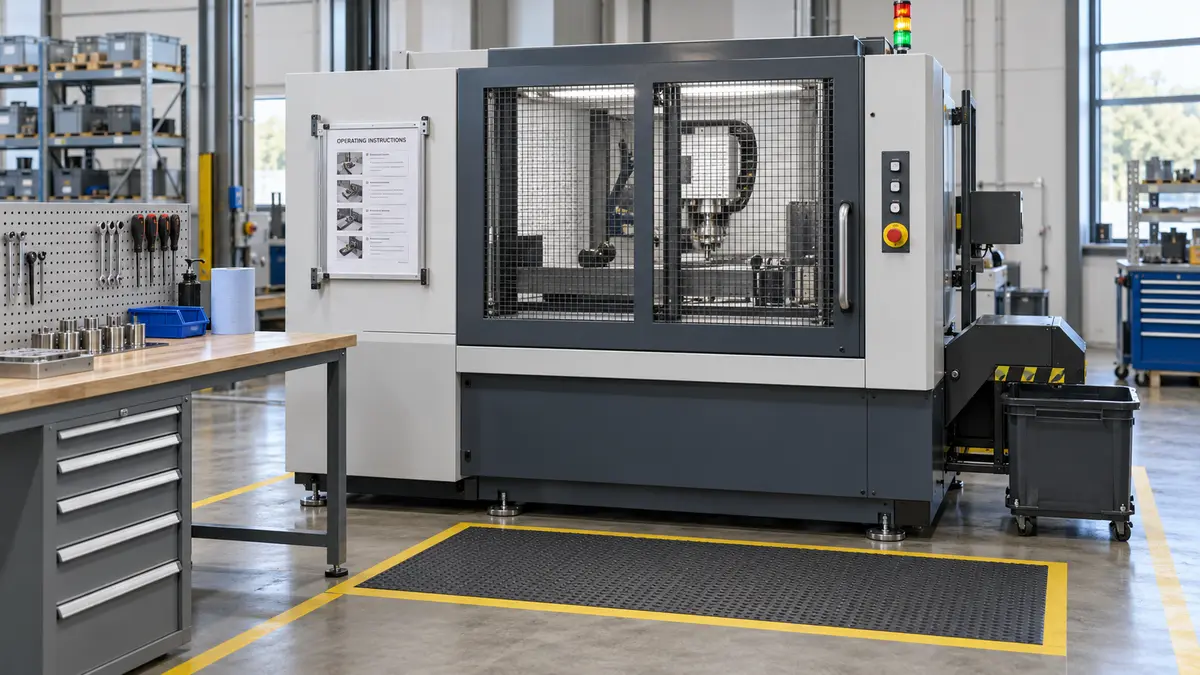
Handing a machine over to a new operator should end with confirmation that the worker understands their tasks, the conditions for safe use and the limits of permitted intervention. Simply showing them the start button or obtaining their signature after general training does not achieve this. Prepare machine-specific documentation, appoint someone to conduct the training and decide what must be assessed before the worker may operate the machine independently.
This is not an operating guide for a particular type of machine. Such a guide must be based on the manufacturer’s instructions and local conditions. This procedure is intended for the manager organising the handover of the workstation. It does not replace any required professional or medical fitness or the specific qualification requirements for a particular machine.
The documents must relate to the machine being handed over
Start by identifying the equipment and the task. The employee must know which machine they may use and in which operating mode. Similar machines may have different procedures, equipment or restrictions. A folder simply labelled “production” is not a usable guide for every model.
Prepare the instructions, relevant operating documentation and local procedures. Section 3(1)(a) of nařízení vlády č. 378/2001 Sb., kterým se stanoví bližší požadavky na bezpečný provoz a používání strojů, technických zařízení, přístrojů a nářadí requires equipment to be used for its intended purposes and under the intended conditions, in accordance with the operating documentation; the employer may set additional requirements in local operating safety rules. Under Section 4(2), the equipment must have operating documentation and must subsequently be inspected at least once every 12 months—the article on kontroly strojů a technických zařízení podle NV 378/2001 explains what this involves. Handing the machine over to a new worker, however, does not automatically constitute recommissioning the entire machine.
Check the documents against the machine’s actual condition: the correct model, the current local version, and their accessibility and comprehensibility for the operator. SÚIP distinguishes between technical documentation and a machine’s instructions for use: the machinery’s technical documentation may be in one or more official EU languages, but under point 1.7.4 of Annex 1 to nařízení vlády č. 176/2008 Sb., the instructions for use must be in the official language of the country where the machine is placed on the market or put into service—in the Czech Republic, this means Czech, possibly as a translation accompanied by the original instructions. An English manual kept in a cabinet is therefore not enough for the operator.
If the instructions are missing or the equipment has been modified, flag the issue and have it addressed by the appropriate person. An experienced colleague saying, “We’ve done it this way for twenty years,” neither replaces missing documentation nor guarantees a safe procedure. Independent work must not be assigned until the necessary conditions have been clarified.
Distinguish routine operation, adjustments and maintenance
A worker may be authorised to carry out routine operation but not arbitrary interventions. During the handover, distinguish between the tasks included in their role and those that must be referred to someone else. Labels such as “adjustment” and “maintenance” must not conceal tasks that the worker is not actually authorised to perform.
| Handover area | Question the operator must be able to answer |
|---|---|
| Routine task | Under what conditions may I start the task? |
| Interrupting work | When must I stop work, and whom must I notify? |
| Material and surroundings | What must be ready, and what must not obstruct the work? |
| Abnormal condition | What must I not deal with myself, and how do I call for help? |
| Handover to the next shift | How do I report a restriction, fault or unfinished task? |
| Controls | Where are the controls for a complete stop and an emergency stop, and how do I check them? |
| Isolation from energy sources | Where is the clearly marked means of isolation from energy sources, and who may use it? |
| Danger zone | How do I make sure that no one is in it before starting the machine? |
The last three rows correspond to the minimum requirements of Section 3(1)(i)–(l) of NV č. 378/2001 Sb.: starting only by deliberate actuation of the designated control, a control for a complete and safe stop, emergency stopping where necessary, and clearly identifiable devices for isolating the machine from all energy sources. New operators must know these before starting the machine themselves for the first time.
Section 103 of Zákoník práce requires training related to the work performed and its risks, as well as a defined method of assessment. The current Zákoník práce therefore provides the basis for organising the handover, but does not replace machine-specific instructions.
Section 3(2) of Nařízení vlády č. 378/2001 Sb. stipulates that repairs, adjustments, modifications, maintenance and cleaning may be carried out only when the equipment is isolated from its energy supplies; where this is not technically possible, appropriate protective measures must be taken. Under Section 3(3), the operator must be able to check that no one is in the danger zone; otherwise, the machine must issue a warning signal before starting. Do not use this article to devise your own procedure for isolating energy sources or entering a guarded area. The required safeguards, roles and procedure must be determined for the specific equipment and its documentation; it is not simply a matter of pressing one button.
Plan training as an activity, not a stop for signatures
Determine who will conduct the training, where it will take place and which tasks will be covered. The appointed person must have the necessary competence for the activity concerned. Length of service alone does not demonstrate that an instructor is qualified to train others on every machine or specialist intervention.
Divide the handover into explanation, a safe demonstration, supervised work and assessment. Adapt the pace to the content and the worker’s level of understanding. This procedure does not prescribe a universal number of training hours. The required scope will vary depending on the equipment and the worker’s previous experience.
Protective measures must not be bypassed during the demonstration simply to “make it easier to see.” Do not remove guards, disable safety features or deliberately create a fault for demonstration purposes. Safety scenarios can be explained using the documentation or under prepared, safe conditions intended for training.
Also show the worker where the applicable instructions can be found and whom to contact to report an issue. Instructions kept in the office of someone who is not present during the night shift may not meet the operator’s practical needs. If there is a language barrier, provide information in a comprehensible form and confirm that the worker understands local signals; the procedure is described in the article školení BOZP, když zaměstnanec neumí česky. If the employee is merely changing roles within the company, OHS requirements relating to a change in duties, including any required medical examination, must also be considered.
Assess decisions in failure scenarios
A normal work cycle is only one part of the job. The worker must be able to recognise when not to start a task, or when to stop it and call the appropriate person for help. A suitable assessment may include describing a hypothetical fault and asking what the worker would do under the local procedure. It is not a technical guide to repairing an unknown problem.
Ask the employee to explain the conditions in their own words. If they can repeat the names of the buttons but cannot distinguish routine operation from a maintenance intervention, further training is needed. Likewise, a correct answer in a test may not demonstrate the practical skills required for the work.
Record an unsuccessful assessment in specific terms. State which area is deficient, who will provide the additional training and how the worker will be reassessed. Until then, restrict their work to safe tasks for which they have met the requirements. Do not use a signature stating that the worker has “taken over the machine” as a substitute for an assessed outcome.
Example scenario: a new operator on the next shift
This is a hypothetical example. A worker is moving to a piece of production equipment. An experienced colleague demonstrates a routine task and briefly mentions that they sometimes “give the material a hand.” During the planned assessment, the manager discovers that this unofficial practice is not included in the supplied documents and that the worker does not know where the limits of their operating role lie.
The correct response is not to add the unofficial practice to the training syllabus. The manager arranges for the procedure and the necessary safeguards to be clarified by a competent person. Independent work for which the necessary conditions have not been established does not begin in the meantime. The handover is supplemented with clear intervention limits and instructions for calling the designated person.
After further safe training, the employee can distinguish a routine task from an abnormal condition and knows whom to contact during their shift. The record lists the activities that were actually assessed. Success does not mean granting unrestricted permission to “operate everything,” but assigning work and responsibility clearly.
This example does not explain how to repair a particular machine or release jammed material. It highlights a question to ask during the handover: did the worker acquire a dangerous unofficial habit along with the information?
Handover record and the first independent shifts
The record should link the employee, equipment, tasks, documents used, date, person conducting the training and verified outcome. It is also useful to state any restrictions and how gaps will be addressed. Do not omit the outcome merely because the form has only a signature field.
Ensure that appropriate assistance is available during the worker’s first independent work under the local operating arrangements. A follow-up discussion can establish whether the handover was practical: has the material, procedure or shift contact changed? Any new significant change requires appropriate information and, where necessary, further training—not a reference to an old signature.
When handing work over to the next shift, any restrictions affecting the equipment or task must be apparent. Verbal information exchanged between two people may be lost if shift staffing changes. Choose a local handover method that preserves the necessary information without disclosing employees’ personal data.
Do you need to connect training, local risks and the handover of a specific workstation? BOZP for companies from SOHE can help prepare content and assessments based on the work actually performed.
Frequently asked questions
Is it enough to show a new worker the buttons?
No. They need to understand the working conditions, risks, limits of permitted intervention and procedure for abnormal conditions; the necessary skills must be assessed in a manner appropriate to the task.
Does training always take the same number of hours?
This article does not prescribe a universal duration. The scope depends on the equipment, the work, the required conditions and the worker’s existing knowledge.
May an operator open a guard themselves in the event of a fault?
Not on the basis of a general handover. Interventions are governed by specific documentation, conditions and competencies; authorisation for routine operation is not permission to carry out arbitrary repairs.
Does handing a machine over to a new person constitute recommissioning?
Not automatically. Personnel handover and the technical commissioning of equipment are separate matters.
What if a colleague teaches a procedure that is not in the documentation?
Have the discrepancy clarified by a competent person. An unofficial habit must not automatically be accepted as a safe procedure merely because it has been followed for a long time.
Sources and scope
- Nařízení vlády č. 378/2001 Sb. — e-Sbírka: Sections 3 and 4
- Zákon č. 262/2006 Sb., zákoník práce — e-Sbírka
- SÚIP — Technická dokumentace ke stroji
Sources verified on 7 October 2026. The practical procedure and example scenarios are the author’s recommendations; each specific workplace must be assessed with regard to the equipment and its documentation.